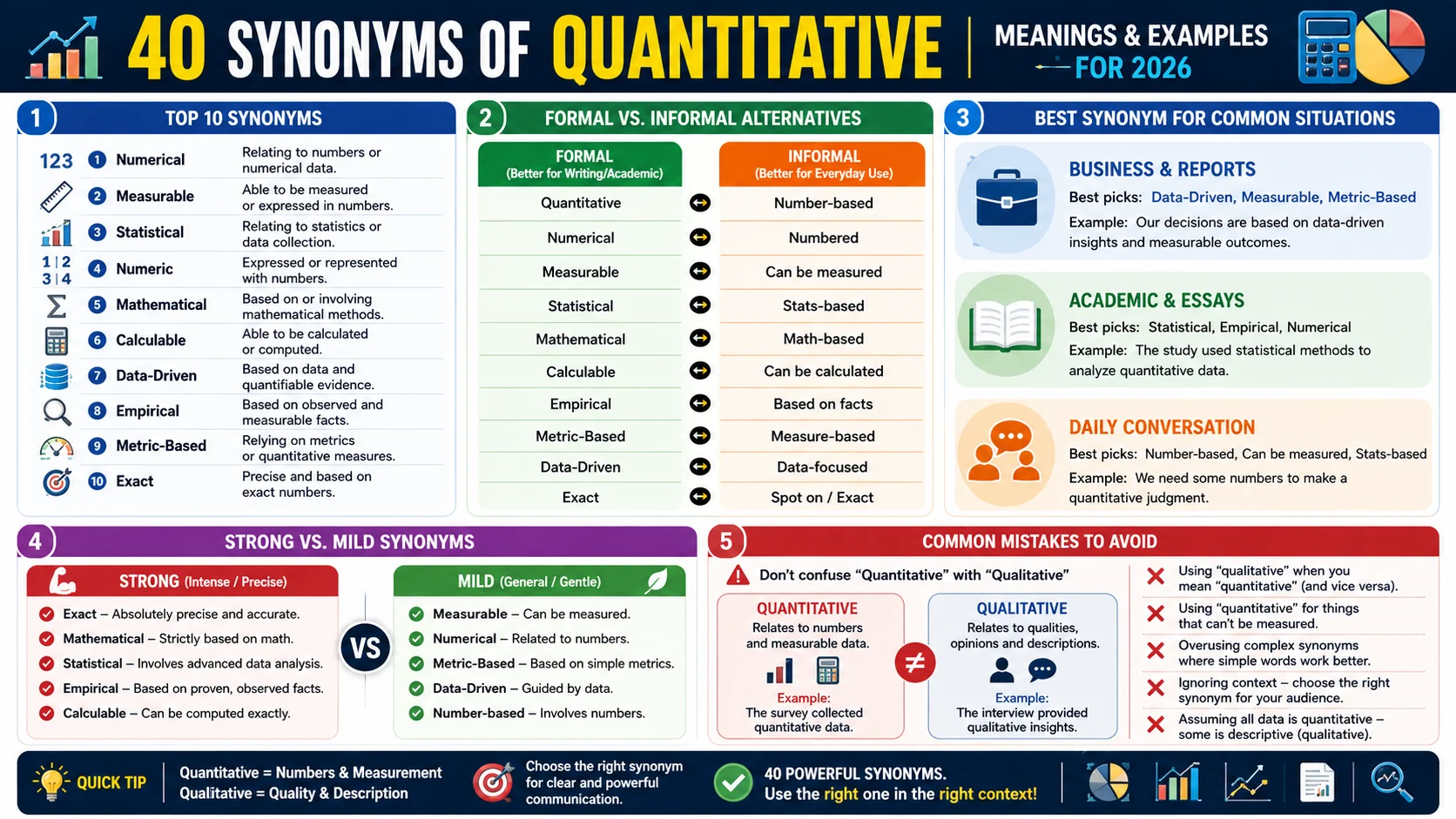
Quantitative” means relating to numbers, amounts, or things that can be measured and expressed numerically. The best synonyms are numerical, measurable, statistical, quantifiable, and metric. “Numerical” is the most common natural alternative. Each synonym has a slightly different meaning and context where it fits best.
Top 10 Synonyms
- Numerical
- Measurable
- Statistical
- Quantifiable
- Metric
- Mathematical
- Data-driven
- Empirical
- Countable
- Numeric
“Quantitative” is a word we encounter frequently in research, business, science, and data analysis. It refers to numbers, amounts, and things we can measure. But using it too often or without understanding its nuances can make your English sound overly technical or repetitive.
Think about it. You can describe quantitative data, quantitative research, quantitative analysis, or quantitative results. Each context might benefit from a different word that captures the specific type of numerical measurement.
In this guide, you’ll learn 35 powerful synonyms for “quantitative.” You’ll discover exactly when to use each one, how formal they are, and what common mistakes to avoid. Let’s begin!
What Does “Quantitative” Mean?
Definition
Quantitative” means relating to numbers, amounts, or things that can be measured and expressed numerically. It focuses on “how much” or “how many” rather than describing what something is like. Quantitative data includes measurements like height, weight, test scores, and sales figures anything that can be counted or measured.
Pronunciation
| Feature | Value |
|---|---|
| US IPA | /ˈkwɑntəteɪtɪv/ |
| UK IPA | /ˈkwɒntɪtətɪv/ |
| Syllables | 4 (quan-ti-ta-tive) |
| Tip | Stress the first syllable: “KWAN-tuh-tay-tiv” |
Grammar
| Grammar Feature | Information |
|---|---|
| Part of Speech | Adjective |
| Common Position | Before a noun or after a linking verb |
| Typical Pattern | Quantitative + noun / Subject + be + quantitative |
Examples:
- “The study used quantitative methods.” (before noun)
- “The data is quantitative.” (after verb)
- “They conducted quantitative research.” (before noun)
Grammar Note: “Quantitative” is the opposite of “qualitative.” While quantitative deals with numbers and measurements, qualitative deals with descriptions and qualities.
Word Family
| Word | Part of Speech | Meaning |
|---|---|---|
| Quantitative | Adjective | Relating to numbers and measurement |
| Quantify | Verb | To express as a number |
| Quantity | Noun | An amount or number |
| Quantifiable | Adjective | Able to be expressed as a number |
| Quantitatively | Adverb | In a quantitative way |
15 Synonyms of “Quantitative”
Numerical
Meaning: Relating to or expressed in numbers.
Best Used For: General references to numbers, data, and calculations.
Formality: Neutral
Tone: Mathematical, Factual
Frequency: ⭐⭐⭐⭐⭐ (Very Common)
CEFR Level: B2
Example Sentence 1: “The survey collected numerical data on customer satisfaction.
Example Sentence 2: “We need numerical values for the report.”
Usage Tip: “Numerical” is the most direct synonym. Use it when you’re talking about anything expressed in numbers. It’s more commonly used than “quantitative” in everyday English.
Common Confusion: Numerical vs Quantitative. “Numerical” simply means expressed in numbers. “Quantitative” often implies measurement and analysis.
Measurable
Meaning: Able to be measured or expressed in numbers.
Best Used For: Goals, progress, physical properties.
Formality: Neutral
Tone: Practical, Achievable
Frequency: ⭐⭐⭐⭐⭐ (Very Common)
CEFR Level: B2
Example Sentence 1: “We need measurable goals for the project.
Example Sentence 2: “The results are measurable and clear.”
Usage Tip: “Measurable” emphasizes that something can be quantified. Use it for goals and objectives.
Statistical
Meaning: Relating to the collection, analysis, and interpretation of numerical data.
Best Used For: Data analysis, research, surveys.
Formality: Formal
Tone: Analytical, Professional
Frequency: ⭐⭐⭐⭐ (Common)
CEFR Level: B2
Example Sentence 1: “The report includes statistical analysis of the data.”
Example Sentence 2: “We need statistical evidence to support our claim.”
Usage Tip: “Statistical” suggests analysis using mathematical methods. Use it for research and data analysis.
Quantifiable
Meaning: Able to be expressed as a number or amount.
Best Used For: Business targets, research variables, anything that can be counted.
Formality: Formal
Tone: Precise, Objective
Frequency: ⭐⭐⭐ (Moderate)
CEFR Level: C1
Example Sentence 1: “We need quantifiable evidence to prove our theory.”
Example Sentence 2: “The benefits of the program are quantifiable.”
Usage Tip: “Quantifiable” is a precise term meaning something can be turned into numbers. It’s very similar to “measurable.”
Metric
Meaning: A standard of measurement; based on or using measurement.
Best Used For: Business, performance, analytics.
Formality: Neutral
Tone: Professional, Measured
Frequency: ⭐⭐⭐⭐ (Common)
CEFR Level: B2
Example Sentence 1: “We track several metrics to measure our success.”
Example Sentence 2: “The metric data shows improvement.”
Usage Tip: “Metric” is widely used in business and technology. Use it for performance indicators and data points.
Mathematical
Meaning: Relating to mathematics or numbers.
Best Used For: Calculations, equations, scientific contexts.
Formality: Formal
Tone: Technical, Precise
Frequency: ⭐⭐⭐⭐ (Common)
CEFR Level: B2
Example Sentence 1: “The model uses mathematical formulas.”
Example Sentence 2: “We need a mathematical approach to this problem.”
Usage Tip: “Mathematical” relates to the science of numbers. Use it for formal and technical contexts.
Data-driven
Meaning: Based on data and analysis rather than intuition.
Best Used For: Business, decision-making, modern contexts.
Formality: Neutral
Tone: Modern, Professional
Frequency: ⭐⭐⭐⭐ (Common)
CEFR Level: B2
Example Sentence 1: “We use a data-driven approach to decision-making.”
Example Sentence 2: “Their strategy is entirely data-driven.
Usage Tip: “Data-driven” is a modern term. Use it for decisions based on hard evidence.
Empirical
Meaning: Based on observation and experience, often using data.
Best Used For: Research, science, evidence-based approaches.
Formality: Formal
Tone: Scientific, Evidenced
Frequency: ⭐⭐⭐ (Moderate)
CEFR Level: C1
Example Sentence 1: “They conducted empirical research to test their hypothesis.”
Example Sentence 2: “We need empirical evidence to support our conclusions.”
Usage Tip: “Empirical” means based on observation and measurement. It’s broader than “quantitative.”
Countable
Meaning: Able to be counted.
Best Used For: People, items, countable things.
Formality: Neutral
Tone: Practical, Direct
Frequency: ⭐⭐⭐⭐ (Common)
CEFR Level: B2
Example Sentence 1: “The countable data was easy to analyze.”
Example Sentence 2: “We need countable results.”
Usage Tip: “Countable” is simple and direct. Use it when something can be counted item by item.
Numeric
Meaning: Another way of saying “numerical.”
Best Used For: Data, values, systems.
Formality: Neutral
Tone: Technical, Factual
Frequency: ⭐⭐⭐⭐ (Common)
CEFR Level: B2
Example Sentence 1: “The numeric values were recorded correctly.”
Example Sentence 2: “We need numeric data for this analysis.”
Usage Tip: “Numeric” is a common alternative to “numerical.” They’re often interchangeable.
Quantified
Meaning: Having been expressed as a number or amount.
Best Used For: Data, variables, outcomes.
Formality: Formal
Tone: Precise, Measured
Frequency: ⭐⭐⭐ (Moderate)
CEFR Level: C1
Example Sentence 1: “The quantified results were impressive.”
Example Sentence 2: “We need quantified evidence.”
Usage Tip: “Quantified” means converted into numbers. It’s the past tense of “quantify.”
Decimal
Meaning: Based on the number ten; relating to numbers with decimal points.
Best Used For: Mathematics, currencies, measurements.
Formality: Neutral
Tone: Mathematical, Technical
Frequency: ⭐⭐⭐ (Moderate)
CEFR Level: B2
Example Sentence 1: “The decimal system is used worldwide.”
Example Sentence 2: “We need decimal values for precision.”
Usage Tip: “Decimal” specifically relates to the base-10 number system. Use it for precise numerical contexts.
Assessable
Meaning: Able to be assessed or evaluated.
Best Used For: Performance, risks, value.
Formality: Formal
Tone: Evaluative, Professional
Frequency: ⭐⭐⭐ (Moderate)
CEFR Level: C1
Example Sentence 1: “The assessable data allowed for accurate conclusions.”
Example Sentence 2: “We need assessable results.”
Usage Tip: “Assessable” emphasizes the ability to evaluate something systematically.
Mensurable
Meaning: Able to be measured.
Best Used For: Formal contexts, measurement.
Formality: Very Formal
Tone: Academic, Precise
Frequency: ⭐ (Very Rare)
CEFR Level: C1
Example Sentence 1: “The mensurable data was reliable.”
Example Sentence 2: “Only mensurable outcomes were considered.”
Usage Tip: “Mensurable” is a rare, formal synonym. Use it only in very formal academic contexts.
Computational
Meaning: Involving the use of computers for calculations.
Best Used For: Technology, mathematics, modeling.
Formality: Formal
Tone: Technical, Modern
Frequency: ⭐⭐⭐ (Moderate)
CEFR Level: C1
Example Sentence 1: “The computational analysis was performed using advanced software.”
Example Sentence 2: “We need computational methods to solve this problem.”
Usage Tip: “Computational” involves computers in numerical analysis. Use it for technical contexts.
Synonyms Comparison Table
| Synonym | Best Context | Formality | Tone | Frequency |
|---|---|---|---|---|
| Numerical | General numbers | Neutral | Factual | ⭐⭐⭐⭐⭐ |
| Measurable | Goals, progress | Neutral | Practical | ⭐⭐⭐⭐⭐ |
| Statistical | Analysis, research | Formal | Analytical | ⭐⭐⭐⭐ |
| Quantifiable | Business targets | Formal | Precise | ⭐⭐⭐ |
| Metric | Business analytics | Neutral | Professional | ⭐⭐⭐⭐ |
| Data-driven | Modern business | Neutral | Professional | ⭐⭐⭐⭐ |
| Mathematical | Calculations | Formal | Technical | ⭐⭐⭐⭐ |
| Empirical | Science, research | Formal | Scientific | ⭐⭐⭐ |
| Countable | Counting things | Neutral | Direct | ⭐⭐⭐⭐ |
| Numeric | Data, values | Neutral | Technical | ⭐⭐⭐⭐ |
Best Synonyms by Situation
| Situation | Best Synonym | Why It Works |
|---|---|---|
| Daily Conversation | Numerical | Natural and common |
| Business Email | Measurable | Practical and clear |
| Academic Writing | Quantitative | Formal and precise |
| School Assignment | Numerical | Simple and clear |
| Professional Meeting | Data-driven | Modern and professional |
| Presentation | Quantitative | Clear and authoritative |
| Research Paper | Statistical | Formal and appropriate |
| Social Media | Measurable | Casual and relatable |
| Data Analysis | Numeric | Precise and technical |
Formal vs Informal Synonyms
Formal Alternatives
| Synonym | Best Used For |
|---|---|
| Statistical | Data analysis, research |
| Empirical | Evidence-based research |
| Computable | Technology, algorithms |
| Mensurable | Very formal academic contexts |
| Quantifiable | Business and measurement |
Neutral Alternatives
| Synonym | Best Used For |
|---|---|
| Numerical | Most general situations |
| Measurable | Goals, outcomes |
| Countable | Simple counting |
| Metric | Business performance |
Informal Alternatives
| Synonym | Best Used For |
|---|---|
| Data-driven | Modern business |
| Mathematical | General calculations |
| Numeric | Data and values |
Choosing the Right Level: Use “statistical” and “empirical” for formal academic writing. Use “numerical” and “measurable” for most situations. Use “data-driven” for modern business contexts.
Strong vs Mild Synonyms
Mild
Suitable for everyday situations with less intensity.
- Numerical
- Countable
- Measurable
Moderate
More specific or technical alternatives.
- Quantifiable
- Metric
- Mathematical
- Assessable
Strong
High-intensity alternatives suggesting rigorous analysis.
- Statistical (formal analysis)
- Empirical (scientific evidence)
- Computational (technical precision)
How Intensity Changes Meaning: “We need numerical data” is simple. “We need statistical analysis” suggests formal research. Choose stronger words when you want to emphasize rigor and precision.
Real-Life Examples
School: “The students collected quantitative data for their science project.”
Office: “We need measurable goals for the team to achieve.”
Business Email: “Please provide statistical analysis of the sales figures.”
Meetings: “Our approach is data-driven and evidence-based.”
Presentations: “The quantitative results clearly show improvement.”
Daily Conversations: “We need numerical evidence to support that claim.”
Social Media: “Measurable results are the best way to track progress.”
Academic Writing: “The study employed quantitative research methods.”
Common Collocations
| Common Phrase | Better Alternative |
|---|---|
| Quantitative data | Numerical data |
| Quantitative analysis | Statistical analysis |
| Quantitative research | Empirical research |
| Quantitative results | Measurable results |
| Quantitative methods | Numerical methods |
Common Phrases
By the numbers: Using quantitative methods. (e.g., “We run our business by the numbers.”)
Crunch the numbers: To analyze quantitative data. (e.g., “Let’s crunch the numbers.”)
Hard data: Quantitative information. (e.g., “We need hard data, not guesses.”)
Track record: Quantitative history of performance. (e.g., “She has a strong track record.”)
The bottom line: The final quantitative result. (e.g., “The bottom line is profit.”)
Context Guide
| Situation | Best Synonym | Reason |
|---|---|---|
| Essay | Quantitative | Academic and formal |
| Speech | Measurable | Clear and inspiring |
| Business Email | Quantifiable | Professional and clear |
| Novel | Numerical | Simple and clear |
| Presentation | Quantitative | Clear and authoritative |
| Conversation | Numerical | Natural and relatable |
| Academic Writing | Empirical | Precise and formal |
| Marketing Copy | Measurable | Engaging and convincing |
Related Words
Near Synonyms
- Metric-based: Relating to metrics.
- Analytical: Relating to analysis.
- Evidence-based: Based on evidence.
- Data-driven: Based on data.
- Numerical: Expressed in numbers.
Antonyms
- Qualitative: Relating to qualities, not quantities.
- Descriptive: Describing rather than measuring.
- Subjective: Based on personal opinion.
- Intuitive: Based on instinct, not data.
- Anecdotal: Based on stories, not data.
Related Adjectives
- Quantitative: Relating to measurement.
- Qualitative: Relating to qualities.
- Numerical: Relating to numbers.
- Empirical: Based on observation.
- Statistical: Relating to statistics.
Related Nouns
- Quantity: An amount or number.
- Data: Information, often numerical.
- Statistics: Numerical information.
- Metrics: Standards of measurement.
- Numbers: Numerical values.
Related Verbs
- Quantify: To express as a number.
- Measure: To find the size or amount.
- Count: To find the number of.
- Calculate: To compute.
- Compute: To calculate.
Frequently Asked Questions
What is another word for quantitative?
Common synonyms include numerical, measurable, statistical, quantifiable, and metric. “Numerical” is the most common alternative.
Which synonym sounds the most professional?
Statistical and empirical sound very professional. “Quantitative” itself is also excellent for academic contexts.
What is the strongest synonym for quantitative?
Statistical and empirical are among the strongest synonyms. They suggest rigorous, scientific analysis.
Which synonym is best for essays?
Quantitative is the best choice for academic essays. It’s the most precise term. “Empirical” is also excellent for research-based writing.
What’s the difference between quantitative and numerical?
“Numerical” simply means expressed in numbers. “Quantitative” often implies measurement and analysis. “Numerical” is more common in everyday English.
Which synonym is most common in everyday English?
“Numerical” is the most common in everyday speech. “Measurable” is also frequently used.
What is the opposite of quantitative?
The direct opposite is qualitative. Other opposites include descriptive, subjective, and anecdotal.
Conclusion
“Quantitative” is a precise and powerful word, but now you have 35 fantastic alternatives. Each synonym adds a different shade of meaning to your language.
Remember, the key is understanding the context. Use “numerical” for general numbers. Use “statistical” for formal analysis. Use “measurable” for goals and outcomes. Use “empirical” for evidence-based research.
The best way to improve is practice. Try using one or two new synonyms each day. Listen for these words in academic and professional contexts. Your vocabulary will become richer and more precise with time.
