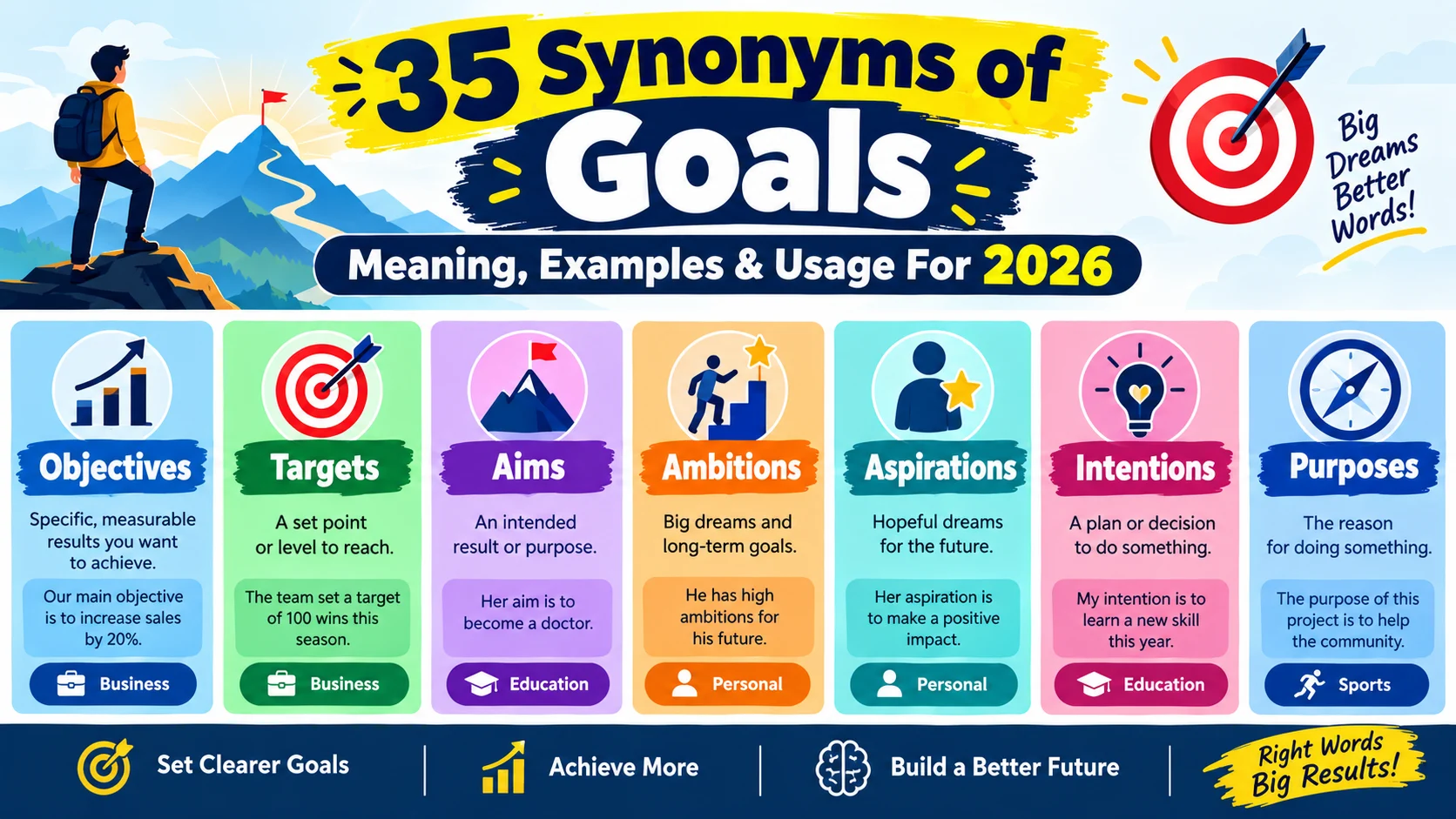
Goals are the things you want to achieve or accomplish. The best synonyms include objectives, targets, aims, ambitions, aspirations, intentions, and purposes. The most common everyday synonym is aims when talking about what you want to achieve, and targets when discussing specific measurable outcomes. Each synonym has a slightly different meaning, tone, and context.
We all have things we want to achieve. Maybe you’re working toward a promotion, saving money for a trip, or trying to learn a new skill. Whatever it is, you’re talking about goals. But here’s the thing English has so many wonderful ways to express this idea!
Sometimes “goals” sounds too formal. Other times, it doesn’t capture the full meaning of what you’re trying to say. That’s where synonyms come in handy. In this guide, I’ll walk you through 30 excellent alternatives for “goals,” complete with clear explanations, real examples, and practical tips. By the end, you’ll be able to choose the perfect word for any situation whether you’re writing a business plan or chatting with friends about your dreams.
What Does “Goals” Mean?
Definition
Goals are the things you’re trying to achieve the results you want. Think of them as your targets, your dreams in action, or your planned destinations. A goal could be big (like becoming a doctor) or small (like finishing a book this week). The key is that a goal is something you actively work toward. It gives you direction and purpose.
Pronunciation
| Feature | Information |
|---|---|
| US IPA | /ɡoʊlz/ |
| UK IPA | /ɡəʊlz/ |
| Syllables | 1 |
| Tip | The “o” sounds like the “o” in “go” |
Grammar
| Feature | Information |
|---|---|
| Part of Speech | Noun (plural), Verb (third person) |
| Common Position | Subject, object, or after prepositions |
| Typical Pattern | “goals for [something]” or “set goals” |
Example Sentences:
- My goals for this year include learning Spanish and traveling more.
- The team set ambitious goals for the next quarter.
- She achieved all her academic goals with hard work.
Grammar Note: “Goal” is a countable noun, so you can have one goal, two goals, or many goals. It’s also used as a verb in sports (“He goals the ball”), but that’s much less common.
Word Family
| Word | Part of Speech | Meaning |
|---|---|---|
| Goal | Noun | Something you want to achieve |
| Goal-setting | Noun | The process of deciding goals |
| Goal-oriented | Adjective | Focused on achieving goals |
| Goalless | Adjective | Without goals |
| Goal-keeper | Noun | A player who defends the goal in sports |
30 Synonyms of Goals
1. Objectives
Meaning: Specific, measurable things you plan to achieve.
Best Used For: Business writing, academic contexts, professional planning.
Formality: Formal
Tone: Professional
Frequency: ⭐⭐⭐⭐⭐ Very Common
CEFR Level: B2
Example Sentence 1: The company’s objectives for this year include increasing sales by 20%.
Example Sentence 2: We need to define clear objectives before starting the project.
Usage Tip: “Objectives” sound professional and specific. Use them when you need to be precise about what you want to achieve.
Common Confusion: Objectives vs Goals. “Objectives” are usually more specific and measurable, while “goals” can be broader and more general.
2. Targets
Meaning: Specific, measurable aims you’re trying to hit.
Best Used For: Business, sports, performance reviews, sales.
Formality: Neutral
Tone: Professional
Frequency: ⭐⭐⭐⭐⭐ Very Common
CEFR Level: B1
Example Sentence 1: Our sales team has a target of 50 new clients this month.
Example Sentence 2: She met all her performance targets for the year.
Usage Tip: “Targets” suggests a specific number or measurable outcome. It’s very common in business and sports.
3. Aims
Meaning: Things you want to achieve, often with a sense of direction.
Best Used For: Everyday conversation, education, personal development.
Formality: Neutral
Tone: Neutral
Frequency: ⭐⭐⭐⭐⭐ Very Common
CEFR Level: A2
Example Sentence 1: Her main aim in life is to help others.
Example Sentence 2: The aim of the project is to reduce waste.
Usage Tip: “Aims” is the most natural synonym in everyday conversation. It’s simple and works in almost any context.
4. Ambitions
Meaning: Strong desires to achieve something important.
Best Used For: Personal development, interviews, inspirational contexts.
Formality: Neutral
Tone: Positive, Motivational
Frequency: ⭐⭐⭐⭐ Common
CEFR Level: B2
Example Sentence 1: His ambition is to become a successful entrepreneur.
Example Sentence 2: She has big ambitions for her music career.
Usage Tip: “Ambitions” suggests strong personal drive and big dreams. Use it when you want to sound passionate or motivated.
5. Aspirations
Meaning: Hopes or ambitions for the future.
Best Used For: Personal growth, inspirational contexts, education.
Formality: Formal
Tone: Positive, Hopeful
Frequency: ⭐⭐⭐⭐ Common
CEFR Level: B2
Example Sentence 1: His aspirations include becoming a famous writer.
Example Sentence 2: The program helps students achieve their educational aspirations.
Usage Tip: “Aspirations” sounds hopeful and slightly formal. It’s great for discussing dreams and future plans.
6. Intentions
Meaning: Plans or things you intend to do.
Best Used For: Everyday conversation, professional contexts.
Formality: Neutral
Tone: Neutral
Frequency: ⭐⭐⭐⭐⭐ Very Common
CEFR Level: B1
Example Sentence 1: My intention is to finish the report by Friday.
Example Sentence 2: He stated his intention to run for office.
Usage Tip: “Intentions” suggests that you plan to do something, but it might not be as strong as a “goal.” It’s more about your plans than your targets.
7. Purposes
Meaning: The reasons for doing something.
Best Used For: Explanations, professional contexts, writing.
Formality: Neutral
Tone: Neutral
Frequency: ⭐⭐⭐⭐⭐ Very Common
CEFR Level: A2
Example Sentence 1: The purpose of the meeting is to review progress.
Example Sentence 2: We need to clarify the purpose of this project.
Usage Tip: “Purposes” focuses on the reason behind your actions. It’s related to goals but emphasizes why, not just what.
8. Missions
Meaning: Important tasks or goals, often with a sense of purpose.
Best Used For: Organizations, military, dramatic contexts.
Formality: Neutral
Tone: Purposeful
Frequency: ⭐⭐⭐⭐ Common
CEFR Level: B2
Example Sentence 1: The company’s mission is to provide clean water to everyone.
Example Sentence 2: He completed his mission successfully.
Usage Tip: “Missions” suggests something important and meaningful. It’s often used by organizations and in heroic contexts.
9. Visions
Meaning: A mental picture of what you want to achieve.
Best Used For: Leadership, business, creative projects.
Formality: Formal
Tone: Inspirational
Frequency: ⭐⭐⭐ Moderate
CEFR Level: B2
Example Sentence 1: The leader shared her vision for the company’s future.
Example Sentence 2: His artistic vision shaped the entire project.
Usage Tip: “Visions” are big-picture ideas about the future. They’re more abstract than “goals” and focus on the overall direction.
10. Resolutions
Meaning: Firm decisions to do or not do something.
Best Used For: New Year’s resolutions, personal change.
Formality: Neutral
Tone: Determined
Frequency: ⭐⭐⭐ Moderate
CEFR Level: B2
Example Sentence 1: Her New Year’s resolution is to exercise every day.
Example Sentence 2: He made a resolution to stop procrastinating.
Usage Tip: “Resolutions” often involve personal change or habits. They’re common around the New Year.
11. Desires
Meaning: Strong feelings of wanting something.
Best Used For: Personal contexts, emotional situations.
Formality: Neutral
Tone: Emotional
Frequency: ⭐⭐⭐⭐ Common
CEFR Level: B1
Example Sentence 1: Her desire to help others led her to become a doctor.
Example Sentence 2: He has a strong desire to travel the world.
Usage Tip: “Desires” focuses on wanting rather than planning. It’s more emotional than “goals.”
12. Dreams
Meaning: Aspirations that you hope to achieve.
Best Used For: Personal contexts, inspirational messages.
Formality: Informal
Tone: Hopeful, Emotional
Frequency: ⭐⭐⭐⭐⭐ Very Common
CEFR Level: A2
Example Sentence 1: Her dream of becoming a teacher motivated her studies.
Example Sentence 2: We should never give up on our dreams.
Usage Tip: “Dreams” is emotional and personal. It suggests aspirations that feel more like fantasies than concrete plans.
13. Plans
Meaning: Detailed proposals for achieving something.
Best Used For: Most situations work, personal, school.
Formality: Neutral
Tone: Neutral
Frequency: ⭐⭐⭐⭐⭐ Very Common
CEFR Level: A2
Example Sentence 1: They made plans to expand the business.
Example Sentence 2: My plans for the weekend include relaxing and reading.
Usage Tip: “Plans” is the most versatile alternative. It works for both big and small goals.
14. Strategies
Meaning: Careful plans to achieve a goal.
Best Used For: Business, military, chess, complex situations.
Formality: Formal
Tone: Strategic
Frequency: ⭐⭐⭐⭐ Common
CEFR Level: B2
Example Sentence 1: The company developed a new marketing strategy.
Example Sentence 2: She created a strategy to improve her grades.
Usage Tip: “Strategies” suggests careful planning and thinking ahead. It’s more formal and complex than simple “plans.”
15. Intent
Meaning: The purpose or aim of an action.
Best Used For: Formal contexts, professional writing.
Formality: Formal
Tone: Professional
Frequency: ⭐⭐⭐ Moderate
CEFR Level: B2
Example Sentence 1: His intent was to help, not to cause problems.
Example Sentence 2: The intent of the policy is to protect consumers.
Usage Tip: “Intent” is similar to “intention” but slightly more formal. It’s often used in legal or professional contexts.
16. Ends
Meaning: The results that someone aims for.
Best Used For: Philosophical contexts, formal writing.
Formality: Formal
Tone: Neutral
Frequency: ⭐⭐ Rare
CEFR Level: C1
Example Sentence 1: The ends justify the means in this case.
Example Sentence 2: We must consider the ends of our actions.
Usage Tip: “Ends” is formal and philosophical. It’s often used in discussions about morality and results.
17. Destinations
Meaning: The place you’re heading toward (literal or metaphorical).
Best Used For: Travel, life goals, metaphors.
Formality: Neutral
Tone: Metaphorical
Frequency: ⭐⭐⭐ Moderate
CEFR Level: B1
Example Sentence 1: His final destination is to become a CEO.
Example Sentence 2: The training program is the destination for career growth.
Usage Tip: “Destinations” is a metaphor that suggests a journey. It’s poetic and creative.
18. Endpoints
Meaning: The final point where something ends.
Best Used For: Projects, timelines, processes.
Formality: Formal
Tone: Professional
Frequency: ⭐⭐ Rare
CEFR Level: C1
Example Sentence 1: We haven’t reached the endpoint of our research yet.
Example Sentence 2: The endpoint of the project is December 31st.
Usage Tip: “Endpoints” is very specific to the end of a process. It’s not a general synonym for “goals.”
19. Summit
Meaning: The highest point or peak of achievement.
Best Used For: Metaphorical contexts, inspirational writing.
Formality: Neutral
Tone: Inspirational
Frequency: ⭐⭐ Rare
CEFR Level: B2
Example Sentence 1: Reaching the summit of his career took years.
Example Sentence 2: The summit of her achievements is her Nobel Prize.
Usage Tip: “Summit” is a metaphor for the highest achievement. It’s powerful and dramatic.
20. Apex
Meaning: The very top or highest point.
Best Used For: Metaphorical contexts, professional contexts.
Formality: Formal
Tone: Dramatic
Frequency: ⭐⭐ Rare
CEFR Level: C1
Example Sentence 1: He reached the apex of his profession.
Example Sentence 2: The apex of the project was the product launch.
Usage Tip: “Apex” is similar to “summit” but sounds more formal and technical.
21. Pinnacle
Meaning: The highest point of success or achievement.
Best Used For: Achievements, career success.
Formality: Formal
Tone: Inspirational
Frequency: ⭐⭐ Rare
CEFR Level: C1
Example Sentence 1: Winning the championship was the pinnacle of her career.
Example Sentence 2: The pinnacle of his success came after years of hard work.
Usage Tip: “Pinnacle” is a dramatic word for the very top of achievement. Use it sparingly for the most important achievements.
22. Mark
Meaning: A standard or goal to reach.
Best Used For: Performance reviews, sports, personal challenges.
Formality: Neutral
Tone: Neutral
Frequency: ⭐⭐⭐⭐ Common
CEFR Level: B1
Example Sentence 1: She set her mark at finishing the marathon in under four hours.
Example Sentence 2: I’ve reached my mark for the number of books I wanted to read.
Usage Tip: “Mark” suggests a specific level or standard you want to reach. It’s often used in sports and performance contexts.
23. Milestone
Meaning: An important event or achievement along the way.
Best Used For: Projects, career development, personal growth.
Formality: Neutral
Tone: Significant
Frequency: ⭐⭐⭐⭐ Common
CEFR Level: B2
Example Sentence 1: Graduating from university was a major milestone.
Example Sentence 2: The project reached its first milestone ahead of schedule.
Usage Tip: “Milestones” are the important checkpoints along the journey to a larger goal. They celebrate progress.
24. Benchmarks
Meaning: Standards or points of reference for measurement.
Best Used For: Business, performance evaluation, education.
Formality: Formal
Tone: Professional
Frequency: ⭐⭐⭐ Moderate
CEFR Level: B2
Example Sentence 1: Our team’s performance exceeded the industry benchmarks.
Example Sentence 2: The teacher set clear benchmarks for student achievement.
Usage Tip: “Benchmarks” are standards you compare yourself to. They’re more about measurement than personal desires.
25. Motivations
Meaning: The reasons that drive you to achieve something.
Best Used For: Psychology, personal development, explaining behavior.
Formality: Neutral
Tone: Neutral
Frequency: ⭐⭐⭐⭐ Common
CEFR Level: B2
Example Sentence 1: Her motivation to succeed comes from her family.
Example Sentence 2: Understanding your motivations is key to setting goals.
Usage Tip: “Motivations” focuses on why you want to achieve something, not the achievement itself.
26. Endeavors
Meaning: Serious efforts or attempts to achieve something.
Best Used For: Professional contexts, formal writing.
Formality: Formal
Tone: Professional
Frequency: ⭐⭐⭐ Moderate
CEFR Level: B2
Example Sentence 1: Her endeavors to improve education were commendable.
Example Sentence 2: We support their charitable endeavors.
Usage Tip: “Endeavors” suggests sustained effort. It’s often used in formal or professional contexts.
27. Quests
Meaning: Long, challenging journeys to achieve something.
Best Used For: Storytelling, dramatic contexts, metaphorical writing.
Formality: Neutral
Tone: Dramatic, Adventurous
Frequency: ⭐⭐ Rare
CEFR Level: B2
Example Sentence 1: His quest to find the treasure took him across the world.
Example Sentence 2: The team’s quest to reduce poverty continues.
Usage Tip: “Quests” sounds adventurous and dramatic. Use it for stories or for goals that feel like a journey.
28. Challenges
Meaning: Tasks that test your abilities.
Best Used For: Personal growth, fitness, career development.
Formality: Neutral
Tone: Motivating
Frequency: ⭐⭐⭐⭐⭐ Very Common
CEFR Level: A2
Example Sentence 1: She views new projects as exciting challenges.
Example Sentence 2: The challenge is to finish the race in under an hour.
Usage Tip: “Challenges” focuses on the difficulty of what you’re trying to achieve. It’s motivating and active.
29. Hopes
Meaning: Feelings of expectation and desire for something to happen.
Best Used For: Personal contexts, emotional situations.
Formality: Neutral
Tone: Hopeful
Frequency: ⭐⭐⭐⭐⭐ Very Common
CEFR Level: A2
Example Sentence 1: His hope is to finally buy a house this year.
Example Sentence 2: We share the same hopes for a better future.
Usage Tip: “Hopes” is less concrete than “goals.” It’s about wishing rather than planning.
30. Drives
Meaning: Strong inner motivation to achieve something.
Best Used For: Psychology, personal development.
Formality: Neutral
Tone: Motivational
Frequency: ⭐⭐⭐ Moderate
CEFR Level: B2
Example Sentence 1: His drive to succeed is truly impressive.
Example Sentence 2: The drive to learn is what separates successful students.
Usage Tip: “Drive” focuses on the inner force that pushes you toward your goals.
Synonyms Comparison Table
| Synonym | Best Context | Formality | Tone | Frequency |
|---|---|---|---|---|
| Objectives | Business, academic | Formal | Professional | ⭐⭐⭐⭐⭐ |
| Targets | Business, sports | Neutral | Professional | ⭐⭐⭐⭐⭐ |
| Aims | Most situations | Neutral | Neutral | ⭐⭐⭐⭐⭐ |
| Ambitions | Personal, interviews | Neutral | Positive | ⭐⭐⭐⭐ |
| Aspirations | Personal growth | Formal | Hopeful | ⭐⭐⭐⭐ |
| Intentions | Everyday, professional | Neutral | Neutral | ⭐⭐⭐⭐⭐ |
| Purposes | Explanations | Neutral | Neutral | ⭐⭐⭐⭐⭐ |
| Missions | Organizations | Neutral | Purposeful | ⭐⭐⭐⭐ |
| Visions | Leadership, creative | Formal | Inspirational | ⭐⭐⭐ |
| Resolutions | Personal change | Neutral | Determined | ⭐⭐⭐ |
Best Synonyms by Situation
| Situation | Best Synonym | Why It Works |
|---|---|---|
| Daily Conversation | Aims | Simple and natural |
| Business Email | Objectives | Professional and clear |
| Academic Writing | Aspirations | Formal and precise |
| School Assignment | Goals | Expected and clear |
| Professional Meeting | Targets | Measurable and focused |
| Presentation | Visions | Inspirational and big-picture |
| Creative Writing | Quests | Adventurous and dramatic |
| Social Media | Dreams | Relatable and personal |
| Movie Review | Ambitions | Focused on characters |
| Book Review | Aspirations | Literary and thoughtful |
Formal vs Informal Synonyms
Formal Alternatives
| Synonym | Best Used For |
|---|---|
| Objectives | Business plans |
| Aspirations | Career development |
| Visions | Leadership contexts |
| Strategies | Complex planning |
| Benchmarks | Performance measurement |
Neutral Alternatives
| Synonym | Best Used For |
|---|---|
| Aims | Most situations |
| Targets | Professional contexts |
| Intentions | Everyday use |
| Plans | General planning |
| Purposes | Explanations |
Informal Alternatives
| Synonym | Best Used For |
|---|---|
| Dreams | Casual conversation |
| Hopes | Emotional contexts |
| Resolutions | New Year’s goals |
| Quests | Storytelling |
Strong vs Mild Synonyms
Mild
- Hopes – simple wishing
- Intentions – basic plans
- Purposes – reasons for action
- Aims – general direction
Moderate
- Goals – desired outcomes
- Objectives – specific outcomes
- Targets – measurable outcomes
- Plans – organized approaches
Strong
- Ambitions – strong desires
- Aspirations – high hopes
- Visions – big-picture ideas
- Quests – epic journeys
Real-Life Examples
Classroom:
“The teacher asked us to write down our academic goals for the semester. I listed three objectives: improve my writing, get an A in math, and read five books.”
Workplace:
“During the meeting, the manager outlined our targets for the quarter. Our main aim is to increase sales by 15%, and we need strategies to achieve this.”
Business Email:
“Dear team, please review the attached document outlining our objectives for the upcoming year. Our primary goal is to expand into three new markets.”
Everyday Conversation:
“What are your aims for this year? I’ve got big ambitions I want to learn French and travel to Europe.”
Academic Paper:
“The study’s primary objectives were to identify factors that contribute to student success. The researchers’ aspirations include improving educational outcomes for all students.”
Common Collocations
| Common Phrase | Better Alternative |
|---|---|
| Set goals | Establish objectives |
| Achieve goals | Meet targets |
| Reach goals | Accomplish aims |
| Career goals | Professional ambitions |
| Life goals | Personal aspirations |
Common Phrases
| Phrase | Meaning | Better Alternative |
|---|---|---|
| Goals in life | Life aims | Aspirations |
| Goal-oriented | Focused on goals | Target-driven |
| Make a goal | Set a goal | Establish an objective |
Context Guide
| Situation | Best Synonym | Reason |
|---|---|---|
| Essay | Objectives | Academic precision |
| Speech | Aspirations | Inspirational tone |
| Business Email | Objectives | Professional clarity |
| Novel | Ambitions | Character development |
| Presentation | Visions | Big-picture thinking |
| Conversation | Aims | Natural and simple |
| Academic Writing | Aspirations | Formal tone |
| Marketing Copy | Dreams | Emotional appeal |
Related Words
Near Synonyms
- Goals and aims are often used interchangeably, but “aims” feels slightly more general. Objectives and targets are more specific and measurable.
Antonyms
- Failures – not achieving what you wanted
- Defeats – losing or being beaten
- Shortcomings – weaknesses
Related Adjectives
- Goal-oriented – focused on achieving
- Ambitious – having strong goals
- Driven – highly motivated
Related Nouns
- Achievement – something accomplished
- Success – accomplishing goals
- Progress – forward movement
Related Verbs
- Set – to establish goals
- Achieve – to reach goals
- Pursue – to work toward goals
- Accomplish – to complete goals
Frequently Asked Questions
What is another word for goals?
The most common synonyms for goals are aims, objectives, targets, ambitions, and aspirations. Each one has a slightly different meaning and context.
Which synonym sounds the most professional?
Objectives and targets sound the most professional. They’re specific and measurable, making them perfect for business and academic contexts.
What’s the difference between goals and objectives?
Goals are broad, general aims, while objectives are specific, measurable steps to achieve a goal. For example, “get fit” is a goal, while “exercise three times a week” is an objective.
Which synonym is best for everyday conversation?
Aims is the most natural choice for everyday conversation. It’s simple, clear, and works in almost any context.
What is the strongest synonym for goals?
Ambitions and aspirations are among the strongest synonyms. They suggest deeply held desires and high-level achievements.
What’s the difference between aims and ambitions?
Aims are general things you want to achieve, while ambitions are strong desires, often for big accomplishments. Ambitions are more passionate and driven.
Which synonym is most common in everyday English?
Plans, aims, and targets are the most common synonyms in everyday English. They’re simple and widely used.
What is the opposite of goals?
Failure, defeat, and shortcoming are the main opposites. They describe not achieving what you wanted.
Can “goals” be used in sports too?
Yes! In sports, a “goal” is the target (like a soccer net) or the act of scoring. This is a different meaning from personal goals.
What’s the difference between resolutions and goals?
Resolutions are decisions to change behavior, often made at New Year. Goals are general aims. Resolutions are more specific to personal change.
Conclusion
We’ve explored a wonderful variety of synonyms for “goals,” from the simple and natural “aims” to the ambitious “aspirations” and the professional “objectives.” The key to choosing the right synonym lies in understanding your context, audience, and the specific meaning you want to convey.
For everyday conversations, stick with aims and plans they’re simple and natural. For professional settings, objectives and targets sound polished and specific. When you want to inspire others, visions and aspirations work beautifully. And for your most personal dreams, ambitions and desires capture the passion perfectly.
Remember, the best synonym is the one that fits your context and helps you communicate clearly. Practice using these different words, pay attention to how native speakers use them, and don’t be afraid to experiment. Your vocabulary will grow stronger with each new word you try. Now go ahead and start using these fantastic alternatives!
