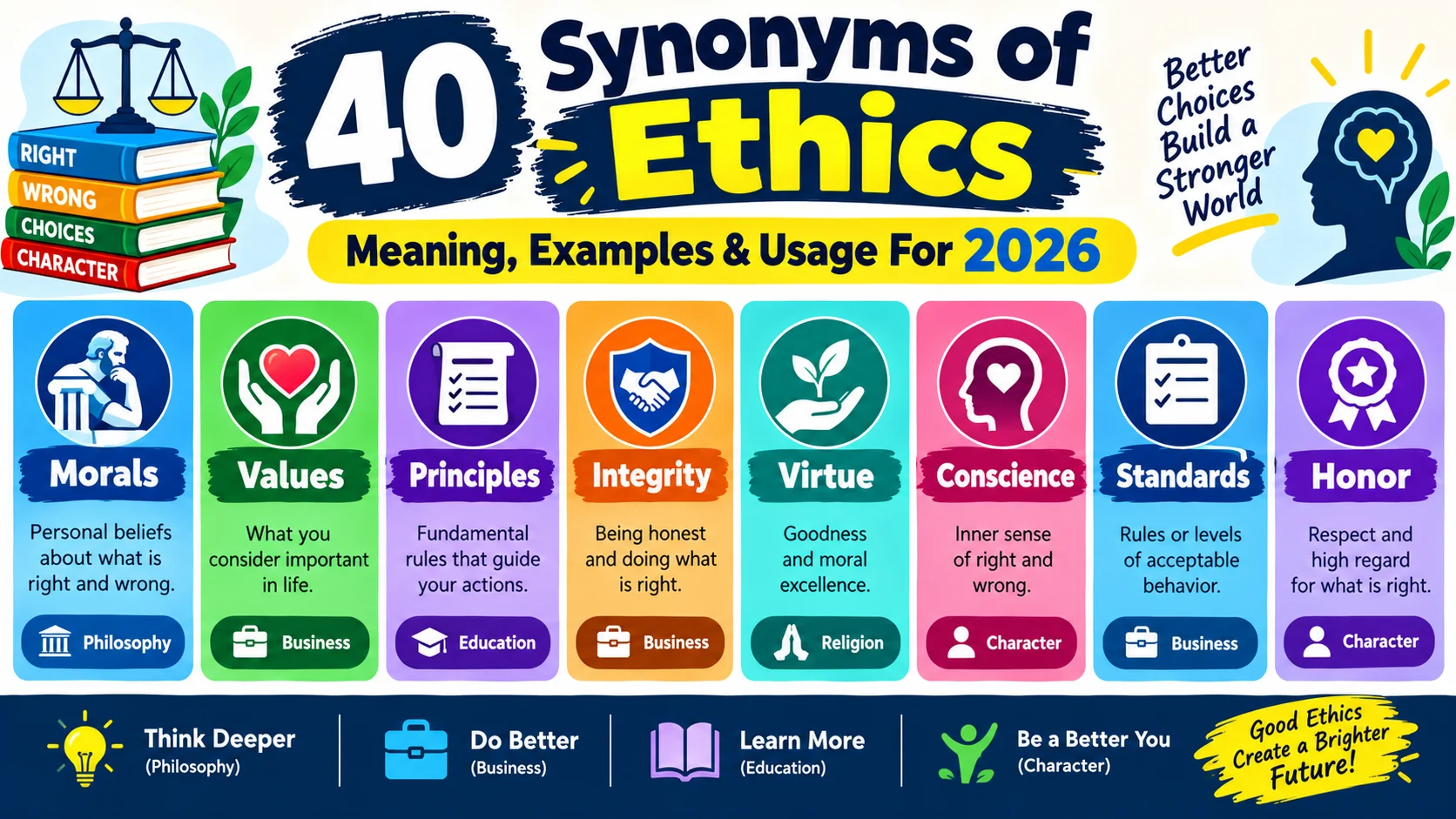
Ethics means a set of moral principles that guide how people behave. The best synonyms include morals, values, principles, integrity, virtue, conscience, and standards. The most common everyday synonym is morals when discussing right and wrong, and integrity when discussing honest behavior. Each synonym has a slightly different meaning, tone, and context.
Have you ever stopped to think about what guides your decisions? That’s ethics at work. Ethics are like an internal compass that tells us what’s right and wrong. They shape how we treat others, how we do business, and how we live our lives.
But the word “ethics” isn’t the only way to talk about this important concept. There’s a whole world of alternatives that can make your writing and speaking more precise and interesting. Whether you’re writing a philosophy paper, having a discussion about values, or just trying to express yourself more clearly, this guide will give you 30 fantastic alternatives. Let’s explore them together!
What Does “Ethics” Mean?
Definition
Ethics refers to the moral principles that govern a person’s behavior or the way an activity is conducted. In simple terms, it’s about knowing the difference between right and wrong and choosing to do what’s right. Ethics can be personal (your own sense of right and wrong), professional (rules for a specific job), or societal (what a community considers acceptable).
Pronunciation
| Feature | Information |
|---|---|
| US IPA | /ˈɛθ.ɪks/ |
| UK IPA | /ˈeθ.ɪks/ |
| Syllables | 2 (eth-ics) |
| Tip | Stress the first syllable: ETH-ics |
Grammar
| Feature | Information |
|---|---|
| Part of Speech | Noun (usually plural) |
| Common Position | Subject or object of a sentence |
| Typical Pattern | “ethics of [something]” or “ethics in [context]” |
Example Sentences:
- Medical ethics require doctors to protect patient privacy.
- Her personal ethics wouldn’t allow her to lie.
- The company has a strict ethics policy.
Grammar Note: “Ethics” is a plural noun but is often treated as singular when referring to a field of study (e.g., “Ethics is an important subject”). It’s also used as a plural when referring to specific principles (e.g., “His ethics are questionable”).
Word Family
| Word | Part of Speech | Meaning |
|---|---|---|
| Ethics | Noun | Moral principles guiding behavior |
| Ethical | Adjective | Morally right or good |
| Ethically | Adverb | In a morally right way |
| Unethical | Adjective | Morally wrong or bad |
| Ethicist | Noun | An expert in ethics |
| Ethos | Noun | The character or spirit of a culture |
30 Synonyms of Ethics
1. Morals
Meaning: Principles about what is right and wrong, especially in behavior.
Best Used For: Daily conversation, personal discussions, education.
Formality: Neutral
Tone: Neutral
Frequency: ⭐⭐⭐⭐⭐ Very Common
CEFR Level: A2
Example Sentence 1: My grandmother taught me good morals from a young age.
Example Sentence 2: The movie explores the morals of its characters.
Usage Tip: “Morals” is the most common and natural synonym for “ethics.” Use it in everyday conversation when discussing right and wrong.
Common Confusion: Morals vs Ethics. “Morals” usually refers to personal beliefs about right and wrong, while “ethics” often refers to rules of conduct in a profession or society.
2. Values
Meaning: Beliefs about what is important in life.
Best Used For: Business, education, personal development.
Formality: Neutral
Tone: Positive
Frequency: ⭐⭐⭐⭐⭐ Very Common
CEFR Level: A2
Example Sentence 1: Our company values include honesty and respect.
Example Sentence 2: His values guided every decision he made.
Usage Tip: “Values” focuses on what you consider important. It’s broader than ethics and includes personal priorities.
3. Principles
Meaning: Basic truths or rules that guide behavior.
Best Used For: Formal writing, professional contexts, leadership.
Formality: Formal
Tone: Professional
Frequency: ⭐⭐⭐⭐⭐ Very Common
CEFR Level: B1
Example Sentence 1: She refused to compromise her principles.
Example Sentence 2: The principles of justice apply to everyone equally.
Usage Tip: “Principles” suggests strong, unchangeable rules. Use it when you want to emphasize firm beliefs.
4. Integrity
Meaning: The quality of being honest and having strong moral principles.
Best Used For: Professional settings, leadership, personal character.
Formality: Formal
Tone: Positive
Frequency: ⭐⭐⭐⭐ Common
CEFR Level: B2
Example Sentence 1: The manager was known for her integrity.
Example Sentence 2: Business integrity is essential for long-term success.
Usage Tip: “Integrity” specifically refers to honesty and moral strength. It’s a powerful word for describing someone’s character.
5. Virtue
Meaning: Behavior showing high moral standards.
Best Used For: Philosophy, religion, literature.
Formality: Formal
Tone: Positive
Frequency: ⭐⭐⭐ Moderate
CEFR Level: B2
Example Sentence 1: Patience is a virtue in many cultures.
Example Sentence 2: The book teaches the importance of virtue.
Usage Tip: “Virtue” focuses on positive moral qualities. It’s often used in religious or philosophical contexts.
6. Conscience
Meaning: An inner sense of right and wrong.
Best Used For: Personal reflection, psychology, literature.
Formality: Neutral
Tone: Emotional
Frequency: ⭐⭐⭐⭐ Common
CEFR Level: B2
Example Sentence 1: Her conscience wouldn’t let her ignore the problem.
Example Sentence 2: He followed his conscience and told the truth.
Usage Tip: “Conscience” is personal and internal. It’s about your own sense of right and wrong.
7. Standards
Meaning: Levels of quality or behavior that are considered acceptable.
Best Used For: Work, education, professional settings.
Formality: Formal
Tone: Professional
Frequency: ⭐⭐⭐⭐ Common
CEFR Level: B1
Example Sentence 1: The company maintains high ethical standards.
Example Sentence 2: Journalists must follow professional standards.
Usage Tip: “Standards” suggests expectations that others have set. Use it when discussing professional requirements.
8. Code
Meaning: A set of rules or principles, often written down.
Best Used For: Professional contexts, rules, organizational guidelines.
Formality: Formal
Tone: Professional
Frequency: ⭐⭐⭐ Moderate
CEFR Level: B2
Example Sentence 1: The code of conduct explains the rules.
Example Sentence 2: Doctors follow a professional code.
Usage Tip: “Code” is often used with “of conduct” or “of ethics.” It suggests formal, written rules.
9. Honor
Meaning: A sense of what is right and just.
Best Used For: Historical contexts, literature, formal speech.
Formality: Formal
Tone: Noble
Frequency: ⭐⭐⭐ Moderate
CEFR Level: B2
Example Sentence 1: He fought for the honor of his family.
Example Sentence 2: She acted with honor in every situation.
Usage Tip: “Honor” suggests dignity and respect. It’s often used in formal or historical contexts.
10. Rectitude
Meaning: Morally correct behavior or thinking.
Best Used For: Formal writing, legal contexts, philosophical discussion.
Formality: Formal
Tone: Serious
Frequency: ⭐⭐ Rare
CEFR Level: C1
Example Sentence 1: The judge was known for her rectitude.
Example Sentence 2: His rectitude was respected by everyone.
Usage Tip: “Rectitude” is very formal and rarely used in conversation. Use it only in formal writing.
11. Righteousness
Meaning: The quality of being morally right or justifiable.
Best Used For: Religion, moral arguments, passionate speech.
Formality: Formal
Tone: Emotional
Frequency: ⭐⭐⭐ Moderate
CEFR Level: B2
Example Sentence 1: He believed in the righteousness of his cause.
Example Sentence 2: The movement was fueled by moral righteousness.
Usage Tip: “Righteousness” often has a religious or passionate tone. It can sometimes imply self-righteousness (thinking you’re better than others).
12. Goodness
Meaning: The quality of being morally good.
Best Used For: Simple conversation, describing people, religion.
Formality: Neutral
Tone: Positive
Frequency: ⭐⭐⭐⭐ Common
CEFR Level: A2
Example Sentence 1: I admire her goodness and kindness.
Example Sentence 2: The story celebrates the goodness of ordinary people.
Usage Tip: “Goodness” is simple and direct. It’s a gentle, positive word.
13. Decency
Meaning: Behavior that shows respect and is morally acceptable.
Best Used For: Social behavior, education, describing people.
Formality: Neutral
Tone: Positive
Frequency: ⭐⭐⭐⭐ Common
CEFR Level: B1
Example Sentence 1: Basic decency requires treating others with respect.
Example Sentence 2: He showed decency by helping the stranger.
Usage Tip: “Decency” focuses on respectful, kind behavior. It’s about common courtesy as much as morality.
14. Probity
Meaning: Complete honesty and integrity.
Best Used For: Formal writing, financial contexts, legal documents.
Formality: Formal
Tone: Serious
Frequency: ⭐⭐ Rare
CEFR Level: C1
Example Sentence 1: The treasurer was praised for her probity.
Example Sentence 2: Probity is essential in financial management.
Usage Tip: “Probity” is very formal and uncommon. Use it in official or financial contexts only.
15. Credo
Meaning: A set of beliefs or principles.
Best Used For: Business, religion, personal statements.
Formality: Formal
Tone: Inspiring
Frequency: ⭐⭐ Rare
CEFR Level: C1
Example Sentence 1: His credo was “always tell the truth.”
Example Sentence 2: The company’s credo guides all decisions.
Usage Tip: “Credo” is like a personal or group motto. It’s formal but inspiring.
16. Ethos
Meaning: The character or guiding beliefs of a person or group.
Best Used For: Sociology, cultural studies, business.
Formality: Formal
Tone: Academic
Frequency: ⭐⭐⭐ Moderate
CEFR Level: B2
Example Sentence 1: The school’s ethos emphasizes community service.
Example Sentence 2: The company’s ethos is built on trust.
Usage Tip: “Ethos” is the Greek root of “ethics.” It refers to the spirit or character of a group.
17. Tenet
Meaning: A principle or belief, especially in a religion or philosophy.
Best Used For: Religion, philosophy, formal writing.
Formality: Formal
Tone: Serious
Frequency: ⭐⭐⭐ Moderate
CEFR Level: B2
Example Sentence 1: One of the tenets of democracy is freedom of speech.
Example Sentence 2: She follows the tenets of her faith.
Usage Tip: “Tenet” suggests a core, unchanging belief. It’s often used for religious or philosophical ideas.
18. Canon
Meaning: A set of principles or rules.
Best Used For: Literature, law, religion.
Formality: Formal
Tone: Serious
Frequency: ⭐⭐ Rare
CEFR Level: C1
Example Sentence 1: The canons of professional conduct are strict.
Example Sentence 2: He violated the canon of journalistic ethics.
Usage Tip: “Canon” suggests official, established rules. It’s formal and specific.
19. Precept
Meaning: A general rule intended to regulate behavior.
Best Used For: Religion, education, formal writing.
Formality: Formal
Tone: Serious
Frequency: ⭐⭐ Rare
CEFR Level: C1
Example Sentence 1: The precepts of the religion guide daily life.
Example Sentence 2: He failed to follow the basic precepts of morality.
Usage Tip: “Precept” is formal and often used in religious or educational contexts.
20. Rule
Meaning: A principle guiding behavior or action.
Best Used For: Every situation, daily conversation.
Formality: Neutral
Tone: Neutral
Frequency: ⭐⭐⭐⭐⭐ Very Common
CEFR Level: A2
Example Sentence 1: The golden rule is to treat others as you want to be treated.
Example Sentence 2: Ethical rules prevent conflicts of interest.
Usage Tip: “Rule” is simple and direct. It works in almost every context.
21. Law
Meaning: A system of rules recognized by a community.
Best Used For: Legal contexts, government, formal discussion.
Formality: Formal
Tone: Neutral
Frequency: ⭐⭐⭐⭐⭐ Very Common
CEFR Level: A2
Example Sentence 1: The law requires equal treatment for everyone.
Example Sentence 2: Natural law is the basis of human rights.
Usage Tip: “Law” is about legal rules, while “ethics” is about moral rules. They’re related but different.
22. Guideline
Meaning: A general rule or piece of advice.
Best Used For: Work, education, government policy.
Formality: Formal
Tone: Helpful
Frequency: ⭐⭐⭐⭐ Common
CEFR Level: B1
Example Sentence 1: The guidelines for ethical research are clear.
Example Sentence 2: Medical guidelines prevent harmful practices.
Usage Tip: “Guideline” suggests advice rather than strict rules. It’s about helping people do the right thing.
23. Policy
Meaning: A course of action adopted by an organization.
Best Used For: Business, government, institutional decisions.
Formality: Formal
Tone: Professional
Frequency: ⭐⭐⭐⭐ Common
CEFR Level: B1
Example Sentence 1: The company’s ethical policy is available online.
Example Sentence 2: Policy decisions should be guided by ethics.
Usage Tip: “Policy” is about official decisions and rules, especially in organizations.
24. Honor code
Meaning: A set of ethical rules for a specific group.
Best Used For: Schools, military, professional associations.
Formality: Formal
Tone: Serious
Frequency: ⭐⭐⭐ Moderate
CEFR Level: B2
Example Sentence 1: Students must sign the honor code.
Example Sentence 2: The military honor code requires loyalty.
Usage Tip: “Honor code” is specific to institutions like schools or the military. It’s about formal promises.
25. Morality
Meaning: Principles concerning the distinction between right and wrong.
Best Used For: Philosophy, religion, general discussion.
Formality: Formal
Tone: Neutral
Frequency: ⭐⭐⭐⭐ Common
CEFR Level: B2
Example Sentence 1: Morality is the foundation of civilization.
Example Sentence 2: Her morality was shaped by her upbringing.
Usage Tip: “Morality” is a broader term than “ethics.” It’s about the entire system of right and wrong.
26. Character
Meaning: The mental and moral qualities distinctive to a person.
Best Used For: Personal development, describing people.
Formality: Neutral
Tone: Neutral
Frequency: ⭐⭐⭐⭐⭐ Very Common
CEFR Level: A2
Example Sentence 1: Good character is more important than intelligence.
Example Sentence 2: He proved his character by telling the truth.
Usage Tip: “Character” is about who someone is as a person, including their ethics.
27. Chivalry
Meaning: The combination of qualities expected of an ideal knight.
Best Used For: Historical contexts, literature, old-fashioned speech.
Formality: Formal
Tone: Romantic
Frequency: ⭐⭐ Rare
CEFR Level: B2
Example Sentence 1: Chivalry demanded bravery and courtesy.
Example Sentence 2: His chivalry was appreciated by everyone.
Usage Tip: “Chivalry” is specific to medieval knights. It’s not used for modern ethics.
28. Nobility
Meaning: The quality of being noble, virtuous, or honorable.
Best Used For: Literature, historical contexts, describing people.
Formality: Formal
Tone: Admiring
Frequency: ⭐⭐ Rare
CEFR Level: B2
Example Sentence 1: Her nobility of character was inspiring.
Example Sentence 2: Nobility is about actions, not titles.
Usage Tip: “Nobility” suggests grace and high moral character. It’s somewhat old-fashioned.
29. Piety
Meaning: The quality of being religious or reverent.
Best Used For: Religion, describing religious behavior.
Formality: Formal
Tone: Serious
Frequency: ⭐⭐ Rare
CEFR Level: B2
Example Sentence 1: Her piety was evident in her daily prayers.
Example Sentence 2: Filial piety means respecting your parents.
Usage Tip: “Piety” is specifically about religious devotion. It’s not about ethics in general.
30. Civility
Meaning: Formal politeness and courtesy in behavior.
Best Used For: Social behavior, professional conduct.
Formality: Neutral
Tone: Positive
Frequency: ⭐⭐⭐ Moderate
CEFR Level: B2
Example Sentence 1: Civility is essential for healthy communities.
Example Sentence 2: Disagreements should be handled with civility.
Usage Tip: “Civility” is about polite, respectful behavior. It’s a form of social ethics.
Synonyms Comparison Table
| Synonym | Best Context | Formality | Tone | Frequency |
|---|---|---|---|---|
| Morals | Daily conversation | Neutral | Neutral | ⭐⭐⭐⭐⭐ |
| Values | Business, education | Neutral | Positive | ⭐⭐⭐⭐⭐ |
| Principles | Professional contexts | Formal | Professional | ⭐⭐⭐⭐⭐ |
| Integrity | Leadership, character | Formal | Positive | ⭐⭐⭐⭐ |
| Virtue | Philosophy, religion | Formal | Positive | ⭐⭐⭐ |
| Conscience | Personal reflection | Neutral | Emotional | ⭐⭐⭐⭐ |
| Standards | Work, education | Formal | Professional | ⭐⭐⭐⭐ |
| Code | Professional rules | Formal | Professional | ⭐⭐⭐ |
| Honor | Historical, formal | Formal | Noble | ⭐⭐⭐ |
| Goodness | Simple conversation | Neutral | Positive | ⭐⭐⭐⭐ |
Best Synonyms by Situation
| Situation | Best Synonym | Why It Works |
|---|---|---|
| Daily Conversation | Morals | Simple and widely understood |
| Business Email | Values | Professional and positive |
| Academic Writing | Principles | Formal and precise |
| School Assignment | Morality | Expected in academic settings |
| Professional Meeting | Integrity | Strong and impressive |
| Presentation | Values | Engaging and relatable |
| Creative Writing | Conscience | Emotional and personal |
| Social Media | Standards | Clear and modern |
| Movie Review | Morality | Analytical and relevant |
| Book Review | Principles | Thoughtful and precise |
Formal vs Informal Synonyms
Formal Alternatives
| Synonym | Best Used For |
|---|---|
| Rectitude | Legal contexts, formal writing |
| Probity | Financial contexts |
| Tenet | Philosophical discussion |
| Precept | Religious or educational contexts |
| Canon | Professional rules |
Neutral Alternatives
| Synonym | Best Used For |
|---|---|
| Morals | Most situations |
| Values | Personal and professional settings |
| Principles | General use |
| Integrity | Professional settings |
| Conscience | Personal reflection |
Informal Alternatives
| Synonym | Best Used For |
|---|---|
| Goodness | Simple conversation |
| Decency | Social behavior |
| Rule | Everyday language |
Strong vs Mild Synonyms
Mild
- Goodness – simple and gentle
- Decency – about being kind and respectful
- Rule – everyday expectation
- Civility – polite behavior
Moderate
- Morals – personal right and wrong
- Values – what’s important
- Principles – firm beliefs
- Integrity – honest character
Strong
- Rectitude – strict moral correctness
- Probity – complete honesty
- Righteousness – passionate moral conviction
- Tenet – core belief
Real-Life Examples
Classroom:
“The teacher taught us about ethics in the business world. She explained how morals guide professionals in their decisions.”
Workplace:
“The CEO emphasized the importance of integrity. She said our values would guide every business decision we make.”
Business Email:
“It’s essential that we maintain our ethical standards. Our principles are what set us apart from competitors.”
Everyday Conversation:
“My grandmother always told me that character matters more than money. She said decency is the most important quality a person can have.”
Academic Paper:
“The study examines the ethics of genetic engineering. The researchers explore the moral implications of the new technology.”
Common Collocations
| Common Phrase | Better Alternative |
|---|---|
| Code of ethics | Code of conduct |
| Ethical standards | Professional standards |
| Moral values | Personal values |
| Business ethics | Corporate integrity |
| Strong ethics | Strong principles |
Common Phrases
| Phrase | Meaning | Better Alternative |
|---|---|---|
| Work ethic | Dependable work habits | Professionalism |
| Questionable ethics | Possibly wrong behavior | Ethical concerns |
| Ethics violation | Breaking the rules | Code violation |
Context Guide
| Situation | Best Synonym | Reason |
|---|---|---|
| Essay | Principles | Formal and precise |
| Speech | Morals | Easy to understand |
| Business Email | Values | Professional and positive |
| Novel | Conscience | Emotional and personal |
| Presentation | Integrity | Inspiring and strong |
| Conversation | Character | Natural and common |
| Academic Writing | Morality | Standard term |
| Marketing Copy | Values | Positive and appealing |
Related Words
Near Synonyms
- Ethics and morals are often used interchangeably, but “ethics” usually refers to rules of conduct in a profession, while “morals” refers to personal beliefs.
Antonyms
- Corruption – dishonest behavior
- Dishonesty – lack of truthfulness
- Immorality – wrong or evil behavior
- Related Adjectives
- Ethical – morally right
- Unethical – morally wrong
- Moral – concerned with right and wrong
- Immoral – not conforming to accepted standards
Related Nouns
- Ethicist – an expert in ethics
- Morality – the system of right and wrong
- Integrity – honest and strong principles
- Character – a person’s moral qualities
- Related Verbs
- Exemplify – to be a good example of something
- Uphold – to maintain or support
- Compromise – to weaken or damage
- Practice – to perform or exercise
Frequently Asked Questions
What is another word for ethics?
The most common synonyms for ethics are morals, values, principles, integrity, virtue, and conscience. Each one has a slightly different meaning, so choose based on your context.
Which synonym sounds the most professional?
Integrity and principles sound the most professional. “Integrity” is especially powerful for describing someone’s honest character, while “principles” emphasizes firm beliefs.
What’s the difference between ethics and morals?
Ethics usually refers to rules of conduct in a profession or society, while morals refers to personal beliefs about right and wrong. You might have moral objections to something but follow ethical rules at work.
Which synonym is best for everyday conversation?
Morals and values are the most natural choices for everyday conversation. They’re simple, widely understood, and work in almost any context.
What is the strongest synonym for ethics?
Rectitude and probity are among the strongest synonyms, but they’re very formal. For everyday use, integrity is a powerful and impressive word.
What’s the opposite of ethics?
Corruption, dishonesty, and immorality are the main opposites. They all describe a lack of moral principles or unethical behavior.
Which synonym is most common in everyday English?
Morals, values, and principles are the most common synonyms in everyday English. You’ll hear them in conversations, at work, and in media.
How do you use ethics in a sentence?
“Ethics” is usually used as a plural noun. Example: “Her ethics wouldn’t allow her to cut corners.” It can also be singular when referring to the field of study: “Ethics is an important subject in philosophy.”
What’s the difference between integrity and honesty?
Honesty is about telling the truth. Integrity is broader it means having strong moral principles and consistently following them. You can be honest without having integrity, but integrity includes honesty.
Can “values” mean ethics?
Yes, in many contexts, values can mean ethics. However, “values” is broader and can include personal priorities like ambition or hard work, while ethics is specifically about right and wrong.
Conclusion
We’ve explored a rich collection of words that can replace “ethics” in your vocabulary. From the everyday “morals” and “values” to the more sophisticated “rectitude” and “probity,” there’s a perfect synonym for every situation.
- The key to choosing the right word is understanding your context. For casual conversations, stick with morals and values. For professional settings, principles and integrity will serve you well. For academic writing, morality and ethics are the standard choices. And for creative or personal expression, conscience and character add depth and emotion.
Remember, the best way to improve your vocabulary is to practice. Try using a new synonym in your next conversation or email. Notice which words native speakers use in different situations. With time and practice, choosing the right word will become second nature. Keep learning, keep practicing, and your English will continue to improve!
