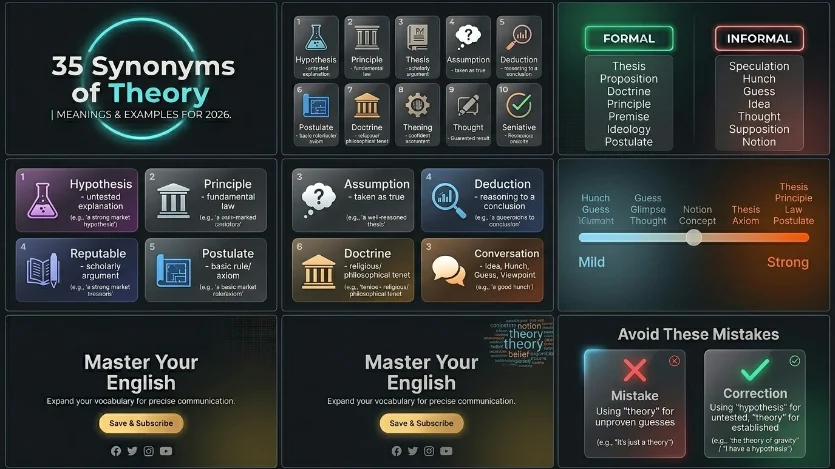
“Theory” means a set of ideas used to explain something, or a guess based on limited information. The best synonyms are hypothesis, concept, idea, notion, and speculation. “Hypothesis” is the most common alternative in academic contexts. Each synonym has a slightly different meaning and context where it fits best.
Top 10 Synonyms
- Hypothesis
- Concept
- Idea
- Notion
- Speculation
- Principle
- Explanation
- Model
- Framework
- Premise
Theory” is a fascinating word with two different meanings. In science, it means a well-tested explanation. In everyday use, it often means a guess or idea. But using it too often can make your English feel repetitive and imprecise.
Think about it. You can talk about a scientific theory, a theory about why something happened, or a theory in a book. Each situation might need a different word that captures the exact type of idea or explanation.
In this guide, you’ll learn 35 powerful synonyms for “theory.” You’ll discover exactly when to use each one, how formal they are, and what common mistakes to avoid. Let’s begin!
What Does “Theory” Mean?
Definition
Theory” has two main meanings. First, it means a set of ideas that explains something, like the theory of evolution. Second, it means an idea or guess about something, often based on limited evidence. When you have a theory, you have a way of understanding or explaining something.
Pronunciation
| Feature | Value |
|---|---|
| US IPA | /ˈθiəri/ |
| UK IPA | /ˈθɪəri/ |
| Syllables | 3 (the-o-ry) |
| Tip | Stress the first syllable: “THEE-uh-ree” |
Grammar
| Grammar Feature | Information |
|---|---|
| Part of Speech | Noun |
| Common Position | Subject or object |
| Typical Pattern | Theory + of/about + something |
Examples:
- “Darwin’s theory of evolution is well-known.” (scientific)
- “I have a theory about why she left.” (guess)
- “The theory is supported by evidence.” (academic)
Grammar Note: “Theory” can be countable or uncountable. You can have “a theory” (one idea) or “theory” (the general concept).
Word Family
| Word | Part of Speech | Meaning |
|---|---|---|
| Theory | Noun | A set of ideas explaining something |
| Theoretical | Adjective | Based on theory, not practice |
| Theoretically | Adverb | In a theoretical way |
| Theorize | Verb | To form a theory |
| Theorist | Noun | Someone who develops theories |
15 Synonyms of “Theory”
Hypothesis
Meaning: An idea or explanation that needs to be tested.
Best Used For: Science, research, academic writing.
Formality: Formal
Tone: Analytical, Scientific
Frequency: ⭐⭐⭐⭐ (Common)
CEFR Level: B2
Example Sentence 1: “The scientists tested their hypothesis with experiments.”
Example Sentence 2: “We need to form a hypothesis before starting the research.”
Usage Tip: “Hypothesis” is a specific, testable idea. Use it in scientific and academic contexts.
Common Confusion: Hypothesis vs Theory. In science, a hypothesis is untested. A theory has been tested and supported.
Concept
Meaning: A general idea or understanding of something.
Best Used For: Philosophy, education, general ideas.
Formality: Formal
Tone: Abstract, Intellectual
Frequency: ⭐⭐⭐⭐⭐ (Very Common)
CEFR Level: B2
Example Sentence 1: “The concept of freedom is important in politics.
Example Sentence 2: “She explained the basic concept of the theory.”
Usage Tip: “Concept” is a general, abstract idea. Use it for foundational ideas in any field.
Idea
Meaning: A thought or suggestion about how something works.
Best Used For: Everyday conversation, simple explanations.
Formality: Informal
Tone: Casual, Practical
Frequency: ⭐⭐⭐⭐⭐ (Very Common)
CEFR Level: A2
Example Sentence 1: “I have an idea about what happened.”
Example Sentence 2: “That’s an interesting idea.
Usage Tip: “Idea” is the most common and casual synonym. Use it in everyday conversation.
Notion
Meaning: A general or vague idea about something.
Best Used For: Abstract ideas, personal beliefs.
Formality: Neutral
Tone: Vague, Abstract
Frequency: ⭐⭐⭐ (Moderate)
CEFR Level: B2
Example Sentence 1: “She has a notion that things will get better.”
Example Sentence 2: “The notion of equality is important.”
Usage Tip: “Notion” often suggests a vague or imperfect idea. It’s less formal than “concept.”
Speculation
Meaning: An idea or guess based on incomplete information.
Best Used For: Guesses, predictions, uncertain situations.
Formality: Formal
Tone: Uncertain, Conjectural
Frequency: ⭐⭐⭐ (Moderate)
CEFR Level: B2
Example Sentence 1: “His theory was pure speculation without evidence.”
Example Sentence 2: “There is much speculation about the future of the company.”
Usage Tip: “Speculation” suggests an idea without strong evidence. Use it for guesses.
Principle
Meaning: A basic truth or rule that explains something.
Best Used For: Science, law, philosophy.
Formality: Formal
Tone: Fundamental, Authoritative
Frequency: ⭐⭐⭐⭐ (Common)
CEFR Level: B2
Example Sentence 1: “The principle of gravity explains why things fall.”
Example Sentence 2: “She explained the basic principles of the theory.”
Usage Tip: “Principle” is a fundamental rule or truth. It’s more certain than a theory.
Explanation
Meaning: A reason or set of reasons for why something happens.
Best Used For: General contexts, everyday use.
Formality: Neutral
Tone: Clear, Informative
Frequency: ⭐⭐⭐⭐⭐ (Very Common)
CEFR Level: B1
Example Sentence 1: “His explanation made perfect sense.”
Example Sentence 2: “We need an explanation for this phenomenon.”
Usage Tip: “Explanation” is a common, clear word for why something happens.
Model
Meaning: A simplified representation of how something works.
Best Used For: Science, economics, systems.
Formality: Formal
Tone: Analytical, Technical
Frequency: ⭐⭐⭐⭐ (Common)
CEFR Level: B2
Example Sentence 1: “The economist presented a new economic model.”
Example Sentence 2: “This model explains how the climate changes.”
Usage Tip: “Model” is a formal way to describe a simplified version of a complex system.
Framework
Meaning: A basic structure of ideas used to understand something.
Best Used For: Academic writing, research, policy.
Formality: Formal
Tone: Structured, Analytical
Frequency: ⭐⭐⭐ (Moderate)
CEFR Level: C1
Example Sentence 1: “The theoretical framework guided the research.
Example Sentence 2: “We need a framework for understanding this issue.”
Usage Tip: “Framework” suggests an organized structure of ideas. Use it in academic contexts.
Premise
Meaning: An idea or statement that forms the basis of an argument.
Best Used For: Logic, arguments, philosophy.
Formality: Formal
Tone: Logical, Argumentative
Frequency: ⭐⭐⭐ (Moderate)
CEFR Level: C1
Example Sentence 1: “The premise of his argument was flawed.
Example Sentence 2: “We need to examine the premises of the theory.”
Usage Tip: “Premise” is used in logical arguments. It’s a formal, academic word.
Guess
Meaning: An attempt to give an answer without enough information.
Best Used For: Casual conversation, informal contexts.
Formality: Informal
Tone: Casual, Uncertain
Frequency: ⭐⭐⭐⭐⭐ (Very Common)
CEFR Level: A2
Example Sentence 1: “My guess is that she’ll be late.”
Example Sentence 2: “That’s just a guess—I’m not sure.”
Usage Tip: “Guess” is very informal. Use it when you’re being casual about an uncertain idea.
Conjecture
Meaning: An idea or opinion based on incomplete information.
Best Used For: Formal writing, academic contexts.
Formality: Formal
Tone: Conjectural, Uncertain
Frequency: ⭐⭐ (Rare)
CEFR Level: C1
Example Sentence 1: “His conclusions were based on conjecture, not fact.”
Example Sentence 2: “The historian’s conjecture was interesting but unproven.”
Usage Tip: “Conjecture” is a formal word for an educated guess. Use it in formal writing.
Thesis
Meaning: A statement or theory that is put forward as a premise.
Best Used For: Academic writing, essays, dissertations.
Formality: Formal
Tone: Academic, Argumentative
Frequency: ⭐⭐⭐ (Moderate)
CEFR Level: C1
Example Sentence 1: “Her thesis focused on the theory of education.
Example Sentence 2: “The thesis of the book is very interesting.”
Usage Tip: “Thesis” is a formal word for a main idea or argument, often in academic work.
Postulate
Meaning: An idea that is assumed to be true for the sake of argument.
Best Used For: Science, philosophy, logic.
Formality: Formal
Tone: Logical, Theoretical
Frequency: ⭐⭐ (Rare)
CEFR Level: C1
Example Sentence 1: “The theory is based on several key postulates.”
Example Sentence 2: “This postulate is essential to the argument.”
Usage Tip: “Postulate” is a very formal word for something assumed to be true.
Assumption
Meaning: Something you believe to be true without proof.
Best Used For: Arguments, research, planning.
Formality: Neutral
Tone: Unproven, Presumed
Frequency: ⭐⭐⭐⭐ (Common)
CEFR Level: B2
Example Sentence 1: “His theory is based on several assumptions.”
Example Sentence 2: “We need to check our assumptions before we begin.”
Usage Tip: “Assumption” suggests something taken for granted. It’s a common, useful word.
Synonyms Comparison Table
| Synonym | Best Context | Formality | Tone | Frequency |
|---|---|---|---|---|
| Idea | General use | Informal | Casual | ⭐⭐⭐⭐⭐ |
| Explanation | General reasons | Neutral | Clear | ⭐⭐⭐⭐⭐ |
| Hypothesis | Science, research | Formal | Analytical | ⭐⭐⭐⭐ |
| Concept | Abstract ideas | Formal | Intellectual | ⭐⭐⭐⭐⭐ |
| Notion | Vague ideas | Neutral | Abstract | ⭐⭐⭐ |
| Principle | Fundamental rules | Formal | Authoritative | ⭐⭐⭐⭐ |
| Model | Systems, science | Formal | Technical | ⭐⭐⭐⭐ |
| Speculation | Guesses | Formal | Uncertain | ⭐⭐⭐ |
| Framework | Structured ideas | Formal | Analytical | ⭐⭐⭐ |
| Assumption | Unproven beliefs | Neutral | Presumed | ⭐⭐⭐⭐ |
Best Synonyms by Situation
| Situation | Best Synonym | Why It Works |
|---|---|---|
| Daily Conversation | Idea | Natural and casual |
| Business Email | Concept | Professional and clear |
| Academic Writing | Hypothesis | Formal and precise |
| School Assignment | Explanation | Clear and simple |
| Professional Meeting | Framework | Sounds structured |
| Presentation | Concept | Clear and effective |
| Creative Writing | Notion | Adds literary depth |
| Social Media | Idea | Casual and relatable |
| Scientific Context | Hypothesis | Specific and accurate |
Formal vs Informal Synonyms
Formal Alternatives
| Synonym | Best Used For |
|---|---|
| Hypothesis | Scientific research |
| Concept | Abstract, intellectual ideas |
| Framework | Structured analysis |
| Thesis | Academic arguments |
| Postulate | Logical assumptions |
Neutral Alternatives
| Synonym | Best Used For |
|---|---|
| Explanation | General reasons |
| Notion | Vague ideas |
| Principle | Fundamental rules |
| Model | Simplified systems |
Informal Alternatives
| Synonym | Best Used For |
|---|---|
| Idea | Everyday conversation |
| Guess | Casual uncertainty |
| Hunch | Intuitive feeling |
Choosing the Right Level: Use “hypothesis” and “framework” for academic writing. Use “concept” and “principle” for professional contexts. Use “idea” and “guess” with friends.
Strong vs Mild Synonyms
Mild
Suitable for everyday situations with less intensity.
- Idea
- Guess
- Notion
Moderate
More structured or formal alternatives.
- Concept
- Explanation
- Principle
- Model
Strong
High-intensity alternatives suggesting depth or formality.
- Hypothesis (scientific rigor)
- Framework (structured analysis)
- Thesis (central argument)
- Postulate (logical foundation)
How Intensity Changes Meaning: “I have an idea” is simple. “I have a hypothesis” is more formal. Choose stronger words when you want to emphasize academic or scientific rigor.
Real-Life Examples
School: “The teacher explained the theory of evolution.”
Office: “Our concept for the new product was well-received.”
Business Email: “Please review the theoretical framework before the meeting.”
Meetings: “The hypothesis needs to be tested before we proceed.”
Presentations: “The principle behind this approach is simple.”
Daily Conversations: “I have a theory about why the store is closed.”
Social Media: “Anyone have a guess about what happens next?”
Academic Writing: “The study tested several hypotheses.”
Common Collocations
| Common Phrase | Better Alternative |
|---|---|
| Theory of evolution | Concept of evolution |
| Theory about something | Idea about something |
| Scientific theory | Scientific hypothesis |
| Political theory | Political concept |
| Conspiracy theory | Conspiracy idea |
Common Phrases
In theory: In an ideal world. (e.g., “In theory, this should work.”)
Just a theory: Not proven. (e.g., “That’s just a theory, not a fact.”)
Work on a theory: To develop an idea. (e.g., “She’s working on a new theory.”)
Put forward a theory: To suggest an idea. (e.g., “He put forward an interesting theory.”)
Theory and practice: Ideas vs. reality. (e.g., “There’s a gap between theory and practice.”)
Context Guide
| Situation | Best Synonym | Reason |
|---|---|---|
| Essay | Hypothesis | Academic and formal |
| Speech | Concept | Clear and inspiring |
| Business Email | Framework | Professional and structured |
| Novel | Notion | Adds literary depth |
| Presentation | Principle | Clear and authoritative |
| Conversation | Idea | Natural and relatable |
| Academic Writing | Hypothesis | Precise and formal |
| Marketing Copy | Concept | Engaging and professional |
Related Words
Near Synonyms
- Hunch: A feeling or intuition. (e.g., “I have a hunch about this.”)
- Conjecture: An educated guess (formal).
- Postulate: An assumed truth (very formal).
- Hypothesis: A testable idea (scientific).
- Surmise: To guess without evidence.
Antonyms
- Fact: Something proven true.
- Reality: What actually exists.
- Certainty: Something known for sure.
- Proof: Evidence that confirms something.
- Truth: What is actually true.
Related Adjectives
- Theoretical: Based on theory.
- Hypothetical: Based on a guess.
- Abstract: Not concrete.
- Conceptual: Based on concepts.
- Speculative: Based on guessing.
Related Nouns
- Idea: A thought or suggestion.
- Concept: A general idea.
- Principle: A fundamental truth.
- Hypothesis: A testable explanation.
- Model: A simplified representation.
Related Verbs
- Theorize: To form a theory.
- Hypothesize: To form a hypothesis.
- Speculate: To guess.
- Conjecture: To form an opinion (formal).
Frequently Asked Questions
What is another word for theory?
Common synonyms include hypothesis, concept, idea, notion, and speculation. “Hypothesis” is the most common alternative in academic contexts.
Which synonym sounds the most professional?
Hypothesis and framework sound very professional. “Concept” is also excellent for business contexts.
What is the strongest synonym for theory?
Hypothesis is one of the strongest for scientific contexts. “Postulate” is also strong for logical assumptions.
Which synonym is best for essays?
Hypothesis is the best choice for academic essays. “Framework” is also excellent for research papers.
What’s the difference between theory and hypothesis?
In science, a hypothesis is an untested idea that needs to be tested. A theory has been tested and supported by evidence. In everyday use, they’re often used interchangeably.
Which synonym is most common in everyday English?
“Idea” is the most common in everyday speech. “Guess” is also very common for informal contexts.
What is the opposite of theory?
Common opposites are fact, reality, certainty, and proof. These words describe things that are proven true.
Conclusion
“Theory” is a fascinating word, but now you have 35 fantastic alternatives. Each synonym adds a different shade of meaning to your language.
Remember, the key is understanding the context. Use “hypothesis” for scientific and academic contexts. Use “concept” for general abstract ideas. Use “idea” for everyday conversation. Use “framework” for structured analysis.
The best way to improve is practice. Try using one or two new synonyms each day. Listen for these words in conversations and books. Your vocabulary will become richer and more impressive with time.
