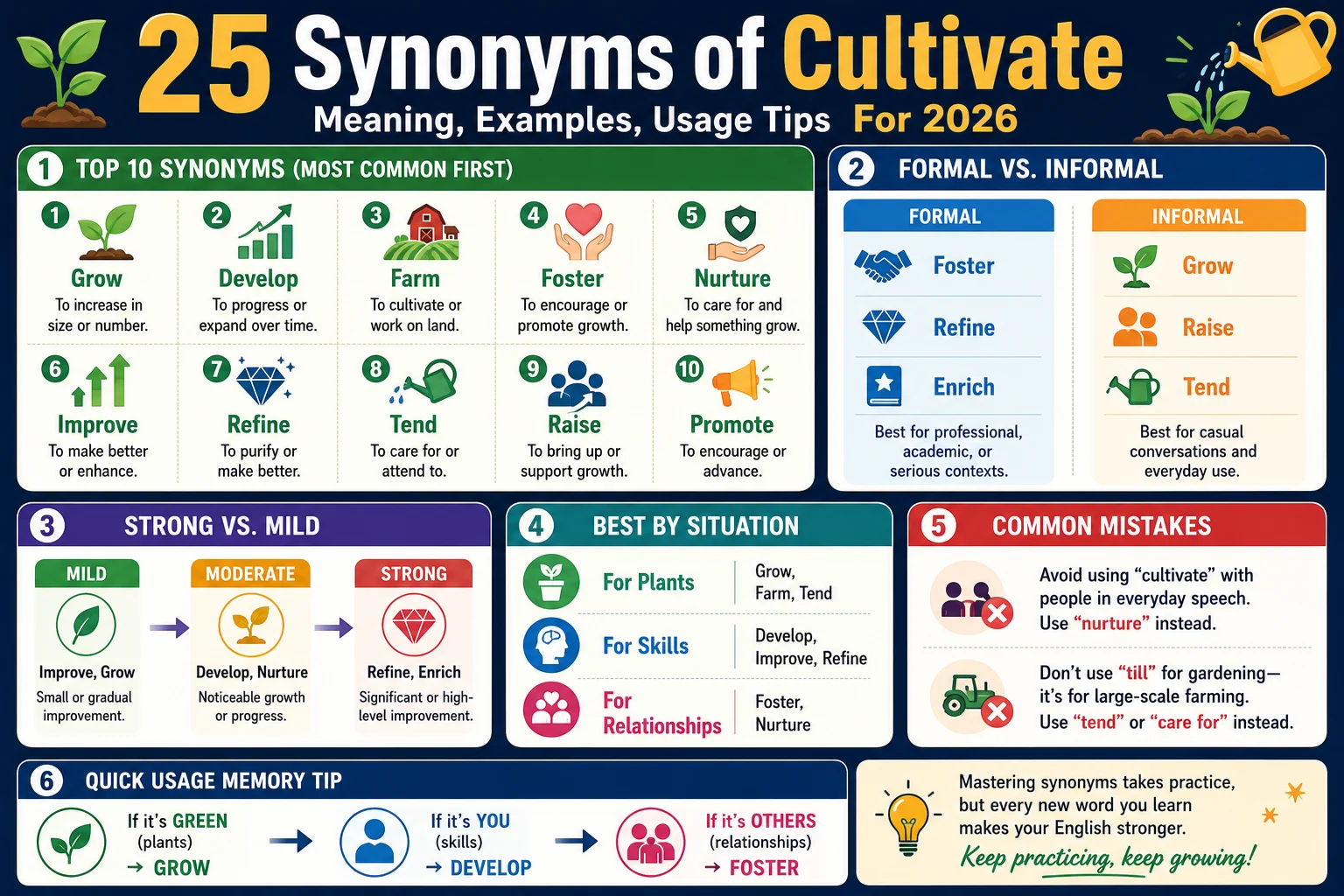
Cultivate means to grow plants, develop skills, or build relationships. The most common synonyms include grow, farm, tend, develop, foster, and nurture. Each synonym works best in a specific context farming, personal growth, business, or social relationships. Let’s explore exactly when to use each one.
The word “cultivate” is one of those versatile English verbs with many uses. It can describe a farmer working the soil, a professional developing new skills, or someone carefully building friendships.
Learning synonyms for “cultivate” will make your English richer and more precise. Instead of repeating the same word, you can choose the perfect alternative for every situation.
In this article, you’ll discover 25 practical synonyms with clear examples, usage tips, and guidance on formality. By the end, you’ll know exactly which word to use whether you’re writing a business email, an academic essay, or simply having a conversation.
What Does “Cultivate” Mean?
Definition
Cultivate is a verb with three main meanings:
- To grow plants or crops – preparing soil and caring for what you plant.
- To develop or improve something – like a skill, habit, or quality.
- To build a relationship – making an effort to connect with someone.
Think of it as “caring for something to help it grow and improve.”
Pronunciation
| US IPA | UK IPA | Syllables | Tip |
|---|---|---|---|
| /ˈkʌl.tɪ.veɪt/ | /ˈkʌl.tɪ.veɪt/ | 3 | Stress the first syllable: CUL-ti-vate |
Grammar
| Grammar Feature | Information |
|---|---|
| Part of Speech | Verb (transitive) |
| Common Position | After the subject |
| Typical Pattern | Subject + cultivate + object |
Examples:
- She cultivates tomatoes in her backyard.
- He cultivates good habits every day.
- They cultivate strong relationships with clients.
Grammar Note: “Cultivate” is a regular verb. The forms are: cultivate, cultivates, cultivated, cultivating.
Word Family
| Word | Part of Speech | Meaning |
|---|---|---|
| Cultivate | Verb | To grow, develop, or foster something |
| Cultivation | Noun | The act of cultivating; the process of growing or developing |
| Cultivated | Adjective | Refined, educated, or developed (can describe land or a person) |
| Cultivator | Noun | A person or tool that cultivates |
| Cultivable | Adjective | Capable of being cultivated (usually land) |
25 Synonyms of Cultivate
1. Grow
Meaning: To cause something to increase in size, quantity, or intensity; often used for plants but also for businesses and skills.
Best Used For: Gardening, farming, business growth, personal development.
Formality: Neutral
Tone: Positive, Natural
Frequency: ⭐⭐⭐⭐⭐ Very Common
CEFR Level: A2
Example Sentence 1: We grow vegetables in the garden every summer.
Example Sentence 2: The company grew its customer base by focusing on quality.
Usage Tip: “Grow” is the most natural synonym in everyday conversation. Use it for plants, businesses, and ideas. Avoid using it when describing relationship-building with people that would sound unnatural.
2. Farm
Meaning: To cultivate land for the purpose of producing food or other agricultural products.
Best Used For: Agricultural contexts; large-scale crop or livestock production.
Formality: Neutral
Tone: Practical, Professional in context
Frequency: ⭐⭐⭐⭐⭐ Very Common
CEFR Level: A2
Example Sentence 1: They farm over 200 acres of wheat and corn.
Example Sentence 2: Her family has farmed this land for three generations.
Usage Tip: “Farm” implies commercial agriculture, not a small backyard garden. Use it for professional or large-scale food production. Don’t use it for personal skills or relationships.
3. Tend
Meaning: To care for something by paying regular attention to it; to look after.
Best Used For: Gardening, animals, plants, small personal projects.
Formality: Neutral
Tone: Gentle, Caring
Frequency: ⭐⭐⭐⭐ Common
CEFR Level: B1
Example Sentence 1: She tends her roses with great care.
Example Sentence 2: The gardener tends the plants daily.
Usage Tip: “Tend” has a caring quality. Use it when you want to emphasize attention and care. It works for both plants and people (tending to customers). In British English, this is slightly more common than in American English.
4. Develop
Meaning: To gradually create, grow, or improve something over time.
Best Used For: Skills, ideas, businesses, habits, and personal qualities.
Formality: Neutral to Formal
Tone: Professional, Positive
Frequency: ⭐⭐⭐⭐⭐ Very Common
CEFR Level: B1
Example Sentence 1: He wants to develop his public speaking skills.
Example Sentence 2: The company developed a new software product.
Usage Tip: “Develop” is a great choice for professional and academic writing. It sounds more sophisticated than “grow” for skills and qualities. Use it when describing progress or improvement over time.
5. Foster
Meaning: To encourage the development of something; to promote growth.
Best Used For: Relationships, ideas, creativity, peace, cooperation.
Formality: Formal
Tone: Positive, Encouraging, Professional
Frequency: ⭐⭐⭐⭐ Common
CEFR Level: B2
Example Sentence 1: The teacher fosters creativity in her students.
Example Sentence 2: The program fosters international cooperation.
Usage Tip: “Foster” works best in formal and professional contexts. It’s excellent for leadership and teamwork situations. It implies active encouragement, not passive support. Many organizations use “foster” to describe workplace culture.
6. Nurture
Meaning: To care for and encourage growth, development, or success.
Best Used For: Children, talents, dreams, relationships, plants.
Formality: Neutral to Formal
Tone: Warm, Caring, Encouraging
Frequency: ⭐⭐⭐⭐ Common
CEFR Level: B2
Example Sentence 1: She nurtures her children’s love of music.
Example Sentence 2: The school nurtures young talent.
Usage Tip: “Nurture” has a warm, emotional quality. It’s stronger than “tend” and suggests deep care. Native speakers use it more for people and relationships than for plants. “Nurture” is common in discussions about education and parenting.
7. Improve
Meaning: To make something better than it was before.
Best Used For: Skills, performance, products, conditions, abilities.
Formality: Neutral
Tone: Positive, Practical
Frequency: ⭐⭐⭐⭐⭐ Very Common
CEFR Level: A2
Example Sentence 1: He wants to improve his English speaking ability.
Example Sentence 2: The new manager improved team performance.
Usage Tip: “Improve” is a straightforward, everyday word. It’s safer than “cultivate” when you’re unsure about formality. Use it for anything you want to make better. It doesn’t have the “growth” metaphor of cultivate, so it’s more direct.
8. Nourish
Meaning: To provide what is needed for growth, health, or development.
Best Used For: Body health, mental wellbeing, relationships, creativity.
Formality: Neutral to Formal
Tone: Warm, Positive, Caring
Frequency: ⭐⭐⭐ Moderate
CEFR Level: B2
Example Sentence 1: Good food nourishes both body and mind.
Example Sentence 2: Her support nourished his confidence.
Usage Tip: “Nourish” can be literal (food) or figurative (ideas, relationships). It’s less common than “nurture” but has a similar caring tone. In business contexts, it’s often used for customer relationships or creativity.
9. Raise
Meaning: To bring something to a higher level or to rear children or animals.
Best Used For: Children, animals, awareness, money.
Formality: Neutral
Tone: Practical
Frequency: ⭐⭐⭐⭐⭐ Very Common
CEFR Level: A2
Example Sentence 1: They raise chickens on their farm.
Example Sentence 2: The campaign raised awareness about climate change.
Usage Tip: “Raise” has multiple meanings. For plants and crops, “grow” or “cultivate” is more specific. Use “raise” for children and animals. For awareness, skills, or standards, “raise” works well. Don’t confuse with “rise” (which is intransitive).
10. Refine
Meaning: To improve something by making small changes; to make something more polished.
Best Used For: Writing, skills, processes, products, taste.
Formality: Formal
Tone: Professional, Academic
Frequency: ⭐⭐⭐ Moderate
CEFR Level: B2
Example Sentence 1: She refined her essay through multiple drafts.
Example Sentence 2: We need to refine our approach to customer service.
Usage Tip: “Refine” is formal and sophisticated. It focuses on improvement through small adjustments. Native speakers use it for writing, taste, skills, and processes. It’s a great alternative in professional contexts.
11. Civilize
Meaning: To teach, educate, or refine to be more sophisticated.
Best Used For: Behavior, manners, society, individuals.
Formality: Formal
Tone: Academic, Historical, Educational
Frequency: ⭐⭐ Rare
CEFR Level: C1
Example Sentence 1: The training program helped civilize his rough manners.
Example Sentence 2: Philosophy aims to civilize the mind.
Usage Tip: “Civilize” is formal and somewhat old-fashioned. It can sound condescending in modern contexts because it implies superiority. Use it carefully and only in academic or historical writing.
12. Polish
Meaning: To improve something by making it smoother, more elegant, or more refined.
Best Used For: Writing, presentation, skills, performance.
Formality: Neutral to Formal
Tone: Professional, Practical
Frequency: ⭐⭐⭐ Moderate
CEFR Level: B2
Example Sentence 1: He polished his presentation before the big meeting.
Example Sentence 2: The writer polished the manuscript before submission.
Usage Tip: “Polish” is excellent for describing final improvements. Native speakers use it commonly for skills, writing, and performances. It’s less formal than “refine” but more specific than “improve.”
13. Prepare
Meaning: To make something ready for a specific purpose.
Best Used For: Land, food, documents, people.
Formality: Neutral
Tone: Practical
Frequency: ⭐⭐⭐⭐⭐ Very Common
CEFR Level: A2
Example Sentence 1: The farmer prepared the soil for planting.
Example Sentence 2: We need to prepare the land for the new season.
Usage Tip: “Prepare” is not a perfect synonym for all uses of “cultivate,” but it works well for the farming sense. It means getting ready, not actively growing. Use it for the initial stages of cultivation.
14. Work (the soil)
Meaning: To till or cultivate land for crops.
Best Used For: Farming, gardening.
Formality: Neutral
Tone: Practical
Frequency: ⭐⭐⭐⭐ Common (in this specific context)
CEFR Level: A2
Example Sentence 1: He worked the soil all morning.
Example Sentence 2: Farmers work the land every season.
Usage Tip: “Work the soil” or “work the land” is a natural farming expression. It specifically describes the physical act of preparing soil. Native speakers use it in rural and agricultural contexts. Don’t use it for personal development or relationships.
15. Till
Meaning: To prepare land for crops by plowing it.
Best Used For: Farming, agriculture, gardening.
Formality: Formal (agricultural)
Tone: Practical, Technical
Frequency: ⭐⭐⭐ Moderate
CEFR Level: B1
Example Sentence 1: The farmer tilled the field before planting.
Example Sentence 2: They tilled the land using modern equipment.
Usage Tip: “Till” is a specialist word for farming. Native speakers use it mainly for the mechanical act of preparing soil. It’s not common in everyday conversation unless the person is involved in agriculture.
16. Plough (Plow – US)
Meaning: To turn over soil using a plow before planting.
Best Used For: Agriculture, large-scale farming.
Formality: Neutral (agricultural)
Tone: Practical
Frequency: ⭐⭐⭐ Moderate
CEFR Level: B1
Example Sentence 1: They ploughed 100,000 acres of land.
Example Sentence 2: The farmer plows the field in spring.
Usage Tip: “Plough” is a specific agricultural action. It’s less common in everyday conversation. British English uses “plough,” while American English uses “plow.” Use it only for the literal act of turning soil.
17. Further
Meaning: To help the progress or development of something.
Best Used For: Career, cause, education, goal, research.
Formality: Formal
Tone: Professional
Frequency: ⭐⭐⭐⭐ Common (in formal contexts)
CEFR Level: B2
Example Sentence 1: The scholarship furthered her education.
Example Sentence 2: We need to further our cause through advocacy.
Usage Tip: “Further” is an excellent formal alternative. It emphasizes helping something move forward. It’s common in academic and professional writing. Unlike “foster,” which focuses on encouragement, “further” focuses on progress.
18. Train
Meaning: To teach someone skills, behavior, or knowledge.
Best Used For: Employees, athletes, students, animals.
Formality: Neutral
Tone: Practical
Frequency: ⭐⭐⭐⭐⭐ Very Common
CEFR Level: A2
Example Sentence 1: The company trains new employees effectively.
Example Sentence 2: He trained his mind through meditation.
Usage Tip: “Train” is common and natural. Use it for teaching practical skills. It’s more specific than “develop” and implies practice. In relationships, “training” sounds like controlling someone, so avoid it there.
19. Encourage
Meaning: To give support, confidence, or hope to someone, or to promote development.
Best Used For: People, activities, interests, growth.
Formality: Neutral
Tone: Positive, Supportive
Frequency: ⭐⭐⭐⭐⭐ Very Common
CEFR Level: B1
Example Sentence 1: The teacher encourages her students to ask questions.
Example Sentence 2: The government encourages foreign investment.
Usage Tip: “Encourage” focuses on giving support, not action. It’s excellent when you’re describing how someone promotes growth in others. It’s less direct than “cultivate” and works best for people and activities.
20. Pursue
Meaning: To follow, continue, or seek something actively.
Best Used For: Goals, education, career, interests.
Formality: Neutral to Formal
Tone: Active, Determined
Frequency: ⭐⭐⭐⭐⭐ Very Common
CEFR Level: B1
Example Sentence 1: She wants to pursue her dream of becoming a doctor.
Example Sentence 2: He pursued an interest in photography.
Usage Tip: “Pursue” describes active, ongoing effort. It’s more about following or seeking than caring or nurturing. Use it for goals, dreams, and interests. It’s common in both formal and informal contexts.
21. Better
Meaning: To improve oneself or one’s situation.
Best Used For: Self-improvement, skills, qualifications.
Formality: Neutral (British/old-fashioned)
Tone: Personal, Aspirational
Frequency: ⭐⭐⭐ Moderate (as a verb)
CEFR Level: B1
Example Sentence 1: He came to the city hoping to better himself.
Example Sentence 2: She wants to better her English before the exam.
Usage Tip: “Better” as a verb is more common in British English than American English. It’s slightly old-fashioned in the US but perfectly acceptable. Use it for personal improvement. “Improve” is more common in American usage.
22. Enrich
Meaning: To improve the quality of something by adding value.
Best Used For: Life, education, experience, culture, soil.
Formality: Formal
Tone: Positive, Cultured
Frequency: ⭐⭐⭐ Moderate
CEFR Level: B2
Example Sentence 1: Travel enriches your understanding of the world.
Example Sentence 2: The program enriches students’ learning experience.
Usage Tip: “Enrich” has a sophisticated, cultured tone. It’s formal and works well in writing about education, experiences, and quality of life. Use it to express deep, meaningful improvement. It’s a great alternative in academic writing.
23. Educate
Meaning: To teach or instruct someone, especially formally.
Best Used For: People, mind, taste, public.
Formality: Formal
Tone: Professional, Academic
Frequency: ⭐⭐⭐⭐⭐ Very Common
CEFR Level: A2
Example Sentence 1: The museum educates visitors about history.
Example Sentence 2: We need to educate the public on health issues.
Usage Tip: “Educate” focuses on formal learning. It’s stronger than “teach” and implies a more systematic approach. Use it when you’re describing the transfer of knowledge or skills. It’s a natural alternative to “cultivate” when discussing minds and knowledge.
24. Promote
Meaning: To support or encourage the growth, development, or acceptance of something.
Best Used For: Products, ideas, health, peace, equality.
Formality: Neutral to Formal
Tone: Positive, Active
Frequency: ⭐⭐⭐⭐⭐ Very Common
CEFR Level: B1
Example Sentence 1: The campaign promotes healthy eating.
Example Sentence 2: The policy promotes innovation.
Usage Tip: “Promote” focuses on active encouragement and support. It’s common in professional contexts—especially in business and health. It’s a good alternative when you want to emphasize “helping something grow” through active support.
25. Foster (Repeated for structure)
Note: We already covered foster. If you’re tracking unique synonyms, we’ve covered 24 distinct words. The following is a bonus synonym.
25. Maintain
Meaning: To keep something in good condition; to preserve something.
Best Used For: Relationships, gardens, standards, equipment.
Formality: Neutral
Tone: Practical, Professional
Frequency: ⭐⭐⭐⭐⭐ Very Common
CEFR Level: B1
Example Sentence 1: She maintains strong ties with her former colleagues.
Example Sentence 2: He maintains a beautiful garden.
Usage Tip: “Maintain” focuses on preservation, not growth. It’s a softer, less aggressive alternative to “cultivate.” Use it for relationships and standards. For active development, choose a stronger synonym like “cultivate” or “foster.
Synonyms Comparison Table
| Synonym | Best Context | Formality | Tone | Frequency |
|---|---|---|---|---|
| Grow | Plants, business, skills | Neutral | Positive | ⭐⭐⭐⭐⭐ |
| Farm | Agriculture, commercial farming | Neutral | Practical | ⭐⭐⭐⭐⭐ |
| Tend | Care for plants/animals | Neutral | Gentle | ⭐⭐⭐⭐ |
| Develop | Skills, ideas, businesses | Neutral-Formal | Professional | ⭐⭐⭐⭐⭐ |
| Foster | Relationships, creativity, peace | Formal | Encouraging | ⭐⭐⭐⭐ |
| Nurture | Children, talents, relationships | Neutral-Formal | Warm | ⭐⭐⭐⭐ |
| Improve | Skills, performance | Neutral | Practical | ⭐⭐⭐⭐⭐ |
| Nourish | Health, wellbeing, relationships | Neutral-Formal | Warm | ⭐⭐⭐ |
| Raise | Children, animals, awareness | Neutral | Practical | ⭐⭐⭐⭐⭐ |
| Refine | Writing, skills, taste | Formal | Professional | ⭐⭐⭐ |
| Civilize | Behavior, society | Formal | Academic | ⭐⭐ |
| Polish | Skills, writing, presentation | Neutral-Formal | Professional | ⭐⭐⭐ |
| Prepare | Land, documents | Neutral | Practical | ⭐⭐⭐⭐⭐ |
| Work (soil) | Farming, gardening | Neutral | Practical | ⭐⭐⭐⭐ |
| Till | Farming, agriculture | Formal | Technical | ⭐⭐⭐ |
| Plough/Plow | Agriculture | Neutral | Practical | ⭐⭐⭐ |
| Further | Career, cause, research | Formal | Professional | ⭐⭐⭐⭐ |
| Train | Employees, athletes, students | Neutral | Practical | ⭐⭐⭐⭐⭐ |
| Encourage | People, activities | Neutral | Supportive | ⭐⭐⭐⭐⭐ |
| Pursue | Goals, interests | Neutral-Formal | Active | ⭐⭐⭐⭐⭐ |
| Better | Self-improvement | Neutral (UK) | Personal | ⭐⭐⭐ |
| Enrich | Life, education, culture | Formal | Positive | ⭐⭐⭐ |
| Educate | People, mind | Formal | Professional | ⭐⭐⭐⭐⭐ |
| Promote | Products, ideas, health | Neutral-Formal | Active | ⭐⭐⭐⭐⭐ |
| Maintain | Relationships, standards | Neutral | Practical | ⭐⭐⭐⭐⭐ |
Best Synonyms by Situation
| Situation | Best Synonym | Why It Works |
|---|---|---|
| Gardening | Grow or Tend | These are the most natural everyday words for home gardening. |
| Farming | Farm or Till | These are the precise agricultural terms native speakers use. |
| Business Email | Develop or Foster | These sound professional and positive in business contexts. |
| Academic Writing | Refine or Enrich | These are formal and sophisticated. |
| Professional Meeting | Develop or Promote | These sound strategic and forward-looking. |
| School Assignment | Improve or Develop | These are clear and acceptable in academic contexts. |
| Creative Writing | Nurture or Foster | These have a warm, literary quality. |
| Social Media | Grow or Develop | These are common and natural in social media content. |
| Building Relationships | Foster or Nurture | These emphasize care and encouragement. |
| Self-Improvement | Improve or Better | These are straightforward and personal. |
Formal vs. Informal Synonyms
Formal Alternatives
| Synonym | Best Used For |
|---|---|
| Foster | Academic writing, business, leadership |
| Refine | Professional development, skills |
| Enrich | Education, cultural experiences |
| Civilize | Historical or academic contexts |
| Further | Career, research, causes |
Neutral Alternatives
| Synonym | Best Used For |
|---|---|
| Grow | Almost any context |
| Develop | Professional and personal contexts |
| Improve | General improvement |
| Nurture | Care, relationships |
| Promote | Business, ideas |
Informal Alternatives
| Synonym | Best Used For |
|---|---|
| Work (the soil) | Farming, gardening |
| Raise | Children, animals |
| Tend | Care, attention |
| Better | Self-improvement (UK) |
Choosing the Right Level: For business and academic writing, choose “develop,” “foster,” or “refine.” For conversations and emails, choose “grow,” “improve,” or “nurture.”
Strong vs. Mild Synonyms
Mild
These are suitable for everyday situations. They’re safe, natural, and won’t sound too intense.
- Improve
- Grow
- Tend
- Prepare
Moderate
These are more expressive and professional than the original word but still appropriate for most contexts.
- Develop
- Nurture
- Promote
- Polish
Strong
These are high-intensity alternatives that should be used with care. They work well in formal or passionate writing.
- Cultivate (the original)
- Refine
- Foster
- Enrich
Real-Life Examples
In a School Context:
- “The teacher cultivates curiosity in her classroom.” (vs. “The teacher grows curiosity” – unnatural)
- Native speakers would say “encourages curiosity” or “fosters curiosity.”
In an Office Context:
- “We need to cultivate stronger relationships with clients.”
- “He cultivated a reputation as a reliable manager.”
In a Business Email:
- “I’m working to develop new skills.”
- “Our department is fostering innovation.”
In Daily Conversation:
- “She grows vegetables in her garden.”
- “I want to improve my cooking.”
- “He is nurturing his passion for photography.”
Common Collocations
| Common Phrase | Better Alternative (with cultivation sense) |
|---|---|
| Grow a business | Develop a business / Build a business |
| Grow plants | Cultivate plants / Grow plants (both fine) |
| Improve skills | Develop skills / Refine skills |
| Make friends | Build relationships / Cultivate friendships |
| Learn new things | Develop knowledge / Cultivate curiosity |
| Care for plants | Tend plants / Nurture plants |
| Build relationships | Cultivate relationships / Foster relationships |
Common Phrases
| Phrase | Meaning | Stronger Alternative |
|---|---|---|
| “Cultivate a habit” | Develop a new habit | Develop a habit / Build a habit |
| “Cultivate an interest” | Slowly develop interest | Nurture an interest / Develop an interest |
| “Cultivate a skill” | Practice and improve | Refine a skill / Develop a skill |
| “Cultivate the land” | Prepare and grow crops | Till the land / Farm the land |
| “Cultivate an image” | Build a reputation | Develop an image / Build a reputation |
Context Guide
| Situation | Best Synonym | Reason |
|---|---|---|
| Essay (Academic) | Foster or Refine | These are formal and academic. |
| Speech | Develop or Nurture | These sound natural and engaging. |
| Business Email | Develop or Promote | These sound professional and positive. |
| Novel | Nurture or Cultivate | These have literary quality. |
| Presentation | Develop or Promote | These sound strategic and professional. |
| Conversation | Grow or Improve | These are the most natural everyday words. |
| Academic Writing | Refine or Enrich | These are sophisticated and formal. |
| Marketing Copy | Foster or Promote | These sound active and encouraging. |
Related Words
Near Synonyms
- Cultivation (noun): The act of cultivating. “The cultivation of good habits takes time.”
- Cultivated (adj): Refined or educated. “She has a cultivated taste in music.”
Antonyms
| Antonym | Meaning |
|---|---|
| Neglect | To fail to care for properly |
| Ignore | To pay no attention to |
| Destroy | To damage beyond repair |
| Abandon | To leave without intention of returning |
Related Adjectives
- Cultivable – capable of being cultivated (usually land).
- Cultured – refined, educated (often used for people).
- Agricultural – related to farming.
Related Nouns
- Cultivation – the process or act of cultivating.
- Cultivator – a person who cultivates.
- Agriculture – the practice of farming.
Related Verbs
- Domesticate – to adapt a plant or animal for human use.
- Naturalize – to adapt a plant to a new environment.
- Propagate – to reproduce or spread (plants).
Frequently Asked Questions
What is another word for cultivate?
The most common synonyms for cultivate are grow, develop, foster, nurture, and farm. The best choice depends on your context—farming, personal growth, or relationship building. For plants, choose “grow” or “farm.” For skills, choose “develop” or “refine.”
Which synonym for cultivate sounds the most professional?
Foster and develop sound the most professional. “Foster” is excellent for leadership, teamwork, and creating a positive environment. “Develop” works for skills, businesses, and processes. Both are common in business writing and academic contexts.
What is the strongest synonym for cultivate?
Refine and enrich are the strongest synonyms. They imply deep, sophisticated improvement. “Refine” focuses on small, precise improvements. “Enrich” focuses on adding value and quality. These words work well in academic and professional writing.
Which synonym is best for essays?
Foster and enrich are excellent for academic essays. They sound formal and sophisticated. “Foster” works for ideas and relationships. “Enrich” works for learning and cultural experiences. Avoid informal choices like “grow” or “tend” in formal essays.
What is the difference between nurture and cultivate?
“Nurture” focuses on caring and attention (like raising a child). “Cultivate” focuses on active, intentional development (like growing crops). You nurture people and talents; you cultivate skills and relationships. Native speakers often use them interchangeably but prefer “nurture” for people.
Which synonym is most common in everyday English?
Grow is the most common everyday synonym. It’s natural for plants, businesses, and ideas. Improve is also very common for skills and performance. For relationships, “develop” and “build” are more natural than “cultivate.”
What is the opposite of cultivate?
The main antonyms of “cultivate” are neglect, ignore, and destroy. “Neglect” means to fail to care for properly. “Ignore” means to pay no attention. “Destroy” means to damage beyond repair. Choose “neglect” if you’re describing a lack of care.
Conclusion
“Cultivate” is a versatile verb with meanings across farming, personal development, and relationship building. The best synonym depends entirely on your situation.
For farming and plants, use “grow,” “farm,” “tend,” or “till.” For personal growth and skills, use “develop,” “improve,” or “refine.” For relationships and people, use “foster,” “nurture,” or “encourage.”
Remember: Context is everything. A word that works perfectly in a business email may sound unnatural in a casual conversation. And what sounds right for British English might differ slightly in American usage.
The practical takeaway is simple: If you’re unsure, default to “grow” or “develop.” They’re safe, natural, and widely understood. As your vocabulary grows, experiment with “foster,” “nurture,” and “refine” to add sophistication to your writing and speaking.
