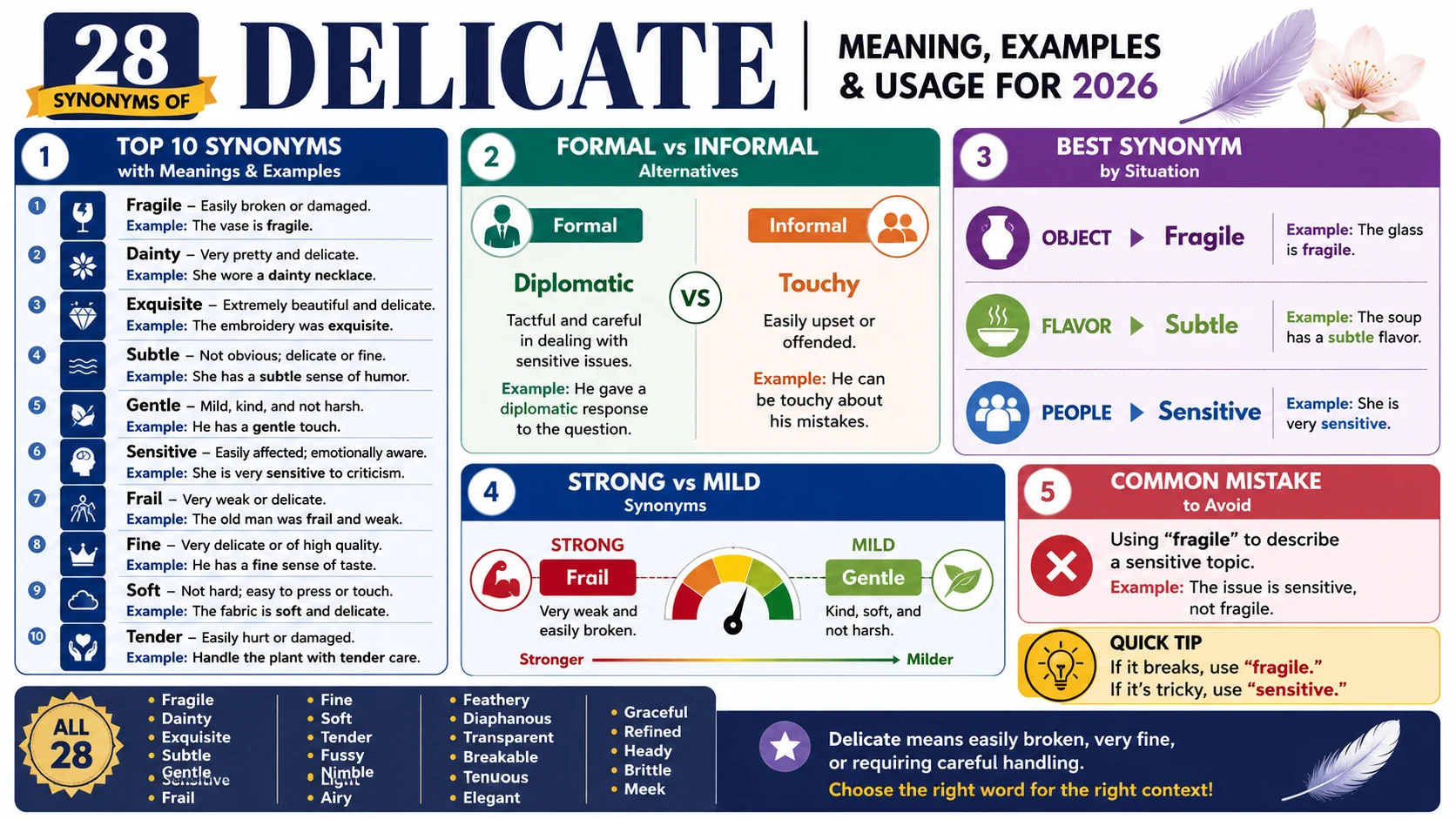
Delicate describes things that are easily broken, require careful handling, or are pleasingly subtle. The most common synonyms are fragile, dainty, exquisite, gentle, and sensitive. However, the best choice depends on whether you are describing a physical object, a situation, or a person’s feelings. Each synonym carries a slightly different tone and should be used in the appropriate context .
Why settle for the word “delicate” when a more precise word could make your writing shine? Think about it: a “delicate” situation is not the same as a “delicate” flower. Using the right synonym helps you say exactly what you mean, whether you’re writing an email, telling a story, or having a conversation.
In this article, we’ll explore the most common synonyms for “delicate.” You’ll learn what each one means, when to use it, and how to avoid common mistakes. Let’s get started.
What Does “Delicate” Mean?
Definition
In simple terms, “delicate” can mean a few different things. First, it describes things that are easily damaged or broken, like thin glass or a fragile flower . Second, it can describe things that are gentle, subtle, and pleasing, like a soft color or a mild flavor . Third, it can describe a situation that is difficult to handle because it requires tact and sensitivity . Finally, it can refer to someone’s health or feelings . In short, “delicate” means something that needs gentle care.
Pronunciation
- US IPA: /ˈdɛlɪkət/
- UK IPA: /ˈdɛlɪkət/
- Syllables: Three
- Tip: Stress the first syllable: DEL-i-kut.
Grammar
| Grammar Feature | Information |
|---|---|
| Part of Speech | Adjective |
| Common Position | Before a noun (e.g., “delicate glass”) or after a linking verb (e.g., “The situation is delicate.”) |
| Typical Pattern | Modifies nouns to describe fragility, subtlety, or complexity. |
Examples:
- She placed the delicate glass ornament on the top shelf.
- This issue is politically delicate and requires careful thought.
- The chef added a delicate hint of garlic.
Word Family
| Word | Part of Speech | Meaning |
|---|---|---|
| Delicate | Adjective | Easily broken; requiring careful handling; subtle. |
| Delicately | Adverb | In a careful or gentle way. |
| Delicacy | Noun | Fineness of texture or quality; something delicate. |
28 Synonyms of “Delicate”
1. Fragile
- Meaning: Very easily broken or damaged.
- Best Used For: Physical objects that break easily.
- Formality: Neutral
- Tone: Neutral
- Frequency: ⭐⭐⭐⭐⭐ Very Common
- CEFR Level: B1
- Example Sentence 1: Be careful! That ancient vase is incredibly fragile.
- Example Sentence 2: The insect’s wings were so fragile they looked like glass.
- Usage Tip: Use “fragile” for things that are literally breakable. It’s often written on boxes as a warning .
2. Dainty
- Meaning: Small, pretty, and delicately made .
- Best Used For: Describing small, attractive objects or graceful people.
- Formality: Neutral
- Tone: Positive
- Frequency: ⭐⭐⭐⭐ Common
- CEFR Level: B2
- Example Sentence 1: She wore a dainty silver chain around her neck.
- Example Sentence 2: The tiny cakes were almost too dainty to eat.
- Usage Tip: “Dainty” suggests something that is small, elegant, and pleasing to the eye. Don’t use it for large items .
3. Exquisite
- Meaning: Extremely beautiful and carefully made .
- Best Used For: Things that are so beautiful they impress you.
- Formality: Neutral/Formal
- Tone: Positive
- Frequency: ⭐⭐⭐⭐ Common
- CEFR Level: B2
- Example Sentence 1: The jewelry was made with exquisite workmanship.
- Example Sentence 2: They served an exquisite meal that I’ll never forget.
- Usage Tip: This is a stronger word than “beautiful.” It implies a high level of detail and craftsmanship .
4. Subtle
- Meaning: Not obvious or strong; delicate in taste, color, or meaning .
- Best Used For: Flavors, smells, colors, or differences that are slight.
- Formality: Neutral
- Tone: Neutral
- Frequency: ⭐⭐⭐⭐⭐ Very Common
- CEFR Level: B2
- Example Sentence 1: The wine has a subtle hint of oak.
- Example Sentence 2: There was a subtle change in her tone of voice.
- Usage Tip: Use “subtle” when something is understated and not in-your-face.
5. Sensitive
- Meaning: Easily damaged, hurt, or offended .
- Best Used For: People’s feelings, skin, or topics that are controversial.
- Formality: Neutral
- Formal/Neutral: Neutral
- Tone: Neutral
- Frequency: ⭐⭐⭐⭐⭐ Very Common
- CEFR Level: B1
- Example Sentence 1: This is a sensitive subject, so please be careful with your words.
- Example Sentence 2: My skin is very sensitive to the sun.
- Usage Tip: “Sensitive” is often used for emotional or interpersonal contexts, whereas “fragile” is more for physical objects.
6. Gentle
- Meaning: Mild, kind, and careful; not strong or violent .
- Best Used For: Actions, touches, or people who are kind.
- Formality: Neutral
- Tone: Positive
- Frequency: ⭐⭐⭐⭐⭐ Very Common
- CEFR Level: A2
- Example Sentence 1: She gave the baby a gentle kiss on the forehead.
- Example Sentence 2: A gentle breeze blew through the window.
- Usage Tip: Use “gentle” when describing a soft touch or a calm person. It is not used for objects that break.
7. Elegant
- Meaning: Graceful and stylish in appearance or manner .
- Best Used For: Fashion, design, and people who are graceful.
- Formality: Neutral/Formal
- Tone: Positive
- Frequency: ⭐⭐⭐⭐ Common
- CEFR Level: B1
- Example Sentence 1: She looked so elegant in her evening dress.
- Example Sentence 2: The room was decorated with elegant simplicity.
- Usage Tip: “Elegant” focuses on style and grace. It can describe a person, an object, or a solution.
8. Brittle
- Meaning: Hard but easily broken or cracked .
- Best Used For: Materials that snap easily, like glass or old bones.
- Formality: Neutral
- Tone: Neutral
- Frequency: ⭐⭐⭐ Moderate
- CEFR Level: B2
- Example Sentence 1: The old tree’s branches were dry and brittle.
- Example Sentence 2: The paint was old and brittle, flaking off at the slightest touch.
- Usage Tip: Use “brittle” when something is hard but lacks flexibility.
9. Ticklish
- Meaning: Difficult to handle; requiring careful and tactful treatment .
- Best Used For: Situations or problems that are sensitive.
- Formality: Informal
- Tone: Neutral
- Frequency: ⭐⭐⭐ Moderate
- CEFR Level: B2
- Example Sentence 1: The negotiation was a ticklish affair.
- Example Sentence 2: He’s in a ticklish position and doesn’t want to make a mistake.
- Usage Tip: This is a great word for “delicate” situations in a slightly informal context.
10. Touchy
- Meaning: Easily upset or offended; requiring careful handling .
- Best Used For: Subjects or people who are easily angered.
- Formality: Informal
- Tone: Negative
- Frequency: ⭐⭐⭐⭐ Common
- CEFR Level: B2
- Example Sentence 1: Don’t bring up politics; it’s a touchy subject.
- Example Sentence 2: He is feeling very touchy today, so be nice.
- Usage Tip: Use “touchy” to warn that a topic might cause an argument.
11. Weak
- Meaning: Lacking physical strength or power .
- Best Used For: Health, arguments, or tea/coffee.
- Formality: Neutral
- Tone: Negative
- Frequency: ⭐⭐⭐⭐⭐ Very Common
- CEFR Level: A2
- Example Sentence 1: The child was too weak to walk after the illness.
- Example Sentence 2: He made a weak excuse for being late.
- Usage Tip: “Weak” is a general word for a lack of strength, but “delicate” often has more positive connotations.
12. Frail
- Meaning: Weak and fragile, especially of a person or an object .
- Best Used For: Describing an older person or a thin object.
- Formality: Neutral
- Tone: Neutral
- Frequency: ⭐⭐⭐⭐ Common
- CEFR Level: B2
- Example Sentence 1: His grandmother is getting old and frail.
- Example Sentence 2: The chair was too frail to hold a heavy person.
- Usage Tip: “Frail” often describes a person who is weak in body or an object that is not sturdy.
13. Flimsy
- Meaning: Weakly made; lacking strength or substance .
- Best Used For: Poorly built objects or weak arguments.
- Formality: Informal
- Tone: Negative
- Frequency: ⭐⭐⭐⭐ Common
- CEFR Level: B2
- Example Sentence 1: That flimsy table will break if you stand on it.
- Example Sentence 2: His excuse was so flimsy that no one believed him.
- Usage Tip: “Flimsy” is often used critically to describe something that is not well-made or is unreliable.
14. Sickly
- Meaning: Weak and often ill .
- Best Used For: People or animals who are not healthy.
- Formality: Neutral
- Tone: Negative
- Frequency: ⭐⭐⭐ Moderate
- CEFR Level: B2
- Example Sentence 1: The plant looked sickly with its yellow leaves.
- Example Sentence 2: He was a sickly child who missed a lot of school.
- Usage Tip: Use “sickly” to describe someone who is unhealthy or a plant that is dying.
15. Diplomatic
- Meaning: Careful and tactful in dealing with people .
- Best Used For: Handling people, negotiations, or embarrassing situations.
- Formality: Formal
- Tone: Positive
- Frequency: ⭐⭐⭐⭐ Common
- CEFR Level: B2
- Example Sentence 1: He was very diplomatic when he declined her invitation.
- Example Sentence 2: A diplomatic answer can sometimes avoid a fight.
- Usage Tip: This is the formal cousin of “delicate” when referring to handling a social situation.
16. Refined
- Meaning: Elegant, cultured, and free from coarseness .
- Best Used For: Manners, tastes, or language.
- Formality: Formal
- Tone: Positive
- Frequency: ⭐⭐⭐⭐ Common
- CEFR Level: B2
- Example Sentence 1: She has very refined tastes in music and art.
- Example Sentence 2: His manners were refined and polite.
- Usage Tip: Use “refined” to describe someone sophisticated or something that is very pure.
17. Considerate
- Meaning: Careful not to hurt or inconvenience others; thoughtful .
- Best Used For: Describing people who are kind and think of others.
- Formality: Neutral
- Tone: Positive
- Frequency: ⭐⭐⭐⭐ Common
- CEFR Level: B1
- Example Sentence 1: It was very considerate of you to bring me tea.
- Example Sentence 2: A good host is always considerate of their guests’ needs.
- Usage Tip: While “delicate” can describe something fragile, “considerate” is always about people’s behavior.
18. Tender
- Meaning: Easily damaged; physically sensitive; kind .
- Best Used For: Skin, meat, emotions, and care.
- Formality: Neutral
- Tone: Positive
- Frequency: ⭐⭐⭐⭐⭐ Very Common
- CEFR Level: B1
- Example Sentence 1: My arm is still tender where I hit it.
- Example Sentence 2: This meat is incredibly tender.
- Usage Tip: “Tender” has a dual meaning—it refers to physical pain/sensitivity or a gentle emotional quality.
19. Graceful
- Meaning: Moving in a smooth and attractive way .
- Best Used For: People, animals, and their movements.
- Formality: Neutral
- Tone: Positive
- Frequency: ⭐⭐⭐⭐ Common
- CEFR Level: B1
- Example Sentence 1: The dancer was so graceful.
- Example Sentence 2: The swan had a long, graceful neck.
- Usage Tip: Use “graceful” for describing someone who is physically elegant and moves with ease.
20. Fine
- Meaning: Very good, pure, or thin; made of small particles .
- Best Used For: Details, weather, and thin objects.
- Formality: Neutral
- Tone: Positive
- Frequency: ⭐⭐⭐⭐⭐ Very Common
- CEFR Level: A2
- Example Sentence 1: The artist uses fine strokes to paint.
- Example Sentence 2: He has a fine collection of antiques.
- Usage Tip: “Fine” has many meanings. Here, it refers to something being of high quality or very thin.
21. Light
- Meaning: Not heavy or intense; gentle .
- Best Used For: Scent, sounds, rain, and objects.
- Formality: Neutral
- Tone: Neutral
- Frequency: ⭐⭐⭐⭐⭐ Very Common
- CEFR Level: A2
- Example Sentence 1: There was a light rain falling.
- Example Sentence 2: She gave him a light kiss on the cheek.
- Usage Tip: Use “light” when something is not heavy or not severe.
22. Exquisite (repeated)
- Exquisite was included at #3.
23. Muted
- Meaning: Not loud or bright; subtle .
- Best Used For: Colors, sounds, and emotional reactions.
- Formality: Neutral
- Tone: Neutral
- Frequency: ⭐⭐⭐ Moderate
- CEFR Level: B2
- Example Sentence 1: The room was decorated in muted shades of blue and gray.
- Example Sentence 2: The crowd responded with muted applause.
- Usage Tip: Use “muted” to describe something that has been toned down.
24. Pastel
- Meaning: A soft, pale shade of a color .
- Best Used For: Colors in art, fashion, and design.
- Formality: Neutral
- Tone: Positive
- Frequency: ⭐⭐⭐⭐ Common
- CEFR Level: A2
- Example Sentence 1: The baby’s room was painted in pastel colors.
- Example Sentence 2: She wore a beautiful pastel pink dress.
- Usage Tip: Use “pastel” specifically for light, gentle colors.
25. Weak (repeated)
- Weak was included at #11.
26. Ailing
- Meaning: Suffering from illness .
- Best Used For: People, businesses, and economies.
- Formality: Neutral
- Tone: Negative
- Frequency: ⭐⭐⭐ Moderate
- CEFR Level: B2
- Example Sentence 1: He visited his ailing grandmother in the hospital.
- Example Sentence 2: The government is trying to fix the ailing economy.
- Usage Tip: “Ailing” is a slightly formal word that implies someone is in a state of declining health.
27. Debilitated
- Meaning: Weakened by illness or injury.
- Best Used For: People who are in very poor health.
- Formality: Formal
- Tone: Negative
- Frequency: ⭐⭐ Rare
- CEFR Level: C1
- Example Sentence 1: He was debilitated by a long fever.
- Example Sentence 2: The soldier returned home debilitated.
- Usage Tip: This is a formal, strong word for a serious weakness.
28. Prudent
- Meaning: Acting with care and thought for the future .
- Best Used For: Advice, decisions, and people who are wise.
- Formality: Formal
- Tone: Positive
- Frequency: ⭐⭐⭐⭐ Common
- CEFR Level: B2
- Example Sentence 1: It would be prudent to check the weather before you go hiking.
- Example Sentence 2: She is a very prudent woman with her money.
- Usage Tip: Use “prudent” when describing wise caution.
Synonyms Comparison Table
| Synonym | Best Context | Formality | Tone | Frequency |
|---|---|---|---|---|
| Fragile | Physical objects, glass | Neutral | Neutral | ⭐⭐⭐⭐⭐ |
| Dainty | Small, attractive items | Neutral | Positive | ⭐⭐⭐⭐ |
| Exquisite | Beautiful craftsmanship | Formal | Positive | ⭐⭐⭐⭐ |
| Subtle | Flavors, differences | Neutral | Neutral | ⭐⭐⭐⭐⭐ |
| Sensitive | Feelings, skin, topics | Neutral | Neutral | ⭐⭐⭐⭐⭐ |
| Gentle | Touches, people | Neutral | Positive | ⭐⭐⭐⭐⭐ |
| Elegant | Style, fashion | Formal | Positive | ⭐⭐⭐⭐ |
| Brittle | Glass, wood | Neutral | Neutral | ⭐⭐⭐ |
| Ticklish | Difficult situations | Informal | Neutral | ⭐⭐⭐ |
| Touchy | Topics, people | Informal | Negative | ⭐⭐⭐⭐ |
| Weak | Health, arguments | Neutral | Negative | ⭐⭐⭐⭐⭐ |
| Frail | Elderly people, thin objects | Neutral | Neutral | ⭐⭐⭐⭐ |
| Flimsy | Poorly made items | Informal | Negative | ⭐⭐⭐⭐ |
| Sickly | Unhealthy people/plants | Neutral | Negative | ⭐⭐⭐ |
| Diplomatic | Handling people | Formal | Positive | ⭐⭐⭐⭐ |
| Refined | Manners, tastes | Formal | Positive | ⭐⭐⭐⭐ |
| Considerate | Kind people | Neutral | Positive | ⭐⭐⭐⭐ |
| Tender | Skin, emotions, meat | Neutral | Positive | ⭐⭐⭐⭐⭐ |
| Graceful | Movements, dancing | Neutral | Positive | ⭐⭐⭐⭐ |
Best Synonyms by Situation
Formal vs Informal Synonyms
Formal Alternatives
| Synonym | Best Used For |
|---|---|
| Diplomatic | Business writing, negotiations . |
| Refined | Academic writing, professional communication. |
| Prudent | Professional advice, financial contexts. |
Neutral Alternatives
| Synonym | Best Used For |
|---|---|
| Sensitive | Most everyday situations . |
| Fragile | Physical descriptions. |
| Subtle | Describing flavors or small changes. |
Informal Alternatives
| Synonym | Best Used For |
|---|---|
| Touchy | Friends, social media . |
| Ticklish | Casual conversation . |
| Flimsy | Critical descriptions of arguments. |
In general, use formal alternatives like “diplomatic” in professional settings and “touchy” with friends.
Strong vs Mild Synonyms
Mild
These are suitable for everyday situations.
- Gentle, Light, Fine.
Moderate
These are more expressive than the original word.
- Sensitive, Fragile, Weak.
Strong
Use these alternatives carefully. They indicate high intensity.
- Exquisite, Frail, Debilitated.
Using a “strong” word like “debilitated” implies a much more severe condition than “delicate.”
Real-Life Examples
In a Business Email:
“We need to discuss the sensitive issue of budget cuts, but I want to be diplomatic about it.”
In a Book:
“The intricate, delicate lace on her wedding dress was a testament to the seamstress’s skill.”
In a Daily Conversation:
“Be careful with that vase, it’s really fragile.”
Common Collocations
| Common Phrase | Better Alternative |
|---|---|
| delicate subject | touchy subject (informal) or sensitive issue (neutral) |
| delicate operation | intricate procedure |
| delicate health | frail health |
| delicate handling | careful handling |
Common Phrases
- Handle with delicate care: Means to treat something gently.
- Delicate condition: Usually refers to someone who is pregnant or in poor health.
Context Guide
Related Words
Near Synonyms
- Intricate: Detailed and complicated.
- Fine: Thin or high quality.
Antonyms
Related Adjectives
- Breakable: Can be broken.
- Breakable vs. Unbreakable: “Breakable” is a direct synonym for “fragile” .
Frequently Asked Questions
What is another word for “delicate”?
Depending on the context, common synonyms include fragile, dainty, exquisite, gentle, and sensitive. “Fragile” is best for physical objects, while “sensitive” is often used for people’s feelings .
Which synonym sounds the most professional?
The most professional synonym is diplomatic when referring to handling a situation . For describing items, refined or exquisite are often used in business writing.
What is the strongest synonym for “delicate”?
Strong alternatives include debilitated (for health) or exquisite (for beauty). These words suggest an extreme state.
Which synonym is best for essays?
Subtle is a great choice for writing essays because it shows you can understand fine distinctions.
What’s the difference between “fragile” and “delicate”?
All fragile things are delicate, but not all delicate things are fragile. “Delicate” can also describe a pleasant subtlety (like a flavor) or a tricky situation. “Fragile” always means easily broken .
What is the opposite of “delicate”?
The opposite (antonym) includes words like strong, sturdy, and rough . If describing a color, bold would be an antonym.
Conclusion
The word “delicate” is incredibly versatile, but using the right synonym makes your English sound much more natural and precise. Whether you choose “fragile” for a glass vase, “sensitive” for a tricky conversation, or “exquisite” for a beautiful meal, understanding the context is key.
The best way to improve your vocabulary is to practice. Try using one of these new synonyms in a sentence today. By paying attention to tone, formality, and meaning, you’ll soon be speaking and writing with greater confidence.
