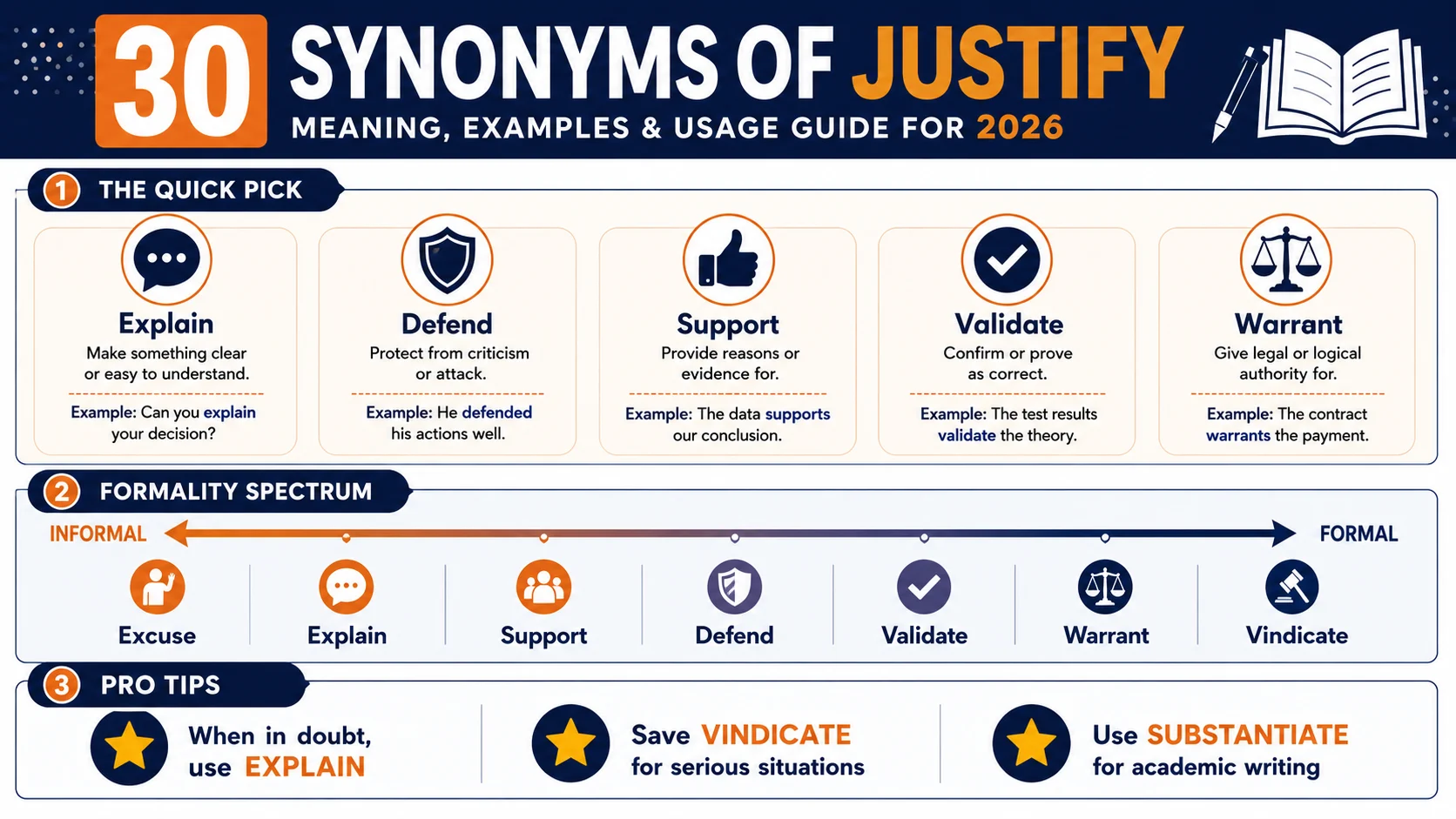
The word justify means to show that something is right, reasonable, or necessary . The best synonyms include defend, warrant, vindicate, explain, and support. In everyday conversation, native speakers often say “I can explain” or “let me defend my position” instead of using the word justify. Each synonym carries a slightly different tone, so choosing the right one depends on your situation and audience.
Top 10 Synonyms of Justify:
- Defend
- Warrant
- Vindicate
- Explain
- Support
- Excuse
- Uphold
- Validate
- Legitimize
- Rationalize
Do you ever feel like you keep using the same word over and over again? The word “justify” is a common culprit. While it’s a useful word, using it too often can make your writing sound repetitive and dull.
Learning synonyms of justify is about more than just avoiding repetition. It’s about finding the right word that perfectly captures your intended meaning and tone. Are you defending an unpopular decision? Explaining a mistake? Or proving that an idea is valid? Different situations call for different words.
In this guide, I’ll teach you the best synonyms for justify, explain exactly when and how to use them, and help you avoid common mistakes that even advanced English learners make. By the end, you’ll have a practical vocabulary toolset ready to use in your writing and conversations.
What Does “Justify” Mean?
Definition
In simple terms, justify means to give a good reason for something or to prove that something is right and reasonable . When you justify your actions, you explain why you did what you did.
For example, if you arrive late to work, you might justify your lateness by saying, “I had a flat tire.” You are providing a reason to show that your lateness was unavoidable.
Pronunciation
- US IPA: /ˈdʒʌs.tə.faɪ/
- UK IPA: /ˈdʒʌs.tɪ.faɪ/
- Syllables: 3 (JUS-ti-fy)
- Tip: Stress the first syllable. Say it like “JUS-ti-fy,” not “jus-TI-fy.”
Grammar
| Grammar Feature | Information |
|---|---|
| Part of Speech | Verb (regular) |
| Common Position | Followed by a direct object or a clause |
| Typical Pattern | justify + something / justify + doing something |
Example Sentences:
- She tried to justify her decision, but no one agreed.
- How can you justify spending so much money on a new phone?
- I don’t need to justify my choices to anyone.
Grammar Note: “Justify” is a transitive verb, which means it always needs an object. You must justify something.
Word Family
| Word | Part of Speech | Meaning |
|---|---|---|
| Justify | Verb | To show that something is right or reasonable. |
| Justification | Noun | The reason or explanation that justifies something. |
| Justified | Adjective | Having a valid reason or explanation. |
| Justifiable | Adjective | Able to be justified; reasonable. |
| Justifiably | Adverb | In a way that is reasonable and justified. |
| Unjustified | Adjective | Not having a valid reason or explanation. |
15 Synonyms of “Justify”
Defend
Meaning: To protect someone or something from criticism or attack .
Best Used For: Formal debates, conversations where someone is being blamed, and political discussions.
Formality: Neutral to Formal
Tone: Protective, Assertive
Frequency: ⭐⭐⭐⭐⭐ Very Common
CEFR Level: B1
Example Sentence 1: The lawyer had to defend his client against the serious accusations.
Example Sentence 2: I feel the need to defend my reputation after those rumors spread around the office.
Usage Tip: “Defend” is often a perfect choice when you are not just explaining an action but actively protecting someone or something from criticism. It has a stronger protective nuance than “justify.”
Warrant
Meaning: To provide an official reason or justification for an action or decision .
Best Used For: Legal contexts, official documents, and discussing whether an action is appropriate.
Formality: Formal
Tone: Authoritative, Objective
Frequency: ⭐⭐⭐ Moderate
CEFR Level: B2
Example Sentence 1: The evidence was strong enough to warrant a full investigation.
Example Sentence 2: His rude behavior does not warrant a second chance.
Usage Tip: Use “warrant” when you want to emphasize that there is enough evidence or reason for something. It often implies an official or logical justification.
Vindicate
Meaning: To prove that someone is right, free from blame, or justified, especially after doubts .
Best Used For: Formal and legal contexts, often when someone has been cleared of suspicion.
Formality: Formal
Tone: Triumphant, Vindicated
Frequency: ⭐⭐ Rare
CEFR Level: C1
Example Sentence 1: The new evidence will vindicate her and show she was telling the truth all along.
Example Sentence 2: After years of criticism, the success of the project seemed to vindicate the team’s approach.
Usage Tip: “Vindicate” is a strong word and has a very specific meaning. It’s not just about explaining a decision; it’s about being proven correct after being doubted or blamed. A common learner mistake is using it interchangeably with “justify” when the person has not been previously doubted.
Explain
Meaning: To make an idea or situation clear to someone by describing it in more detail.
Best Used For: Everyday conversations, teaching, and clarifying misunderstandings.
Formality: Neutral
Tone: Informative, Helpful
Frequency: ⭐⭐⭐⭐⭐ Very Common
CEFR Level: A2
Example Sentence 1: Can you explain why you made that decision?
Example Sentence 2: He tried to explain his actions, but his story didn’t make sense.
Usage Tip: “Explain” is the most neutral and common synonym. It focuses on making something clear, while “justify” focuses on showing something is right. Use “explain” when your goal is clarity, not defense.
Support
Meaning: To agree with and help to prove that an idea is correct or right.
Best Used For: Academic writing, debates, and discussions about opinions.
Formality: Neutral to Formal
Tone: Supportive, Collaborative
Frequency: ⭐⭐⭐⭐⭐ Very Common
CEFR Level: B1
Example Sentence 1: Can you find evidence to support your argument?
Example Sentence 2: The data from the study supports the theory that exercise improves mental health.
Usage Tip: “Support” is often a great choice in academic or professional writing when you want to say an idea is backed by evidence. It’s less defensive than “defend” and more objective.
Excuse
Meaning: To try to lessen the blame for something or to forgive someone for a fault .
Best Used For: Informal conversations, explaining mistakes.
Formality: Neutral to Informal
Tone: Apologetic, Defensive
Frequency: ⭐⭐⭐⭐ Common
CEFR Level: B1
Example Sentence 1: Nothing can excuse such rude behavior.
Example Sentence 2: Don’t try to excuse your laziness by blaming the traffic.
Usage Tip: “Excuse” often has a slightly negative or apologetic tone, suggesting that the reason might not be completely valid.
Uphold
Meaning: To support and maintain a principle, law, or decision.
Best Used For: Legal, professional, and formal contexts.
Formality: Formal
Tone: Committed, Ethical
Frequency: ⭐⭐⭐ Moderate
CEFR Level: B2
Example Sentence 1: The court decided to uphold the original verdict.
Example Sentence 2: As a manager, it is your duty to uphold the company’s policies.
Usage Tip: Use “uphold” when you are justifying a decision by appealing to a higher principle or law, not just a personal reason.
Validate
Meaning: To confirm, prove, or recognize something as true, legitimate, or valuable.
Best Used For: Professional, academic, and personal contexts.
Formality: Formal
Tone: Confirmatory, Affirming
Frequency: ⭐⭐⭐⭐ Common
CEFR Level: B2
Example Sentence 1: The test results will validate the effectiveness of the new drug.
Example Sentence 2: I need someone to validate my feelings; it’s important to feel heard and understood.
Usage Tip: “Validate” is often the best choice when you are proving the truth or legitimacy of a fact, method, or even someone’s feelings.
Rationalize
Meaning: To attempt to explain or justify behavior using logical reasons, often after the event or to hide the real motives.
Best Used For: Psychology, self-reflection, informal conversation.
Formality: Neutral to Formal
Tone: Analytical, Defensive
Frequency: ⭐⭐⭐ Moderate
CEFR Level: B2
Example Sentence 1: He tried to rationalize his anger by blaming his colleagues, but it was really his own fault.
Example Sentence 2: It’s impossible to rationalize such a cruel decision.
Usage Tip: “Rationalize” often has a negative connotation, implying that the reasons given are not the real reasons or are simply an excuse. It’s a more analytical way of saying “make excuses.”
Legitimize
Meaning: To make something legal, acceptable, or legitimate.
Best Used For: Formal contexts, discussions about laws and social issues.
Formality: Formal
Tone: Objective, Authoritative
Frequency: ⭐⭐ Rare
CEFR Level: C1
Example Sentence 1: The new government policy will legitimize the use of certain alternative medicines.
Example Sentence 2: The media should not legitimize hate speech by giving it a platform.
Usage Tip: Use “legitimize” when you are making something officially or socially acceptable, often in the context of laws or social norms.
Substantiate
Meaning: To provide evidence to support or prove the truth of a statement.
Best Used For: Academic, legal, and formal professional writing.
Formality: Formal
Tone: Objective, Evidentiary
Frequency: ⭐⭐ Rare
CEFR Level: C1
Example Sentence 1: You will need to substantiate your claim with concrete evidence.
Example Sentence 2: The witness was called to substantiate the defendant’s alibi.
Usage Tip: “Substantiate” is a powerful, academic-sounding synonym that is perfect for essays and reports when you need to emphasize providing proof.
Argue
Meaning: To give reasons or evidence to support or oppose a particular position, often in a debate.
Best Used For: Essays, debates, persuasive writing.
Formality: Neutral to Formal
Tone: Persuasive, Argumentative
Frequency: ⭐⭐⭐⭐⭐ Very Common
CEFR Level: B1
Example Sentence 1: Many environmentalists argue that we need to reduce our reliance on fossil fuels.
Example Sentence 2: I can argue my case based on the facts.
Usage Tip: “Argue” implies a more active, persuasive attempt, often in a formal debate or essay.
Assert
Meaning: To state a fact or belief confidently and forcefully, often implying a need to justify it .
Best Used For: Formal debates, public speaking, academic writing.
Formality: Formal
Tone: Confident, Forceful
Frequency: ⭐⭐⭐⭐ Common
CEFR Level: B2
Example Sentence 1: The company’s CEO asserted that the new strategy was the best way forward.
Example Sentence 2: She asserted her right to a fair trial.
Usage Tip: “Assert” is about making a strong statement, but it often implies that the speaker feels the need to justify or stand by that statement.
Maintain
Meaning: To assert something strongly and firmly as true .
Best Used For: Formal writing, legal contexts, expressing persistent beliefs.
Formality: Formal
Tone: Persistent, Resolute
Frequency: ⭐⭐⭐⭐ Common
CEFR Level: B2
Example Sentence 1: The suspect maintained his innocence throughout the trial .
Example Sentence 2: She maintains that the policy is fair, despite criticism.
Usage Tip: “Maintain” is ideal for persistently defending a position, often against opposition.
Advocate
Meaning: To publicly support or recommend a particular policy, cause, or course of action.
Best Used For: Political, social, and professional contexts.
Formality: Formal
Tone: Supportive, Active
Frequency: ⭐⭐⭐⭐ Common
CEFR Level: B2
Example Sentence 1: Many doctors advocate for a healthier diet and regular exercise.
Example Sentence 2: The group advocates for changes to the education system.
Usage Tip: “Advocate” suggests active support and public justification, often for a cause or policy.
Condone
Meaning: To accept and allow behavior that is considered morally wrong or offensive to continue.
Best Used For: Discussing ethics, behavior, social issues.
Formality: Formal
Tone: Critical, Objective
Frequency: ⭐⭐ Rare
CEFR Level: C1
Example Sentence 1: I can never condone violence of any kind.
Example Sentence 2: By ignoring the problem, they seem to condone the bullying.
Usage Tip: “Condone” is a near synonym but with a specific negative moral weight. It does not mean to justify with reasons, but to accept something bad as permissible.
Exonerate
Meaning: To officially clear someone from blame or fault.
Best Used For: Legal and formal contexts.
Formality: Formal
Tone: Officially Acquitted
Frequency: ⭐⭐ Rare
CEFR Level: C1
Example Sentence 1: The DNA evidence was enough to exonerate him after ten years in prison.
Example Sentence 2: The investigation will exonerate her of all charges.
Usage Tip: “Exonerate” is the perfect word for being proven innocent after being accused. It’s a powerful, specific synonym.
Synonyms Comparison Table
| Synonym | Best Context | Formality | Tone | Frequency |
|---|---|---|---|---|
| Explain | Everyday conversation | Neutral | Informative | ⭐⭐⭐⭐⭐ |
| Defend | Debates, Legal | Neutral/Formal | Protective | ⭐⭐⭐⭐⭐ |
| Support | Academic, Professional | Neutral/Formal | Supportive | ⭐⭐⭐⭐⭐ |
| Argue | Essays, Debates | Neutral/Formal | Persuasive | ⭐⭐⭐⭐⭐ |
| Maintain | Legal, Formal writing | Formal | Resolute | ⭐⭐⭐⭐ |
| Advocate | Social, Political contexts | Formal | Active | ⭐⭐⭐⭐ |
| Validate | Professional, Academic | Formal | Confirmatory | ⭐⭐⭐⭐ |
| Excuse | Informal conversation | Neutral/Informal | Apologetic | ⭐⭐⭐⭐ |
| Warrant | Legal, Official contexts | Formal | Authoritative | ⭐⭐⭐ |
| Uphold | Legal, Professional | Formal | Committed | ⭐⭐⭐ |
| Rationalize | Psychology, Self-reflection | Neutral/Formal | Analytical | ⭐⭐⭐ |
| Substantiate | Legal, Academic | Formal | Evidentiary | ⭐⭐ |
| Vindicate | Legal, Formal | Formal | Triumphant | ⭐⭐ |
| Legitimize | Legal, Social issues | Formal | Objective | ⭐⭐ |
| Exonerate | Legal contexts | Formal | Acquitted | ⭐⭐ |
Best Synonyms by Situation
| Situation | Best Synonym | Why It Works |
|---|---|---|
| Daily Conversation | Explain / Excuse | These are neutral and natural, perfect for everyday chats without sounding too formal or defensive. |
| Business Email | Support / Validate | They sound professional and objective, focusing on data and reasoning rather than being defensive. |
| Academic Writing | Substantiate / Argue | These demonstrate critical thinking and the use of evidence, which is valued in academic work. |
| Professional Meeting | Defend / Advocate | These show confidence and active support for your ideas in a professional setting. |
| Creative Writing | Rationalize / Vindicate | These add emotional depth and narrative complexity to your characters’ motivations. |
| Social Media | Support / Explain | These are direct and clear, which works best on social media. |
Formal vs Informal Synonyms
Formal Alternatives
| Synonym | Best Used For |
|---|---|
| Warrant | Legal documents, official justifications |
| Vindicate | Legal contexts, clearing someone’s name |
| Uphold | Ethical, legal, or professional principles |
| Validate | Professional and academic proof |
| Substantiate | Academic papers, legal arguments |
| Legitimize | Official recognition, social changes |
Neutral Alternatives
| Synonym | Best Used For |
|---|---|
| Explain | Teaching, clarifying misunderstandings |
| Support | Debates, discussions, professional writing |
| Defend | Protecting an idea or person from criticism |
| Argue | Essays, persuasive situations |
Informal Alternatives
| Synonym | Best Used For |
|---|---|
| Excuse | Casual conversations, explaining minor mistakes |
| Rationalize | Self-talk, explaining behavior to friends |
| Come up with a reason | General conversational use |
Choosing the Right Level of Formality: A good rule of thumb is to choose “explain” or “support” when you’re unsure. They work in almost any setting.
Strong vs Mild Synonyms
Mild Alternatives
- Explain (Making something clear)
- Support (Backing up a point)
Moderate Alternatives
- Defend (Protecting against criticism)
- Argue (Making a case)
Strong Alternatives
- Vindicate (Proving someone right after doubt)
- Exonerate (Officially clearing from blame)
- Warrant (Providing official justification)
Understanding intensity helps you choose the exact right word. Mild synonyms are good for simple situations, while strong synonyms are for formal or serious contexts.
Real-Life Examples
In the Office:
“Our project was over budget, so I had to defend our team’s spending at the meeting. I showed that the costs were necessary.”
In a Business Email:
“The data from our recent campaign supports the need for a revised marketing strategy.”
In a Formal Presentation:
“To substantiate this claim, I will now present data from three independent studies.”
In a Daily Conversation:
“I can’t excuse her behavior, but I understand why she was upset.”
In a Legal Context:
“The new witness testimony will likely vindicate the defendant.”
Common Collocations
| Common Phrase | Better Alternative |
|---|---|
| Justify your actions | Explain your actions / Defend your actions |
| Justify the cost | Warrant the cost / Validate the cost |
| Justify a decision | Support a decision / Uphold a decision |
Common Phrases
- “To justify oneself” – To give reasons for one’s actions. Better alternative: “To explain oneself” is more neutral and common.
- “The ends justify the means” – A famous saying meaning a bad action is okay if it leads to a good result. Better alternative: Be careful with this phrase; it’s a specific idiom.
Context Guide
| Situation | Best Synonym | Reason |
|---|---|---|
| Essay | Substantiate / Argue | Shows use of evidence and persuasive reasoning. |
| Speech | Defend / Advocate | Engages the audience and shows conviction. |
| Business Email | Support / Validate | Sounds professional and objective. |
| Novel | Rationalize / Vindicate | Adds depth to characters’ motivations and plot. |
| Presentation | Warrant / Support | Appeals to logic and evidence. |
| Conversation | Explain / Excuse | Sounds natural and not overly formal. |
| Marketing Copy | Validate / Support | Builds trust with the customer. |
Related Words
Near Synonyms
- Justness (n.) – The quality of being just or fair.
- Reasonableness (n.) – The state of being based on reason.
Antonyms
- Condemn (v.)
- Disprove (v.)
- Refute (v.)
- Undermine (v.)
Related Adjectives
- Justified (adj.) – Having a good reason.
- Unjustified (adj.) – Without a good reason.
- Justifiable (adj.) – Able to be justified.
Related Nouns
- Justification (n.) – A reason or explanation.
- Justice (n.) – Fairness and reasonableness.
Related Verbs
- Excuse (v.) – To overlook or forgive.
- Pardon (v.) – To forgive.
Frequently Asked Questions
What is another word for justify?
Another word for justify is explain, defend, or support. The best choice depends on the context. Explain is best for clarity, defend is best when facing criticism, and support is best when providing evidence .
Which synonym for justify sounds the most professional?
The most professional synonyms are warrant, substantiate, and validate. These are formal, objective, and often used in business or legal contexts. “Substantiate” is excellent for academic and professional writing .
What is the strongest synonym for justify?
The strongest synonyms are vindicate and exonerate. They imply being proven right or cleared of blame after doubts or accusations . They are powerful words best used in formal or legal contexts.
Which synonym for justify is best for essays?
For essays, substantiate and argue are excellent choices. They demonstrate a strong, evidence-based approach. “Substantiate” focuses on providing proof, while “argue” is about building a case.
What is the difference between “justify” and “rationalize”?
“Justify” means to show something is right based on good reasons. “Rationalize” often means to make excuses after the fact, sometimes hiding the real motive. Rationalizing has a slightly negative or defensive connotation.
What is the most common synonym for justify in everyday English?
The most common and natural synonym in everyday conversation is explain. It’s neutral, clear, and commonly used. If you are defending something, defend is also very common in daily speech.
What is the opposite of justify?
The opposite of justify is to condemn, disprove, or refute. These words mean to criticize, prove wrong, or argue against an action or idea.
Is “excuse” a synonym for justify?
Yes, “excuse” is a synonym. However, it often carries a more apologetic or defensive tone. If you want a more neutral tone, “explain” is often a better, more neutral choice .
Conclusion
So, there you have it: a comprehensive guide to the many synonyms for justify. We’ve seen that while “justify” is a useful word, using synonyms like explain, defend, support, validate, and substantiate can significantly improve your English writing and speaking.
The key takeaway is to think about context. Are you trying to be clear and neutral? Use explain. Are you under attack? Use defend or vindicate. Are you writing a formal report? Use substantiate or warrant.
Don’t be afraid to experiment with these new words. Try using one or two new synonyms in your writing this week. The more you use them, the more natural they will feel. With practice, you’ll be able to choose the perfect word every time, making your English more precise and impressive.
