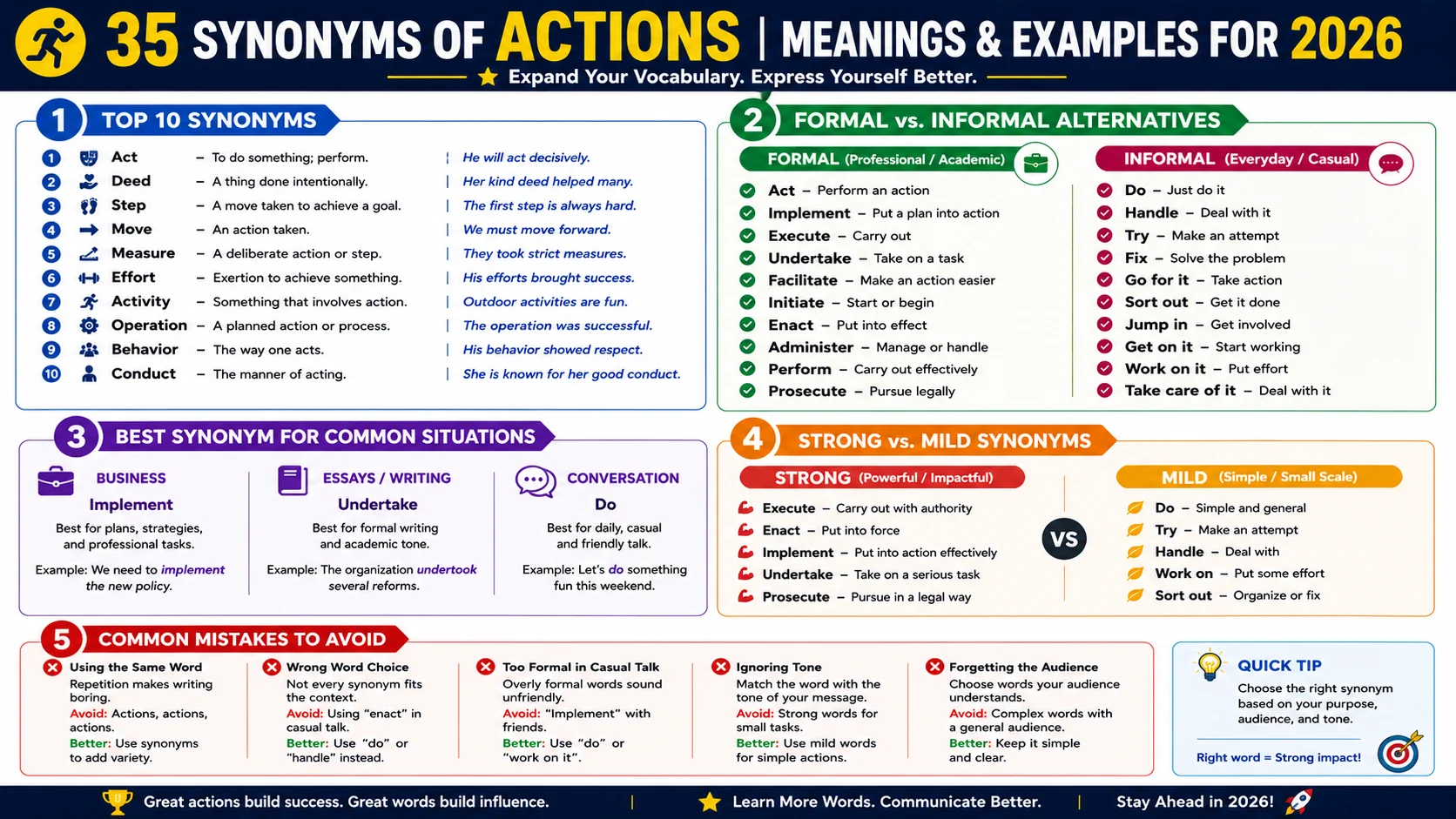
“Actions” means things that people do. The best synonyms are deeds, activities, moves, steps, and undertakings. “Deeds” is the most common natural alternative. Each synonym has a slightly different meaning and context where it fits best.
Top 10 Synonyms
- Deeds
- Activities
- Moves
- Steps
- Undertakings
- Efforts
- Operations
- Procedures
- Performances
- Works
“Actions” is a word we use constantly. We talk about our actions, the actions of others, and the consequences of actions. It’s useful, but using it too often can make your English feel repetitive.
Think about it. You can talk about heroic actions, business actions, legal actions, or everyday actions. Each situation might need a different word that captures the specific type of action.
In this guide, you’ll learn 35 powerful synonyms for “actions.” You’ll discover exactly when to use each one, how formal they are, and what common mistakes to avoid. Let’s begin!
What Does “Actions” Mean?
Definition
Actions” means things that people do, the way they behave, or the process of doing something. It can refer to physical movements, decisions, or any activity. When we talk about actions, we’re talking about what someone does.
Pronunciation
| Feature | Value |
|---|---|
| US IPA | /ˈækʃənz/ |
| UK IPA | /ˈækʃənz/ |
| Syllables | 2 (ac-tions) |
| Tip | Stress the first syllable: “AK-shunz” |
Grammar
| Grammar Feature | Information |
|---|---|
| Part of Speech | Noun (plural) |
| Common Position | Subject or object |
| Typical Pattern | Actions + of + someone / Someone’s + actions |
Examples:
- “His actions spoke louder than words.”
- “We are responsible for our actions.”
- “The actions of the government were criticized.”
Grammar Note: “Actions” is almost always plural. The singular “action” is also used, but “actions” is more common for things people do.
Word Family
| Word | Part of Speech | Meaning |
|---|---|---|
| Act | Verb/Noun | To do something |
| Action | Noun | The process of doing |
| Actions | Noun (plural) | Things done |
| Active | Adjective | Doing things |
| Activity | Noun | Things people do |
15 Synonyms of “Actions”
Deeds
Meaning: Things that someone does, especially good or important things.
Best Used For: Heroic actions, moral actions, notable achievements.
Formality: Formal
Tone: Noble, Important
Frequency: ⭐⭐⭐⭐ (Common)
CEFR Level: B2
Example Sentence 1: “His heroic deeds saved many lives.”
Example Sentence 2: “We are judged by our deeds, not our words.”
Usage Tip: “Deeds” suggests important, often good actions. Use it for memorable or significant actions.
Common Confusion: Deeds vs Actions. “Deeds” often has a more formal, literary feel and suggests importance.
Activities
Meaning: Things people do, especially for fun or as part of daily life.
Best Used For: Hobbies, work tasks, daily routines.
Formality: Neutral
Tone: Practical, Everyday
Frequency: ⭐⭐⭐⭐⭐ (Very Common)
CEFR Level: A2
Example Sentence 1: “She enjoys outdoor activities like hiking.”
Example Sentence 2: “The school offers many after-school activities.”
Usage Tip: “Activities” is great for everyday things people do. Use it for hobbies, routines, and tasks.
Moves
Meaning: Actions taken to achieve something, often in games or business.
Best Used For: Strategy, games, business decisions.
Formality: Neutral
Tone: Strategic, Decisive
Frequency: ⭐⭐⭐⭐ (Common)
CEFR Level: B2
Example Sentence 1: “The chess player made several smart moves.”
Example Sentence 2: “The company’s latest moves surprised everyone.
Usage Tip: “Moves” suggests strategic action. Use it for decisions in games, business, or competition.
Steps
Meaning: Individual actions that are part of a process.
Best Used For: Instructions, processes, procedures.
Formality: Neutral
Tone: Practical, Systematic
Frequency: ⭐⭐⭐⭐⭐ (Very Common)
CEFR Level: A2
Example Sentence 1: “Follow these steps to complete the task.
Example Sentence 2: “We need to take steps to solve the problem.”
Usage Tip: “Steps” is perfect for breaking down a process into individual actions.
Undertakings
Meaning: Important tasks or projects that require effort.
Best Used For: Large projects, business ventures, ambitious goals.
Formality: Formal
Tone: Ambitious, Serious
Frequency: ⭐⭐⭐ (Moderate)
CEFR Level: C1
Example Sentence 1: “The construction was a massive undertaking.”
Example Sentence 2: “Her latest undertaking is writing a book.”
Usage Tip: “Undertakings” suggests significant, ambitious projects. Use it for big efforts.
Efforts
Meaning: Actions that require energy and work.
Best Used For: Trying hard, working toward goals.
Formality: Neutral
Tone: Hardworking, Determined
Frequency: ⭐⭐⭐⭐⭐ (Very Common)
CEFR Level: B1
Example Sentence 1: “Her efforts paid off in the end.”
Example Sentence 2: “We appreciate all your efforts.”
Usage Tip: “Efforts” emphasizes the work and energy behind actions.
Operations
Meaning: Actions or processes that are part of work or business.
Best Used For: Business, military, medicine.
Formality: Formal
Tone: Professional, Systematic
Frequency: ⭐⭐⭐⭐ (Common)
CEFR Level: B2
Example Sentence 1: “The company’s operations run smoothly.”
Example Sentence 2: “The military operation was a success.”
Usage Tip: “Operations” is a formal word for organized, professional activities.
Procedures
Meaning: The official way of doing something.
Best Used For: Instructions, official processes.
Formality: Formal
Tone: Systematic, Official
Frequency: ⭐⭐⭐ (Moderate)
CEFR Level: B2
Example Sentence 1: “Follow the safety procedures at all times.”
Example Sentence 2: “The hiring procedures are strict.”
Usage Tip: “Procedures” suggests official, standardized actions. Use it for formal processes.
Performances
Meaning: Actions done to entertain or complete a task.
Best Used For: Shows, work evaluations, duties.
Formality: Neutral
Tone: Evaluative, Active
Frequency: ⭐⭐⭐⭐ (Common)
CEFR Level: B2
Example Sentence 1: “The actor’s performance was excellent.”
Example Sentence 2: “Her work performance has improved.”
Usage Tip: “Performances” can refer to entertainment or how well someone does their job.
Works
Meaning: Things produced by action, or actions themselves.
Best Used For: Physical labor, art, accomplishments.
Formality: Neutral
Tone: Active, Productive
Frequency: ⭐⭐⭐⭐⭐ (Very Common)
CEFR Level: A2
Example Sentence 1: “The charity does important works.
Example Sentence 2: “His works have inspired many people.”
Usage Tip: “Works” can mean actions or the results of actions.
Transactions
Meaning: Actions involving buying, selling, or exchanging things.
Best Used For: Business, finance, legal contexts.
Formality: Formal
Tone: Business-like, Official
Frequency: ⭐⭐⭐ (Moderate)
CEFR Level: B2
Example Sentence 1: “The company recorded many transactions today.”
Example Sentence 2: “Online transactions are secure.”
Usage Tip: “Transactions” is specific to business and financial exchanges.
Maneuvers
Meaning: Planned actions to achieve something.
Best Used For: Military, strategy, skill-based activities.
Formality: Formal
Tone: Strategic, Skillful
Frequency: ⭐⭐⭐ (Moderate)
CEFR Level: C1
Example Sentence 1: “The pilot performed several maneuvers.”
Example Sentence 2: “His political maneuvers were clever.”
Usage Tip: “Maneuvers” suggests skillful, strategic actions.
Measures
Meaning: Actions taken to achieve a purpose.
Best Used For: Safety, prevention, control.
Formality: Formal
Tone: Preventive, Serious
Frequency: ⭐⭐⭐ (Moderate)
CEFR Level: B2
Example Sentence 1: “We need to take safety measures.”
Example Sentence 2: “The government introduced new measures.”
Usage Tip: “Measures” suggests actions taken for a purpose, often for safety or control.
Exploits
Meaning: Brave or impressive actions.
Best Used For: Heroic achievements, adventures.
Formality: Formal/Literary
Tone: Heroic, Impressive
Frequency: ⭐⭐ (Rare)
CEFR Level: C1
Example Sentence 1: “His exploits became legendary.”
Example Sentence 2: “The book describes her daring exploits.”
Usage Tip: “Exploits” is a literary word for brave, impressive actions.
Engagements
Meaning: Actions involving participation or commitment.
Best Used For: Events, meetings, commitments.
Formality: Formal
Tone: Committed, Planned
Frequency: ⭐⭐⭐ (Moderate)
CEFR Level: C1
Example Sentence 1: “She has many social engagements.”
Example Sentence 2: “His military engagements were numerous.”
Usage Tip: “Engagements” suggests planned or committed actions.
Synonyms Comparison Table
| Synonym | Best Context | Formality | Tone | Frequency |
|---|---|---|---|---|
| Activities | Everyday things | Neutral | Practical | ⭐⭐⭐⭐⭐ |
| Efforts | Hard work | Neutral | Determined | ⭐⭐⭐⭐⭐ |
| Steps | Process parts | Neutral | Systematic | ⭐⭐⭐⭐⭐ |
| Works | Accomplishments | Neutral | Productive | ⭐⭐⭐⭐⭐ |
| Deeds | Important actions | Formal | Noble | ⭐⭐⭐⭐ |
| Operations | Professional work | Formal | Professional | ⭐⭐⭐⭐ |
| Moves | Strategic decisions | Neutral | Strategic | ⭐⭐⭐⭐ |
| Undertakings | Large projects | Formal | Ambitious | ⭐⭐⭐ |
| Procedures | Official ways | Formal | Systematic | ⭐⭐⭐ |
| Measures | Safety, control | Formal | Preventive | ⭐⭐⭐ |
Best Synonyms by Situation
| Situation | Best Synonym | Why It Works |
|---|---|---|
| Daily Conversation | Activities | Natural and common |
| Business Email | Steps/Operations | Professional and clear |
| Academic Writing | Undertakings | Formal and precise |
| School Assignment | Steps | Clear and simple |
| Professional Meeting | Measures | Sounds serious |
| Presentation | Moves | Strategic and clear |
| Creative Writing | Deeds | Adds literary depth |
| Social Media | Moves | Casual and engaging |
| Heroic Stories | Exploits | Impressive and dramatic |
Formal vs Informal Synonyms
Formal Alternatives
| Synonym | Best Used For |
|---|---|
| Undertakings | Large projects |
| Operations | Business or military |
| Procedures | Official processes |
| Transactions | Business exchanges |
| Maneuvers | Strategic actions |
| Engagements | Commitments |
Neutral Alternatives
| Synonym | Best Used For |
|---|---|
| Activities | Most everyday situations |
| Steps | Process parts |
| Efforts | Work and trying |
| Moves | Strategic decisions |
Informal Alternatives
| Synonym | Best Used For |
|---|---|
| Things | Very casual contexts |
| Stuff | Very casual contexts |
| Moves | Games, business slang |
Choosing the Right Level: Use “undertakings” and “operations” for formal writing. Use “activities” and “steps” for most situations. Use “moves” in casual conversations.
Strong vs Mild Synonyms
Mild
Suitable for everyday situations with less intensity.
- Activities
- Steps
- Things
Moderate
More significant or organized alternatives.
- Efforts
- Moves
- Measures
- Works
Strong
High-intensity alternatives suggesting importance or heroism.
- Deeds (important actions)
- Exploits (heroic actions)
- Undertakings (large projects)
- Maneuvers (strategic actions)
How Intensity Changes Meaning: “He took some steps” is simple. “He performed heroic deeds” sounds much more impressive. Choose stronger words when you want to emphasize significance.
Real-Life Examples
School: “The students’ actions during the fire drill were excellent.”
Office: “We need to take steps to improve productivity.”
Business Email: “Please outline the procedures for the new system.”
Meetings: “The company’s moves in the market were strategic.”
Presentations: “Her efforts led to the project’s success.”
Daily Conversations: “What activities do you enjoy on weekends?”
Social Media: “Check out my latest moves in the gym!”
Academic Writing: “The undertakings of the research team were monumental.”
Common Collocations
| Common Phrase | Better Alternative |
|---|---|
| Take action | Take steps |
| Actions speak louder | Deeds speak louder |
| Legal actions | Legal proceedings |
| Everyday actions | Everyday activities |
| Heroic actions | Heroic deeds |
Common Phrases
Actions speak louder than words: What you do matters more than what you say. (e.g., “Remember, actions speak louder than words.”)
Put into action: To start doing something. (e.g., “We put our plan into action.”)
A man of action: Someone who does things rather than just talking. (e.g., “He’s a man of action.”)
Take action: To start doing something. (e.g., “We need to take action now.”)
Course of action: A way of doing things. (e.g., “What course of action should we take?”)
Context Guide
| Situation | Best Synonym | Reason |
|---|---|---|
| Essay | Undertakings | Academic and formal |
| Speech | Deeds | Inspiring and noble |
| Business Email | Steps/Procedures | Professional and clear |
| Novel | Exploits | Adds literary depth |
| Presentation | Moves | Strategic and clear |
| Conversation | Activities | Natural and relatable |
| Academic Writing | Undertakings | Precise and formal |
| Marketing Copy | Moves | Engaging and modern |
Related Words
Near Synonyms
- Doings: Things people do (informal).
- Actions: Things done.
- Behavior: The way someone acts.
- Conduct: How someone behaves.
- Activities: Things people do.
Antonyms
- Inaction: Not doing anything.
- Passivity: Not taking action.
- Idleness: Being inactive.
- Rest: Not doing anything.
- Inactivity: Not being active.
Related Adjectives
- Active: Doing things.
- Energetic: Full of energy.
- Proactive: Taking action in advance.
- Decisive: Making decisions quickly.
Related Nouns
- Action: The process of doing.
- Activity: Things people do.
- Effort: Work and energy.
- Move: A specific action.
- Step: A single action in a process.
Related Verbs
- Act: To do something.
- Do: To perform an action.
- Perform: To carry out.
- Execute: To carry out plans.
- Undertake: To begin a task.
Frequently Asked Questions
What is another word for actions?
Common synonyms include deeds, activities, moves, steps, and undertakings. “Deeds” is a common alternative, but “activities” is often more natural.
Which synonym sounds the most professional?
Operations and procedures sound very professional. “Undertakings” is also excellent for formal contexts.
What is the strongest synonym for actions?
Exploits and deeds are among the strongest synonyms. They suggest important, often heroic actions.
Which synonym is best for essays?
Undertakings is the best choice for academic essays. It’s formal and precise.
What’s the difference between actions and deeds?
“Actions” is more general. “Deeds” often suggests important or good actions and has a more formal feel.
Which synonym is most common in everyday English?
“Activities” and “steps” are very common in everyday speech. “Efforts” is also frequently used.
What is the opposite of actions?
Common opposites are inaction, passivity, and inactivity. These words describe not doing anything.
Conclusion
“Actions” is a useful word, but now you have 35 fantastic alternatives. Each synonym adds a different shade of meaning to your language.
Remember, the key is understanding the context. Use “activities” for everyday things. Use “steps” for processes. Use “deeds” for important actions. Use “undertakings” for large projects.
The best way to improve is practice. Try using one or two new synonyms each day. Listen for these words in conversations and books. Your vocabulary will become richer and more expressive with time.
