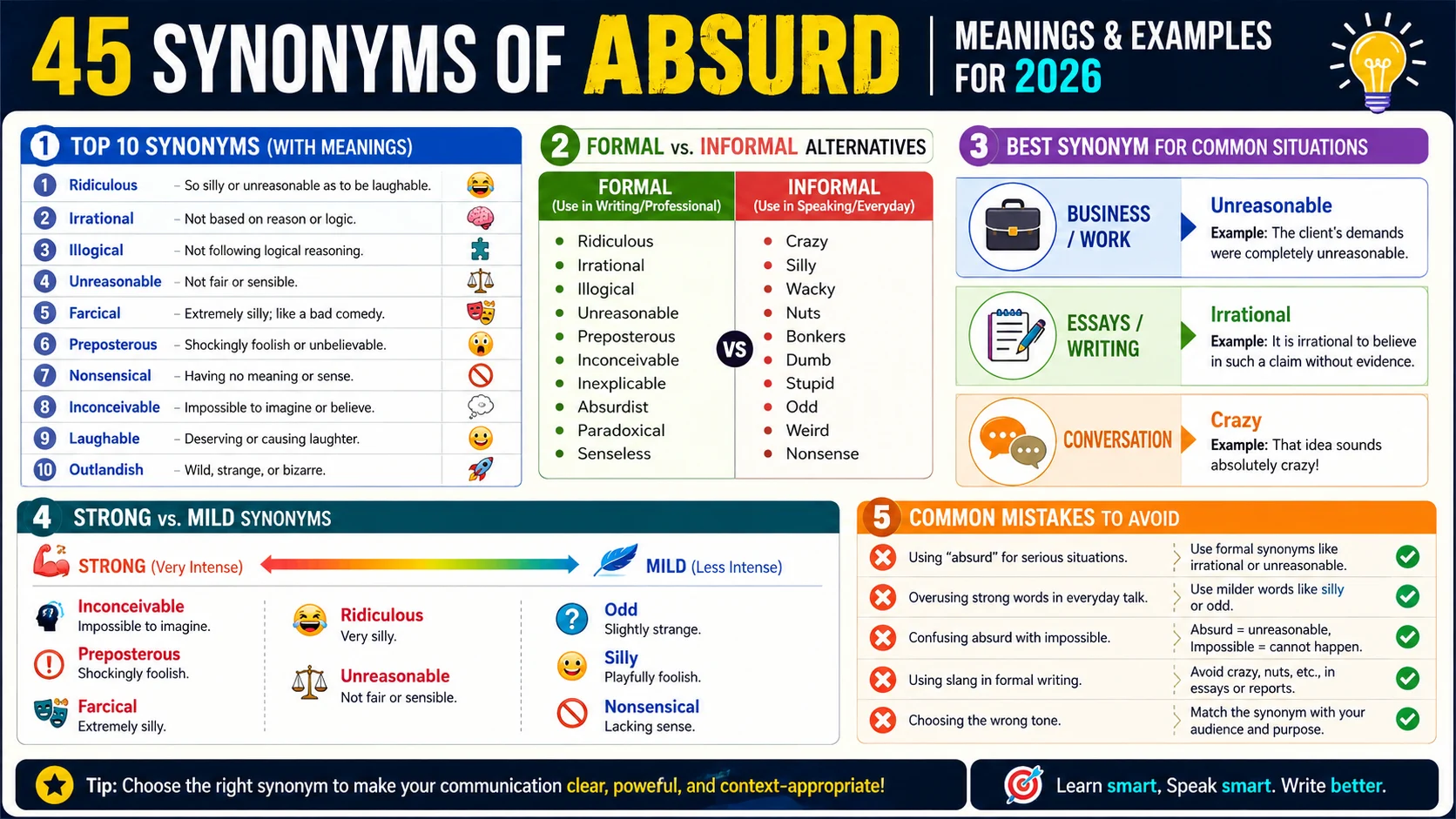
“Absurd” means something is completely ridiculous, unreasonable, or illogical. The best synonyms are ridiculous, preposterous, ludicrous, nonsensical, and outrageous. “Ridiculous” is the most common natural alternative. Each synonym has a slightly different meaning and context where it fits best.
Top 10 Synonyms
- Ridiculous
- Preposterous
- Ludicrous
- Nonsensical
- Outrageous
- Foolish
- Silly
- wild
- Unreasonable
- Absurd
“Absurd” is a great word for describing things that are completely illogical or ridiculous. But using it too often can make your English feel repetitive and one-dimensional.
Think about it. You can call a ridiculous idea absurd. You can call an outrageous price absurd. You can call a silly excuse absurd. Each situation might need a different word that captures the exact type of nonsense.
In this guide, you’ll learn 35 powerful synonyms for “absurd.” You’ll discover exactly when to use each one, how formal they are, and what common mistakes to avoid. Let’s begin!
What Does “Absurd” Mean?
Definition
“Absurd” means something is completely unreasonable, illogical, or ridiculous. It describes ideas, situations, or actions that make no sense at all. When something is absurd, it’s so silly or unreasonable that it’s hard to take seriously.
Pronunciation
| Feature | Value |
|---|---|
| US IPA | /əbˈsɜrd/ |
| UK IPA | /əbˈsɜːd/ |
| Syllables | 2 (ab-surd) |
| Tip | Stress the second syllable: “ub-SURD” |
Grammar
| Grammar Feature | Information |
|---|---|
| Part of Speech | Adjective |
| Common Position | Before a noun or after a linking verb |
| Typical Pattern | Absurd + noun / Subject + be + absurd |
Examples:
- “That is an absurd idea.” (before noun)
- “His explanation was completely absurd.” (after verb)
- “She made an absurd demand.” (before noun)
Grammar Note: “Absurd” is a strong adjective. It can be used with words like “completely,” “utterly,” and “totally” to make it stronger.
Word Family
| Word | Part of Speech | Meaning |
|---|---|---|
| Absurd | Adjective | Completely unreasonable or ridiculous |
| Absurdly | Adverb | In an absurd way |
| Absurdity | Noun | The quality of being absurd |
| Absurdities | Noun (plural) | Ridiculous things or ideas |
15 Synonyms of “Absurd”
Ridiculous
Meaning: Deserving to be laughed at because it’s so silly or unreasonable.
Best Used For: Everyday situations, bad ideas, funny situations.
Formality: Neutral
Tone: Funny, Silly
Frequency: ⭐⭐⭐⭐⭐ (Very Common)
CEFR Level: A2
Example Sentence 1: “The price of that handbag is absolutely ridiculous.”
Example Sentence 2: “He made a ridiculous excuse for being late.”
Usage Tip: “Ridiculous” is the most common and natural synonym. Use it for anything that’s laughably silly or unreasonable.
Common Confusion: Ridiculous vs Absurd. “Ridiculous” often has a funny, laughable quality. “Absurd” is more about being illogical.
Preposterous
Meaning: Completely unreasonable and impossible to believe.
Best Used For: Formal writing, strong disbelief, shocking situations.
Formality: Formal
Tone: Shocking, Unbelievable
Frequency: ⭐⭐⭐ (Moderate)
CEFR Level: C1
Example Sentence 1: “The idea that we could finish in one day is preposterous.”
Example Sentence 2: “His preposterous claims were quickly disproven.
Usage Tip: “Preposterous” is a formal word for something so unreasonable it’s impossible to believe.
Ludicrous
Meaning: So foolish or unreasonable that it’s funny.
Best Used For: Situations, arguments, plans.
Formality: Formal
Tone: Funny, Unbelievable
Frequency: ⭐⭐⭐ (Moderate)
CEFR Level: C1
Example Sentence 1: “The plan to build a bridge in a week was ludicrous.
Example Sentence 2: “She made a ludicrous suggestion at the meeting.”
Usage Tip: “Ludicrous” is similar to “ridiculous” but slightly more formal. It suggests something is laughably foolish.
Nonsensical
meaning: Having no meaning or sense; not logical.
Best Used For: Statements, arguments, ideas.
Formality: Formal
Tone: Illogical, Confusing
Frequency: ⭐⭐⭐ (Moderate)
CEFR Level: B2
Example Sentence 1: “His argument was completely nonsensical.
Example Sentence 2: “The nonsensical rules made no sense to anyone.”
Usage Tip: “Nonsensical” focuses on the lack of logic or meaning. Use it for confusing statements.
Outrageous
Meaning: Shocking and extremely unreasonable.
Best Used For: Prices, behavior, claims.
Formality: Neutral
Tone: Shocking, Extreme
Frequency: ⭐⭐⭐⭐ (Common)
CEFR Level: B2
Example Sentence 1: “The price of that house is outrageous.”
Example Sentence 2: “His outrageous behavior shocked everyone.”
Usage Tip: “Outrageous” suggests something is so extreme it’s shocking. It’s a strong, emotional word.
Foolish
Meaning: Lacking good sense or judgment.
Best Used For: Actions, decisions, people.
Formality: Neutral
Tone: Silly, Unwise
Frequency: ⭐⭐⭐⭐ (Common)
CEFR Level: A2
Example Sentence 1: “It was foolish to spend all his money on a car.”
Example Sentence 2: “She made a foolish mistake.”
Usage Tip: “Foolish” suggests a lack of wisdom or common sense. It’s less extreme than “absurd.”
Silly
Meaning: Showing a lack of good sense; foolish.
Best Used For: Children, jokes, minor mistakes.
Formality: Informal
Tone: Playful, Light
Frequency: ⭐⭐⭐⭐⭐ (Very Common)
CEFR Level: A2
Example Sentence 1: “Don’t ask such silly questions.”
Example Sentence 2: “She wore a silly hat to the party.”
Usage Tip: “Silly” is informal and often playful. Use it for minor foolishness, not serious situations.
wild
Meaning: Extremely foolish or irrational.
Best Used For: Ideas, plans, people (informal).
Formality: Informal
Tone: Strong, Casual
Frequency: ⭐⭐⭐⭐⭐ (Very Common)
CEFR Level: A2
Example Sentence 1: “That’s a wild idea.”
Example Sentence 2: “She must be wild to do that.”
Usage Tip: “wild” is very common in casual speech. Use it for wild ideas or plans. Be careful—it can be offensive in some contexts.
Unreasonable
Meaning: Not based on good sense or fairness.
Best Used For: Demands, expectations, behavior.
Formality: Neutral
Tone: Unfair, Demanding
Frequency: ⭐⭐⭐⭐ (Common)
CEFR Level: B1
Example Sentence 1: “His demands were completely unreasonable.
Example Sentence 2: “You’re being unreasonable about this.”
Usage Tip: “Unreasonable” suggests something is not fair or sensible. It’s less extreme than “absurd.”
Irrational
Meaning: Not based on reason or logic.
Best Used For: Fears, beliefs, behavior.
Formality: Formal
Tone: Logical, Analytical
Frequency: ⭐⭐⭐ (Moderate)
CEFR Level: B2
Example Sentence 1: “His fear of spiders is irrational.”
Example Sentence 2: “Irrational thinking leads to bad decisions.
Usage Tip: “Irrational” is a logical word. Use it for things that go against reason.
Inane
meaning: Silly and without meaning.
Best Used For: Comments, questions, conversation.
Formality: Formal
Tone: Pointless, Silly
Frequency: ⭐⭐ (Rare)
CEFR Level: C1
Example Sentence 1: “She made an inane comment about the weather.”
Example Sentence 2: “I couldn’t listen to his inane chatter.”
Usage Tip: “Inane” is a formal word for something that’s empty of meaning or intelligence.
Absurdist
Meaning: Related to the philosophy that life is meaningless and illogical.
Best Used For: Literature, philosophy, theater.
Formality: Formal
Tone: Philosophical, Literary
Frequency: ⭐ (Very Rare)
CEFR Level: C1
Example Sentence 1: “The play had an absurdist quality.”
Example Sentence 2: “He was interested in absurdist philosophy.”
Usage Tip: “Absurdist” is a very specific term used in literature and philosophy.
Far-fetched
Meaning: Not likely to be true; difficult to believe.
Best Used For: Stories, excuses, explanations.
Formality: Neutral
Tone: Unbelievable
Frequency: ⭐⭐⭐ (Moderate)
CEFR Level: B2
Example Sentence 1: “His explanation was far-fetched.”
Example Sentence 2: “The plot of the movie was far-fetched.”
Usage Tip: “Far-fetched” suggests something is hard to believe, often because it’s too imaginative.
Illogical
Meaning: Not based on good reasoning or logic.
Best Used For: Arguments, conclusions, thinking.
Formality: Formal
Tone: Logical, Critical
Frequency: ⭐⭐⭐ (Moderate)
CEFR Level: B2
Example Sentence 1: “Her conclusion was completely illogical.”
Example Sentence 2: “Illogical reasoning leads to wrong answers.”
Usage Tip: “Illogical” is a straightforward word for something that doesn’t follow logic.
Wacky
Meaning: Strange, unusual, and sometimes silly.
Best Used For: Ideas, characters, humor.
Formality: Informal
Tone: Funny, Quirky
Frequency: ⭐⭐⭐ (Moderate)
CEFR Level: B1
Example Sentence 1: “He came up with a wacky idea for a new product.”
Example Sentence 2: “She has a wacky sense of humor.”
Usage Tip: “Wacky” is informal and positive. Use it for things that are strangely funny or creative.
Synonyms Comparison Table
| Synonym | Best Context | Formality | Tone | Frequency |
|---|---|---|---|---|
| Ridiculous | Everyday situations | Neutral | Funny | ⭐⭐⭐⭐⭐ |
| Silly | Minor foolishness | Informal | Playful | ⭐⭐⭐⭐⭐ |
| Mistaken | Casual speech | Informal | Strong | ⭐⭐⭐⭐⭐ |
| Outrageous | Shocking situations | Neutral | Extreme | ⭐⭐⭐⭐ |
| Unreasonable | Demands, expectations | Neutral | Unfair | ⭐⭐⭐⭐ |
| Preposterous | Formal writing | Formal | Unbelievable | ⭐⭐⭐ |
| Ludicrous | Foolish plans | Formal | Funny | ⭐⭐⭐ |
| Nonsensical | Illogical statements | Formal | Confusing | ⭐⭐⭐ |
| Irrational | Logic, reasoning | Formal | Analytical | ⭐⭐⭐ |
| Far-fetched | Unbelievable stories | Neutral | Doubtful | ⭐⭐⭐ |
Best Synonyms by Situation
| Situation | Best Synonym | Why It Works |
|---|---|---|
| Daily Conversation | Ridiculous | Natural and common |
| Business Email | Unreasonable | Professional and clear |
| Academic Writing | Preposterous | Formal and strong |
| School Assignment | Nonsensical | Shows critical thinking |
| Professional Meeting | Unreasonable | Keeps it professional |
| Presentation | Outrageous | Strong and clear |
| Creative Writing | Absurdist | Adds literary depth |
| Social Media | Mistaken | Casual and engaging |
| Friendly Chat | Silly | Light and playful |
Formal vs Informal Synonyms
Formal Alternatives
| Synonym | Best Used For |
|---|---|
| Preposterous | Formal writing, strong disbelief |
| Ludicrous | Foolish, laughable situations |
| Irrational | Logic, reasoning |
| Inane | Pointless comments |
| Absurdist | Literature, philosophy |
Neutral Alternatives
| Synonym | Best Used For |
|---|---|
| Ridiculous | Most situations |
| Outrageous | Shocking situations |
| Unreasonable | Unfair demands |
| Nonsensical | Illogical statements |
Informal Alternatives
| Synonym | Best Used For |
|---|---|
| Silly | Playful, light situations |
| Mistaken | Casual speech |
| Wacky | Funny, quirky things |
| Absurd | General use |
Choosing the Right Level: Use “preposterous” or “irrational” for formal writing. Use “ridiculous” or “outrageous” for most situations. Use “silly” or “cwild” with friends.
Strong vs Mild Synonyms
Mild
Suitable for everyday situations with less intensity.
- Silly
- Foolish
- Unreasonable
Moderate
More serious or noticeable alternatives.
- Ridiculous
- Outrageous
- Nonsensical
- Far-fetched
Strong
High-intensity alternatives suggesting extreme foolishness.
- Preposterous (completely unbelievable)
- Ludicrous (laughably foolish)
- Irrational (against all reason)
- Absurdist (philosophically meaningless)
How Intensity Changes Meaning: “That’s a silly idea” is mild. “That’s a preposterous idea” is strong. Choose stronger words when you want to emphasize how unreasonable something is.
Real-Life Examples
School: “The homework load this week is absolutely ridiculous.”
Office: “His demands for a raise were completely unreasonable.”
Business Email: “The proposal contains some preposterous claims.”
Meetings: “The suggestion to cut the budget by 50% is ludicrous.”
Presentations: “The graph shows an outrageous increase in costs.”
Daily Conversations: “You’re being silly—don’t worry about it.”
Social Media: “That outfit is absolutely wild!”
Academic Writing: “The theory is nonsensical and lacks evidence.”
Common Collocations
| Common Phrase | Better Alternative |
|---|---|
| Absurd idea | Ridiculous idea |
| Absurd behavior | Outrageous behavior |
| Absurd claim | Preposterous claim |
| Absurd situation | Ludicrous situation |
| Absurd excuse | Silly excuse |
Common Phrases
As silly as: Very silly. (e.g., “That’s as silly as it gets.”)
Off the wall: Strange and unusual. (e.g., “He has some off-the-wall ideas.”)
Out of this world: Extremely unusual. (e.g., “Her fashion sense is out of this world.”)
Far out: Very strange or unusual (informal). (e.g., “That’s far out, man.”)
Over the top: Too extreme. (e.g., “His reaction was over the top.”)
Context Guide
| Situation | Best Synonym | Reason |
|---|---|---|
| Essay | Preposterous | Formal and academic |
| Speech | Outrageous | Strong and clear |
| Business Email | Unreasonable | Professional |
| Novel | Absurdist | Literary and deep |
| Presentation | Ludicrous | Strong and clear |
| Conversation | Ridiculous | Natural and relatable |
| Academic Writing | Irrational | Precise and logical |
| Marketing Copy | Mistaken | Engaging and memorable |
Related Words
Near Synonyms
- Farcical: Comically ridiculous. (e.g., “The whole situation was farcical.”)
- Grotesque: Strange and ugly. (e.g., “A grotesque misunderstanding.”)
- Zany: Funny and wild. (e.g., “A zany character in a comedy.”)
- Quirky: Strange in an interesting way. (e.g., “She has a quirky sense of humor.”)
Antonyms
- Sensible: Showing good judgment.
- Logical: Based on reason.
- Reasonable: Fair and sensible.
- Rational: Based on clear thinking.
- Sane: Mentally healthy.
Related Adjectives
- Silly: Foolish or playful.
- wild: Extremely foolish.
- Irrational: Not logical.
- Foolish: Lacking good sense.
- Outlandish: Strange and unusual.
Related Nouns
- Absurdity: The quality of being absurd.
- Nonsense: Words or ideas without meaning.
- Folly: Foolishness.
- Foolishness: Lack of good sense.
Related Verbs
- Laugh at: To find something silly.
- Mock: To make fun of.
- Dismiss: To reject as unimportant.
- Belittle: To make something seem less important.
Frequently Asked Questions
What is another word for absurd?
Common synonyms include ridiculous, preposterous, ludicrous, nonsensical, and outrageous. “Ridiculous” is the most common and natural alternative.
Which synonym sounds the most professional?
Preposterous and irrational sound very professional. “Preposterous” is excellent for formal writing.
What is the strongest synonym for absurd?
Preposterous is one of the strongest synonyms. It suggests something is so unreasonable it’s impossible to believe. “Ludicrous” is also strong.
Which synonym is best for essays?
Preposterous and irrational are excellent for academic essays. “Nonsensical” is also a good choice.
What’s the difference between absurd and ridiculous?
“Ridiculous” often has a funny, laughable quality. “Absurd” is more about being illogical. Both are similar but “ridiculous” is more common.
Which synonym is most common in everyday English?
“Ridiculous” and “silly” are the most common in everyday speech. “wild” is also very common in casual contexts.
What is the opposite of absurd?
Common opposites are sensible, logical, reasonable, and rational. These words describe things that make sense.
Conclusion
“Absurd” is a wonderful word, but now you have 35 fantastic alternatives. Each synonym adds a different shade of meaning to your language.
Remember, the key is understanding the context. Use “ridiculous” for everyday silliness. Use “preposterous” for formal writing. Use “outrageous” for shocking situations. Use “silly” for playful, light situations.
The best way to improve is practice. Try using one or two new synonyms each day. Listen for these words in conversations and books. Your vocabulary will become richer and more expressive with time.
