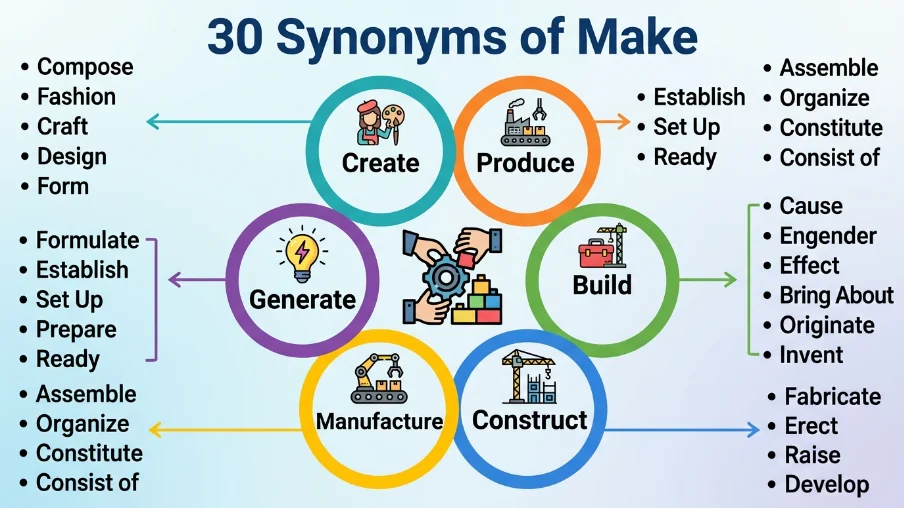
Make means to create, build, or cause something to happen. The most common synonyms are create, produce, build, construct, manufacture, form, generate, cause, prepare, and compose. Each synonym has a slightly different tone and context some are formal, some are casual, and some are best for specific situations like business or creative writing.
The word make is one of the most frequently used verbs in English. You probably use it every day without thinking twice. But here’s the thing: using the same word over and over can make your English sound repetitive and boring.
That’s why learning synonyms matters. When you know different ways to say make, you can:
- Sound more professional at work
- Write more clearly and vividly
- Choose the exact word for your situation
- Avoid repeating the same word in essays or emails
In this guide, you’ll learn 30 powerful synonyms for make, complete with meanings, example sentences, and practical tips. By the end, you’ll know exactly which word to use in conversations, business writing, academic work, and creative projects.
What Does “Make” Mean?
Definition
Make means to create, build, or produce something by combining materials or putting parts together. It can also mean to cause something to happen or to prepare something for use. For example, you can make a cake, make a decision, or make someone happy. It’s a general-purpose verb that works in almost any situation.
In simple terms: when you make something, you bring it into existence whether it’s a physical object, a plan, or a feeling.
Pronunciation
| Feature | Information |
|---|---|
| US IPA | /meɪk/ |
| UK IPA | /meɪk/ |
| Syllables | 1 |
| Tip | Rhymes with “cake” and “take.” The sound is long and clear. |
Grammar
| Grammar Feature | Information |
|---|---|
| Part of Speech | Verb (transitive and intransitive) |
| Common Position | Subject + make + object |
| Typical Pattern | make + noun (make a cake) / make + object + adjective (make me happy) |
Example Sentences:
- I make breakfast every morning.
- She made a beautiful painting for her mother.
- The news made him sad.
Grammar Note: Make is often followed by a direct object (the thing being created) or an object complement (an adjective describing the result).
Word Family
| Word | Part of Speech | Meaning | Root Word |
|---|---|---|---|
| make | Verb | To create or produce | make |
| maker | Noun | A person or thing that makes something | make + -er |
| making | Noun | The process of creating something | make + -ing |
| handmade | Adjective | Made by hand, not machine | hand + made |
| homemade | Adjective | Made at home | home + made |
| make-believe | Noun/Adjective | Pretend; imaginary | make + believe |
20 Synonyms of “Make”
1. Create
Meaning: To bring something new into existence.
Best Used For: Creative writing, art, innovation, and original ideas.
Formality: Neutral
Tone: Positive, Creative
Frequency: ⭐⭐⭐⭐⭐ Very Common
CEFR Level: B1
Example Sentence 1: The artist created a stunning mural on the side of the building.
Example Sentence 2: We need to create a new marketing strategy for the product launch.
Usage Tip: Use create when you want to emphasize originality or imagination. It sounds more artistic and thoughtful than make. Don’t use it for routine tasks like making coffee that would sound unnatural.
2. Produce
Meaning: To make something, especially in large quantities or through a process.
Best Used For: Business, manufacturing, farming, and formal writing.
Formality: Neutral to Formal
Tone: Professional, Neutral
Frequency: ⭐⭐⭐⭐⭐ Very Common
CEFR Level: B1
Example Sentence 1: The factory produces over 10,000 cars every year.
Example Sentence 2: California produces a lot of grapes for wine.
Usage Tip: Produce is more formal than make and often implies a systematic or industrial process. Use it in reports, business contexts, and when talking about goods or crops.
3. Build
Meaning: To construct something by putting parts or materials together.
Best Used For: Construction, development, and long-term projects.
Formality: Neutral
Tone: Positive, Practical
Frequency: ⭐⭐⭐⭐⭐ Very Common
CEFR Level: A2
Example Sentence 1: They built a new school in our neighborhood last year.
Example Sentence 2: We’re building a stronger team by hiring talented people.
Usage Tip: Build suggests a process that takes time and effort. Use it for physical structures, teams, relationships, or systems. It’s stronger than make when you want to highlight the work involved.
4. Construct
Meaning: To build or put together something complex, often following a plan.
Best Used For: Architecture, engineering, formal writing, and large projects.
Formality: Formal
Tone: Professional, Technical
Frequency: ⭐⭐⭐⭐ Common
CEFR Level: B2
Example Sentence 1: Engineers will construct a new bridge across the river.
Example Sentence 2: She constructed a convincing argument in her essay.
Usage Tip: Construct is more technical and formal than build. Use it in academic writing, engineering contexts, or when describing complex structures both physical and abstract.
5. Manufacture
Meaning: To make goods on a large scale using machines and industrial processes.
Best Used For: Business, industry, and formal reports.
Formality: Formal
Tone: Professional, Industrial
Frequency: ⭐⭐⭐⭐ Common
CEFR Level: B2
Example Sentence 1: The company manufactures electronic components for smartphones.
Example Sentence 2: They manufacture furniture in their workshop.
Usage Tip: Manufacture is the right word for factory production and industrial goods. Use it when you want to sound professional and precise about large-scale making.
6. Form
Meaning: To shape or develop something gradually.
Best Used For: Describing natural processes, habits, or abstract things.
Formality: Neutral
Tone: Neutral, Descriptive
Frequency: ⭐⭐⭐⭐ Common
CEFR Level: B1
Example Sentence 1: Water vapor forms clouds in the sky.
Example Sentence 2: Good habits form when you practice consistently.
Usage Tip: Form often describes things that develop naturally or over time, rather than being created instantly. Use it for shapes, habits, relationships, and ideas.
7. Generate
Meaning: To produce or create something, especially energy, interest, or results.
Best Used For: Business, science, marketing, and abstract outcomes.
Formality: Formal
Tone: Professional, Positive
Frequency: ⭐⭐⭐⭐ Common
CEFR Level: B2
Example Sentence 1: Solar panels generate electricity from sunlight.
Example Sentence 2: The campaign generated a lot of interest in the new product.
Usage Tip: Generate is great for describing outcomes, energy, enthusiasm, or revenue. It’s a favorite in business and scientific writing.
8. Cause
Meaning: To make something happen, especially something negative.
Best Used For: Explaining reasons, effects, and problems.
Formality: Neutral
Tone: Neutral (often negative)
Frequency: ⭐⭐⭐⭐⭐ Very Common
CEFR Level: B1
Example Sentence 1: Smoking can cause serious health problems.
Example Sentence 2: Heavy rain caused the river to overflow.
Usage Tip: Cause is used to explain why something happens. It often describes negative outcomes, but it can be neutral too. Use it when you want to focus on the reason or trigger.
9. Prepare
Meaning: To make something ready for use or for a specific purpose.
Best Used For: Cooking, planning, and getting things organized.
Formality: Neutral
Tone: Practical, Helpful
Frequency: ⭐⭐⭐⭐⭐ Very Common
CEFR Level: A2
Example Sentence 1: She prepared a delicious meal for her guests.
Example Sentence 2: I need to prepare my presentation for tomorrow’s meeting.
Usage Tip: Prepare emphasizes the process of getting something ready. Use it for meals, documents, speeches, and plans. It sounds more deliberate than make.
10. Compose
Meaning: To create something by arranging parts or elements, especially music or writing.
Best Used For: Music, writing, art, and formal creative work.
Formality: Formal
Tone: Artistic, Literary
Frequency: ⭐⭐⭐ Moderate
CEFR Level: B2
Example Sentence 1: He composed a beautiful symphony for the orchestra.
Example Sentence 2: She composed a heartfelt letter to her grandmother.
Usage Tip: Compose is the word for creating music, poetry, or letters. It suggests careful arrangement and artistry. Use it when you want to sound elegant and creative.
11. Craft
Meaning: To make something with skill and care, often by hand.
Best Used For: Artisanal work, creative projects, and careful writing.
Formality: Neutral
Tone: Positive, Skillful
Frequency: ⭐⭐⭐ Moderate
CEFR Level: B2
Example Sentence 1: She crafted a beautiful necklace from silver and gemstones.
Example Sentence 2: The author crafted a compelling story that readers loved.
Usage Tip: Craft emphasizes skill and attention to detail. Use it when you want to highlight the care and expertise that went into making something.
12. Develop
Meaning: To grow, create, or improve something over time.
Best Used For: Business, technology, personal growth, and gradual processes.
Formality: Formal
Tone: Positive, Progressive
Frequency: ⭐⭐⭐⭐⭐ Very Common
CEFR Level: B1
Example Sentence 1: The company developed a new app for language learning.
Example Sentence 2: Regular exercise helps develop stronger muscles.
Usage Tip: Develop implies a process of growth or improvement. Use it for skills, products, ideas, and relationships that evolve over time.
13. Assemble
Meaning: To put parts together to form a whole.
Best Used For: Furniture, machinery, and teams.
Formality: Neutral
Tone: Practical, Systematic
Frequency: ⭐⭐⭐⭐ Common
CEFR Level: B1
Example Sentence 1: I need to assemble this bookshelf before the weekend.
Example Sentence 2: The manager assembled a team of experts for the project.
Usage Tip: Assemble is perfect when you’re joining separate parts into a complete object or group. It’s more specific than make for furniture, equipment, and teams.
14. Fabricate
Meaning: To make or construct something, often using industrial methods.
Best Used For: Industry, manufacturing, and formal writing.
Formality: Formal
Tone: Professional, Technical
Frequency: ⭐⭐⭐ Moderate
CEFR Level: C1
Example Sentence 1: The parts are fabricated in a specialized workshop.
Example Sentence 2: The story was completely fabricated it never happened.
Usage Tip: Fabricate has two meanings: making something and lying. Be careful! In industrial contexts, it’s neutral. In other contexts, it can mean “to invent a lie.
15. Erect
Meaning: To build or put up a structure.
Best Used For: Formal descriptions of building construction.
Formality: Formal
Tone: Professional, Official
Frequency: ⭐⭐⭐ Moderate
CEFR Level: B2
Example Sentence 1: They erected a monument in the town square.
Example Sentence 2: The workers erected scaffolding around the building.
Usage Tip: Erect is a formal synonym for build or put up. Use it in official or architectural contexts. It sounds more serious and technical than build.
16. Forge
Meaning: To create or shape something with strong effort, often using heat or pressure.
Best Used For: Metalworking, partnerships, and strong efforts.
Formality: Neutral to Formal
Tone: Strong, Determined
Frequency: ⭐⭐⭐ Moderate
CEFR Level: B2
Example Sentence 1: The blacksmith forged a sword from iron.
Example Sentence 2: They forged a strong partnership over many years.
Usage Tip: Forge suggests strength, effort, and durability. Use it for relationships, alliances, or metalwork. It’s a powerful alternative to make.
17. Fashion
Meaning: To make or shape something, especially with skill.
Best Used For: Creative work, clothing, and careful shaping.
Formality: Neutral to Formal
Tone: Artistic, Skillful
Frequency: ⭐⭐⭐ Moderate
CEFR Level: B2
Example Sentence 1: She fashioned a dress from old curtains.
Example Sentence 2: He fashioned a tool from a piece of metal.
Usage Tip: Fashion as a verb means to create with skill and care. It’s more creative and artistic than make. Use it when you want to highlight craftsmanship.
18. Put together
Meaning: To assemble or create something from separate parts.
Best Used For: Everyday situations, DIY projects, and informal contexts.
Formality: Informal
Tone: Casual, Practical
Frequency: ⭐⭐⭐⭐ Common
CEFR Level: A2
Example Sentence 1: Can you help me put together this toy for my son?
Example Sentence 2: She put together a great presentation in just one hour.
Usage Tip: This is a casual, everyday phrase. Use it in conversation and informal writing. It’s perfect for describing quick assembly or organization.
19. Whip up
Meaning: To prepare something quickly, especially food.
Best Used For: Cooking, quick preparation, and informal contexts.
Formality: Informal
Tone: Casual, Lively
Frequency: ⭐⭐⭐ Moderate
CEFR Level: B1
Example Sentence 1: I can whip up some pasta in fifteen minutes.
Example Sentence 2: She whipped up a delicious dessert for the party.
Usage Tip: Whip up is playful and informal. Use it when you’re making something fast, especially a meal. It’s never appropriate in formal writing.
20. Bring about
Meaning: To cause something to happen.
Best Used For: Formal writing, change, and results.
Formality: Formal
Tone: Professional, Neutral
Frequency: ⭐⭐⭐⭐ Common
CEFR Level: B2
Example Sentence 1: The new policy brought about significant improvements.
Example Sentence 2: Hard work can bring about positive change in your life.
Usage Tip: Bring about is a formal phrasal verb that means “to cause.” Use it in reports, essays, and professional writing when discussing changes or results.
Synonyms Comparison Table
| Synonym | Best Context | Formality | Tone | Frequency |
|---|---|---|---|---|
| create | Art, innovation, original ideas | Neutral | Creative | ⭐⭐⭐⭐⭐ |
| produce | Business, manufacturing, farming | Neutral–Formal | Professional | ⭐⭐⭐⭐⭐ |
| build | Construction, teams, systems | Neutral | Practical | ⭐⭐⭐⭐⭐ |
| construct | Engineering, formal writing | Formal | Technical | ⭐⭐⭐⭐ |
| manufacture | Industry, factory goods | Formal | Industrial | ⭐⭐⭐⭐ |
| form | Natural processes, habits | Neutral | Descriptive | ⭐⭐⭐⭐ |
| generate | Energy, interest, results | Formal | Professional | ⭐⭐⭐⭐ |
| cause | Explaining reasons, problems | Neutral | Often negative | ⭐⭐⭐⭐⭐ |
| prepare | Cooking, planning, organizing | Neutral | Practical | ⭐⭐⭐⭐⭐ |
| compose | Music, writing, art | Formal | Artistic | ⭐⭐⭐ |
Best Synonyms by Situation
| Situation | Best Synonym | Why It Works |
|---|---|---|
| Daily Conversation | make | Simple, natural, and universally understood |
| Business Email | produce / generate | Professional and clear |
| Academic Writing | construct / generate | Formal and precise |
| School Assignment | create / develop | Shows effort and thought |
| Professional Meeting | develop / generate | Sound strategic and professional |
| Presentation | create / develop | Positive and forward-looking |
| Creative Writing | compose / craft / fashion | Artistic and expressive |
| Social Media | make / whip up | Casual and engaging |
| Movie Review | create / craft | Describes artistic effort |
| Book Review | compose / craft | Highlights the author’s skill |
Formal vs Informal Synonyms
Formal Alternatives
| Synonym | Best Used For |
|---|---|
| construct | Engineering, architecture, formal arguments |
| manufacture | Industrial production, business reports |
| generate | Business, science, outcomes |
| compose | Music, literature, formal writing |
| fabricate | Technical manufacturing |
| erect | Construction, formal descriptions |
| bring about | Formal writing about change |
Neutral Alternatives
| Synonym | Best Used For |
|---|---|
| create | Most situations, especially creative ones |
| produce | General production and creation |
| build | Physical and abstract construction |
| form | Natural processes and gradual development |
| prepare | Getting things ready |
| develop | Growth and improvement over time |
Informal Alternatives
| Synonym | Best Used For |
|---|---|
| put together | DIY, everyday assembly |
| whip up | Quick cooking, casual tasks |
| make | The default works everywhere |
When to Choose: Use formal synonyms in essays, reports, and professional emails. Use neutral synonyms for most everyday writing. Save informal synonyms for conversations with friends and casual social media posts.
Strong vs Mild Synonyms
Mild
Suitable for everyday situations.
- make – The most neutral and common choice.
- prepare – Getting something ready.
- form – Shaping or developing naturally.
Moderate
More expressive than the original word.
- create – Emphasizes originality.
- produce – Focuses on output or results.
- build – Highlights effort and construction.
- develop – Suggests growth and improvement.
Strong
High-intensity alternatives that should be used carefully.
- forge – Suggests strength and determination.
- manufacture – Implies large-scale industrial production.
- construct – Technical and formal.
- generate – Powerful for outcomes and energy.
How intensity changes meaning: Using a strong synonym like forge instead of make adds power and seriousness. But be careful using strong words too often can sound exaggerated or unnatural.
Real-Life Examples
School: The students created a science fair project about renewable energy.
Office: Our team developed a new workflow that saves two hours every day.
Business Email: We plan to produce the first batch of products by next month.
Meeting: Let’s generate some ideas for the upcoming marketing campaign.
Book: The author crafted a story that kept me reading until 3 AM.
Conversation: “Can you make dinner tonight?” “Sure, I’ll whip up something quick.”
Social Media: Just made this beautiful cake! Check out the recipe below.
Academic Writing: The study brings about important questions about climate policy.
Common Collocations
| Common Phrase | Better Alternative |
|---|---|
| make a decision | reach a decision / take a decision |
| make a difference | create change / have an impact |
| make a mistake | commit an error (formal) |
| make a plan | develop a plan / formulate a plan |
| make a choice | select / choose |
| make an effort | put in effort / exert effort |
| make progress | achieve progress / advance |
| make a speech | deliver a speech / give a speech |
| make a promise | give a promise / pledge |
Common Phrases
- make a decision – To choose between options. Better: reach a decision.
- make a difference – To cause change. Better: create change.
- make money – To earn income. Better: earn money / generate income.
- make a living – To earn enough to live on.
- make sense – To be logical or understandable.
- make sure – To confirm or verify.
- make time – To find time for something.
- make friends – To form friendships.
Context Guide
| Situation | Best Synonym | Reason |
|---|---|---|
| Essay | construct / generate | Formal and academic |
| Speech | deliver / give | Standard for presentations |
| Business Email | produce / develop | Professional and clear |
| Novel | compose / craft / fashion | Artistic and literary |
| Presentation | create / develop | Positive and forward-looking |
| Conversation | make / put together | Natural and casual |
| Academic Writing | construct / bring about | Formal and precise |
| Marketing Copy | create / generate | Engaging and energetic |
Related Words
Near Synonyms
- Generate – produce or create something
- Fabricate – construct or invent
- Assemble – put parts together
- Compile – collect and arrange information
Antonyms
- Destroy – to completely ruin or break
- Break – to separate into pieces
- Demolish – to tear down a structure
- Ruin – to damage beyond repair
Related Adjectives
- Productive – producing good results
- Creative – using imagination to make things
- Constructive – helpful and positive
- Handmade – made by hand, not machine
Related Nouns
- Creation – something that has been made
- Product – something that is produced
- Construction – the process of building
- Production – the process of making goods
Related Verbs
- Build – to construct something
- Design – to plan and create
- Shape – to give form to something
- Invent – to create something new
Frequently Asked Questions
What is another word for make?
The most common synonyms for make are create, produce, build, and construct. The best choice depends on your context create for originality, produce for manufacturing, build for construction, and construct for formal or technical writing.
Which synonym sounds the most professional?
Produce, generate, and develop sound professional and are widely used in business writing. Manufacture is also professional but is specific to industrial contexts.
What is the strongest synonym for make?
Forge is a strong synonym that suggests effort, determination, and durability. Construct and manufacture are also strong but in more technical or industrial ways.
Which synonym is best for essays?
Construct, generate, and bring about are excellent for academic essays. They sound formal, precise, and thoughtful.
What’s the difference between make and create?
Make is a general verb for producing anything. Create emphasizes originality and imagination. You make dinner, but you create a work of art.
Which synonym is most common in everyday English?
Make is the most common word. After that, build, create, and prepare are frequently used in daily conversation.
What is the opposite of make?
The most direct opposites are destroy, break, demolish, and ruin. These words mean to take apart or eliminate something that was made.
Conclusion
Make is a versatile verb that means to create, build, or cause something to happen. While it’s useful in almost any situation, learning synonyms helps you communicate more precisely and sound more natural.
The best synonyms to start with are create (for originality), produce (for output), build (for construction), and generate (for results). Remember that context, tone, and formality matter what works in a casual conversation might not be appropriate in a business email.
As you practice, pay attention to which words native speakers use in different situations. The more you notice, the more natural your English will become. Start by replacing make with one new synonym this week and see how it changes your writing and speaking.
