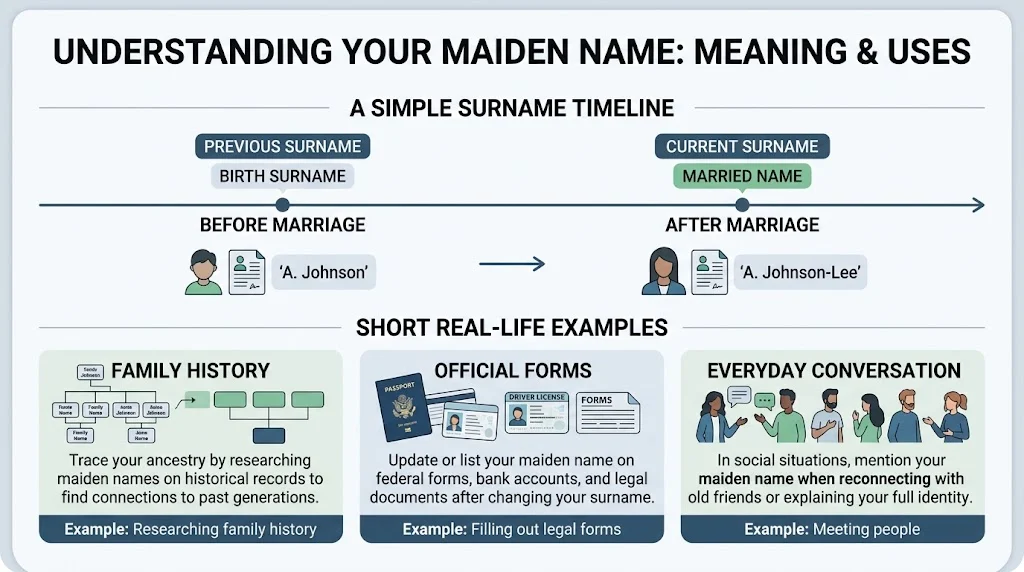
Maiden name meaning refers to the family surname a woman used before marriage, especially when she later adopts a spouse’s surname. The term appears in forms, genealogy, family conversations, historical records, and discussions about names and identity.
The maiden name’s meaning is straightforward: it describes a woman’s family surname before marriage. In American English, people often use the phrase when distinguishing a previous surname from a current married surname.
However, the phrase carries more context than a simple dictionary definition suggests. A surname can connect someone to family history, childhood records, professional work, genealogy, and older documents.
For example, someone named Emily Carter before marriage might later use Emily Johnson. In that case, Carter can be described as her maiden name if she adopted Johnson through marriage.
Importantly, changing a surname is not required after marriage. Some people keep their original surname. Others hyphenate surnames, combine names, or choose another naming arrangement.
Therefore, the phrase usually describes a historical surname rather than a rule about what someone must call herself.
The term also appears in everyday American paperwork. Banks, government records, genealogy websites, and other organizations may ask for a previous surname to connect records.
At the same time, language around names continues to change. Some people prefer terms such as birth surname, birth name, or previous surname because those expressions can be more gender neutral.
This guide explains the definition, context, history, digital usage, conversational patterns, alternatives, and common misunderstandings surrounding the phrase.
QUICK ANSWER BOX
| Meaning | Context | Primary Platforms | Example | Tone |
| A woman’s surname before marriage | Family, records, genealogy | Forms, websites, social media, texting | “What was your mother’s maiden name?” | Neutral or administrative |
| Previous family surname | Identity and historical records | Genealogy platforms | “Her maiden name was Carter.” | Informational |
| Former surname | Marriage related conversations | Texting and social media | “She kept her maiden name.” | Casual |
| Birth surname | Modern or gender neutral wording | Professional communication | “Please enter your birth surname.” | Formal |
What Does a maiden name Mean?
The phrase has a specific dictionary meaning. Cambridge defines a maiden name as the family name a woman has before she gets married.
In practical terms, imagine a person named Sarah Miller who marries someone named Daniel Brown.
If Sarah changes her surname to Brown, Miller is her maiden name.
Her name history might look like this:
| Life stage | Example surname |
| Before marriage | Sarah Miller |
| After marriage | Sarah Brown |
| Previous surname | Miller |
| Current surname | Brown |
The important point is that maiden name refers to the surname, not usually the entire name.
Sarah’s first name remains Sarah. Her surname changes from Miller to Brown. Therefore, Miller is the part described by the phrase.
What does the word “maiden” contribute?
The word maiden historically referred to a young or unmarried woman. The expression survived even as the standalone word became less common in everyday English.
The phrase therefore reflects older naming conventions. It became associated with a woman’s surname before marriage.
That historical background explains why the expression specifically refers to women in traditional dictionary definitions.
Is it the same as a birth name?
Not always.
A birth name can refer more broadly to the name assigned at birth. It can include a person’s given name and surname.
A maiden name, by contrast, traditionally refers to a woman’s surname before marriage.
For example:
| Term | Typical meaning |
| Birth name | Name given at birth |
| Birth surname | Family surname at birth |
| Maiden name | Woman’s surname before marriage |
| Previous surname | Earlier surname used by a person |
| Married name | Surname adopted after marriage |
Consequently, these terms overlap in some situations but are not perfect synonyms.
Does someone have a maiden name if she never changes her surname?
In traditional usage, the term can still describe the surname a woman had before marriage. However, if her surname remains unchanged, there may be little practical reason to contrast a “maiden” surname with a “married” surname.
For instance, if Maria Garcia marries Alex Lee but continues using Garcia, Garcia remains her current surname.
In ordinary conversation, saying “her maiden name is Garcia” may sound unnecessary because there is no surname change to distinguish.
Contextual Dynamics & Nuances of the Term
The meaning stays stable, but the context can change how natural the phrase sounds.
Administrative context
Forms may request a previous surname to help identify records.
For example:
“Please enter your maiden name if applicable.”
This wording can appear in older administrative systems or identity questions.
However, modern forms may use broader wording such as “previous surname” or “birth surname.”
Family history context
Genealogy is one of the clearest situations for the expression.
Researchers often need earlier surnames to connect marriage certificates, census records, birth records, obituaries, and family trees.
For example:
“I found my grandmother’s maiden name in an old marriage record.”
Here, the phrase helps identify the surname she used before marriage.
Casual conversation
Friends and relatives may also use it naturally.
For example:
“What was your mom’s maiden name?”
The speaker is asking for the mother’s surname before marriage.
The question is understandable in American English. However, the information may be private, especially when used as an account security question.
Professional identity
A person may continue using a previous surname professionally.
For example, a writer could publish under a surname used before marriage.
Likewise, an academic, artist, physician, lawyer, or business owner may retain an established professional identity.
Therefore, a previous surname does not necessarily disappear from public use after marriage.
Cultural and personal differences
Naming customs vary widely.
Some people change surnames after marriage. Others do not.
Some people use hyphenated surnames. Others combine surnames or select different arrangements.
Therefore, avoid assuming that marriage automatically creates a new surname.
Real Life Conversation Examples Using maiden name meaning
The phrase is usually easy to understand when the surrounding context makes the relationship between past and present surnames clear.
Example 1: Talking about a friend
Alex: Did Jenna change her last name after the wedding?
Maya: Yes. She uses Parker now.
Alex: What was her maiden name?
Maya: It was Williams.
This exchange uses the phrase in a normal conversational way.
Example 2: Discussing family history
Daniel: I’m building our family tree.
Chris: Nice. What information do you have?
Daniel: I know my grandmother’s married name, but I’m trying to find her maiden name.
Chris: Her old photo albums might help.
Here, the phrase refers to a surname used before marriage.
Example 3: Talking about a mother
Emma: What was Grandma’s last name before she married Grandpa?
Lily: Her maiden name was Carter.
Emma: That helps. I can search the old records now.
The conversation makes the meaning clear without requiring a definition.
Example 4: Discussing a professional name
Jordan: I found one of Mom’s old articles.
Taylor: Was it published under her current name?
Jordan: No. She used her maiden name professionally.
Taylor: That explains why I couldn’t find the article before.
This example shows why previous surnames can remain relevant long after marriage.
Example 5: Texting about genealogy
Nora: I’m stuck on the family tree.
Sam: What are you missing?
Nora: My great grandmother’s maiden name.
Sam: Check her marriage certificate. It might list her previous surname.
The phrase works naturally because genealogy often requires historical name information.
Platform Specific Breakdown
The expression is not really internet slang. It is a standard English noun phrase.
Still, people use it across digital platforms. The meaning remains essentially the same.
How It Is Used on Snapchat
Snapchat conversations tend to be informal and brief.
Someone might write:
“What was your mom’s maiden name?”
Or:
“I found her old account under her maiden name.”
The phrase does not acquire a special Snapchat definition.
Instead, users shorten the surrounding conversation because messaging is fast.
For example:
A: Your aunt changed her last name, right?
B: Yeah.
A: What was her maiden name?
B: Davis.
The phrase functions exactly as it would in ordinary speech.
The Role of maiden name meaning on TikTok
TikTok may introduce the phrase through educational videos, family stories, genealogy content, or discussions about marriage.
A creator might explain:
“My mom used a different surname before she married.”
The caption could then include the phrase for search clarity.
However, there is no established TikTok slang definition that changes the standard meaning.
This distinction matters because internet users sometimes assume every frequently searched phrase is slang.
That is not the case here.
Instagram and Texting Dynamics
Instagram posts may use the phrase when discussing family history, wedding stories, name changes, or genealogy.
For example:
“Found an old photo from before Grandma changed her surname.”
A comment might ask:
“What was her maiden name?”
Texting works similarly.
The expression can appear in casual messages, although shorter alternatives may feel more natural among close friends.
For example:
“What was your mom’s last name before marriage?”
That sentence communicates almost exactly the same idea.
| Phrase | Meaning | Typical use |
| Maiden name | Woman’s surname before marriage | General English |
| Birth surname | Surname associated with birth | Formal or modern |
| Birth name | Name given at birth | Broad identity context |
| Previous surname | Earlier surname | Administrative contexts |
| Former surname | Surname used previously | Formal writing |
| Family name | Shared surname | General naming |
| Last name | Surname | Everyday American English |
| Married name | Surname adopted after marriage | Marriage discussions |
| Née | Born with a particular surname | Formal biographies |
Née and surname history
The French word née means “born” when used to identify a woman’s original surname in certain formal contexts.
For example:
“Laura Johnson, née Carter”
This indicates that Carter was her earlier surname.
However, née is not simply a casual replacement for the phrase in every sentence.
It is more common in biographies, historical writing, and formal descriptions.
Birth surname as a modern alternative
Birth surnames can be useful when gender neutrality matters.
For example:
“Please provide your birth surname.”
This wording focuses on the surname itself rather than marital status.
That distinction can make it preferable in some professional settings.
Previous surname
The previous surname is another straightforward option.
For example:
“Enter any previous surnames used on official records.”
This wording is broad.
It does not assume that the surname changed because of marriage.
Consequently, it can work better for forms that need inclusive language.
Misinterpretations:
The phrase is simple, but several mistakes occur in real conversations.
Mistake 1: Treating it as a first name
A maiden name is generally a surname.
It is not a nickname.
It is not automatically a middle name.
It does not mean the person’s entire original name.
For example, if someone was born Emily Grace Carter, “Carter” is the relevant surname.
Mistake 2: Assuming every married woman changed her surname
Marriage does not automatically mean someone adopted a spouse’s surname.
A person may retain the same surname.
Therefore, ask carefully when the distinction matters.
Mistake 3: Applying the traditional term to everyone
Traditional dictionary definitions describe a woman’s surname before marriage.
Because the term is tied to older naming conventions, it may not fit every modern naming situation.
For broader situations, “birth surname” or “previous surname” may be clearer.
Mistake 4: Treating it as internet slang
The phrase is not inherently slang.
It is a standard English expression.
People may discuss it on TikTok, Snapchat, Instagram, Reddit, or messaging apps. Yet the platform does not create a separate definition.
Mistake 5: Sharing sensitive information casually
A person’s previous surname can be personal information.
This is especially important because “mother’s maiden name” has historically appeared as an account security question.
Therefore, do not assume someone should disclose it simply because you ask.
How to Respond in Chat Comfortably
If someone uses the phrase in a message, your response depends on what they are asking.
When they ask for your previous surname
You can answer directly if you are comfortable.
“It was Carter.”
You can also clarify the context.
“Do you mean my surname before marriage?”
That response works when the question is ambiguous.
When you do not want to share it
You can set a simple boundary.
“I’d rather not share that information.”
There is no need to provide a long explanation.
When you are confused
Ask for clarification.
“Do you mean my last name before marriage?”
This avoids answering the wrong question.
When someone asks about a relative
You can provide context.
“Her surname before marriage was Carter.”
That wording is particularly clear for genealogy discussions.
When responding professionally
A more formal response may work better.
“My previous surname was Carter.”
This phrasing avoids assumptions about why the surname changed.
FAQs
What does maiden name meaning refer to?
The phrase refers to the surname a woman used before marriage, particularly when she later adopted a different surname.
Is a maiden name the same as a last name?
Not necessarily.
A last name is a general term for a surname. A maiden name specifically identifies a woman’s surname before marriage.
Therefore, the same surname can be both a last name and a maiden name at different points in a person’s life.
Is a maiden name the same as a birth name?
No.
A birth name is broader. It can refer to the name given at birth.
The traditional expression focuses specifically on a woman’s surname before marriage.
Can someone keep her maiden name after marriage?
Yes.
A person may keep using the same surname after marriage.
In that situation, there may be no practical distinction between a former surname and current surname.
What is the difference between a maiden name and a married name?
A maiden name refers to a woman’s surname before marriage.
A married name generally refers to a surname adopted after marriage.
However, not everyone adopts a new surname after marrying.
Why do forms ask for a mother’s maiden name?
Historically, organizations have used previous surnames as identifying information.
However, this information can also create security and privacy concerns. You should treat such details carefully.
Is “maiden name” an outdated phrase?
Some people consider it old fashioned because it reflects traditional assumptions about women changing surnames after marriage.
Others still use it as a familiar administrative and family history term.
Modern alternatives include “birth surname” and “previous surname.”
What is another word for a maiden name?
Depending on context, alternatives include birth surname, previous surname, and former surname.
They are not always exact equivalents.
The best choice depends on whether the context concerns marriage, birth records, or general identity history.
Can men have a maiden name?
Traditionally, the phrase is defined around a woman’s surname before marriage.
For men or gender neutral situations, terms such as “birth surname” or “previous surname” are usually clearer.
How do I use the phrase in a sentence?
Common patterns include:
“Her maiden name was Carter.”
“What was your mother’s maiden name?”
“She kept her maiden name after marriage.”
These examples show the phrase functioning as a noun phrase rather than slang.
Conclusion:
The core maiden name meaning is simple. It refers to a woman’s surname before marriage, especially when that surname differs from the one she uses later.
However, the surrounding language has become more nuanced.
Today, people may keep their original surname, adopt a spouse’s surname, hyphenate surnames, combine names, or use another arrangement. Consequently, writers should avoid assuming that marriage always produces a surname change.
The phrase remains familiar in American English. It appears in genealogy, family conversations, historical records, forms, biographies, and digital communication.
At the same time, alternatives such as birth surname, previous surname, and former surname can offer greater clarity in some situations.
The phrase also should not be confused with internet slang. Snapchat, TikTok, Instagram, and texting may feature the expression, but they do not fundamentally change its meaning.
Ultimately, understanding the term requires both a dictionary definition and awareness of modern naming practices.
That combination makes the phrase easier to interpret accurately in conversations, forms, family research, and online content.
