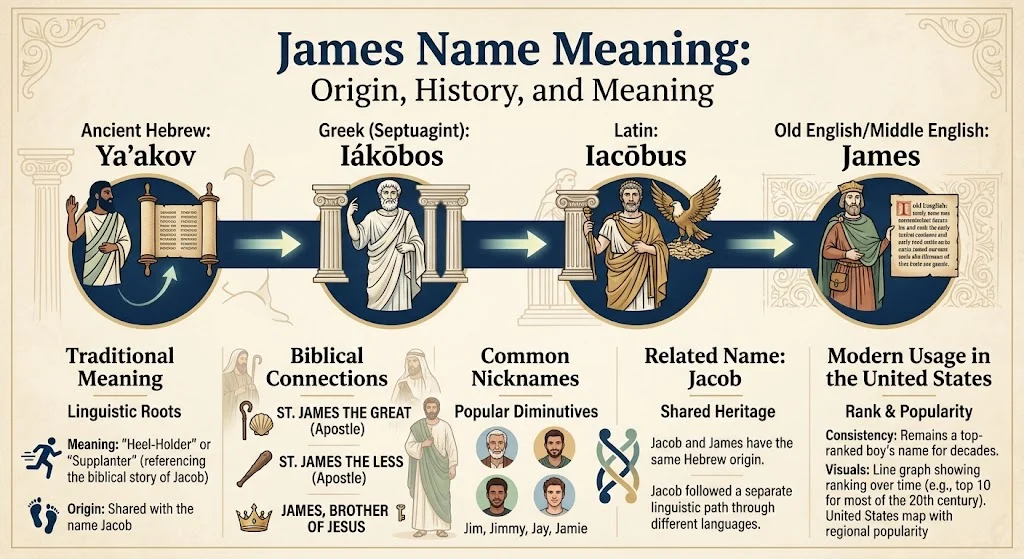
James’ name meaning is commonly understood as “supplanter” or “one who follows.” James comes from the Hebrew name Jacob through Greek and Latin forms. It has strong biblical roots and remains a classic English given name.
James’ name meaning has a long history that connects Hebrew, Greek, Latin, English, and biblical naming traditions. The name remains familiar across the United States and many other English speaking countries.
James is more than a traditional first name. It carries centuries of linguistic development, religious history, royal usage, literary influence, and modern cultural recognition.
The name ultimately traces back to the Hebrew name Ya’akov, commonly rendered as Jacob in English. Through Greek Iakōbos and Latin Iacobus, English developed the form James.
This journey explains why James and Jacob can represent different English forms of the same ancient name family.
However, the meaning deserves some context. Many name references translate James as “supplanter,” “holder of the heel,” or “one who follows.” These meanings connect to the traditional interpretation of Jacob.
The word “supplanter” can sound negative today. Historically, however, biblical name meanings often reflect stories, word associations, or linguistic roots rather than a person’s fixed character.
James also has strong Christian associations. Several important figures in the New Testament were named James. As a result, the name became deeply established across Christian Europe.
Today, James works across generations. It can sound traditional, formal, friendly, literary, or modern depending on the context.
The name also offers many familiar short forms. These include Jim, Jimmy, Jamie, and Jem, although usage varies by region and family.
QUICK ANSWER BOX
| Meaning | Context | Primary Platforms | Example | Tone |
| Supplanter, one who follows, or holder of the heel | Traditional biblical and linguistic interpretation | Baby names, genealogy, social profiles, naming discussions | “We chose James because of its history.” | Classic, familiar, timeless |
| English form of Jacob | Hebrew, Greek, Latin, and English name history | Family records, historical texts, religious contexts | “James and Jacob share an ancient origin.” | Historical and informative |
| Traditional masculine given name | Modern English usage | Everyday speech, schools, workplaces, media | “James is a common first name.” | Neutral and versatile |
What Does James’ Name Mean?
The most common interpretation of James’ name meaning is “supplanter.” Other explanations include “one who follows” and **“holder of the heel.”
These interpretations come from the name’s relationship with Jacob.
The Hebrew connection
James ultimately belongs to the same family as Jacob. The Hebrew name is commonly represented as Ya’akov.
Traditional explanations connect Jacob with the Hebrew root associated with the heel. The biblical story of Jacob provides the main cultural background for this interpretation.
According to Genesis, Jacob was born holding his twin brother Esau’s heel. The narrative later connects Jacob with ideas of taking the place of another or obtaining something through strategic action.
That connection contributed to the English interpretation “supplanter.”
However, modern linguistics requires some caution. A personal name does not always have one perfectly fixed dictionary definition.
Names develop through languages, pronunciation changes, spelling changes, and cultural traditions.
How Jacob became James
The development from Jacob to James happened through several languages.
| Language | Traditional Form |
| Hebrew | Ya’akov |
| Greek | Iakōbos |
| Latin | Iacobus |
| Old French and related medieval forms | James and related forms |
| English | James |
The exact historical development contains several linguistic stages. English did not simply change Jacob directly into James.
Instead, different forms developed through medieval European naming traditions.
This explains an interesting feature of English naming history. Jacob and James are separate modern names, yet they share an ancient linguistic ancestry.
Why “supplanter” appears in name dictionaries
Name dictionaries often provide short definitions because readers want a quick answer.
“Supplanter” became a standard English gloss because of the traditional interpretation of Jacob’s biblical story.
Still, it should not be treated as a personality prediction.
A person named James is not inherently manipulative, competitive, or deceptive. A name’s meaning describes historical associations rather than psychological traits.
That distinction matters when researching baby names.
Does James have a biblical meaning?
Yes. James has a strong biblical connection because the New Testament contains several people named James.
The best known include James the son of Zebedee, one of Jesus’ apostles, and James the son of Alphaeus, another apostle.
The New Testament also refers to James, the brother of Jesus, in early Christian tradition and texts.
Because these figures played important roles in Christian history, James became an influential Christian name.
Contextual Dynamics & Nuances of the Term
The meaning of a traditional name can change depending on the context in which someone discusses it.
For example, a parent choosing James may focus on family heritage rather than the literal interpretation “supplanter.”
Similarly, someone researching genealogy may care more about historical forms than modern symbolism.
James as a classic name
James is widely perceived as a classic English language name.
It has remained recognizable across many generations. Therefore, it can work for both children and adults without sounding strongly tied to one particular era.
That versatility is one reason the name has remained culturally durable.
James as a family name
James can also appear as a surname.
English naming traditions frequently transformed personal names into family names. A surname such as James may therefore indicate ancestral use of the given name.
However, surname origins can vary. A surname should not automatically be assumed to have one single origin.
James as a middle name
James is also widely used as a middle name.
Parents may select it because it is short, familiar, traditional, or connected to a family member.
Its two syllables and simple spelling make it easy to combine with many first names.
For example:
| First Name | Middle Name Combination |
| William | James |
| Henry | James |
| Alexander | James |
| Daniel | James |
| Benjamin | James |
The combination often creates a traditional English language naming style.
James and religious heritage
James has a particularly strong Christian history.
Biblical usage helped spread the name throughout Europe. Later, saints, monarchs, writers, scholars, and public figures reinforced its visibility.
Consequently, the name can carry religious significance for some families while remaining completely secular for others.
Real-Life Conversation Examples Using james name meaning
People rarely discuss historical name meanings in exactly the same way. The following examples show natural conversations.
Example 1: Choosing a baby name
Sarah: We are thinking about naming the baby James.
Emily: I like that. Did you know James comes from the same ancient name family as Jacob?
Sarah: Really? I thought they were completely different names.
Emily: They look different now, but they share historical roots.
Sarah: That makes the name even more interesting.
Example 2: Asking about the meaning
Mike: What does your name mean?
James: The usual explanation is “supplanter” or “one who follows.”
Mike: That’s pretty interesting.
James: Yeah. The name has Hebrew, Greek, Latin, and English history behind it.
Example 3: Discussing biblical origins
Anna: Is James a biblical name?
David: Yes. Several people named James appear in the New Testament.
Anna: So the name became popular partly through Christianity?
David: Exactly. Biblical usage helped establish it across Europe.
Example 4: Comparing James and Jacob
Chris: Are James and Jacob related names?
Tom: Yes. They’re different English forms from the same ancient name family.
Chris: I never realized that.
Tom: The linguistic history is actually pretty fascinating.
Example 5: Discussing nicknames
Rachel: Is Jimmy short for James?
Laura: Yes. Jim and Jimmy are traditional forms of James.
Rachel: What about Jamie?
Laura: Jamie can also be associated with James, especially in English speaking countries.
Rachel: I like Jamie better as a nickname.
These conversations show an important point. A name’s meaning usually appears in discussions about family, history, religion, identity, or naming choices.
It does not function like modern internet slang.
Platform-Specific Breakdown
Modern naming discussions happen across websites and social platforms. However, the way people discuss names can differ by platform.
How It Is Used on Snapchat
Snapchat conversations are usually informal and personal.
Someone might ask about a person’s name after meeting them. Friends may also discuss baby names, nicknames, or unusual name meanings through direct messages.
For example:
“Wait, what does your name mean?”
A person named James could respond:
“It comes from the same old family as Jacob. People often translate it as ‘supplanter.’”
The conversation would normally stay casual.
Snapchat does not give James a special slang definition. If someone mentions the name there, its meaning usually depends on the surrounding conversation.
The Role of james name meaning on TikTok
TikTok can make name history highly shareable.
Creators may publish videos about baby names, biblical names, genealogy, name origins, or unusual linguistic connections.
A short video might explain:
James → Jacob → ancient Hebrew origin
However, social media explanations can simplify complicated linguistic histories.
Therefore, viewers should distinguish between a quick name meaning video and a carefully researched etymological source.
TikTok content may also mix historical facts with personality claims.
For example, a creator might claim that people named James are naturally confident or loyal.
Such claims are not established by the etymology of the name.
A name’s history can explain where a name came from. It cannot reliably predict personality.
Instagram and Texting Dynamics
Instagram naming content often appears in baby name accounts, family posts, genealogy pages, and educational reels.
Texting is even simpler.
Someone might ask:
“What does James mean?”
A natural response could be:
“It comes from the same ancient family as Jacob. The traditional meaning is ‘supplanter.’”
Another person might ask:
“Is James a religious name?”
A balanced answer would mention its strong biblical history while recognizing that modern people use the name in both religious and secular settings.
Alternative Meanings
Search behavior around name meanings produces many related phrases.
People may search for:
- James meaning
- meaning of James
- James name origin
- James biblical meaning
- James Hebrew origin
- James name history
- James baby name meaning
- James meaning in the Bible
- what does James mean
- origin of the name James
- James etymology
- James name symbolism
- James nickname
- James short form
- James and Jacob connection
These phrases represent different search intentions.
Informational intent
A user may simply want the definition.
For example:
“What does James mean?”
This requires a short answer.
Historical intent
Another user may want the complete linguistic history.
For example:
“Where did the name James come from?”
This requires information about Hebrew, Greek, Latin, medieval European languages, and English.
Biblical intent
A religious search may focus on biblical figures.
For example:
“What does James mean in the Bible?”
The answer should separate the name’s linguistic origin from the roles of biblical people named James.
Baby naming intent
Parents may search:
“Is James a good baby name?”
That question involves personal preference rather than an objective linguistic answer.
A useful guide can discuss history, pronunciation, nicknames, cultural familiarity, and naming traditions without declaring one choice universally better.
NLP relationships
From a semantic perspective, James connects with several concepts:
| Semantic Category | Related Concepts |
| Origin | Hebrew, Greek, Latin |
| Related name | Jacob |
| Religion | Bible, Christianity, apostles |
| Meaning | Supplanter, follower, heel |
| Nicknames | Jim, Jimmy, Jamie |
| Gender | Traditionally masculine |
| Language | English |
| Culture | British, American, European |
| Naming | Baby names, family names, middle names |
This semantic network helps explain why searches about James can involve many different questions.
Misinterpretations:
The phrase can be misunderstood when people treat a historical meaning as a personality diagnosis.
Do not use the meaning as a personality test
A person named James is not automatically a “supplanter.”
The word comes from historical linguistic and biblical interpretation.
It does not establish someone’s behavior.
Do not confuse James with Jacob in everyday English
James and Jacob are distinct modern English names.
They share an ancient linguistic origin, but that does not mean an English speaker should normally substitute one for the other.
For example:
“His name is James”
does not mean:
“His name is Jacob.”
The relationship is historical rather than a rule for modern conversation.
Do not assume every James has religious beliefs
Biblical usage gave James significant religious history.
However, modern name bearers can have any religious background or none.
A traditional name does not determine someone’s beliefs.
Do not treat social media claims as etymological evidence
Internet posts sometimes attach personality characteristics to names.
These statements may be entertaining, but they are not equivalent to historical linguistic research.
A reliable explanation should distinguish documented etymology from modern naming trends.
How to Respond in Chat Comfortably
If someone asks about the name James, the best response depends on what they actually want to know.
If they ask for the basic meaning
Say:
“James traditionally means ‘supplanter’ or ‘one who follows.’ It comes through historical forms related to Jacob.”
That answer is short and useful.
If they ask whether it is biblical
Say:
“Yes. James is strongly connected with the New Testament, where several people named James appear.”
You can then explain the relevant biblical figures if they want more detail.
If they ask whether James and Jacob are related
Say:
“Yes. James and Jacob are different English forms that ultimately come from the same ancient name family.”
This is one of the most interesting facts about the name.
If someone asks about a nickname
Common forms include:
- Jim
- Jimmy
- Jamie
- Jem
Usage depends on family tradition and region.
If someone asks about symbolism
A careful answer should distinguish historical association from modern symbolism.
You might say:
“The name is often associated with biblical heritage, tradition, endurance, and historical continuity, but those are cultural associations rather than fixed personality traits.”
That keeps the explanation accurate.
FAQs
1. What is the James name meaning?
The traditional interpretation is “supplanter,” with related explanations including “one who follows” and “holder of the heel.” These meanings connect James to the ancient name Jacob.
2. Is James a biblical name?
Yes. James appears several times in the New Testament. The name became particularly influential in Christian naming traditions.
3. Is James the same name as Jacob?
James and Jacob are different modern English names, but they ultimately belong to the same ancient name family. Their modern forms developed through different linguistic pathways.
4. What is the origin of the name James?
James ultimately traces to the Hebrew name associated with Jacob. It passed through Greek and Latin forms before developing into the English James.
5. What does James mean in Hebrew?
The underlying Hebrew name is commonly represented as Ya’akov. Traditional interpretations connect it with the heel and with the idea of following or supplanting.
6. Is James a popular American name?
James has been a longstanding name in the United States. Its continued recognition comes from religious history, English naming traditions, family usage, and cultural familiarity.
7. What are common nicknames for James?
Common nicknames include Jim, Jimmy, and Jamie. Jem is another historical or literary form.
8. Is James a traditional name?
Yes. James has centuries of use in English speaking societies. It has also appeared among biblical figures, monarchs, writers, and other notable historical figures.
9. Does the name James determine personality?
No. A name’s etymology does not determine personality, behavior, intelligence, or character. Personality develops through many biological, social, cultural, and individual factors.
10. Why are James and Jacob connected?
Both names descend from the same ancient name family. Their different modern English forms reflect centuries of linguistic development across Hebrew, Greek, Latin, and European languages.
Conclusion:
The history behind James’ name’s meaning reaches much further back than modern naming trends.
James developed through a long linguistic journey. Its ancient roots connect it with Jacob, while its biblical usage helped establish the name across Christian Europe.
The traditional interpretation is usually given as “supplanter.” Other explanations include “one who follows” and “holder of the heel.”
However, these definitions should remain in their historical context.
A name’s meaning is not a personality prediction. It does not determine character, behavior, beliefs, or life outcomes.
James has survived because it works across many contexts. It can appear as a first name, middle name, surname, biblical reference, family name, or historical name.
Its nickname tradition adds even more flexibility. Jim, Jimmy, Jamie, and Jem all demonstrate how a formal name can develop familiar everyday forms.
The name also illustrates how languages change.
Jacob and James look unrelated to many modern English speakers. Yet their shared history demonstrates how names can transform as they move between Hebrew, Greek, Latin, French, and English traditions.
That linguistic evolution is one of the most useful lessons in studying personal names.
Ultimately, James combines ancient roots, biblical history, linguistic development, and modern familiarity. Its continued use in the United States reflects the lasting influence of traditional names while allowing each generation to give the name its own cultural meaning.
