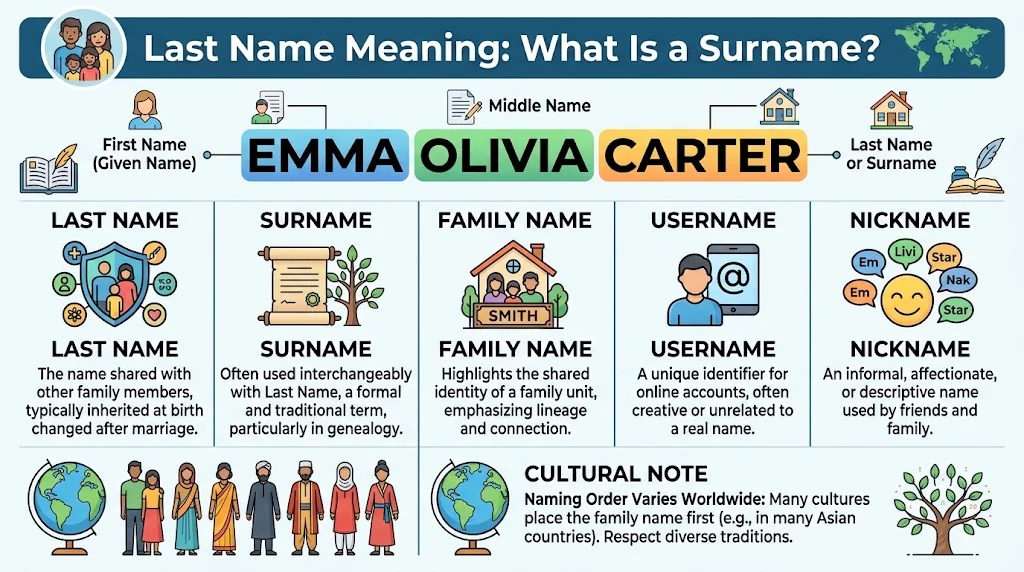
A last name is the family name or surname associated with a person. In American English, it usually appears after the given name and may reflect family history, ancestry, geography, occupation, or cultural naming traditions.
Last name meaning refers to the definition and significance of a person’s family name or surname. In American English, the term usually means the name that follows a person’s given name. Cambridge Dictionary defines it as a family name used in formal situations and notes that it generally comes after other given names.
However, a surname is more than a field on an application. It can connect people to family history, geography, occupations, languages, and cultural traditions. FamilySearch explains that surnames are typically passed from one generation to another. They can also provide clues about ancestry and geographic origins.
The phrase also creates confusion because naming systems vary worldwide. In many English speaking contexts, the family name appears at the end. However, that pattern is not universal. Some cultures use multiple family names. Others place the family name before the given name.
Therefore, understanding the term requires more than knowing its dictionary definition. You also need to understand how people use it in forms, in conversations, online profiles, genealogy research, and everyday American English.
Quick Answer Box
| Meaning | Context | Primary Platforms | Example | Tone |
| Family name or surname | Forms and everyday speech | Websites, apps, documents | “My last name is Carter.” | Neutral |
| Surname shared with family members | Family history | Genealogy platforms | “What is your family name?” | Informational |
| Name appearing after given names in common US usage | Personal identification | School, work, travel | “Enter your first and last names.” | Formal |
| A hereditary or culturally transmitted name | Genealogy and identity | Family records | “The surname appears in several records.” | Academic |
What Does Last Name Mean?
The basic last name meaning is simple: it refers to what the phrase last name means.
A last name is commonly understood as a person’s family name. The terms surname and family name are often used as equivalents. Cambridge specifically identifies “last name” as the usual US term for “surname.”
For example, consider the fictional name Jordan Michael Carter.
In that name:
| Name part | Example | Common description |
| Given name | Jordan | First name |
| Middle name | Michael | Middle name |
| Family name | Carter | Last name or surname |
The position matters in American English. The family name generally comes after the given names. That explains why forms often ask for a first name and last name separately.
However, “last” does not mean that every culture places the family name last. It describes the common English naming order. FamilySearch notes that some cultures record both the mother’s and father’s family names.
Last name, surname, and family name
These expressions overlap heavily.
Last names are especially common in American English. Surname is more formal and is common in British English as well. Family name emphasizes the connection between the name and a family group. Cambridge lists these terms as closely related.
| Term | Typical meaning | Common usage |
| Last name | Family or surname | Very common in US English |
| Surname | Family name | Formal and international |
| Family name | Name shared or inherited within a family | Clear and descriptive |
| First name | Given name | Common in everyday US English |
| Given name | Personal name assigned at birth or otherwise used as the main personal name | Formal and administrative |
These terms are often interchangeable. Still, context can affect which expression sounds most natural.
For example, an American employee might say, “What’s your last name?” A government form might use “surname.” A genealogy researcher might use “family name” when discussing ancestry.
Origin and historical development of surnames
Surnames developed through different historical processes. There is no single origin story for all family names.
Some surnames developed from occupations. Others came from places, personal names, physical descriptions, relationships, or nicknames. FamilySearch explains that surname research can reveal information about ancestry, cultural background, and geographic origin.
For example, an occupational surname may have originally described a person’s work. A geographic surname may have identified where someone lived. A patronymic surname may have connected a person with a parent or ancestor.
Consequently, a surname can carry historical information without having one simple modern definition.
The surname Smith, for example, has a strong association with an occupation. Yet a person named Smith today does not necessarily work as a blacksmith. The original historical meaning and the modern family name are separate concepts.
Does a last name always reveal ancestry?
No. A surname can provide a clue, but it cannot prove a person’s ancestry by itself.
Names can change through marriage, adoption, immigration, spelling variation, translation, legal changes, and other circumstances. Records can also contain errors.
FamilySearch notes that tracing family history depends on available records, historical events, and cultural practices.
Therefore, surname research works best when combined with birth records, marriage records, census information, immigration documents, and other reliable evidence.
Contextual Dynamics & Nuances of the Term
The phrase changes slightly depending on context.
In casual conversation, it usually means a person’s family name. On a government form, it identifies a specific field. In genealogy, it can refer to a family line or hereditary naming tradition.
Everyday conversation
People commonly use the phrase when introducing themselves.
For example:
“My first name is Emma, and my last name is Davis.”
The sentence is direct and natural. No special slang interpretation exists.
You may also hear:
“What’s your last name?”
This question is common when someone needs to identify a person accurately.
However, context matters. Asking for someone’s full name can feel more formal than asking for a first name. Therefore, tone depends on the relationship and situation.
Forms and applications
Forms frequently divide a full name into separate fields.
A typical structure might look like this:
| Form field | What you usually enter |
| First name | Your given name |
| Middle name | Your middle or additional given name |
| Last name | Your family name or surname |
| Suffix | Jr., Sr., III, and similar suffixes |
However, forms can differ. Some systems use surname, family name, or family name / surname instead.
You should follow the instructions on the specific form. Do not assume every international form follows American naming order.
Legal and official contexts
Names become more precise in official records.
A passport, birth certificate, court document, school record, or financial account may require your legal name. In those situations, the correct spelling and order matter.
A person may also have more than one family name. FamilySearch notes that some cultures use both maternal and paternal surnames.
As a result, reducing every naming system to “first name plus last name” can create errors.
Genealogy and family history
Genealogy adds another layer.
Researchers may investigate a surname to identify family connections. They may compare historical spellings and geographic records. They may also investigate how a name changed over generations.
Still, a surname alone does not establish a complete family relationship.
For example, two unrelated people may share the same surname. Conversely, relatives may have different surnames because of marriage, adoption, cultural naming practices, or other family circumstances.
Real Life Conversation Examples Using last name meaning
The following examples show how the phrase and related terms work naturally in American English.
Scenario 1: Meeting someone
Alex: Hi, I’m Alex.
Jordan: Nice to meet you. I’m Jordan.
Alex: What’s your last name?
Jordan: Carter.
Here, the question simply asks for the person’s family name. The tone is neutral and conversational.
Scenario 2: Filling out a form
Mia: This form is asking for my first name and last name.
Sam: Put your given name in the first field and your family name in the second.
Mia: Got it. My last name goes there.
The phrase is common because many forms divide names into separate fields.
Scenario 3: Clarifying spelling
Receptionist: Could I have your last name?
Customer: Martinez.
Receptionist: Could you spell that for me?
Customer: M A R T I N E Z.
Here, the family name helps distinguish the customer from other people with the same first name.
Scenario 4: Discussing genealogy
Taylor: I’m researching my family tree.
Morgan: Do you know where your surname came from?
Taylor: Not exactly. I’m looking through old records.
This conversation uses surnames because the setting is genealogy. The word sounds natural in historical and research contexts.
Scenario 5: Explaining American naming order
Chris: Which part is your family name?
Daniel: Rodriguez.
Chris: So Rodriguez is your last name in the US format?
Daniel: Exactly.
This example highlights an important distinction. The term “last name” describes the common English order. It does not mean that every culture places a family name last.
Platform Specific Breakdown
The phrase is not internet slang. It is standard English vocabulary. Therefore, its meaning does not fundamentally change on Snapchat, TikTok, Instagram, or messaging apps.
However, digital platforms can change how people display and request names.
How It Is Used on Snapchat
On Snapchat, users may have a display name and a username. Those labels are not automatically equivalent to a legal family name.
For example, someone might display:
Jordan Carter
while using a username such as:
@jcarter24
The username functions as an account identifier. The family name remains part of the person’s name rather than becoming a special slang term.
Therefore, if someone asks, “What’s your last name?” they are normally asking for the family name.
The Role of last name meaning on TikTok
TikTok also separates account identity from personal naming.
A creator can use a nickname, brand name, stage name, or other display identity. Consequently, the name visible on a profile may not represent the person’s legal or family name.
This distinction matters for privacy.
Someone can share a public display name without publicly sharing their surname. Likewise, a profile name does not prove a person’s legal identity.
Instagram and Texting Dynamics
Instagram and texting work similarly.
People often use shortened names, nicknames, initials, or usernames. Those formats can be useful for communication. However, they do not redefine the word last name.
For example:
“What’s your last name? I want to add you to the group.”
The person is asking for a family name.
By contrast:
“What’s your username?”
asks for an account identifier.
Those questions may appear in the same conversation, but they have different meanings.
Alternative Meanings
Natural language processing systems need to distinguish several closely related terms.
Common semantic variations
| Phrase | Relationship to the topic |
| Last name | Standard US expression |
| Surname | Formal equivalent |
| Family name | Descriptive equivalent |
| Family surname | Expanded expression |
| Second name | Can be ambiguous across cultures |
| Maiden name | A specific historical or marital context |
| Married name | A surname used after marriage |
| Given name | Different from a family name |
| Full name | Usually includes given and family names |
| Legal name | Name recognized in an official context |
The distinction between these terms is important.
A maiden name is not simply another word for a surname. It can refer specifically to a woman’s surname before marriage. FamilySearch defines a maiden name in this context.
Likewise, a nickname is not a surname. It is an informal name used instead of, or alongside, a person’s given name.
Linguistic variations
American English often favors last names.
British English frequently uses surnames.
International English may use family names because it reduces ambiguity across different naming systems.
Therefore, the phrase can have different levels of familiarity depending on the speaker.
Pronunciation
In US English, “last name” is pronounced approximately:
last name
The two words are normally pronounced separately. The phrase has no unusual slang pronunciation.
Grammar
“Last name” functions as a noun phrase.
Examples include:
“What is your last name?”
“Her last name is Johnson.”
“Please enter your last name.”
The plural is last names.
For example:
“The database contains several last names.”
Misinterpretations:
The phrase should not be treated as slang.
It is also important not to assume that every person has a single surname placed at the end of their complete name.
Do not confuse a surname with a username
A username identifies an account. A surname identifies a family or naming relationship.
| Term | Main purpose |
| Last name | Family name |
| Username | Online account identifier |
| Display name | Name shown publicly on a platform |
| Nickname | Informal personal name |
| Handle | Online identifier or account name |
Do not assume every culture follows the US order
American naming conventions are not universal.
FamilySearch specifically notes that some naming systems include both maternal and paternal surnames.
Therefore, a person’s “last” written element may not always function the same way as an American family name.
Do not infer ethnicity from a surname alone
A surname can have historical or geographic associations. However, it does not provide definitive evidence of an individual’s ethnicity or identity.
Migration and language change can spread surnames across countries. Families can also adopt or change names.
Do not treat surname meanings as personal descriptions
Suppose a surname historically came from an occupation.
That does not mean the person carrying it today has that occupation.
Historical surname meaning and modern personal identity are separate concepts.
How to Respond in Chat Comfortably
When someone asks about a person’s family name, the simplest response is usually the best.
If someone asks for your family name
You can answer:
“My last name is Carter.”
If you want a more formal response:
“My surname is Carter.”
Both are natural.
If you are unsure what someone means
You can ask:
“Do you mean my family name?”
This works especially well when the conversation involves people from different naming traditions.
If a form asks for your last name
Enter the family name requested by the form instructions.
If the form uses an unfamiliar naming convention, check its guidance before entering information.
If you do not want to share it
You can simply say:
“I’d rather not share my last name.”
That response is clear and polite.
If someone asks for a username instead
Do not substitute your surname automatically.
A username and a family name serve different purposes. This distinction becomes especially important on public social platforms.
FAQs
What does last name meaning refer to?
It refers to the meaning of the phrase last name. In US English, it generally means a person’s family name or surname. Cambridge identifies it as the family name that typically follows given names in English.
Is a last name the same as a surname?
Usually, yes. In American English, last name is a common expression for surname. Cambridge specifically describes surname as the family name and identifies “last name” as the usual US term.
What is a family name?
A family name is a name associated with a family and commonly shared or inherited among family members. It is often synonymous with surname or last name.
Is a middle name the same as a last name?
No. A middle name is generally an additional given name. A last name is the family name. FamilySearch distinguishes given names from surnames in its explanation of name components.
Why is it called a last name?
In common English naming order, the family name appears after the given names. Therefore, it is described as the “last” name in the sequence. This does not mean every culture places family names last.
Can someone have two last names?
Yes. Some cultures use multiple family names. FamilySearch gives examples in which both maternal and paternal family names appear as surnames.
Can a last name change?
Yes. Names can change for various legal, personal, cultural, and family reasons. Marriage is one familiar example, but it is not the only circumstance.
Does a surname tell you where someone is from?
It can provide clues, but it does not prove geographic origin. FamilySearch notes that surname information can provide insights into ancestry and geographic origin. However, individual family histories can be much more complicated.
Is a last name the same as a username?
No. A last name is a family name. A username is an account identifier used on a website or service.
How can I research my surname?
Start with reliable family records. Birth certificates, marriage records, census records, immigration documents, and historical directories can help connect a surname with specific people and places. FamilySearch also provides surname research tools and historical records.
Conclusion:
The phrase last name has a straightforward meaning in American English. It normally refers to a person’s family name or surname. It is a standard vocabulary term, not internet slang. Cambridge identifies it as the family name commonly used after a person’s given names in English.
However, the broader subject of surnames is much more complex.
Family names can reflect historical occupations, geographic locations, family relationships, cultural traditions, and long periods of linguistic change. FamilySearch notes that surname research can provide clues about ancestry, cultural background, and geographic origin.
Modern digital communication adds another distinction. Social platforms frequently separate personal names from usernames and display names. Consequently, a profile name should not automatically be treated as a person’s legal or family name.
Naming conventions also vary across cultures. Some people use one family name. Others use multiple surnames. Some naming systems place family names before given names. Therefore, American English terminology should not be treated as a universal naming rule.
Ultimately, understanding last name’s meaning requires both linguistic and cultural awareness. In everyday US conversation, the answer is simple: it means your family name. In genealogy and international contexts, however, the story can extend across generations, languages, locations, and family traditions.
