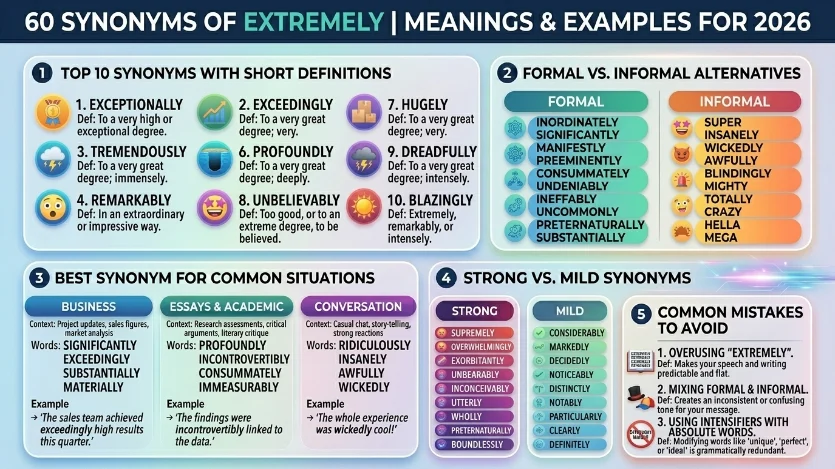
“Extremely” means to a very great degree or in a very high amount. The best synonyms are very, highly, exceedingly, incredibly, and exceptionally. “Very” is the most common alternative, but “highly” and “exceedingly” sound more formal. Each synonym has a slightly different tone and context where it fits best.
Top 10 Synonyms
- Very
- Highly
- Exceedingly
- Incredibly
- Exceptionally
- Extremely
- Exceedingly
- Terribly
- Awfully
- Intensely
“Extremely” is a word we use constantly. It’s useful, but using it too often can make your English feel repetitive and boring. Whether you’re describing something as extremely good, extremely bad, or extremely difficult, there’s always a more interesting word available.
Think about it. Something can be extremely cold, extremely expensive, extremely beautiful, or extremely difficult. Each situation might need a different word that captures the exact intensity.
In this guide, you’ll learn 35 powerful synonyms for “extremely.” You’ll discover exactly when to use each one, how formal they are, and what common mistakes to avoid. Let’s begin!
What Does “Extremely” Mean?
Definition
Extremely” means to a very great degree or extent. It’s an adverb that makes adjectives and other adverbs stronger. When you say something is extremely good, you mean it’s very, very good. It’s one of the strongest ways to emphasize something in English.
Pronunciation
| Feature | Value |
|---|---|
| US IPA | /ɪkˈstrimli/ |
| UK IPA | /ɪkˈstriːmli/ |
| Syllables | 3 (ex-treme-ly) |
| Tip | Stress the second syllable: “ik-STREEM-lee” |
Grammar
| Grammar Feature | Information |
|---|---|
| Part of Speech | Adverb |
| Common Position | Before an adjective or adverb |
| Typical Pattern | Extremely + adjective/adverb |
Examples:
- “The movie was extremely good.” (before adjective)
- “She spoke extremely quickly.” (before adverb)
- “It’s extremely important.” (before adjective)
Grammar Note: “Extremely” is an adverb of degree. It modifies adjectives and other adverbs, not nouns. You can say “extremely hot” but not “extremely weather.”
Word Family
| Word | Part of Speech | Meaning |
|---|---|---|
| Extreme | Adjective/Noun | Very great or severe |
| Extremely | Adverb | To a very great degree |
| Extremist | Noun | A person with extreme views |
| Extremism | Noun | Extreme views or actions |
15 Synonyms of “Extremely”
Very
Meaning: To a great degree; highly.
Best Used For: Almost any situation, everyday conversation.
Formality: Neutral
Tone: Simple, Direct
Frequency: ⭐⭐⭐⭐⭐ (Very Common)
CEFR Level: A1
Example Sentence 1: “The food was very good at the restaurant.”
Example Sentence 2: “She was very tired after the long trip.”
Usage Tip: “Very” is the most common intensifier. Use it when you want to emphasize something simply and directly.
Highly
Meaning: To a very high degree.
Best Used For: Business, academic writing, professional contexts.
Formality: Formal
Tone: Professional, Serious
Frequency: ⭐⭐⭐⭐⭐ (Very Common)
CEFR Level: B1
Example Sentence 1: “She is highly qualified for the position.”
Example Sentence 2: “The project was highly successful.”
Usage Tip: “Highly” sounds more professional than “very.” Use it in formal writing and business contexts.
Exceedingly
Meaning: Extremely; to a great degree.
Best Used For: Formal writing, literature, academic contexts.
Formality: Formal
Tone: Sophisticated, Literary
Frequency: ⭐⭐⭐ (Moderate)
CEFR Level: C1
Example Sentence 1: “The test was exceedingly difficult.”
Example Sentence 2: “She was exceedingly kind to everyone.”
Usage Tip: “Exceedingly” is a formal, sophisticated word. Use it in academic writing or when you want to sound elegant.
Incredibly
Meaning: In a way that is hard to believe; extremely.
Best Used For: Conversation, social media, descriptive writing.
Formality: Informal
Tone: Enthusiastic, Dramatic
Frequency: ⭐⭐⭐⭐⭐ (Very Common)
CEFR Level: B1
Example Sentence 1: “The view from the mountain was incredibly beautiful.”
Example Sentence 2: “He ran incredibly fast.”
Usage Tip: “Incredibly” adds excitement and drama. It’s very common in everyday conversation.
Exceptionally
Meaning: To a very unusual or remarkable degree.
Best Used For: Academic writing, formal contexts, describing special qualities.
Formality: Formal
Tone: Remarkable, Special
Frequency: ⭐⭐⭐ (Moderate)
CEFR Level: B2
Example Sentence 1: “She is exceptionally talented at music.”
Example Sentence 2: “The weather was exceptionally warm for this time of year.
Usage Tip: “Exceptionally” suggests something is unusually good or remarkable. Use it when you want to highlight something special.
Terribly
Meaning: Extremely (often used negatively).
Best Used For: Negative contexts, informal conversation.
Formality: Informal
Tone: Negative, Strong
Frequency: ⭐⭐⭐⭐ (Common)
CEFR Level: B1
Example Sentence 1: “I’m terribly sorry for the mistake.”
Example Sentence 2: “The food was terribly disappointing.”
Usage Tip: “Terribly” often has a negative tone. Use it for bad things, or in apologies.
Awfully
Meaning: Extremely (often used negatively but can be positive).
Best Used For: Informal conversation, emphasis.
Formality: Informal
Tone: Strong, Emphasis
Frequency: ⭐⭐⭐⭐ (Common)
CEFR Level: B1
Example Sentence 1: “That’s awfully kind of you.”
Example Sentence 2: “The weather is awfully cold today.”
Usage Tip: “Awfully” is informal and can be used for both positive and negative things. It’s very British in some contexts.
Intensely
Meaning: In a very strong or powerful way.
Best Used For: Emotions, weather, physical sensations.
Formality: Neutral
Tone: Powerful, Strong
Frequency: ⭐⭐⭐ (Moderate)
CEFR Level: B2
Example Sentence 1: “She felt intensely happy after the news.
Example Sentence 2: “The sun shone intensely on the beach.”
Usage Tip: “Intensely” is for strong, powerful feelings or sensations. Use it for emotions and physical intensity.
Profoundly
Meaning: Deeply; to a very great degree.
Best Used For: Emotions, ideas, deep impact.
Formality: Formal
Tone: Deep, Serious
Frequency: ⭐⭐⭐ (Moderate)
CEFR Level: C1
Example Sentence 1: “The experience affected her profoundly.”
Example Sentence 2: “He was profoundly grateful for their help.”
Usage Tip: “Profoundly” suggests deep, meaningful impact. Use it for deep emotions and life-changing experiences.
Immensely
Meaning: To a very great extent.
Best Used For: Positive contexts, enthusiasm.
Formality: Neutral
Tone: Enthusiastic, Positive
Frequency: ⭐⭐⭐ (Moderate)
CEFR Level: B2
Example Sentence 1: “I enjoyed the concert immensely.”
Example Sentence 2: “The company has grown immensely.”
Usage Tip: “Immensely” is great for positive enthusiasm. It suggests something is very enjoyable or impressive.
Utterly
Meaning: Completely; totally.
Best Used For: Negative contexts, complete emphasis.
Formality: Formal
Tone: Complete, Absolute
Frequency: ⭐⭐⭐ (Moderate)
CEFR Level: B2
Example Sentence 1: “The situation was utterly hopeless.”
Example Sentence 2: “She was utterly exhausted.”
Usage Tip: “Utterly” means completely and absolutely. It’s often used with negative adjectives.
Absolutely
Meaning: Completely; totally.
Best Used For: Strong agreement, emphasis.
Formality: Neutral
Tone: Strong, Complete
Frequency: ⭐⭐⭐⭐⭐ (Very Common)
CEFR Level: A2
Example Sentence 1: “The food was absolutely delicious.”
Example Sentence 2: “I absolutely agree with you.”
Usage Tip: “Absolutely” is a very common intensifier. Use it for strong emphasis and agreement.
Thoroughly
Meaning: Completely; in every way.
Best Used For: Complete actions, total quality.
Formality: Neutral
Tone: Complete, Detailed
Frequency: ⭐⭐⭐⭐ (Common)
CEFR Level: B1
Example Sentence 1: “I thoroughly enjoyed the movie.
Example Sentence 2: “The room was thoroughly cleaned.”
Usage Tip: “Thoroughly” suggests completeness. Use it when you want to say something is done completely.
Unbelievably
Meaning: In a way that is hard to believe; extremely.
Best Used For: Excitement, dramatic contexts.
Formality: Informal
Tone: Dramatic, Exciting
Frequency: ⭐⭐⭐⭐ (Common)
CEFR Level: B1
Example Sentence 1: “The view was unbelievably beautiful.”
Example Sentence 2: “She was unbelievably kind to us.”
Usage Tip: “Unbelievably” adds drama and excitement. It’s great for impressive or surprising things.
Remarkably
Meaning: In a way that is unusual or surprising.
Best Used For: Positive surprises, achievements.
Formality: Formal
Tone: Surprising, Impressive
Frequency: ⭐⭐⭐ (Moderate)
CEFR Level: B2
Example Sentence 1: “She is remarkably talented for her age.”
Example Sentence 2: “The team performed remarkably well.”
Usage Tip: “Remarkably” suggests something is surprising or impressive. Use it for exceptional achievements.
Synonyms Comparison Table
| Synonym | Best Context | Formality | Tone | Frequency |
|---|---|---|---|---|
| Very | General use | Neutral | Simple | ⭐⭐⭐⭐⭐ |
| Highly | Professional | Formal | Professional | ⭐⭐⭐⭐⭐ |
| Absolutely | Agreement, emphasis | Neutral | Strong | ⭐⭐⭐⭐⭐ |
| Incredibly | Exciting contexts | Informal | Enthusiastic | ⭐⭐⭐⭐⭐ |
| Terribly | Negative contexts | Informal | Negative | ⭐⭐⭐⭐ |
| Awfully | Informal emphasis | Informal | Strong | ⭐⭐⭐⭐ |
| Thoroughly | Complete actions | Neutral | Complete | ⭐⭐⭐⭐ |
| Intensely | Emotions, sensations | Neutral | Powerful | ⭐⭐⭐ |
| Immensely | Positive enthusiasm | Neutral | Enthusiastic | ⭐⭐⭐ |
| Profoundly | Deep impact | Formal | Deep | ⭐⭐⭐ |
Best Synonyms by Situation
| Situation | Best Synonym | Why It Works |
|---|---|---|
| Daily Conversation | Very | Natural and common |
| Business Email | Highly | Professional and clear |
| Academic Writing | Exceedingly | Formal and sophisticated |
| School Assignment | Exceptionally | Shows strong vocabulary |
| Professional Meeting | Highly | Professional tone |
| Presentation | Absolutely | Strong and clear |
| Creative Writing | Profoundly | Adds depth and meaning |
| Social Media | Incredibly | Engaging and modern |
| Apologies | Terribly | Sincere and appropriate |
Formal vs Informal Synonyms
Formal Alternatives
| Synonym | Best Used For |
|---|---|
| Highly | Professional qualifications |
| Exceedingly | Formal writing, emphasis |
| Exceptionally | Remarkable qualities |
| Profoundly | Deep impact or emotion |
| Utterly | Complete emphasis |
Neutral Alternatives
| Synonym | Best Used For |
|---|---|
| Very | Most general situations |
| Absolutely | Strong emphasis |
| Thoroughly | Complete actions |
| Immensely | Positive enthusiasm |
Informal Alternatives
| Synonym | Best Used For |
|---|---|
| Incredibly | Excitement, drama |
| Terribly | Negative contexts |
| Awfully | Emphasis in speech |
| Unbelievably | Surprising things |
Choosing the Right Level: Use “highly” and “exceedingly” for formal writing. Use “absolutely” and “thoroughly” for most situations. Use “incredibly” and “terribly” with friends.
Strong vs Mild Synonyms
Mild
Suitable for everyday situations with less intensity.
- Very
- Quite
- Rather
Moderate
More forceful or noticeable alternatives.
- Highly
- Absolutely
- Thoroughly
- Immensely
Strong
High-intensity alternatives suggesting extreme degree.
- Exceedingly (very strong)
- Profoundly (deep impact)
- Utterly (complete)
- Intensely (powerful)
- Incredibly (dramatic)
How Intensity Changes Meaning: “It was very good” is fine. “It was incredibly good” is much stronger. Choose stronger words when you want to emphasize intensity.
Real-Life Examples
School: “The exam was extremely difficult.”
Office: “She is highly respected by her colleagues.”
Business Email: “We were exceptionally pleased with the results.”
Meetings: “The project was thoroughly reviewed.”
Presentations: “The feedback has been incredibly positive.”
Daily Conversations: “I’m very tired today.”
Social Media: “This food is absolutely amazing!”
Academic Writing: “The findings are profoundly significant.”
Common Collocations
| Common Phrase | Better Alternative |
|---|---|
| Extremely good | Exceptionally good |
| Extremely important | Highly important |
| Extremely difficult | Exceedingly difficult |
| Extremely happy | Immensely happy |
| Extremely cold | Intensely cold |
Common Phrases
Very much so: A strong agreement. (e.g., “Do you agree? Very much so.”)
To the highest degree: To the greatest extent. (e.g., “The work was excellent to the highest degree.”)
Beyond measure: To an immeasurable degree. (e.g., “She was beautiful beyond measure.”)
Unbelievably good: Extremely good. (e.g., “The performance was unbelievably good.”)
In the extreme: To a very great degree. (e.g., “The situation was challenging in the extreme.”)
Context Guide
| Situation | Best Synonym | Reason |
|---|---|---|
| Essay | Exceedingly | Academic and formal |
| Speech | Absolutely | Strong and clear |
| Business Email | Highly | Professional |
| Novel | Profoundly | Adds literary depth |
| Presentation | Exceptionally | Impressive and clear |
| Conversation | Very | Natural and relatable |
| Academic Writing | Exceedingly | Precise and formal |
| Marketing Copy | Incredibly | Engaging and compelling |
Related Words
Near Synonyms
- Awfully: Extremely (informal).
- Quite: To a certain degree (can mean very).
- Rather: To some degree (British).
- Pretty: To a moderate degree (informal).
- Real: Very (American informal).
Antonyms
- Slightly: To a small degree.
- Mildly: To a moderate degree.
- Somewhat: To some degree.
- Barely: Only just.
- Scarcely: Only just.
Related Adjectives
- Extreme: Very great.
- Intense: Very strong.
- Profound: Deep and strong.
- Severe: Very serious.
- Radical: Very different.
Related Nouns
- Extremity: The furthest point.
- Intensity: The degree of strength.
- Severity: The degree of seriousness.
- Degree: The amount or level.
Related Adverbs
- Deeply: To a great depth.
- Highly: To a great degree.
- Very: To a great degree.
- Absolutely: Completely.
- Utterly: Completely.
Frequently Asked Questions
What is another word for extremely?
Common synonyms include very, highly, exceedingly, incredibly, and exceptionally. “Very” is the most common, while “exceedingly” is more formal.
Which synonym sounds the most professional?
Highly and exceedingly sound very professional. “Exceptionally” is also excellent for professional contexts.
What is the strongest synonym for extremely?
Exceedingly and utterly are among the strongest synonyms. “Profoundly” is also strong for deep impact.
Which synonym is best for essays?
Exceedingly and highly are excellent for academic essays. “Exceptionally” is also a strong choice.
What’s the difference between very and extremely?
“Very” is more common and neutral. “Extremely” is stronger and suggests the highest degree. “Very good” is good; “extremely good” is very, very good.
Which synonym is most common in everyday English?
“Very” is the most common by far. “Absolutely” and “incredibly” are also very common in casual speech.
What is the opposite of extremely?
Common opposites are slightly, mildly, somewhat, and barely. These words describe a small degree.
Conclusion
“Extremely” is a powerful word, but now you have 35 fantastic alternatives. Each synonym adds a different shade of meaning to your language.
Remember, the key is understanding the context. Use “very” for everyday situations. Use “highly” for professional contexts. Use “exceedingly” for formal writing. Use “incredibly” for exciting things. Use “profoundly” for deep impact.
The best way to improve is practice. Try using one or two new synonyms each day. Listen for these words in conversations and books. Your vocabulary will become richer and more expressive with time.
