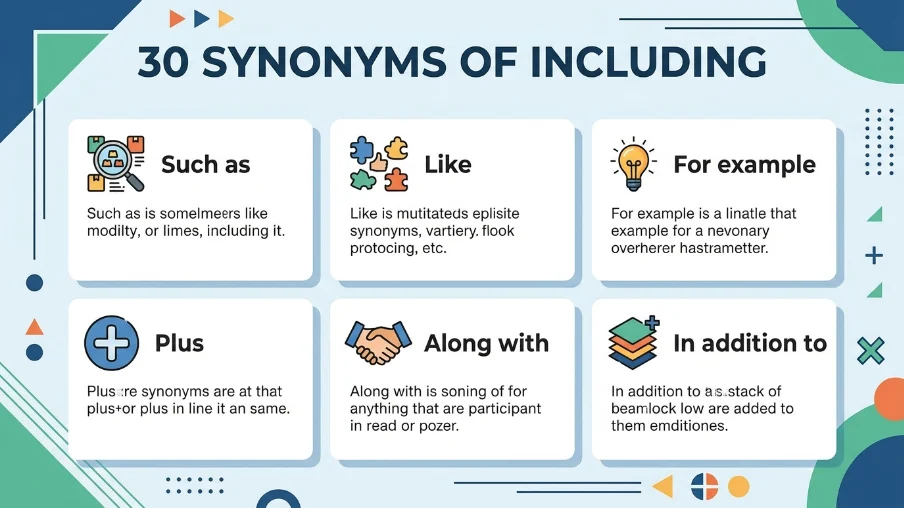
“Including” is a preposition used to introduce examples or parts of a larger group. The best synonyms are such as, like, for example, among, and plus. “Such as” and “like” are the most common in everyday English. Each synonym has a slightly different tone and context where it fits best.
Top 10 Synonyms
- Such as
- Like
- For example
- Among
- Plus
- Along with
- Together with
- As well as
- In addition to
- Not to mention
Finding the right synonyms of including can make your English clearer, more precise, and less repetitive. The word “including” is useful when you want to mention something as part of a larger group, but repeating it too often can make your writing feel flat. In everyday conversation, academic work, business emails, and professional reports, choosing the right alternative depends on context and meaning.
Words such as containing, featuring, comprising, involving, covering, incorporating, and encompassing can work well, but they are not always interchangeable. That small difference matters. Based on standard English usage and practical writing principles, this guide explains the most useful alternatives with clear meanings and examples. Whether you need a formal synonym for including or a natural option for casual writing, you’ll find practical choices that help you communicate with greater accuracy and confidence.
What Does “Including” Mean?
Definition
Including” means containing something as part of a whole. It is used to introduce examples or additional items that are part of a larger group. For example, when you say “I love fruits, including apples and bananas,” you mean apples and bananas are part of the fruits you love. It helps you specify exactly what you mean.
Pronunciation
| Feature | Value |
|---|---|
| US IPA | /ɪnˈkluːdɪŋ/ |
| UK IPA | /ɪnˈkluːdɪŋ/ |
| Syllables | 3 (in-clud-ing) |
| Tip | Stress the second syllable: “in-KLOO-ding” |
Grammar
| Grammar Feature | Information |
|---|---|
| Part of Speech | Preposition |
| Common Position | Before a noun or noun phrase |
| Typical Pattern | Main clause + including + examples |
Examples:
- “The team includes five members, including Sarah and Tom.”
- “I enjoy many sports, including soccer and tennis.”
- “We visited several countries, including France and Italy.”
Grammar Note: “Including” is a preposition and is always followed by a noun or noun phrase. It is often used with a comma before it when it introduces extra information.
Word Family
| Word | Part of Speech | Meaning |
|---|---|---|
| Include | Verb | To contain as part of a whole |
| Including | Preposition | Introducing examples or parts |
| Included | Adjective | Contained as part of something |
| Inclusion | Noun | The act of including something |
| Inclusive | Adjective | Covering everything |
15 Synonyms of “Including”
Such as
Meaning: Used to introduce examples of a larger group. It shows that what follows is just one example among many.
Best Used For: Formal writing, academic writing, professional contexts.
Formality: Neutral
Tone: Professional, Clear
Frequency: ⭐⭐⭐⭐⭐ (Very Common)
CEFR Level: B1
Example Sentence 1: “I enjoy outdoor activities, such as hiking and camping.”
Example Sentence 2: “Many countries, such as Canada and Japan, have universal healthcare.”
Usage Tip: “Such as” is more formal than “like” and is preferred in academic and professional writing. It clearly signals that you are giving examples, not making a comparison.
Common Confusion: Such as vs Like. Such as” is for giving examples; “like” can mean “similar to” or be used informally for examples.
Like
Meaning: Used informally to introduce examples or show similarity to something.
Best Used For: Daily conversation, informal writing, social media.
Formality: Informal
Tone: Casual, Friendly
Frequency: ⭐⭐⭐⭐⭐ (Very Common)
CEFR Level: A2
Example Sentence 1: “I love tropical fruits, like mangoes and pineapples.”
Example Sentence 2: “She enjoys outdoor activities, like swimming and cycling.”
Usage Tip: “Like” is extremely common in spoken English. However, in formal writing, “such as” or “for example” is usually better. Avoid using “like” too much in academic essays.
For example
Meaning: Used to introduce a specific example that illustrates a point.
Best Used For: All types of writing and speaking, especially when you want to be explicit.
Formality: Neutral
Tone: Clear, Direct
Frequency: ⭐⭐⭐⭐⭐ (Very Common)
CEFR Level: A2
Example Sentence 1: “We need to practice every day. For example, we could study for 30 minutes each morning.”
Example Sentence 2: “Many animals are endangered. For example, the giant panda is at risk.”
Usage Tip: “For example” is perfect when you want to be very clear that you are giving an example. It can start a new sentence or be used in the middle of one.
Among
Meaning: Used to mention someone or something as part of a larger group.
Best Used For: Formal writing, academic contexts, professional communication.
Formality: Formal
Tone: Academic, Professional
Frequency: ⭐⭐⭐⭐ (Common)
CEFR Level: B1
Example Sentence 1: “The students, among whom were several international scholars, attended the conference.”
Example Sentence 2: “She was chosen among hundreds of applicants.”
Usage Tip: “Among” suggests being part of a group. It’s more formal than “including” and often used in academic or official writing.
Plus
Meaning: Used to add extra information or items to a list.
Best Used For: Informal conversation, lists, social media.
Formality: Informal
Tone: Casual, Adding
Frequency: ⭐⭐⭐⭐ (Common)
CEFR Level: B1
Example Sentence 1: “We need to buy bread, milk, plus eggs and cheese.
Example Sentence 2: “The trip includes flights, hotels, plus daily breakfast.”
Usage Tip: “Plus” feels very conversational. It is great for informal writing but should be avoided in formal reports or academic essays.
Along with
Meaning: In addition to; together with someone or something.
Best Used For: Formal and neutral writing, professional contexts.
Formality: Neutral
Tone: Collaborative, Inclusive
Frequency: ⭐⭐⭐⭐ (Common)
CEFR Level: B1
Example Sentence 1: “The manager, along with her team, attended the meeting.”
Example Sentence 2: “Please bring your passport, along with any other identification.”
Usage Tip: “Along with” emphasizes that things are together or in addition to each other. It is more formal than “plus” but less formal than “together with.”
Together with
Meaning: In addition to; combined with someone or something.
Best Used For: Formal writing, legal documents, professional communication.
Formality: Formal
Tone: Official, Professional
Frequency: ⭐⭐⭐ (Moderate)
CEFR Level: B2
Example Sentence 1: “The manager, together with her team, attended the meeting.”
Example Sentence 2: “The documents, together with the signed contract, were submitted.”
Usage Tip: “Together with” is quite formal. It is often used in legal or official documents to make clear that multiple things are included.
As well as
Meaning: In addition to; used to add extra information.
Best Used For: Writing, formal and neutral contexts.
Formality: Neutral
Tone: Professional, Adding
Frequency: ⭐⭐⭐⭐ (Common)
CEFR Level: B1
Example Sentence 1: “She knows French as well as Spanish and Italian.”
Example Sentence 2: “The course teaches theory as well as practical skills.
Usage Tip: “As well as” is a great way to add extra information. It is more formal than “and” and sounds more professional than “plus.”
In addition to
Meaning: Used to introduce something that is included along with something else.
Best Used For: Formal writing, business, academic contexts.
Formality: Formal
Tone: Professional, Formal
Frequency: ⭐⭐⭐⭐ (Common)
CEFR Level: B1
Example Sentence 1: “In addition to English, she speaks three other languages.”
Example Sentence 2: “In addition to your salary, you will receive annual bonuses.”
Usage Tip: “In addition to” is a formal way to add information. It’s perfect for business writing and essays where you want to sound professional.
Not to mention
Meaning: Used to add extra information that makes the previous point even stronger.
Best Used For: Informal and neutral writing, persuasive contexts.
Formality: Informal
Tone: Emphatic, Persuasive
Frequency: ⭐⭐⭐ (Moderate)
CEFR Level: B2
Example Sentence 1: “The job is challenging, not to mention the long hours.”
Example Sentence 2: “She is kind and funny, not to mention incredibly talented.”
Usage Tip: “Not to mention” is a great phrase to emphasize an additional point. It suggests the extra point is so important it’s almost unnecessary to state it.
Incorporating
Meaning: Including something as a part of a larger whole.
Best Used For: Academic writing, business, professional contexts.
Formality: Formal
Tone: Professional, Strategic
Frequency: ⭐⭐⭐ (Moderate)
CEFR Level: B2
Example Sentence 1: “The new building features a modern design, incorporating eco-friendly materials.”
Example Sentence 2: “The course is designed, incorporating the latest research in the field.”
Usage Tip: “Incorporating” sounds very professional and suggests that the included thing is fully integrated into the whole.
Comprising
Meaning: Consisting of; made up of something.
Best Used For: Formal writing, academic contexts, technical descriptions.
Formality: Formal
Tone: Academic, Technical
Frequency: ⭐⭐ (Rare)
CEFR Level: C1
Example Sentence 1: “The committee, comprising 12 experts, met to discuss the issue.”
Example Sentence 2: “The collection, comprising over 100 works, is on display.”
Usage Tip: “Comprising” is a high-level word for “made up of.” It suggests the parts together form the whole. It is rare in everyday conversation.
Encompassing
Meaning: Including or covering a wide range of things.
Best Used For: Academic writing, formal writing, descriptions.
Formality: Formal
Tone: Broad, Comprehensive
Frequency: ⭐⭐⭐ (Moderate)
CEFR Level: B2
Example Sentence 1: “The report covers the topic broadly, encompassing economic and social factors.”
Example Sentence 2: “The museum has a large collection, encompassing art from around the world.”
Usage Tip: “Encompassing” suggests something is very broad and includes many different things. It is great for emphasizing the scope of something.
Embracing
Meaning: Including something as part of a larger whole, often with a positive feeling.
Best Used For: Creative writing, formal writing with positive tone.
Formality: Formal/Literary
Tone: Positive, Inclusive
Frequency: ⭐⭐ (Rare)
CEFR Level: B2
Example Sentence 1: “The school has a strong philosophy, embracing diversity and inclusion.”
Example Sentence 2: “The culture, embracing tradition and innovation, is unique.”
Usage Tip: “Embracing” has a very positive, welcoming tone. It suggests that the included thing is accepted and valued.
Which includes
Meaning: A relative clause that introduces something as part of a whole.
Best Used For: All contexts, especially when you want to be precise.
Formality: Neutral
Tone: Clear, Direct
Frequency: ⭐⭐⭐⭐⭐ (Very Common)
CEFR Level: B1
Example Sentence 1: “The package, which includes a free trial, is very popular.”
Example Sentence 2: “The movie, which includes several famous actors, was a big success.”
Usage Tip: “Which includes” is a very natural way to add information. It’s great for all types of writing and speaking.
Synonyms Comparison Table
| Synonym | Best Context | Formality | Tone | Frequency |
|---|---|---|---|---|
| Such as | Examples | Neutral | Professional | ⭐⭐⭐⭐⭐ |
| Like | Examples, Similarity | Informal | Casual | ⭐⭐⭐⭐⭐ |
| For example | Illustrating points | Neutral | Clear | ⭐⭐⭐⭐⭐ |
| Plus | Lists | Informal | Adding | ⭐⭐⭐⭐ |
| Along with | Adding together | Neutral | Collaborative | ⭐⭐⭐⭐ |
| As well as | Adding info | Neutral | Professional | ⭐⭐⭐⭐ |
| In addition to | Adding info | Formal | Formal | ⭐⭐⭐⭐ |
| Among | Group membership | Formal | Academic | ⭐⭐⭐⭐ |
| Together with | Combining | Formal | Official | ⭐⭐⭐ |
| Not to mention | Emphasis | Informal | Emphatic | ⭐⭐⭐ |
| Incorporating | Integration | Formal | Strategic | ⭐⭐⭐ |
| Encompassing | Broad coverage | Formal | Comprehensive | ⭐⭐⭐ |
Best Synonyms by Situation
| Situation | Best Synonym | Why It Works |
|---|---|---|
| Daily Conversation | Like | It’s the most natural and common in speech. |
| Business Email | As well as | Sounds professional and clear. |
| Academic Writing | Such as | Formal and academic tone. |
| School Assignment | For example | Clear and easy to understand. |
| Professional Meeting | In addition to | Formal and adds information cleanly. |
| Presentation | Such as | Professional and clear for examples. |
| Creative Writing | Embracing | Adds a positive, descriptive quality. |
| Social Media | Plus | Casual and perfect for quick lists. |
Formal vs Informal Synonyms
Formal Alternatives
| Synonym | Best Used For |
|---|---|
| Such as | Giving examples in academic writing . |
| In addition to | Formal additions in business writing. |
| Together with | Official documents and legal contexts. |
| Encompassing | Broad, comprehensive descriptions. |
| Incorporating | Strategic or integrated additions. |
| Comprising | Describing what something is made of. |
Neutral Alternatives
| Synonym | Best Used For |
|---|---|
| For example | All types of clear illustration. |
| Among | Describing group membership. |
| Along with | Adding information collaboratively. |
| As well as | Professional but not overly formal. |
Informal Alternatives
| Synonym | Best Used For |
|---|---|
| Like | Casual conversation and examples. |
| Plus | Adding extra items in lists. |
| Not to mention | Emphasizing extra points. |
Choosing the Right Level: In formal writing, always prefer “such as” and “in addition to.” In everyday conversation, “like” and “plus” sound much more natural. For professional contexts, “as well as” is a great middle ground.
Strong vs Mild Synonyms
Mild
These are gentle ways to add information.
- Like (casual)
- Plus (informal)
- As well as (neutral)
Moderate
More formal ways to include additional information.
- Such as
- For example
- In addition to
- Along with
Strong
These suggest a very broad, comprehensive inclusion.
- Encompassing
- Incorporating
- Comprising
How Intensity Changes Meaning: Using “encompassing” suggests you are including a very wide range of things. Using “like” suggests a simple, casual example. Choose the one that matches how broad or formal your meaning is.
Real-Life Examples
School: “The curriculum includes many subjects, such as mathematics and science.”
Office: “The project requires several resources, including software and hardware.”
Business Email: “In addition to the attached documents, please find the signed contract.”
Meetings: “The team consists of five members, along with a project manager.”
Presentations: “Our strategy focuses on three areas, namely marketing, sales, and development.”
Daily Conversations: “I love sports, like basketball and soccer.”
Social Media: “Check out our latest post, plus a bonus video!”
Academic Writing: “The study explores various factors, encompassing economic and social influences.”
Common Collocations
| Common Phrase | Better Alternative |
|---|---|
| Including but not limited to | Such as / For example |
| Including everything | Encompassing everything |
| Including a wide range | Covering a wide range |
Common Phrases
Including but not limited to: A formal phrase meaning the list isn’t complete. Try “such as” or “for example” for a simpler version.
All inclusive: Including everything. A great alternative for this phrase is “comprehensive” or “all-encompassing.”
Including the kitchen sink: An idiom meaning including everything possible.
Context Guide
| Situation | Best Synonym | Reason |
|---|---|---|
| Essay | Such as / For example | Formal and academic. |
| Speech | For example / Such as | Clear and easy to follow. |
| Business Email | As well as / In addition to | Professional and clear. |
| Novel | Embracing / Including | Adds variety to literary writing. |
| Presentation | Such as / For example | Clear examples for the audience. |
| Conversation | Like / Plus | Natural and casual. |
| Academic Writing | Such as / Encompassing | Formal and precise. |
| Marketing Copy | Plus / As well as | Engaging and adds value. |
Related Words
Near Synonyms
- Exempli gratia (e.g.): A Latin phrase meaning “for example.” It’s used in formal writing. (e.g., “I enjoy sports, e.g., tennis and golf.”)
- Namely: Used to introduce specific details or names. (e.g., “The meeting will focus on one topic, namely the budget.”)
Antonyms
- Excluding: Not including something. (e.g., “Everyone is invited, excluding the managers.”)
- Omitting: Leaving something out. (e.g., “He omitted several important details.”)
- Except: Not including. (e.g., “All are welcome except children.”)
Related Adjectives
- Inclusive: Covering everything or everyone. (e.g., “The inclusive price covers all meals.”)
- Comprehensive: Covering a wide range. (e.g., “The comprehensive report included all aspects.”)
- Exhaustive: Including everything possible. (e.g., “The exhaustive list included every country.”)
Related Nouns
- Inclusion: The act of including something. (e.g., “The inclusion of new members improved the team.”)
- Integration: The process of combining parts into a whole. (e.g., “The integration of technology in schools.”)
Related Verbs
- Incorporate: To include something as part of a whole. (e.g., “We will incorporate these ideas.”)
- Integrate: To combine things into a whole. (e.g., “We need to integrate the new system.”)
- Comprise: To consist of or be made up of. (e.g., “The team comprises five members.”)
Frequently Asked Questions
What is another word for including?
Common synonyms are such as, like, for example, among, and plus. “Such as” and “like” are the most common alternatives depending on the level of formality.
Which synonym sounds the most professional?
Such as and in addition to sound the most professional. “Such as” is preferred in academic writing, while “in addition to” is great for business contexts.
What is the strongest synonym?
Encompassing and comprising are very strong synonyms. Encompassing” suggests covering a wide range, while “comprising” means consisting of.
Which synonym is best for essays?
Such as is the best choice for essays. It is formal, academic, and clearly signals that you are giving examples.
What’s the difference between such as and like?
“Such as” is formal and used for examples in academic writing. Like” is informal and can mean “similar to” or be used casually for examples.
Which synonym is most common in everyday English?
“Like” is the most common in everyday conversation. “Such as” is more common in formal writing.
What is the opposite of including?
The most common opposites are excluding, omitting, and except. They all mean leaving something out.
Conclusion
“Including” is a useful word, but it doesn’t have to be the only word you use. By learning these 30 synonyms, you can add variety and precision to your English.
The most important thing is to choose the right synonym for the right situation. Use “such as” for formal writing and essays. Use “like” for casual conversation. Use “in addition to” for business writing. And use “encompassing” when you want to sound very comprehensive.
Practice using these synonyms in your daily life. Try writing a few sentences with each new word. Listen to native speakers and notice how they add examples and extra information. The more you practice, the more natural these words will become. Your English will be richer, more varied, and more impressive.
Discover More Articles:
- 40+ Synonyms of Leading| Meaning, Examples & Usage For 2026
- 35 Synonyms of Motivation| Meaning, Examples & Usage For 2026
