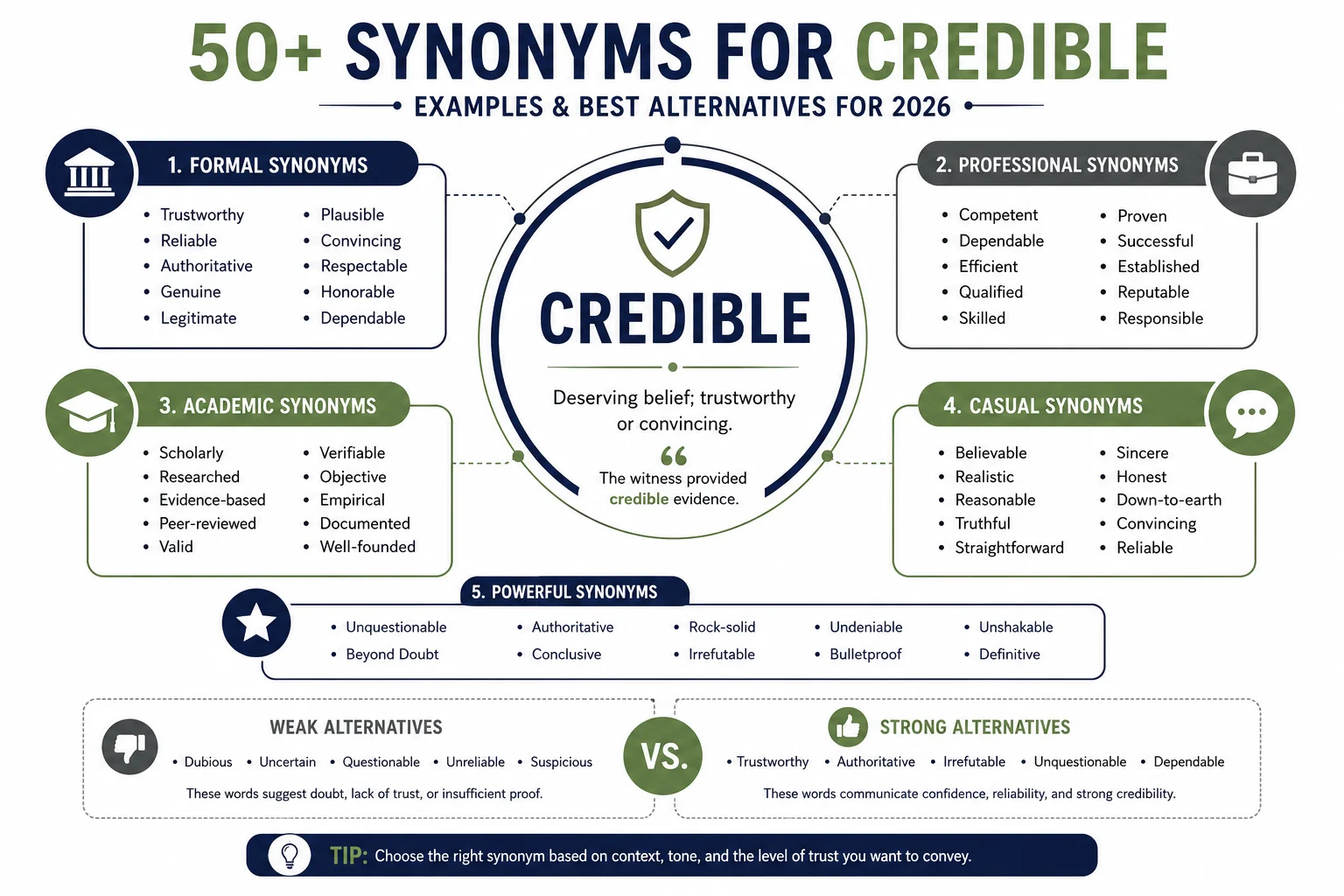
Credible means believable, trustworthy, or convincing enough to be accepted as true. The best synonyms include trustworthy for formal writing, believable for everyday use, reliable for professional contexts, and plausible for academic work.
What is the best credibility synonym when you want your writing to sound clear, trustworthy, and professional? Finding the right word can make your message more convincing. Whether you are writing an essay, business content, an academic paper, or everyday communication, choosing the right synonym for credibility matters.
Credibility means the quality of being trusted, believed, or considered reliable. Common synonyms of credibility include trustworthiness, reliability, authenticity, reputation, believability, and integrity. But which word fits your context best? That depends on what you want to express.
In this guide, you will discover credibility synonyms, their meanings, practical examples, and suitable contexts. We will also answer common questions such as “credibility meaning another word for,” “synonym for credibility,” “credibility what’s another word for,” “credibilidad sinonimo,” and “credibility معنى.” The examples are designed to help you choose words accurately and confidently.
Meaning, Tone and Context
1. Simple definition
Credible describes something that deserves belief or confidence. It applies to people, sources, information, arguments, and evidence.
2. Part of speech
Credible is an adjective. The noun form is credibility, and the adverb form is credibly.
3. Positive, negative, or neutral tone
Credible has a positive tone. It suggests honesty, accuracy, and reliability.
4. Formality level
Credible works in both formal and informal contexts. It is widely accepted across all communication styles.
5. Common use cases
You use credible for news sources, expert witnesses, research studies, business claims, personal statements, and historical accounts.
6. Important word forms
Adjective: credible
Noun: credibility
Adverb: credibly
Opposite: incredible or unbelievable
Related form: creditable, which means deserving praise
When and How to Use “Credible”
Use credible when you want to emphasize trustworthiness and believability. It works best when supporting evidence or reputation backs your claims.
Avoid using credible when you need emotional impact or vivid description. Stronger words like compelling or convincing often create more persuasive writing.
Here are examples across different contexts.
Professional context
The candidate presented a credible business plan with realistic financial projections.
Academic context
The researcher used only credible sources from peer reviewed journals.
Personal context
Her explanation of the situation seemed credible to everyone who knew her.
Creative context
The author built a credible fantasy world with consistent rules and believable characters.
Social media context
Always check if the account sharing health advice is credible before following their recommendations.
Email context
Please ensure all references in the report come from credible industry publications.
Resume context
Developed credible partnerships with five major distributors in the first quarter.
Another Word for “Credible”
The best single replacement depends entirely on your specific context and audience.
For professional writing
Trustworthy works best for business contexts. It emphasizes reliability and integrity in professional relationships.
For academic writing
Reliable serves academic purposes well. It focuses on consistency and dependability of sources and methods.
For casual conversation
Believable fits perfectly in everyday speech. It is straightforward and easy to understand.
For emotional writing
Compelling adds persuasive power. It suggests the information strongly influences opinions or decisions.
For creative writing
Authentic brings depth to descriptions. It implies genuine, original, and true to character.
For resume use
Dependable highlights your reliability as an employee. It suggests consistent performance and trustworthiness.
For social media captions
Solid works well for quick, impactful statements. It is modern and concise.
For stronger meaning
Irrefutable means impossible to deny or question. It suggests absolute certainty.
For softer meaning
Plausible means reasonably believable but not proven. It suggests possibility without certainty.
When Not to Use “Credible”
Credible sounds too vague when you need specific evidence or proof. A more precise synonym improves your message.
Weak usage
The witness gave a credible testimony.
Improved usage
The witness gave a compelling testimony supported by physical evidence.
Weak usage
Her argument was credible.
Improved usage
Her argument was convincing and changed several minds during the debate.
Weak usage
We need a credible source.
Improved usage
We need an authoritative source with verified credentials.
Weak usage
The product seems credible.
Improved usage
The product appears reliable based on customer reviews and testing data.
Words Commonly Confused With “Credible”
Several words share meaning with credible but carry distinct nuances. Understanding these differences helps you choose the right word every time.
Credible vs. Creditable
Credible means believable or trustworthy. Creditable means deserving praise or approval. You call a witness credible. You call their performance creditable.
Credible vs. Believable
Credible often implies evidence or reputation supports trust. Believable simply means possible to accept as true. A fantasy story can be believable but not necessarily credible.
Credible vs. Plausible
Credible suggests trustworthiness based on evidence or character. Plausible suggests reasonable or likely on the surface. A plausible excuse may not be credible under investigation.
Credible vs. Convincing
Credible focuses on trustworthiness. Convincing focuses on persuasive power. A convincing argument changes minds. A credible argument earns trust.
Credible vs. Dependable
Credible applies to information and sources. Dependable applies to people and things. A credible news outlet publishes dependable information.
Credible vs. Authentic
Credible means trustworthy. Authentic means genuine or original. An authentic document is not necessarily credible if it contains false information.
Best Synonym by Context for “Credible”
| Context | Best Synonym | Why It Works | Example |
|---|---|---|---|
| Formal writing | Trustworthy | Emphasizes integrity and reliability in official documents | The commission requires trustworthy evidence before making decisions |
| Academic writing | Reliable | Focuses on consistency and verifiable methods | Reliable data sources strengthen any research paper |
| Professional business | Dependable | Highlights consistent performance and trust | Our dependable supply chain ensures on time delivery |
| Resume use | Reputable | Shows professional standing and respect in your field | Managed projects for reputable clients in the technology sector |
| Casual conversation | Believable | Simple, natural language for everyday talk | His story about the dog was totally believable |
| Creative writing | Authentic | Adds depth and genuine quality to descriptions | The characters felt authentic and true to their time period |
| Emotional tone | Compelling | Adds persuasive power and emotional weight | Her compelling testimony moved the entire jury |
| Strong intensity | Irrefutable | Implies absolute certainty without question | The evidence against the suspect was irrefutable |
| Soft or moderate | Plausible | Suggests reasonability without demanding proof | A plausible explanation emerged from the initial investigation |
| Social media captions | Solid | Modern, concise, and impactful | Solid research supports these health recommendations |
| US usage | Trustworthy | Widely understood and preferred in American English | Trustworthy sources matter in American journalism |
| UK usage | Sound | Common in British formal and professional contexts | The committee gave sound advice to the government |
Which Synonym Should You Choose?
Choose the right synonym by considering three factors: your audience, your purpose, and the strength of your claim.
For formal and academic writing, select reliable or trustworthy. These words signal careful research and professional standards.
For business and workplace communication, choose dependable or reputable. These words emphasize professional standing and consistent performance.
For casual conversations, use believable or plausible. These words keep your message natural and accessible.
For emotional or persuasive writing, pick compelling or convincing. These words add power and influence to your message.
For creative work, select authentic or genuine. These words bring depth and realism to your descriptions.
For maximum impact, use irrefutable or unquestionable. These words leave no room for doubt.
For softer statements, choose plausible or reasonable. These words acknowledge uncertainty while maintaining credibility.
Real Life Examples of “Credible” in Sentences
School setting
The teacher required all students to use credible academic databases for their research papers.
Workplace context
Our manager asked for credible market data before approving the new product launch.
Writing scenario
Good writers build credible arguments by anticipating and addressing counterarguments.
Conversational use
Most people found the politician’s response barely credible after the controversy emerged.
Social media context
The viral post lacked credible sources, so informed readers ignored it completely.
Email communication
Please forward any credible information you find about the new compliance requirements.
Storytelling approach
The novelist created a credible dystopian society that felt disturbingly possible.
Professional negotiation
The client demanded credible proof of our company’s financial stability.
25 Synonyms for “Credible”
| Trustworthy | Deserving of trust and confidence | Professional and formal contexts | The company established itself as a trustworthy partner in the industry |
| Reliable | Consistently good and dependable | Academic and technical writing | Reliable weather forecasts require advanced modeling systems |
| Believable | Possible to accept as true | Everyday conversation | Her explanation was completely believable to everyone present |
| Convincing | Persuading through evidence or argument | Persuasive writing and speeches | The defense attorney presented a convincing case for acquittal |
| Plausible | Reasonably believable on the surface | Initial assessments and theories | The scientist proposed a plausible hypothesis for further testing |
| Dependable | Trustworthy and reliable over time | Business and professional use | Our team delivered dependable results despite tight deadlines |
| Reputable | Having a good reputation | Resume and professional references | She worked for several reputable law firms in New York |
| Authentic | Genuine and true to reality | Creative writing and storytelling | The documentary provided an authentic view of rural life |
| Authoritative | Backed by recognized expertise | Expert opinions and official statements | The authoritative study changed government policy on nutrition |
| Solid | Strong, sound, and reliable | Casual and professional use | We need solid evidence before making any accusations |
| Sound | Based on reason and good judgment | Formal and professional advice | The financial advisor gave sound recommendations for retirement |
| Valid | Logically correct and legally sound | Legal and academic arguments | The contract remained valid despite the minor error |
| Verifiable | Able to be confirmed or proven | Research and investigative contexts | All claims in the article were verifiable through public records |
| Rational | Based on reason rather than emotion | Logical arguments and decisions | Her rational explanation cleared up all misunderstandings |
| Reasonable | Fair and sensible | Everyday decisions and opinions | The judge found his request reasonable under the circumstances |
| Cogent | Clear, logical, and convincing | Formal arguments and presentations | The professor made a cogent argument for curriculum reform |
| Tenable | Capable of being defended | Academic debates and positions | His theory remained tenable after peer review |
| Substantiated | Supported with evidence | Legal and investigative writing | The reporter substantiated every claim with documentary proof |
| Legitimate | Valid and proper | Legal and business contexts | The organization maintained legitimate business practices |
| Honest | Truthful and sincere | Personal and ethical contexts | Honest communication built strong team relationships |
| Sincere | Genuine and heartfelt | Emotional and interpersonal use | Her sincere apology convinced everyone of her regret |
| Unquestionable | Beyond any doubt | Strong, definitive statements | The witness provided unquestionable testimony in court |
| Irrefutable | Impossible to disprove | Scientific and legal certainty | The DNA evidence proved irrefutable in the murder trial |
| Trusty | Reliable and dependable | Informal and friendly use | My trusty assistant confirmed all the appointments |
| Satisfactory | Meeting required standards | Professional evaluations | The audit produced satisfactory results for the committee |
Synonym Groups and Usage Differences
Professional vs. Personal Synonyms
Professional synonyms focus on competence and performance. Dependable, reputable, and solid work well in business contexts. They emphasize reliability in work relationships.
Personal synonyms focus on honesty and sincerity. Trustworthy, sincere, and authentic work better for personal relationships. They emphasize genuine character and emotional connection.
Formal vs. Conversational Synonyms
Formal synonyms include cogent, tenable, and irrefutable. These words belong in academic papers, legal documents, and official reports. They demonstrate precision and careful reasoning.
Conversational synonyms include believable, plausible, and solid. These words work well in everyday speech, emails, and casual writing. They feel natural and accessible.
Academic Synonyms
Academic writing demands precise, evidence based language. Reliable, verifiable, and sound work best for research contexts. These words emphasize methodology and scholarly rigor.
Other strong academic choices include substantiated, tenable, and rational. These words show careful thinking and logical structure. They help establish intellectual credibility.
Professional and Business Synonyms
Business communication needs clear, confident language. Trustworthy, reputable, and dependable convey professionalism. These words help build client and partner confidence.
Valid, satisfactory, and legitimate work well for contracts and official documents. They suggest compliance and proper procedure. These words protect against legal and ethical concerns.
Creative or Literary Synonyms
Creative writing benefits from vivid, descriptive language. Authentic, genuine, and compelling add depth to character and setting. These words help readers connect emotionally with your work.
Cogent and convincing work well for persuasive creative writing. They help arguments feel both artistic and logical. These words balance creativity with substance.
Slang or Modern Synonyms
Modern contexts sometimes use “solid” as a casual synonym. Young professionals use it frequently in workplace conversations. It works well for quick positive assessments.
“Trusty” offers an informal, friendly alternative. It suggests long standing reliability. Use it carefully in professional settings.
Strongest vs. Weaker Synonyms
Intensity scale from mild to strongest:
Plausible (mildest) suggests simple reasonability without proof.
Believable offers basic acceptance of truth.
Convincing implies persuasive power and influence.
Trustworthy suggests earned confidence and integrity.
Substantiated means supported by verified evidence.
Irrefutable (strongest) leaves absolutely no room for doubt.
Emotional vs. Neutral Synonyms
Emotional synonyms add feeling and connection. Compelling, moving, and powerful suggest deep impact. These words work well for persuasive and creative writing.
Neutral synonyms stay factual and objective. Verifiable, reliable, and valid focus on evidence and logic. These words suit academic and professional contexts.
Antonyms of “Credible”
| Antonym | Meaning | Example Sentence |
|---|---|---|
| Incredible | Impossible or hard to believe | The witness gave an incredible account that no one accepted |
| Unbelievable | Not seeming true or possible | His unbelievable story raised suspicions among investigators |
| Implausible | Not seeming reasonable or likely | The defendant offered an implausible explanation for his absence |
| Unreliable | Not trustworthy or dependable | The source proved unreliable after multiple fact checking failures |
| Dubious | Doubtful or uncertain | Many people found her dubious claims hard to accept |
| Untrustworthy | Not deserving of trust | The company gained a reputation for untrustworthy business practices |
| Questionable | Doubtful in quality or honesty | The politician made questionable promises during the campaign |
| Suspicious | Causing distrust or doubt | His suspicious behavior made colleagues question his motives |
| Disreputable | Having a bad reputation | The disreputable website spread false information regularly |
| Fraudulent | Intentionally deceitful and dishonest | The fraudulent report misled investors for several years |
| Fishy | Seeming dishonest or suspicious | Something felt fishy about the sudden resignation |
| Shady | Of questionable honesty | The shady transaction caught the auditor’s attention |
| Unsubstantiated | Not supported by evidence | The unsubstantiated rumor spread quickly through social media |
| Untenable | Impossible to defend or justify | The company’s untenable position forced them to withdraw the claim |
| Deceitful | Dishonest and misleading | The deceitful testimony damaged the case against the defendant |
Comparison: Credible vs. Similar Words
Credible vs. Trustworthy
Main difference
Credible focuses on whether information deserves belief. Trustworthy focuses on whether a person or institution deserves confidence.
Which one is stronger
Both are equally strong but apply to different contexts.
Which one is more formal
Trustworthy appears more formal in most contexts.
Example for credible
The expert provided credible testimony during the trial.
Example for trustworthy
The organization maintained trustworthy relationships with all clients.
Credible vs. Believable
Main difference
Credible implies supporting evidence or reputation. Believable simply means possible to accept without strong evidence.
Which one is stronger
Credible carries more weight than believable.
Which one is more formal
Credible works better in formal and professional contexts.
Example for credible
The researcher offered credible explanations backed by data.
Example for believable
The actor made the science fiction character believable.
Credible vs. Convincing
Main difference
Credible emphasizes trustworthiness. Convincing emphasizes persuasive power and influence.
Which one is stronger
Convincing often has stronger emotional impact.
Which one is more formal
Credible is more formal and objective.
Example for credible
The study provided credible findings accepted by peers.
Example for convincing
The sales pitch was so convincing that everyone signed up.
Credible vs. Plausible
Main difference
Credible suggests proven or established trustworthiness. Plausible suggests reasonable appearance without certainty.
Which one is stronger
Credible is much stronger than plausible.
Which one is more formal
Both work formally, but credible carries more authority.
Example for credible
The witness gave credible testimony supported by documents.
Example for plausible
His plausible theory needed further testing to confirm.
Credible vs. Reputable
Main difference
Credible applies to information, sources, and arguments. Reputable applies to people, organizations, and institutions.
Which one is stronger
Both are strong but apply to different subjects.
Which one is more formal
Reputable appears more formal and business oriented.
Example for credible
The report used credible statistics from government sources.
Example for reputable
She graduated from a reputable university with honors.
Credible vs. Authentic
Main difference
Credible means trustworthy or believable. Authentic means genuine, original, or true to character.
Which one is stronger
Both are strong but emphasize different qualities.
Which one is more formal
Credible suits formal contexts better than authentic.
Example for credible
The historian used credible documents from the national archive.
Example for authentic
The authentic artifacts revealed new information about the culture.
Common Phrases and Expressions with “Credible”
1. Credible source
Meaning A person, publication, or organization that provides trustworthy information.
Example sentence The professor required students to cite only credible sources in their research papers.
2. Credible threat
Meaning A danger or risk that seems genuine and serious.
Example sentence Security officials took the credible threat seriously and increased patrols.
3. Credible evidence
Meaning Reliable proof that supports a claim or argument.
Example sentence The defense team failed to produce credible evidence of their client’s innocence.
4. Credible witness
Meaning A person whose testimony is trustworthy and believable.
Example sentence The prosecution called three credible witnesses to confirm the defendant’s whereabouts.
5. Credible candidate
Meaning A person considered seriously for a position due to their qualifications.
Example sentence Several credible candidates emerged during the recruitment process.
6. Lacks credibility
Meaning Not trustworthy or believable in any way.
Example sentence The witness’s story lacked credibility after contradicting the security footage.
7. Establish credibility
Meaning To prove oneself trustworthy and reliable.
Example sentence The new manager worked hard to establish credibility with her team.
Common Mistakes to Avoid
1. Using credible when you need specific evidence
Credible suggests trustworthiness without specifying why. Use validated, confirmed, or substantiated when you have concrete proof.
Incorrect We found a credible reason for the delay.
Correct We found a confirmed reason for the delay.
2. Confusing credible with creditable
Credible means believable. Creditable means deserving praise. These words sound similar but have distinct meanings.
Incorrect Her performance was credible and earned her a bonus.
Correct Her performance was creditable and earned her a bonus.
3. Using reliable for emotional contexts
Reliable sounds clinical and factual. Use compelling or convincing when you need emotional impact.
Incorrect The reliable argument moved the audience to tears.
Correct The compelling argument moved the audience to tears.
4. Overusing plausible in professional settings
Plausible suggests uncertainty. Use authoritative or irrefutable when you need strong professional claims.
Incorrect Our plausible data shows market growth.
Correct Our verified data shows market growth.
5. Repeating credible too often
Repetitive use of credible weakens your writing. Use varied synonyms to maintain reader engagement.
Incorrect The credible report used credible sources with credible evidence.
Correct The reliable report used authoritative sources with substantiated evidence.
6. Using dubious when you mean questionable
Dubious suggests active doubt or suspicion. Questionable simply suggests uncertainty.
Incorrect The dubious results needed verification.
Correct The questionable results needed verification.
7. Using suspicious in casual conversation
Suspicious can sound accusatory. Use questionable or doubtful for gentler meaning.
Incorrect Her suspicious behavior concerned everyone.
Correct Her questionable behavior concerned everyone.
FAQs
1. What is the best synonym for credible?
Trustworthy serves as the best overall synonym for most contexts. It works well in formal, professional, and personal situations.
2. What is a formal synonym for credible?
Reliable, authoritative, and verifiable are excellent formal synonyms. They suit academic and professional writing perfectly.
3. What is an informal synonym for credible?
Believable works well for casual conversation. Solid also works in modern, informal contexts.
4. What is another word for credible in professional writing?
Reputable and dependable are strong alternatives. They emphasize professional standing and consistent performance.
5. What is the difference between credible and plausible?
Credible suggests proven trustworthiness. Plausible suggests reasonable appearance without certainty.
6. What is the opposite of credible?
Incredible and unbelievable are direct opposites. Untrustworthy and unreliable also work as antonyms in different contexts.
Conclusion
Credible means believable, trustworthy, and worthy of confidence. This versatile word appears across formal, professional, and casual contexts.
The best synonym depends on your situation. Use trustworthy for formal writing, believable for conversation, compelling for persuasion, and irrefutable for absolute certainty. Always consider your audience, purpose, and the strength of your claim.
Strong vocabulary transforms ordinary writing into powerful communication. Start using these synonyms today. Your readers will notice the difference immediately.
Vocabulary tip for the week Replace every “credible” in your current draft with a more specific synonym. Notice how each change improves precision and impact.
