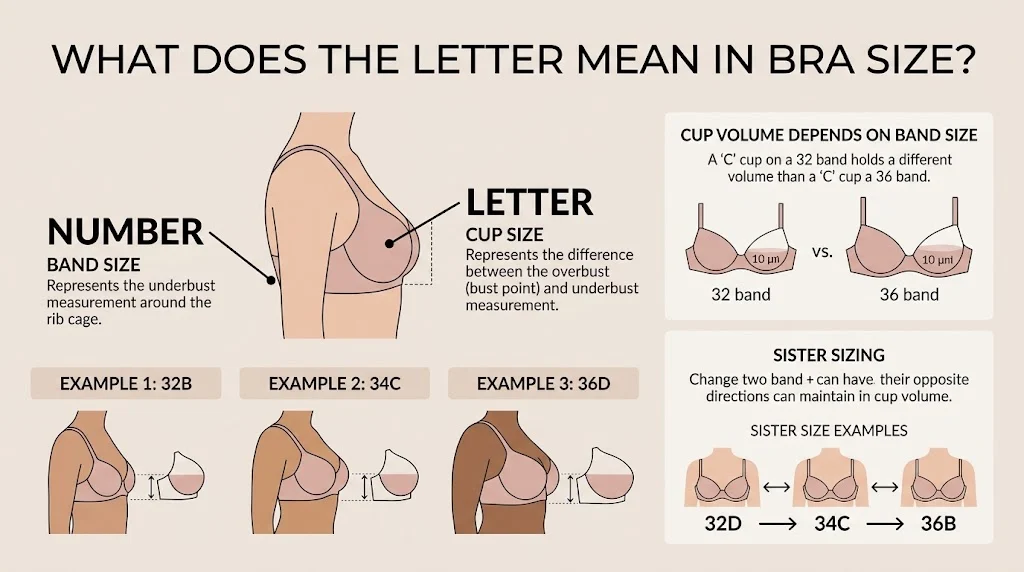
The letter in a bra size represents the cup size, which indicates breast volume relative to the band measurement. A larger letter generally means a larger cup relative to that band, but cup volume also changes with band size.
What does the letter mean in bra size? The letter identifies the cup portion of a bra size, while the number identifies the band measurement around the torso. Together, they describe how the bra should fit around the body and over the breasts.
However, cup letters do not represent one fixed breast size. An important detail often gets overlooked: a D cup does not have the same volume across every band size. For example, a 32D and a 38D have different cup volumes.
This distinction makes bra sizing easier to understand. Instead of treating A, B, C, or D as independent measurements, think of the letter as part of a two part sizing system.
The number and letter work together.
For example, in 34C, 34 refers to the band size, while C refers to the cup size. In 36D, 36 refers to the band, while D refers to the cup.
Furthermore, brands can use slightly different sizing systems. Fit can also vary because of breast shape, bra construction, fabric, and personal preference.
This guide explains the meaning behind cup letters, how they relate to band measurements, why sister sizes matter, and how people commonly discuss bra sizes in everyday conversations.
Quick Answer Box
| Meaning | Context | Primary Platforms | Example | Tone |
| Cup letter | Indicates breast volume relative to the band | Retail websites, fitting guides, texting, social media | 34C means a 34 band with a C cup | Informational |
| Band number | Indicates the measurement around the torso | Bra size charts and fitting discussions | 34C means approximately a 34 band | Practical |
| A, B, C, D | Common cup designations | Retail and fashion contexts | “I usually wear a C cup.” | Casual |
| Double letters | Larger cup designations in many systems | Retail sizing | DD or E may follow D | Technical |
| Sister size | A related size with similar cup volume | Fitting conversations | 34C and 36B can have similar cup volume | Practical |
What Does the Letter Mean in Bra Size?
The letter in a bra size indicates the cup size. More precisely, it describes the difference between the band measurement and the measurement around the fullest part of the bust.
That difference helps manufacturers assign a cup letter.
For example, a bra marked 34C combines two pieces of information:
| Part | Meaning |
| 34 | Band size |
| C | Cup size |
| 34C | The complete bra size |
The cup letter therefore does not work independently.
A C cup on a smaller band is not necessarily the same physical cup volume as a C cup on a larger band. This concept is central to understanding bra sizing.
Why the Letter Is Not a Standalone Breast Measurement
Many people assume that an A cup always means a small bust and that a D cup always means a large bust. That interpretation oversimplifies the sizing system.
Cup volume changes with band size.
For example, consider related sizes such as 32D, 34C, and 36B. These sizes can have similar cup volume even though their letters differ.
This relationship is known as sister sizing.
Therefore, the letter tells you about the cup in relation to the band. It does not provide a universal measurement of breast volume.
How Cup Letters Usually Progress
Most bra sizing systems move through letters in a sequence.
A typical sequence may look like this:
| Cup designation | General position in the sequence |
| AA | Smaller cup designation |
| A | Next designation |
| B | Next designation |
| C | Next designation |
| D | Next designation |
| DD or E | Larger designation |
| DDD or F | Larger designation |
| G and beyond | Progressively larger designations |
However, the exact sequence differs between brands and countries.
Some brands use DD after D. Others use E. Some systems use both double and single letters at different points.
Consequently, you should always check the specific brand’s size chart before assuming that two labels are equivalent.
The Difference Between Band Size and Cup Size
The number and letter answer different questions.
The band number relates to the torso measurement around the rib cage. The cup letter relates to bust volume relative to that band.
A simple way to remember this distinction is:
| Size component | Main information |
| Number | Band measurement |
| Letter | Cup designation |
| Complete size | Band plus cup |
This explains why 32D and 40D should not be treated as identical sizes.
The letter stays the same, but the underlying band changes.
Contextual Dynamics and Nuances of the Term
Bra size terminology can appear in several contexts. People discuss sizes while shopping, comparing fit, asking for advice, or talking about clothing.
The meaning usually stays the same. However, the reason someone mentions a size can change the conversation.
Shopping Context
A person might say:
“I need a 36C.”
Here, the size functions as a practical shopping specification.
They may be searching an online store, checking availability, or asking whether a particular style comes in their size.
Fitting Context
Someone might say:
“This band feels tight, but the cups fit.”
That statement provides more information than the cup letter alone.
The person may need a different band and cup combination rather than simply moving to a larger cup.
For example, sister sizing may provide another option.
Fashion Context
Bra sizes can also appear when people discuss clothing fit.
A person might ask whether a particular dress works well with a certain bra size. In that situation, the conversation often focuses on support, neckline shape, coverage, or strap placement.
Therefore, the size itself does not tell the whole story.
Social Media Context
On social platforms, people sometimes use bra sizes casually. They may discuss shopping experiences, fitting problems, lingerie recommendations, or clothing measurements.
However, context matters.
A bra size is personal information for many people. Someone mentioning their own size does not automatically invite questions about another person’s body.
A respectful conversation focuses on the practical issue rather than making assumptions about someone’s appearance.
Why Context Changes Interpretation
Consider these three statements:
“I wear a 34C.”
“Does this brand carry 34C?”
“Why does my 34C bra fit differently from my other bras?”
All three mention the same size. Yet each sentence has a different purpose.
The first identifies a personal clothing size.
The second asks about product availability.
The third describes a fit issue.
Understanding the surrounding sentence prevents unnecessary confusion.
Real Life Conversation Examples Using What Does the Letter Mean in Bra Size
People often ask this question because bra sizing looks confusing at first. The following conversations show how the topic can appear naturally.
Example 1: Basic Question
Person A: I understand the number, but what does the letter mean in bra size?
Person B: The letter is the cup size. It describes the cup volume relative to the band.
Person A: So the C in 34C is the cup?
Person B: Exactly. The 34 is the band measurement.
This is the most straightforward use. The speaker wants a basic explanation of the sizing system.
Example 2: Shopping Conversation
Person A: What size should I look for?
Person B: I usually wear 34C.
Person A: Does the store use US sizing?
Person B: Yes. Still, I would check their chart because brands can fit differently.
Here, the size works as a shopping reference.
Example 3: Sister Size Question
Person A: My 34C feels tight around the band.
Person B: You could compare it with a sister size.
Person A: Would that change the cup?
Person B: Yes. A larger band usually pairs with a smaller cup letter to maintain similar cup volume.
This conversation introduces an important sizing concept without treating letters as fixed physical measurements.
Example 4: Brand Difference
Person A: I normally wear 36D, but this brand’s 36D feels different.
Person B: That can happen. Bra construction and brand sizing can affect the fit.
Person A: So the label doesn’t guarantee an identical fit?
Person B: Right. The size label gives a starting point, not a guarantee.
This example highlights why trying a bra or checking the brand’s measurement guide can matter.
Example 5: Respectful Conversation
Person A: I need help understanding bra sizes.
Person B: Sure. Are you asking about the number or the letter?
Person A: The letter. I never understood what it represented.
Person B: It refers to the cup designation. The number and letter work together.
This approach keeps the discussion practical and avoids unnecessary comments about someone’s body.
Platform Specific Breakdown
How It Is Used on Snapchat
Snapchat conversations tend to be brief and informal. People may discuss clothing, shopping, fashion, or personal measurements through direct messages.
A bra size can therefore appear in a practical question such as:
“Do you know if this brand carries 32D?”
Another person might ask for clarification about sizing terminology.
However, Snapchat does not give bra size letters a special universal meaning. The interpretation depends on the surrounding conversation.
If someone sends a message containing a letter and a number, do not automatically assume it refers to a bra size. The same combinations can appear in product codes, clothing sizes, measurements, school references, or other contexts.
For example, “34C” could mean a bra size in a fashion conversation. It could mean something entirely different elsewhere.
Context remains the deciding factor.
The Role of What Does the Letter Mean in Bra Size on TikTok
TikTok frequently turns everyday questions into short educational content. Bra fitting is one such topic.
Creators may discuss cup letters, band measurements, sister sizes, bra styles, fitting problems, or shopping experiences.
However, TikTok content varies widely in accuracy.
A creator may simplify the sizing system to make a short video easier to understand. That can help beginners, but simplification can also leave out important details.
For example, saying “D means large breasts” is an incomplete explanation.
A more accurate explanation recognizes that cup volume depends on band size.
Comments can add another layer of confusion. Users may share their own sizes and experiences, but personal experiences do not establish a universal sizing rule.
Therefore, treat short videos as starting points rather than substitutes for a brand’s measurement chart.
Instagram and Texting Dynamics
Instagram conversations often overlap with fashion, lingerie, clothing, and shopping content.
A person may mention a size while discussing a particular product. They might also ask whether a garment provides enough support.
Texting works similarly.
For example:
“Do they have this in 34B?”
That sentence almost certainly refers to a clothing size when the conversation concerns bras.
However, if the earlier messages concern something unrelated to clothing, the same combination may have another meaning.
In direct messages, short phrases often depend heavily on previous context.
Consequently, reading the surrounding messages is more reliable than interpreting one isolated abbreviation.
Online Shopping and Product Pages
Retail websites typically display sizes using a number and a letter. They may also provide regional conversion charts.
A US retailer could show sizes differently from a UK or EU retailer. Therefore, shoppers should confirm the sizing system before ordering.
Some sites provide measurements in inches. Others use centimeters. Some provide separate band and bust measurements.
The safest approach is to use the retailer’s current size guide rather than assuming that a size label translates perfectly across brands.
Alternative Meanings and NLP Variations of the Phrase
Search engines and AI systems may encounter many variations of the same question.
Common versions include:
“What does the letter mean in a bra size?”
“What does the cup letter mean?”
“What do A, B, C, and D mean in bra sizes?”
“What does the C mean in 34C?”
“What does the D stand for in bra size?”
“What is the letter part of a bra size?”
“What does the cup size mean?”
“What do bra cup letters represent?”
These phrases share the same search intent.
From an NLP perspective, the core concepts include cup size, band size, bust measurement, bra fitting, sister sizes, sizing charts, and cup volume.
Semantic Variations
Searchers may use different vocabulary while asking essentially the same question.
| Search phrase | Core concept |
| Cup letter | Cup designation |
| Bra cup size | Cup volume relative to band |
| Letter in bra size | Cup designation |
| Number in bra size | Band size |
| Sister size | Related size with similar cup volume |
| Bra measurement | Sizing process |
| Bust measurement | Measurement around fullest bust area |
| Band measurement | Measurement around rib cage |
These variations help explain why a comprehensive resource should not repeat one phrase in every sentence.
Natural language gives search engines more context.
Why Exact Letter Meanings Can Vary
Bra sizing is not completely standardized across every market and manufacturer.
A letter sequence can differ between systems.
For example, one brand might label a particular cup as DD, while another uses E. International sizing can also introduce different numbers and letters.
Therefore, an answer that treats every global sizing chart as identical can mislead readers.
The better approach is to explain the general principle and then direct readers to the relevant brand or regional chart for exact conversions.
Misinterpretations:
The phrase is useful when someone genuinely asks about bra sizing. It becomes less appropriate when the context does not concern bras or clothing.
Do Not Assume a Letter Combination Is a Bra Size
Suppose someone writes “32B” in a conversation about school grades or product specifications.
You should not automatically interpret it as a bra size.
Likewise, a standalone letter such as “D” has countless meanings.
Context determines meaning.
Do Not Treat Cup Letters as Universal Body Categories
Another common mistake involves turning cup letters into broad descriptions of someone’s body.
For example, saying that every D cup represents the same breast volume creates an inaccurate picture.
Cup letters work with band measurements.
The complete size matters.
Do Not Assume a Larger Letter Always Means a Larger Bust
This is another common misunderstanding.
Compare 32D with 40D. Both use D, but their cup volumes are not identical.
Similarly, sister sizes can have different letters while maintaining comparable cup volume.
Therefore, a letter alone cannot accurately describe someone’s overall breast size.
Do Not Use the Phrase as a Substitute for a Fit Assessment
Knowing the meaning of the letter does not automatically tell you whether a bra fits.
A proper fit also involves the band, cups, straps, center gore, underwire when present, and overall comfort.
A person can wear a technically correct labeled size and still dislike the fit because the bra’s design does not suit their shape or preferences.
How to Respond in Chat Comfortably
When someone asks about bra sizing in a message, a short and factual response usually works well.
You do not need to make the conversation awkward.
Simple Response
“The letter is the cup size. The number is the band size.”
This works when someone wants a basic definition.
More Detailed Response
“The letter refers to the cup designation, while the number refers to the band. The two work together, so a C cup isn’t exactly the same volume across every band size.”
This version works when someone wants more context.
Shopping Response
“If you’re buying one, check the brand’s size chart too. Sizing can vary between brands and regions.”
This response adds practical information without overcomplicating the conversation.
When Someone Seems Confused
You can explain the two components separately.
“The number tells you about the band around your torso. The letter tells you about the cup relative to that band.”
That explanation avoids the common mistake of describing cup letters as standalone measurements.
When Someone Asks About Another Person’s Size
Keep the conversation respectful.
If the information has not been volunteered, avoid guessing or asking intrusive questions. Instead, focus on the clothing or fitting issue.
For example:
“If you’re trying to choose a gift, a retailer’s exchange policy may be more useful than guessing someone’s size.”
This keeps the conversation practical and considerate.
FAQs
1. What does the letter mean in bra size?
The letter represents the cup designation. It describes cup volume relative to the band measurement. The number and letter must be considered together.
2. What does the number mean in a bra size?
The number represents the band size. It relates to the measurement around the torso beneath the bust, although exact measurement methods vary by sizing system.
3. Does a D cup always mean a large bust?
No. Cup volume changes with band size. A D cup on a smaller band does not have the same volume as a D cup on a larger band.
4. Is a C cup the same in every band size?
No. A C cup changes in volume as the band size changes. That is why related sizes can use different letters while having similar cup volume.
5. What are sister sizes?
Sister sizes are bra sizes that have similar cup volume but different band and cup combinations. For example, moving to a larger band generally involves moving to a smaller cup letter to maintain similar cup volume.
6. Why do bra sizes differ between brands?
Brands can use different measurement methods, patterns, materials, and grading systems. As a result, the same labeled size can feel different between manufacturers.
7. Are DD and E the same?
Not always. Some sizing systems use DD, while others use E at a comparable point in the sequence. Regional and brand conventions can differ, so checking the specific chart is important.
8. Can breast shape affect bra fit?
Yes. Breast shape, fullness distribution, tissue placement, and bra construction can affect how a cup fits. Two people with the same labeled size can prefer different bra styles.
9. Is bra size the same worldwide?
No. Different countries and brands use different sizing conventions. US, UK, EU, and other systems can use different numbers, letters, or conversion methods.
10. What should I check besides the cup letter?
Check the band, cup coverage, cup shape, straps, center area, underwire when applicable, and overall comfort. A size label is only one part of the fitting process.
Conclusion:
What does the letter mean in bra size? In practical terms, the letter identifies the cup designation, while the number identifies the band size.
The most important point is that the letter should never be interpreted alone.
A cup letter describes volume relative to a particular band. Consequently, the same letter can represent different physical cup volumes across different band sizes.
Sister sizing further demonstrates why bra labels require context. A different letter does not necessarily mean a completely different cup volume.
Brand and regional differences also matter. A US size may not map directly to a UK or EU label. Therefore, shoppers should use the relevant manufacturer’s size chart when choosing a bra.
Online conversations add another layer. On Snapchat, TikTok, Instagram, and messaging apps, people may mention bra sizes while discussing shopping, fashion, fitting, or clothing. The surrounding conversation determines whether a number and letter actually refer to a bra size.
Ultimately, the simplest explanation remains the most useful: the number describes the band, and the letter describes the cup. Together, they create the bra size.
