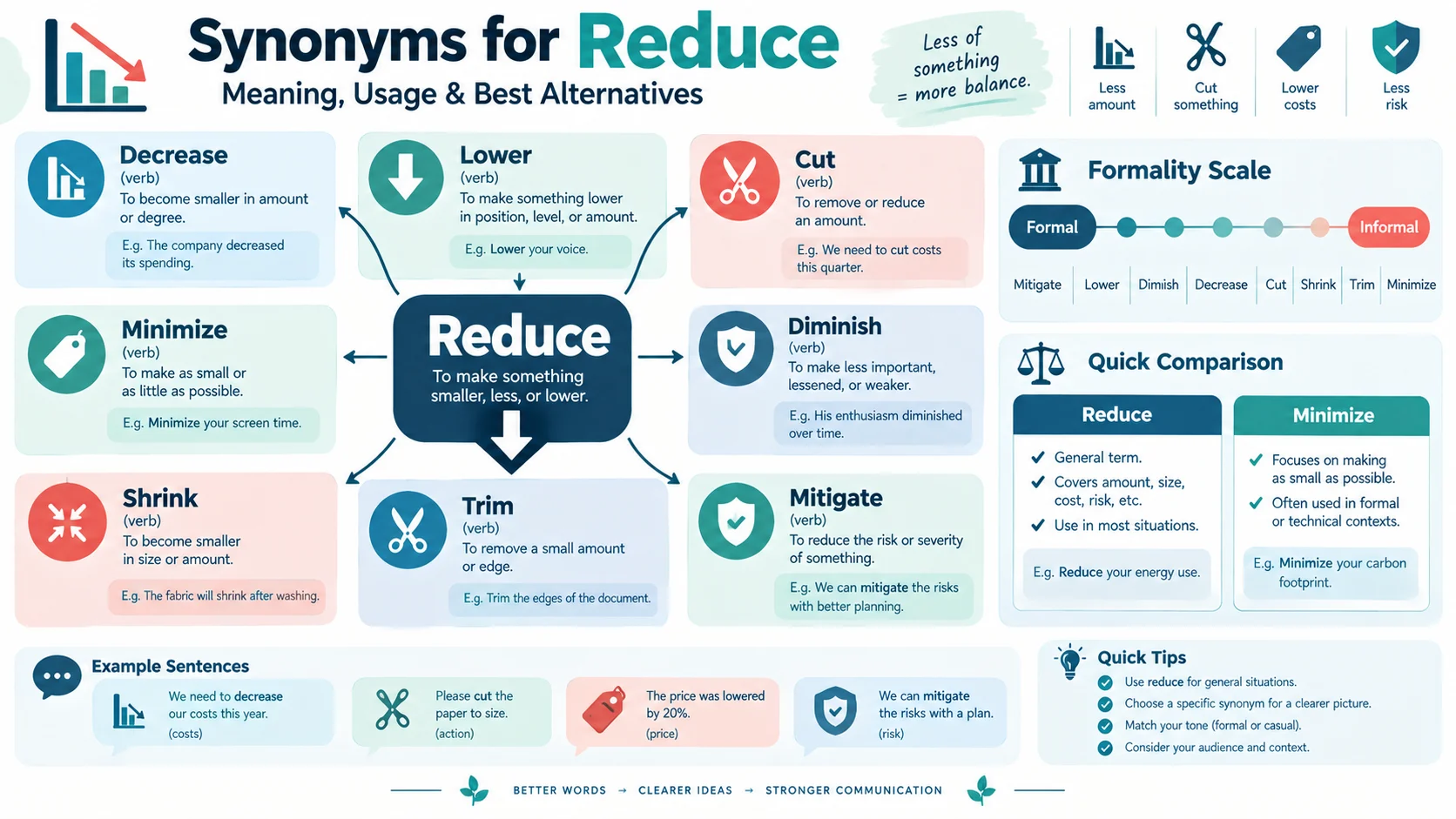
Reduce means to make something smaller, less, or lower in amount, size, or degree. The best synonyms depend on context: use decrease for numbers, cut for budgets, lower for prices, and minimize for risks.Top 10 Synonyms:
- Decrease
- Lower
- Cut
- Minimize
- Diminish
- Shrink
- Trim
- Lessen
- Curtail
- Scale back
Every synonym has a slightly different meaning, tone, or context. Choosing the right one makes your writing clearer and more natural.
Have you ever noticed how often you use the word “reduce” in a single day?
You might write an email asking a colleague to reduce costs. You might explain in a meeting that you need to reduce risk. You might tell a friend you are trying to reduce your screen time.
It is a practical, hardworking word. But using it again and again makes your writing sound repetitive and flat.
Imagine you are writing a business report and every sentence says “reduce.” Or you are drafting an essay about climate change and you keep repeating the same verb. The meaning is clear, but the writing feels dull.
This guide solves that problem. You will learn thirty powerful alternatives for “reduce,” each with its own tone, formality level, and best context. By the end, you will know exactly which word to use in every situation, from casual conversation to formal academic writing.
What Does “Reduce” Mean?
Definition
Reduce means to make something smaller in size, amount, degree, or importance.
In everyday English, it usually means making something less than it was before. You might reduce the volume on your television, reduce the number of meetings on your calendar, or reduce your monthly spending.
The word also appears in formal contexts. Scientists talk about reducing emissions. Businesses work to reduce waste. Doctors discuss reducing inflammation. Government officials announce plans to reduce taxes.
A useful way to think about reduce is this: something existed at one level, and now it exists at a lower level. The change moves downward. That simple idea connects all its meanings.
Pronunciation
US IPA: /rɪˈduːs/
UK IPA: /rɪˈdjuːs/
Syllables: 2 (re-duce)
Tip: Stress the second syllable “DUCE.” The first syllable sounds like “rih,” not “ree.” In American English, the “u” sounds like “oo.”
Grammar
| Grammar Feature | Information |
|---|---|
| Part of Speech | Transitive verb |
| Common Position | After subject, before object |
| Typical Pattern | Subject + reduce + object (OR reduce + object + by/to + amount) |
Example sentences:
- “The company plans to reduce its carbon emissions by 2030.”
- “We need to reduce the number of errors in this report.”
- “She reduced her working hours to spend more time with family.”
Grammar note: Reduce is a transitive verb, so it always needs an object. You cannot say “The numbers reduced.” You must say “We reduced the numbers” or “The numbers were reduced.” This is a common mistake among English learners.
Word Family
| Word | Part of Speech | Meaning |
|---|---|---|
| Reduce | Verb | To make something smaller or less |
| Reduction | Noun | The act of making something smaller |
| Reduced | Adjective | Made smaller or lower |
| Reducible | Adjective | Able to be made smaller |
| Reducing | Verb form | The ongoing act of making smaller |
12 Synonyms of “Reduce”
Decrease
Meaning: To become smaller or make something smaller in number, size, or amount.
Best Used For: Academic writing, business reports, data analysis, formal communication.
Formality: Neutral to Formal
Tone: Neutral, Professional
Frequency: ⭐⭐⭐⭐⭐ Very Common
CEFR Level: B1
Example Sentence 1: “The study shows that stress levels decrease significantly after regular exercise.”
Example Sentence 2: “We need to decrease our production costs without lowering quality.”
Usage Tip: Decrease is one of the safest and most versatile alternatives. It works well with numbers, statistics, and measurable amounts. Native speakers use it constantly in business and academic settings. It is slightly more formal than “reduce” in casual speech.
Common Confusion: Decrease vs Reduce. Decrease often describes something becoming smaller on its own. Reduce usually means someone actively makes it smaller. “Sales decreased” versus “We reduced our prices.”
Lower
Meaning: To move something down or make it less in amount, level, or value.
Best Used For: Business writing, pricing discussions, everyday conversation, formal announcements.
Formality: Neutral
Tone: Professional, Neutral
Frequency: ⭐⭐⭐⭐⭐ Very Common
CEFR Level: A2
Example Sentence 1: “The store decided to lower prices during the holiday season.”
Example Sentence 2: “Doctors recommend lowering salt intake to improve heart health.”
Usage Tip: Lower is simple, clear, and widely understood. It works best with prices, levels, rates, and sounds. It sounds slightly more natural than “reduce” in casual conversation. Use it when the change is easy to measure.
Cut
Meaning: To make something smaller, usually quickly or significantly.
Best Used For: Business writing, news reports, informal conversation, headlines.
Formality: Neutral to Informal
Tone: Direct, Decisive
Frequency: ⭐⭐⭐⭐⭐ Very Common
CEFR Level: A2
Example Sentence 1: “The company cut its marketing budget by twenty percent.”
Example Sentence 2: “You should cut back on sugar if you want more energy.”
Usage Tip: Cut is short, strong, and direct. It suggests a firm decision, often a sudden one. It is very common in business and news writing. However, it can sound too blunt in formal academic writing. Native speakers love it in headlines and casual speech.
Common Confusion: Cut vs Reduce. Cut feels sharper and more decisive. Reduce feels more neutral and measured.
Minimize
Meaning: To make something as small as possible.
Best Used For: Academic writing, business strategy, risk management, professional documents.
Formality: Formal
Tone: Professional, Serious
Frequency: ⭐⭐⭐⭐ Common
CEFR Level: B2
Example Sentence 1: “Our goal is to minimize disruption during the office move.”
Example Sentence 2: “Wearing a helmet can minimize the risk of head injury.”
Usage Tip: Minimize does not just mean make smaller. It means make as small as you possibly can. Use it when you want to emphasize the goal of reaching the lowest possible level. It sounds professional and strategic. Avoid it in casual conversation.
Diminish
Meaning: To become or make something less in size, importance, or intensity.
Best Used For: Formal writing, literature, academic essays, emotional descriptions.
Formality: Formal
Tone: Literary, Serious, Neutral
Frequency: ⭐⭐⭐ Moderate
CEFR Level: B2
Example Sentence 1: “Her enthusiasm did not diminish after the first setback.”
Example Sentence 2: “The medication gradually diminished the pain in his back.”
Usage Tip: Diminish often describes things you cannot measure with numbers, like power, importance, or feelings. It sounds elegant and slightly literary. Use it in essays or formal writing. It is less common in everyday speech.
Shrink
Meaning: To become smaller in size or amount.
Best Used For: Everyday conversation, descriptive writing, business contexts about size.
Formality: Neutral to Informal
Tone: Casual, Descriptive
Frequency: ⭐⭐⭐⭐ Common
CEFR Level: A2
Example Sentence 1: “My favorite sweater shrank in the dryer.”
Example Sentence 2: “The company’s profits shrank during the economic downturn.”
Usage Tip: Shrink usually describes physical size, but it also works for money and resources. It often suggests something becoming smaller on its own. It sounds natural in conversation. Avoid it when you want to sound highly formal.
Trim
Meaning: To make something smaller by removing unnecessary parts.
Best Used For: Business writing, budgeting, editing, lifestyle discussions.
Formality: Neutral
Tone: Practical, Strategic
Frequency: ⭐⭐⭐⭐ Common
CEFR Level: B1
Example Sentence 1: “We trimmed the budget by removing unnecessary subscriptions.”
Example Sentence 2: “The editor trimmed the article to fit the word limit.”
Usage Tip: Trim suggests careful, deliberate cutting. You remove the extra parts, not the essential ones. It works well for budgets, word counts, and schedules. It sounds more thoughtful and less aggressive than “cut.”
Lessen
Meaning: To make something smaller in amount, degree, or intensity.
Best Used For: Formal writing, health discussions, emotional contexts, academic writing.
Formality: Neutral to Formal
Tone: Gentle, Neutral
Frequency: ⭐⭐⭐ Moderate
CEFR Level: B2
Example Sentence 1: “A warm bath can lessen muscle tension after a long day.”
Example Sentence 2: “The new policy aims to lessen the burden on small businesses.”
Usage Tip: Lessen works well with abstract things like pain, stress, burden, or impact. It sounds gentler than “reduce” and often carries a caring tone. It is a good choice in health and social contexts.
Curtail
Meaning: To reduce or limit something, often officially or by force.
Best Used For: Formal writing, news reports, policy discussions, business announcements.
Formality: Formal
Tone: Serious, Authoritative
Frequency: ⭐⭐⭐ Moderate
CEFR Level: C1
Example Sentence 1: “The government curtailed spending on public projects.”
Example Sentence 2: “Bad weather curtailed our travel plans for the weekend.”
Usage Tip: Curtail often implies that someone in authority is limiting something. It carries a sense of restriction. Use it in formal or news writing. It can sound heavy in casual conversation, so use it carefully.
Scale Back
Meaning: To reduce the size, scope, or amount of something.
Best Used For: Business writing, project planning, professional communication.
Formality: Neutral
Tone: Professional, Practical
Frequency: ⭐⭐⭐⭐ Common
CEFR Level: B2
Example Sentence 1: “The startup scaled back its expansion plans after the funding fell through.”
Example Sentence 2: “We should scale back the event to fit our new budget.”
Usage Tip: Scale back is a phrasal verb that works well in business and project contexts. It suggests reducing scope rather than just quantity. It sounds natural and modern. Avoid it in very formal academic writing.
Alleviate
Meaning: To make pain, suffering, or a problem less severe.
Best Used For: Health writing, social policy, formal writing, academic papers.
Formality: Formal
Tone: Caring, Serious
Frequency: ⭐⭐⭐ Moderate
CEFR Level: C1
Example Sentence 1: “The new program aims to alleviate poverty in rural areas.”
Example Sentence 2: “These exercises can alleviate lower back pain.”
Usage Tip: Alleviate is specific to suffering and problems. It does not mean reduce in a general sense. Use it when you want to show care and concern. It is common in medicine, social work, and policy writing.
Mitigate
Meaning: To make something bad less severe or harmful.
Best Used For: Business risk, academic writing, environmental policy, professional reports.
Formality: Formal
Tone: Professional, Technical
Frequency: ⭐⭐⭐⭐ Common
CEFR Level: C1
Example Sentence 1: “The company took steps to mitigate the risks of the new investment.”
Example Sentence 2: “Planting trees can help mitigate the effects of climate change.”
Usage Tip: Mitigate is a technical, professional word. It appears frequently in business, law, and science. It does not mean making something smaller in general. It means reducing harm or risk. Do not use it in casual conversation.
Synonyms Comparison Table
| Synonym | Best Context | Formality | Tone | Frequency |
|---|---|---|---|---|
| Decrease | Data, reports, general use | Neutral to Formal | Neutral | ⭐⭐⭐⭐⭐ |
| Lower | Prices, levels, rates | Neutral | Professional | ⭐⭐⭐⭐⭐ |
| Cut | Budgets, plans, news | Neutral to Informal | Direct | ⭐⭐⭐⭐⭐ |
| Minimize | Risk, disruption, strategy | Formal | Serious | ⭐⭐⭐⭐ |
| Diminish | Emotions, importance | Formal | Literary | ⭐⭐⭐ |
| Shrink | Size, profits, physical items | Neutral to Informal | Casual | ⭐⭐⭐⭐ |
| Trim | Budgets, editing, schedules | Neutral | Practical | ⭐⭐⭐⭐ |
| Lessen | Pain, stress, burden | Neutral to Formal | Gentle | ⭐⭐⭐ |
| Curtail | Policy, official limits | Formal | Authoritative | ⭐⭐⭐ |
| Scale Back | Projects, business plans | Neutral | Professional | ⭐⭐⭐⭐ |
| Alleviate | Suffering, poverty, pain | Formal | Caring | ⭐⭐⭐ |
| Mitigate | Risk, harm, climate | Formal | Technical | ⭐⭐⭐⭐ |
Best Synonyms by Situation
| Situation | Best Synonym | Why It Works |
|---|---|---|
| Daily Conversation | Cut or Lower | Simple, direct, and natural in speech. |
| Business Email | Reduce, Lower, or Scale Back | Professional without sounding cold or technical. |
| Academic Writing | Decrease, Diminish, or Mitigate | Precise, measurable, and appropriate for scholarly work. |
| School Assignment | Decrease or Lower | Clear and easy for teachers to understand. |
| Professional Meeting | Minimize or Scale Back | Strategic and action-oriented. |
| Presentation | Cut, Lower, or Decrease | Easy for audiences to follow quickly. |
| Creative Writing | Diminish or Shrink | Adds imagery and emotional depth. |
| Social Media | Cut or Trim | Short, punchy, and casual. |
| Movie Review | Diminish or Weaken | Useful for discussing character or plot development. |
| Book Review | Diminish or Alleviate | Suits literary analysis of themes and emotions. |
Formal vs Informal Synonyms
Formal Alternatives
| Synonym | Best Used For |
|---|---|
| Minimize | Risk management, strategy documents |
| Diminish | Academic essays, literary analysis |
| Curtail | Policy writing, official announcements |
| Mitigate | Legal, environmental, and business reports |
| Alleviate | Health, social policy, and academic writing |
Neutral Alternatives
| Synonym | Best Used For |
|---|---|
| Decrease | Reports, data, general writing |
| Lower | Prices, rates, levels |
| Trim | Budgets, editing, planning |
| Lessen | Health, stress, burden |
| Scale Back | Business and project planning |
Informal Alternatives
| Synonym | Best Used For |
|---|---|
| Cut | Everyday conversation, headlines |
| Shrink | Casual descriptions of size |
| Slash | Strong casual emphasis on deep cuts |
Choosing the right level of formality: Always match your word to your reader. Formal writing like academic papers and legal documents needs words like mitigate and curtail. Business emails and reports work well with neutral words like lower and scale back. Casual conversation and social media welcome cut and shrink.
Strong vs Mild Synonyms
Mild
These alternatives are gentle and subtle.
- Lessen
- Trim
- Lower
Moderate
These are balanced and suitable for most contexts.
- Decrease
- Reduce
- Shrink
- Scale Back
Strong
These are intense and should be used with care.
- Slash
- Curtail
- Minimize
How intensity changes meaning: Mild words like lessen and trim suggest a small, careful change. Moderate words like decrease and scale back describe normal, measured reductions. Strong words like slash and curtail suggest dramatic or forceful cuts. Using a strong word for a small change sounds exaggerated. Match intensity to the real size of the change.
Real-Life Examples
School Context:
“The teacher asked us to decrease the length of our essays by two hundred words. I had to trim several paragraphs to meet the requirement.”
Office Context:
“Our department needs to cut spending this quarter. We will scale back travel and lower our software subscriptions.”
Business Email:
“I am writing to confirm that we plan to lower our prices next month. This change should help us reduce customer complaints and increase loyalty.”
Professional Meeting:
“We must minimize risk before launching the product. Let’s also curtail any features that are not essential for the first release.”
Presentation:
“Over the past year, we decreased our carbon footprint by thirty percent. Our next goal is to mitigate remaining emissions through new technology.”
Creative Writing:
“As the years passed, his hope diminished. The once bright dreams shrank into quiet, practical plans.”
Daily Conversation:
“I’m trying to cut back on coffee. I also want to lower my screen time in the evenings.”
Social Media:
“Small habits, big results. Trim ten minutes of scrolling and see how your focus improves.”
Common Collocations
| Common Phrase | Better Alternative |
|---|---|
| Reduce costs | Cut costs, lower costs |
| Reduce risk | Minimize risk, mitigate risk |
| Reduce stress | Lessen stress, alleviate stress |
| Reduce emissions | Cut emissions, lower emissions |
| Reduce waste | Trim waste, minimize waste |
| Reduce spending | Scale back spending, curb spending |
| Reduce speed | Lower speed, decrease speed |
| Reduce pain | Alleviate pain, lessen pain |
Common Phrases
Reduce to tears
Meaning: To make someone cry or become very upset.
Better alternative: “Bring to tears” or “upset deeply.”
Example: “The harsh criticism reduced her to tears.”
Reduce to rubble
Meaning: To destroy something completely.
Better alternative: “Demolish” or “flatten.”
Example: “The earthquake reduced the buildings to rubble.”
Reduce to ashes
Meaning: To burn something completely.
Better alternative: “Incinerate” or “burn down.”
Example: “The fire reduced the old barn to ashes.”
At a reduced rate
Meaning: At a lower price than usual.
Better alternative: “At a discount” or “on sale.”
Example: “Members can book the conference room at a reduced rate.”
Context Guide
| Situation | Best Synonym | Reason |
|---|---|---|
| Essay | Diminish or Mitigate | Academic and precise |
| Speech | Lower or Decrease | Clear and easy to follow |
| Business Email | Scale Back or Lower | Professional and natural |
| Novel | Diminish or Shrink | Literary and emotional |
| Presentation | Decrease or Cut | Quick and memorable |
| Conversation | Cut or Lower | Simple and casual |
| Academic Writing | Mitigate or Alleviate | Technical and formal |
| Marketing Copy | Trim, Cut, or Slash | Punchy and action-oriented |
Related Words
Near Synonyms
Decline, drop, ease, relieve, weaken
These words all suggest a downward movement or a lessening of intensity. Drop often suggests a sudden change. Ease suggests a gentle, gradual change.
Antonyms
- Increase
- Raise
- Expand
- Grow
- Boost
- Amplify
Related Adjectives
- Reduced
- Lower
- Minimal
- Diminished
- Decreasing
Related Nouns
- Reduction
- Decrease
- Cutback
- Decline
- Drop
Related Verbs
- Cut
- Lower
- Decrease
- Shrink
- Trim
- Minimize
Frequently Asked Questions
What is another word for reduce?
The best synonym depends on context. Use decrease for numbers and data, lower for prices and levels, cut for budgets and plans, and minimize for risk. Each word carries a slightly different meaning and tone.
Which synonym sounds the most professional?
Minimize and mitigate sound the most professional. They work well in business reports, risk assessments, and formal documents. For general professional writing, decrease and lower are also excellent, safe choices.
What is the strongest synonym for reduce?
Slash is the strongest common synonym. It suggests a large, sudden cut. Curtail is also strong and often implies official limits. Use these words only when the reduction is truly significant.
Which synonym is best for essays?
Decrease, diminish, and mitigate work best in essays. Decrease suits data and measurable changes. Diminish suits emotions and abstract ideas. Mitigate suits discussions of risk and harm.
What is the difference between reduce and decrease?
Reduce means to make something smaller, and it always needs an object. Decrease can mean the same thing, but it can also describe something becoming smaller on its own. You reduce costs, but costs can also decrease by themselves.
What is the opposite of reduce?
The opposite of reduce is increase, raise, or expand. While reduce means making something smaller, these words mean making it larger or higher.
Conclusion
Reduce is a practical, hardworking verb that appears everywhere in English. Mastering its synonyms gives you the ability to express the same idea with more precision, style, and variety.
The best synonym depends entirely on your context. Choose decrease for data and statistics. Choose lower for prices and levels. Choose cut for budgets and firm decisions. Choose minimize and mitigate for risk. Choose diminish and lessen for emotions and abstract ideas.
Tone and formality matter just as much. Formal writing needs words like curtail, alleviate, and mitigate. Business writing thrives with lower, trim, and scale back. Casual conversation is happiest with cut and shrink.
The next time you are about to write “reduce,” pause and ask yourself what kind of change you are describing. Your answer will point you to the perfect word. Small vocabulary choices like this one add up to noticeably better writing.
