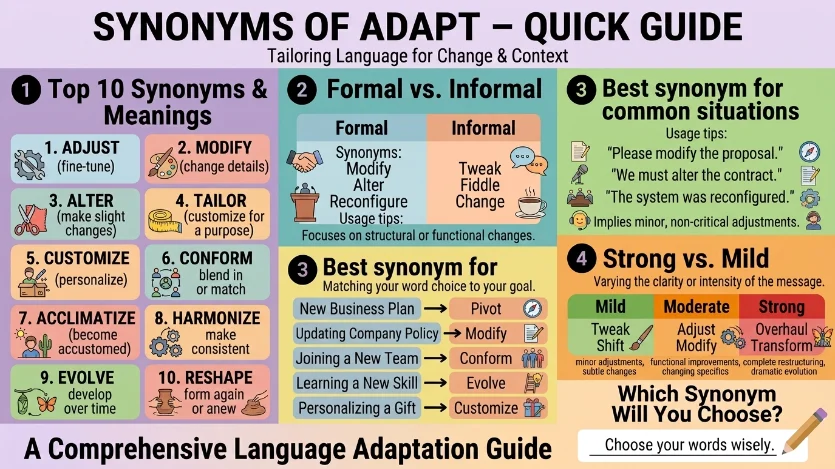
Adapt means to change or adjust to fit new conditions, situations, or environments. The best synonyms are adjust, modify, alter, acclimate, and accommodate. “Adjust” is the most common and natural in everyday English. Each synonym has a slightly different meaning, tone, and context where it fits best.
Top 10 Synonyms
- Adjust
- Modify
- Alter
- Acclimate
- Accommodate
- Conform
- Change
- Revise
- Tailor
- Customize
Have you ever felt like you keep using the same word over and over? Many English learners struggle with this. The word “adapt” is useful, but using it too often can make your speaking and writing feel repetitive.
Learning different ways to say “adapt” helps you express yourself more clearly. It also makes your English sound more natural and impressive. Whether you are writing an essay, talking about change, or describing how you handle new situations, having the right word can make all the difference.
In this guide, you will learn 30 powerful synonyms. You will also discover when to use each one, how formal they are, and common mistakes to avoid. Let’s get started!
What Does “Adapt” Mean?
Definition
Adapt means to change something or yourself to fit a new situation, environment, or purpose. It’s about making adjustments so that things work better. When you move to a new country, you adapt to the culture. When you change a recipe for a different kitchen, you adapt the instructions. It’s a word about flexibility and smart change.
Pronunciation
| Feature | Value |
|---|---|
| US IPA | /əˈdæpt/ |
| UK IPA | /əˈdæpt/ |
| Syllables | 2 (a-dapt) |
| Tip | Stress the second syllable: “uh-DAPT” |
Grammar
| Grammar Feature | Information |
|---|---|
| Part of Speech | Verb |
| Common Position | Often followed by “to” + situation |
| Typical Pattern | Adapt + to + situation / adapt + something + for + purpose |
Examples:
- “She adapted to the new office quickly.”
- “We adapted the classroom for students with disabilities.”
- “The company had to adapt its strategy to compete.”
Note: “Adapt” is a regular verb (adapt, adapted, adapted). It is usually followed by “to” when talking about adjusting to something.
Word Family
| Word | Part of Speech | Meaning |
|---|---|---|
| Adapt | Verb | To change to fit new conditions |
| Adaptation | Noun | The process or result of adapting |
| Adaptable | Adjective | Able to change easily |
| Adaptability | Noun | The quality of being able to adapt |
| Adaptive | Adjective | Relating to or showing adaptation |
10–15 Synonyms of “Adapt”
Adjust
Meaning: To make small changes so that something works better or fits a new situation.
Best Used For: Daily conversation, professional settings, describing minor changes.
Formality: Neutral
Tone: Practical, Precise
Frequency: ⭐⭐⭐⭐⭐ (Very Common)
CEFR Level: B1
Example Sentence 1: “I need to adjust my schedule to fit the new project deadline.
Example Sentence 2: “The mechanic adjusted the car’s mirrors for better visibility.”
Usage Tip: Use “adjust” when you are making small, practical changes. It’s the most common and safe choice for daily English.
Common Confusion: Adjust vs Adapt – “Adjust” suggests small, often temporary changes. “Adapt” suggests bigger, more permanent changes to fit a new environment.
Modify
Meaning: To make changes to something, usually to improve it or make it suitable for a different purpose.
Best Used For: Professional, technical, and academic writing.
Formality: Formal
Tone: Technical, Precise
Frequency: ⭐⭐⭐⭐ (Common)
CEFR Level: B2
Example Sentence 1: “We need to modify the software to meet user requirements.”
Example Sentence 2: “The teacher modified the lesson for younger students.”
Usage Tip: Use “modify” when you are making planned, deliberate changes to something, often to improve it. It sounds professional and specific.
Alter
Meaning: To make a change to something, often a partial or small change.
Best Used For: Neutral or formal contexts, describing changes to plans or appearance.
Formality: Neutral
Tone: Direct, Matter-of-fact
Frequency: ⭐⭐⭐⭐ (Common)
CEFR Level: B1
Example Sentence 1: “She altered her dress to make it shorter.
Example Sentence 2: “The weather forced us to alter our travel plans.
Usage Tip: “Alter” is a good, neutral word for change. It can describe both physical and non-physical changes. It is slightly more formal than “change” but less formal than “modify.”
Acclimate
Meaning: To become used to a new climate, environment, or situation.
Best Used For: Talking about getting used to new places, weather, or conditions.
Formality: Neutral
Tone: Descriptive, Specific
Frequency: ⭐⭐⭐ (Moderate)
CEFR Level: B2
Example Sentence 1: “It took a few weeks to acclimate to the hot weather in Thailand.”
Example Sentence 2: “New employees need time to acclimate to the company culture.”
Usage Tip: “Acclimate” is a more specific synonym for “adapt.” It’s often used when talking about adjusting to a completely new environment, like a new country, climate, or working style.
Accommodate
Meaning: To adapt or adjust to fit someone’s needs or wishes. To make something suitable for someone.
Best Used For: Professional, business, and service contexts.
Formality: Formal
Tone: Helpful, Professional
Frequency: ⭐⭐⭐⭐ (Common)
CEFR Level: B2
Example Sentence 1: “The hotel can accommodate guests with special dietary needs.”
Example Sentence 2: “We will accommodate your request for a later meeting.”
Usage Tip: “Accommodate” is a great word when you are adapting to help someone. It has a helpful and professional tone.
Conform
Meaning: To behave or think in a way that follows rules, standards, or what is expected.
Best Used For: Discussing social behavior, rules, and expectations.
Formality: Formal
Tone: Neutral, Sometimes Negative
Frequency: ⭐⭐⭐ (Moderate)
CEFR Level: B2
Example Sentence 1: “Students are expected to conform to the school’s dress code.”
Example Sentence 2: “She refused to conform to traditional expectations.”
Usage Tip: “Conform” suggests adapting to fit in with rules or group expectations. It can have a slightly negative tone if it implies losing individuality.
Common Confusion: Conform vs Adapt – “Conform” means to follow rules or norms. Adapt” means to change to fit any new situation. You might adapt to a new job, but you conform to its rules.
Change
Meaning: To become or make something different. This is the most general word for alteration.
Best Used For: Everyday conversation, simple and direct communication.
Formality: Neutral (Very Common)
Tone: Neutral, Direct
Frequency: ⭐⭐⭐⭐⭐ (Very Common)
CEFR Level: A2
Example Sentence 1: “People change their habits over time.”
Example Sentence 2: “The plan changed at the last minute.
Usage Tip: “Change” is the most general word. Use it when you don’t need to be specific about the type of change. For more precision, use a different synonym.
Revise
Meaning: To change or improve something by re-examining it, often written work.
Best Used For: Academic writing, editing, making corrections.
Formality: Formal
Tone: Academic, Analytical
Frequency: ⭐⭐⭐⭐ (Common)
CEFR Level: B2
Example Sentence 1: “Please revise your essay before submitting it.”
Example Sentence 2: “The company revised its financial forecast.”
Usage Tip: “Revise” is the perfect word for making changes to written work or plans to improve them. It implies a careful, thoughtful re-evaluation.
Tailor
Meaning: To change or adapt something so it fits a specific person or purpose perfectly.
Best Used For: Business, marketing, education, and personalized contexts.
Formality: Neutral
Tone: Creative, Precise
Frequency: ⭐⭐⭐⭐ (Common)
CEFR Level: B2
Example Sentence 1: “We tailor our training programs to each company’s needs.”
Example Sentence 2: “The teacher tailored the lesson to suit different learning styles.”
Usage Tip: “Tailor” is a great word for describing personalized adaptation. It comes from the work of a tailor who adjusts clothes to fit perfectly. Use it when you want to emphasize making something fit a specific situation or person.
Customize
Meaning: To change or adapt something according to a person’s specific requirements.
Best Used For: Modern, creative, and business contexts, especially technology and services.
Formality: Neutral
Tone: Modern, User-focused
Frequency: ⭐⭐⭐⭐ (Common)
CEFR Level: B2
Example Sentence 1: “You can customize the settings on your phone.
Example Sentence 2: “The company offers customized solutions for each client.”
Usage Tip: “Customize” is very similar to “tailor” but has a more modern, digital feel. It’s often used for technology, products, and services.
Adjust
Meaning: To make small changes to something so it fits better or works more effectively.
Best Used For: Everyday conversations and minor changes.
Formality: Neutral
Tone: Practical
Frequency: ⭐⭐⭐⭐⭐ (Very Common)
CEFR Level: B1
Example Sentence 1: “I need to adjust the temperature in my room.”
Example Sentence 2: “He adjusted his speech for a younger audience.”
Usage Tip: “Adjust” is very common for small, practical changes. It is often used for physical things like settings, positions, or schedules.
Synonyms Comparison Table
| Synonym | Best Context | Formality | Tone | Frequency |
|---|---|---|---|---|
| Adjust | Daily life, minor changes | Neutral | Practical | ⭐⭐⭐⭐⭐ |
| Modify | Professional, technical | Formal | Precise | ⭐⭐⭐⭐ |
| Alter | General changes | Neutral | Direct | ⭐⭐⭐⭐ |
| Acclimate | Getting used to new places | Neutral | Specific | ⭐⭐⭐ |
| Accommodate | Helping others | Formal | Helpful | ⭐⭐⭐⭐ |
| Conform | Rules, expectations | Formal | Neutral | ⭐⭐⭐ |
| Change | General use | Neutral | Direct | ⭐⭐⭐⭐⭐ |
| Revise | Writing, plans | Formal | Academic | ⭐⭐⭐⭐ |
| Tailor | Personalized adaptation | Neutral | Precise | ⭐⭐⭐⭐ |
| Customize | Modern, digital adaptation | Neutral | Modern | ⭐⭐⭐⭐ |
Best Synonyms by Situation
| Situation | Best Synonym | Why It Works |
|---|---|---|
| Daily Conversation | Adjust | It’s simple and natural. |
| Business Email | Modify or Tailor | Sounds professional and precise. |
| Academic Writing | Revise or Modify | Shows careful thought and improvement. |
| School Assignment | Adjust or Change | Easy to understand and appropriate. |
| Professional Meeting | Adapt or Tailor | Shows strategic thinking. |
| Presentation | Adapt or Adjust | Clearly explains change. |
| Creative Writing | Alter or Tailor | Sounds creative and precise. |
| Social Media | Adjust or Change | Short and easy to read. |
Formal vs Informal Synonyms
Formal Alternatives
| Synonym | Best Used For |
|---|---|
| Modify | Technical or professional changes. |
| Revise | Academic or written work. |
| Accommodate | Adapting for others’ needs. |
Neutral Alternatives
| Synonym | Best Used For |
|---|---|
| Adjust | Everyday small changes. |
| Alter | General changes. |
| Change | Most general use. |
Informal Alternatives
| Synonym | Best Used For |
|---|---|
| Switch | Changing to something else. |
| Tweak | Making a small, clever change. |
| Fix | Making something work better. |
Choosing the Right Level: Formal words like “modify” and “revise” are best for professional and academic writing. Neutral words like “adjust” and “alter” are good for most situations. Informal words like “tweak” are best for friends and casual conversation.
Strong vs Mild Synonyms
Mild
Suitable for everyday situations where the change is small or simple.
- Adjust
- Change
- Tweak (informal)
Moderate
More expressive than the original word and good for most contexts.
- Alter
- Modify
- Accommodate
Strong
High-intensity alternatives that suggest significant or permanent change.
- Transform (extreme change)
- Convert (complete change in purpose)
- Revamp (to give a completely new appearance)
How Intensity Changes Meaning: Choosing a stronger word like “transform” signals that the change is very big and important. A milder word like “adjust” just means a small fix. Pick the word that matches the size and importance of the change.
Real-Life Examples
School: “Students must adapt to new learning methods each year.”
Office: “We adapted our strategy to meet market demands.”
Business Email: “Please modify the report to include these new figures.”
Meetings: “The team discussed how to adapt to the new software.”
Presentations: “She explained how the company adapted during the pandemic.”
Books: “The novel explores how people adapt to difficult circumstances.”
Movies: “The film shows how animals adapt to survive in harsh climates.”
Daily Conversations: “It was hard to adapt to the new neighborhood at first.”
Social Media: “We adapt our content to different platforms.”
Professional Writing: “Organizations must adapt to remain competitive.”
Common Collocations
| Common Phrase | Better Alternative |
|---|---|
| Adapt to change | Adjust to change |
| Adapt quickly | Acclimate quickly |
| Adapt the plan | Modify the plan |
| Adapt your style | Tailor your style |
Common Phrases
Adapt to change: Means to get used to new things. Try “adjust to new developments” for a slightly different phrasing.
Ability to adapt: Means being flexible. Try “capacity to adjust” as an alternative.
Adapt accordingly: Means to change in a suitable way. Try “adjust as needed” for simpler language.
Adapt and overcome: A phrase meaning to change and solve problems. Try “adjust and succeed” for a simpler version.
Context Guide
| Situation | Best Synonym | Reason |
|---|---|---|
| Essay | Adapt or Modify | These sound academic and precise. |
| Speech | Adapt or Adjust | These are clear and easy for the audience. |
| Business Email | Tailor or Modify | These sound professional and careful. |
| Novel | Adapt or Alter | These add depth to character development. |
| Presentation | Adapt or Adjust | These are clear and persuasive. |
| Conversation | Adjust or Change | These are natural and easy to understand. |
| Academic Writing | Revise or Modify | These show deep engagement with the topic. |
| Marketing Copy | Tailor or Customize | These show personalization and care. |
Related Words
Near Synonyms
- Transform: To change completely, especially in a positive way.
- Convert: To change from one form or use to another.
- Revamp: To give something a new and improved appearance.
- Tweak: To make a small, minor change.
Antonyms
- Stay: To remain in the same place or condition.
- Remain: To continue to be the same.
- Persist: To continue to exist despite change.
- Resist change: To refuse to adapt.
Related Adjectives
- Adaptable: Able to change easily.
- Flexible: Willing to change or be changed.
- Versatile: Able to adapt to many different situations.
Related Verbs
- Adjust: To make small changes.
- Modify: To make partial changes.
- Alter: To make something different.
Frequently Asked Questions
What is another word for adapt?
Common synonyms are adjust, modify, alter, acclimate, and accommodate. The best choice depends on your context and what type of change you’re describing.
Which synonym sounds the most professional?
Modify and tailor sound the most professional. Modify is great for technical or planned changes. Tailor shows personalized, careful adaptation.
What is the strongest synonym for adapt?
Transform is one of the strongest synonyms. It suggests a complete and dramatic change, often in a positive way. Convert is also strong and suggests a complete change in purpose.
Which synonym is best for essays?
Adapt and modify are both excellent choices for essays. They are academic and precise. Revise is also a good choice when writing about changing written work.
What’s the difference between adapt and adjust?
Adapt suggests a bigger, more permanent change to fit a new situation. Adjust suggests a small, often temporary change to make something work better.
Which synonym is most common in everyday English?
Adjust and change are the most common. Change is the most general word. Adjust is the most common specific synonym for making small changes.
What is the opposite of adapt?
The opposites include stay, remain, and persist. These all mean to stay the same or not change. Resist change is also a common opposite phrase.
Conclusion
Adaptation is a key part of life, and choosing the right word to describe it can make your English clearer and more powerful. As you have learned, no two synonyms are exactly the same. Each carries a slightly different tone and formality.
Remember, “adjust” is perfect for small changes, “modify” for professional contexts, “tailor” for personalized changes, and “acclimate” for getting used to new places. Matching the word to the situation is the secret to great communication.
The best way to improve is to practice. Try using one new synonym each day. Read articles and listen to conversations to see how native speakers use these words in real life. With time, these words will become a natural part of your vocabulary.
