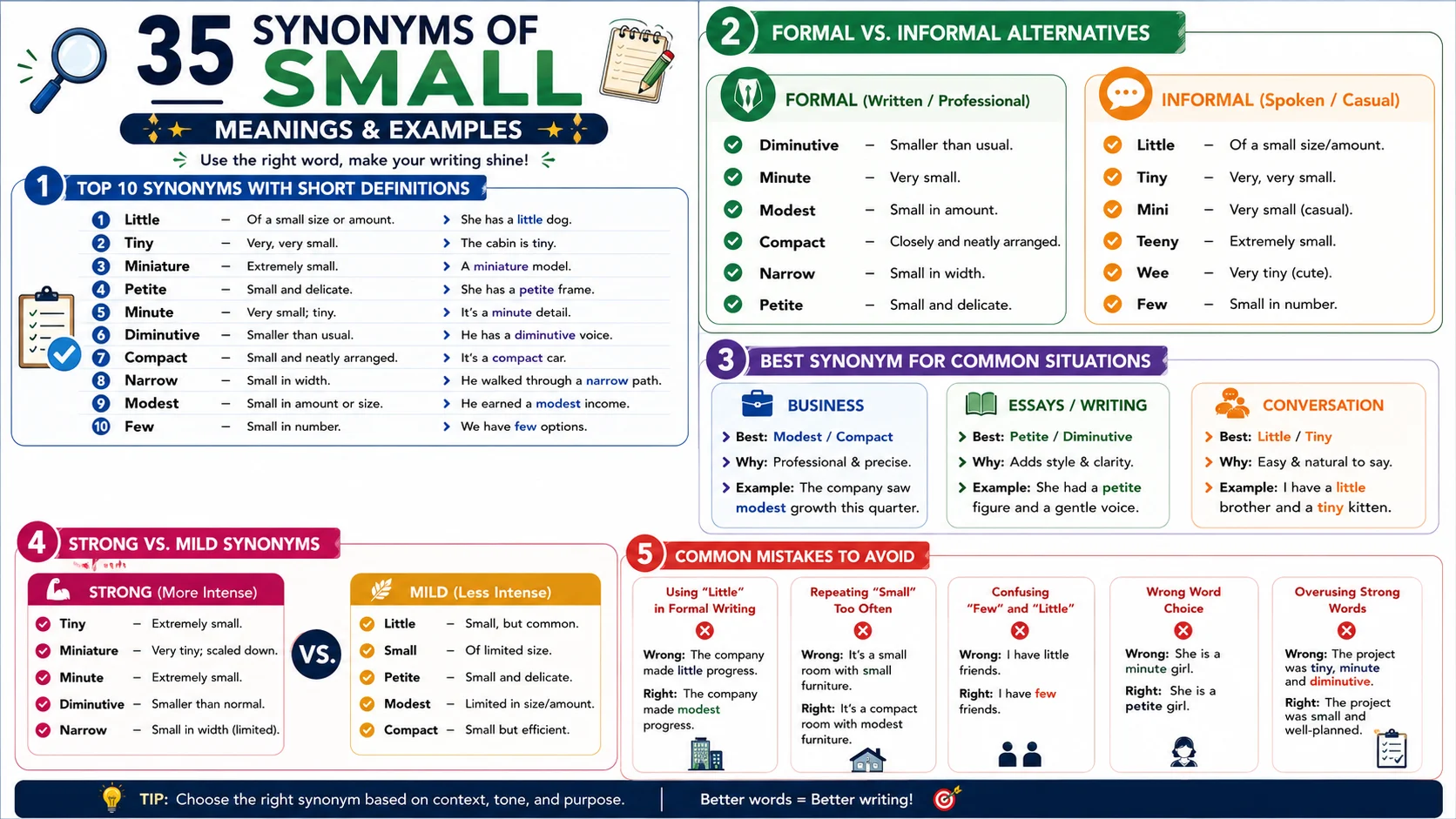
“Small” means little in size, amount, or degree. The best synonyms are little, tiny, miniature, compact, and petite. “Little” is the most common alternative. Each synonym has a slightly different meaning, tone, or context.
Top 10 Synonyms
- Little
- Tiny
- Miniature
- Compact
- Petite
- Minute
- Diminutive
- Modest
- Slight
- Wee
Do you find yourself using the word “small” all the time? You’re certainly not alone. It is one of the most common adjectives in English. But using it too much can make your writing sound repetitive and basic.
English has a rich variety of words to describe things that are not large. Some suggest cuteness, some suggest precision, and others suggest insignificance. The word you choose can completely change how your reader feels.
In this guide, you will learn 35 powerful synonyms for “small.” You’ll discover when to use each one, how formal they are, and what mistakes to avoid. By the end, you will have a more expressive and precise vocabulary.
What Does “Small” Mean?
Definition
Small” means not large in size, amount, degree, or importance. It is a general word for anything that is below average in size. A small house, a small amount of sugar, a small mistake. It is one of the first words English learners learn.
Pronunciation
| Feature | Value |
|---|---|
| US IPA | /smɔːl/ |
| UK IPA | /smɔːl/ |
| Syllables | 1 |
| Tip | Hold the “s” sound slightly: “ss-mall” |
Grammar
| Grammar Feature | Information |
|---|---|
| Part of Speech | Adjective |
| Common Position | Before a noun or after a linking verb |
| Typical Pattern | Small + noun / Subject + be + small |
Examples:
- “She lives in a small apartment.” (before noun)
- “The room is too small.” (after verb)
- “We have a small problem.” (before noun)
Grammar Note: “Small” is a regular adjective. You can use “smaller” for comparisons and “smallest” for superlatives.
Word Family
| Word | Part of Speech | Meaning |
|---|---|---|
| Small | Adjective | Not large in size or amount |
| Smallness | Noun | The quality of being small |
| Smallish | Adjective | Somewhat small |
| Smaller | Adjective | Comparative form of small |
| Smallest | Adjective | Superlative form of small |
15 Synonyms of “Small”
Little
Meaning: Small in size, amount, or degree. Often used affectionately.
Best Used For: Daily conversation, describing children or animals.
Formality: Informal
Tone: Affectionate, Cute
Frequency: ⭐⭐⭐⭐⭐ (Very Common)
CEFR Level: A1
Example Sentence 1: “She has a cute little dog that follows her everywhere.”
Example Sentence 2: “I just need a little more time to finish.
Usage Tip: “Little” is the most common informal alternative. It often sounds more affectionate than “small.” Use it for pets, children, and small amounts.
Common Confusion: Small vs Little. “Small” is more neutral and factual. “Little” is often used with affection or pity.
Tiny
Meaning: Extremely small, much smaller than normal.
Best Used For: Emphasizing extreme smallness in conversation or writing.
Formality: Informal
Tone: Emphatic, Cute
Frequency: ⭐⭐⭐⭐⭐ (Very Common)
CEFR Level: A2
Example Sentence 1: “She wore a tiny diamond ring on her finger.”
Example Sentence 2: “The baby’s tiny fingers were so adorable.”
Usage Tip: Use “tiny” when you want to emphasize that something is very, very small. It is much stronger than “small.”
Miniature
Meaning: Very small, often an exact copy of something larger.
Best Used For: Describing models, replicas, or smaller versions of things.
Formality: Neutral
Tone: Precise, Descriptive
Frequency: ⭐⭐⭐⭐ (Common)
CEFR Level: B1
Example Sentence 1: “She collects miniature furniture for her dollhouse.”
Example Sentence 2: “The museum had a miniature model of the entire city.”
Usage Tip: “Miniature” is perfect when something is a small copy of a larger thing. It suggests careful detail.
Compact
Meaning: Small and well-organized, fitting a lot into a small space.
Best Used For: Describing cars, devices, or organized small spaces.
Formality: Neutral
Tone: Efficient, Practical
Frequency: ⭐⭐⭐⭐ (Common)
CEFR Level: B1
Example Sentence 1: “We bought a compact car that is easy to park.”
Example Sentence 2: “The compact design of the phone makes it very portable.”
Usage Tip: “Compact” has a positive meaning—it suggests smart design and efficiency, not just being small.
Petite
Meaning: Small and slender, used mainly to describe women.
Best Used For: Describing women’s bodies or clothing for smaller women.
Formality: Neutral
Tone: Elegant, Feminine
Frequency: ⭐⭐⭐ (Moderate)
CEFR Level: B1
Example Sentence 1: “She is petite and often buys clothes from the kids’ section.
Example Sentence 2: “The store has a petite section for smaller women.”
Usage Tip: “Petite” is usually used for women and girls. It suggests elegance and delicacy. Use it carefully—it’s not for describing objects.
Minute (my-NOOT)
Meaning: Extremely small, often so small it’s hard to notice.
Best Used For: Academic writing, describing very small details.
Formality: Formal
Tone: Precise, Scientific
Frequency: ⭐⭐⭐ (Moderate)
CEFR Level: B2
Example Sentence 1: “The minute details of the painting were incredible.”
Example Sentence 2: “The lab detected minute amounts of the chemical.”
Usage Tip: “Minute” is pronounced differently from the time word “minute” (MIN-it). It means tiny. Use it in formal or scientific contexts.
Diminutive
Meaning: Extremely small, smaller than average.
Best Used For: Formal writing, literary contexts.
Formality: Formal
Tone: Descriptive, Academic
Frequency: ⭐⭐ (Rare)
CEFR Level: B2
Example Sentence 1: “The diminutive creature hid under the leaf.”
Example Sentence 2: “He was a diminutive man with a loud voice.”
Usage Tip: “Diminutive” is quite formal and literary. It’s a sophisticated word that many learners don’t know.
Modest
Meaning: Not large or extravagant; humble in size or amount.
Best Used For: Describing homes, incomes, or expectations.
Formality: Neutral
Tone: Humble, Unpretentious
Frequency: ⭐⭐⭐⭐ (Common)
CEFR Level: B1
Example Sentence 1: “They live in a modest house in a quiet neighborhood.”
Example Sentence 2: “She has a modest collection of vintage records.”
Usage Tip: “Modest” has a positive connotation. It suggests being humble and not showing off. Use it for size that is appropriate, not excessive.
Slight
Meaning: Small in degree, amount, or significance.
Best Used For: Describing small differences, changes, or physical build.
Formality: Neutral
Tone: Subtle, Understated
Frequency: ⭐⭐⭐⭐ (Common)
CEFR Level: B1
Example Sentence 1: “There is a slight difference between the two colors.”
Example Sentence 2: “He is a slight man with a gentle manner.”
Usage Tip: “Slight” is perfect for small differences, changes, or movements. Use it when you want to sound subtle and careful.
Wee
Meaning: Extremely small, often used for children or cute things.
Best Used For: Informal conversation, describing cute things.
Formality: Informal
Tone: Affectionate, Playful
Frequency: ⭐⭐⭐ (Moderate)
CEFR Level: B1
Example Sentence 1: “The wee little kitten was only a few days old.”
Example Sentence 2: “I have a wee bit of money left.”
Usage Tip: “Wee” is a cute, affectionate word used in informal contexts. It is common in Scotland and Ireland but understood everywhere.
Microscopic
Meaning: So small that it can only be seen with a microscope.
Best Used For: Scientific contexts, describing tiny things.
Formality: Formal
Tone: Scientific, Extreme
Frequency: ⭐⭐⭐ (Moderate)
CEFR Level: B2
Example Sentence 1: “Microscopic organisms live in every drop of water.
Example Sentence 2: “The difference in price is microscopic.”
Usage Tip: “Microscopic” suggests extreme smallness. Use it for anything you want to emphasize is incredibly small.
Mini
Meaning: Very small; smaller than the usual size.
Best Used For: Fashion, products, describing smaller versions.
Formality: Informal
Tone: Modern, Trendy
Frequency: ⭐⭐⭐⭐⭐ (Very Common)
CEFR Level: A2
Example Sentence 1: “She bought a mini version of the handbag.”
Example Sentence 2: “We have a mini refrigerator in our dorm room.”
Usage Tip: “Mini” is a very common prefix and word. It suggests a smaller version of something familiar. Use it casually.
Dwarf
Meaning: Much smaller than the normal size.
Best Used For: Comparing sizes, describing unusually small things.
Formality: Neutral
Tone: Descriptive, Comparative
Frequency: ⭐⭐⭐ (Moderate)
CEFR Level: B1
Example Sentence 1: “They have a dwarf apple tree in their garden.”
Example Sentence 2: “The dwarf planet is smaller than the moon.”
Usage Tip: “Dwarf” is used for things that are unusually small for their type. It suggests something is smaller than expected or standard.
Scant
Meaning: Barely enough; very small in amount.
Best Used For: Describing insufficient amounts.
Formality: Formal
Tone: Critical, Insufficient
Frequency: ⭐⭐ (Rare)
CEFR Level: B2
Example Sentence 1: “We have scant information about the incident.”
Example Sentence 2: “There was only scant evidence to support the claim.”
Usage Tip: “Scant” has a negative meaning—it suggests there is not enough. Use it when you want to emphasize insufficiency.
Short
Meaning: Small in height or length.
Best Used For: Describing people, duration, or length.
Formality: Neutral
Tone: Factual, Direct
Frequency: ⭐⭐⭐⭐⭐ (Very Common)
CEFR Level: A2
Example Sentence 1: “He is short for his age.”
Example Sentence 2: “We had a short meeting this morning.”
Usage Tip: “Short” is very common for height and length. It’s not usually used for width or volume.
Synonyms Comparison Table
| Synonym | Best Context | Formality | Tone | Frequency |
|---|---|---|---|---|
| Little | Children, animals | Informal | Affectionate | ⭐⭐⭐⭐⭐ |
| Tiny | Extreme smallness | Informal | Emphatic | ⭐⭐⭐⭐⭐ |
| Mini | Versions of things | Informal | Trendy | ⭐⭐⭐⭐⭐ |
| Compact | Design, cars | Neutral | Efficient | ⭐⭐⭐⭐ |
| Petite | Women’s size | Neutral | Elegant | ⭐⭐⭐ |
| Modest | Homes, incomes | Neutral | Humble | ⭐⭐⭐⭐ |
| Slight | Differences, build | Neutral | Subtle | ⭐⭐⭐⭐ |
| Minute | Details, science | Formal | Precise | ⭐⭐⭐ |
| Diminutive | Literary contexts | Formal | Descriptive | ⭐⭐ |
| Microscopic | Science, extremes | Formal | Extreme | ⭐⭐⭐ |
Best Synonyms by Situation
| Situation | Best Synonym | Why It Works |
|---|---|---|
| Daily Conversation | Little / Tiny | Natural and common |
| Business Email | Modest / Compact | Professional and positive |
| Academic Writing | Minute / Diminutive | Formal and precise |
| School Assignment | Slight / Modest | Appropriate and clear |
| Professional Meeting | Compact / Modest | Professional and measured |
| Presentation | Slight / Modest | Subtle and professional |
| Creative Writing | Diminutive / Wee | Adds variety and emotion |
| Social Media | Tiny / Mini | Fun and engaging |
| Describing Clothing | Petite | Specifically for small women |
Formal vs Informal Synonyms
Formal Alternatives
| Synonym | Best Used For |
|---|---|
| Minute | Scientific, detailed analysis |
| Diminutive | Literary, formal writing |
| Scant | Insufficient amounts |
Neutral Alternatives
| Synonym | Best Used For |
|---|---|
| Compact | Products, design, cars |
| Modest | Houses, incomes, success |
| Slight | Differences, changes, build |
Informal Alternatives
| Synonym | Best Used For |
|---|---|
| Little | Children, animals, amounts |
| Tiny | Anything very small |
| Mini | Smaller versions of things |
| Wee | Affectionate contexts |
Choosing the Right Level: In academic writing, use “minute” or “diminutive.” In business contexts, “compact” and “modest” are excellent. In everyday conversation, “little” and “tiny” sound much more natural.
Strong vs Mild Synonyms
Mild
Suitable for everyday descriptions.
- Small
- Little
- Modest
- Slight
Moderate
More expressive or specific.
- Tiny
- Compact
- Petite
- Mini
- Short
Strong
High-intensity alternatives suggesting extreme smallness.
- Minute
- Microscopic
- Diminutive
- Wee (affectionate extreme)
How Intensity Changes Meaning: “A small amount” is neutral. “A minute amount” suggests it’s so tiny it’s almost invisible. Choose stronger words when you need to emphasize extreme smallness.
Real-Life Examples
School: “The students had a small class size this year.”
Office: “We need a compact desk for the small office.”
Business Email: “We experienced a slight delay in shipping.”
Meetings: “The team made modest progress this quarter.”
Presentations: “The microscopic details are hard to see from here.”
Daily Conversations: “I have a little bit of time before the meeting.”
Social Media: “Check out this tiny house! I want one.”
Academic Writing: “The researchers discovered minute traces of the chemical.”
Common Collocations
| Common Phrase | Better Alternative |
|---|---|
| Small amount | Slight amount / Modest amount |
| Small difference | Slight difference |
| Small car | Compact car |
| Small house | Modest house |
| Small details | Minute details |
| Small problem | Little problem / Tiny problem |
| Small child | Little child |
Common Phrases
Small world: Used when you meet someone unexpectedly. (e.g., “It’s a small world! I used to live there too.”)
Small talk: Light, casual conversation. (e.g., “They engaged in small talk while waiting.”)
The small hours: Very late at night. (e.g., “He worked into the small hours.”)
Small wonder: Not surprising. (e.g., “Small wonder she was tired after working all day.”)
Context Guide
| Situation | Best Synonym | Reason |
|---|---|---|
| Essay | Minute / Diminutive | Academic and precise |
| Speech | Modest / Slight | Measured and clear |
| Business Email | Compact / Modest | Professional and respectful |
| Novel | Diminutive / Wee | Literary and varied |
| Presentation | Slight / Modest | Subtle and professional |
| Conversation | Little / Tiny | Natural and friendly |
| Academic Writing | Minute / Scant | Formal and analytical |
| Marketing Copy | Compact / Mini | Attractive and positive |
Related Words
Near Synonyms
- Tiny: Extremely small.
- Titchy: Very small (British informal).
- Itty-bitty: Very small (childish).
- Teeny: Extremely small (informal).
- Puny: Small and weak.
Antonyms
- Large: Big in size.
- Huge: Extremely big.
- Enormous: Very, very big.
- Massive: Extremely large and heavy.
- Giant: Very big, like a giant.
- Vast: Extremely large in area or amount.
Related Adjectives
- Miniature: Very small scale model.
- Microscopic: Only visible with a microscope.
- Dwarf: Unusually small for its kind.
- Pocket-sized: Small enough to fit in a pocket.
Related Nouns
- Size: The dimensions of something.
- Scale: The size or level of something.
- Dimension: A measurement of size.
- Magnitude: The great size or extent of something.
Related Verbs
- Shrink: To become smaller.
- Reduce: To make smaller.
- Minimize: To make as small as possible.
Frequently Asked Questions
What is another word for small?
Common synonyms include little, tiny, miniature, compact, petite, minute, and modest. The best choice depends on whether you are describing size, amount, or importance.
Which synonym sounds the most professional?
Compact and modest sound professional and positive. “Minute” is excellent for scientific or formal writing. “Modest” is a respectful word for describing homes or achievements.
What is the strongest synonym for small?
Minute and microscopic are the strongest synonyms. They suggest something is so small it is nearly invisible or only visible with a microscope.
Which synonym is best for essays?
Minute and diminutive are excellent for academic essays. They sound formal and precise. “Modest” is also good for describing unassuming things.
What’s the difference between small and little?
“Small” is neutral and factual. “Little” often has an emotional tone—it can be affectionate, like “my little sister,” or sympathetic, like “poor little thing.”
Which synonym is most common in everyday English?
“Little” is probably the most common alternative, especially in informal contexts. “Tiny” is also very common when emphasizing extreme smallness.
What is the opposite of small?
The most common opposites are large, big, huge, enormous, and giant. The right opposite depends on how much bigger something is.
Conclusion
“Small” is a useful word, but it should not be your only choice. By learning these 35 synonyms, you can now describe size, amount, and degree with much more precision and variety.
Remember, each synonym has its own flavor. Use “little” for affection and cute things. Use “tiny” for extreme smallness. Use “compact” for efficient design. Use “modest” for humility. Use “minute” for scientific precision.
The best way to improve is to practice actively. Try using one or two new synonyms each day. Read widely and notice how native speakers use these words. With time, your vocabulary will become richer, more varied, and more natural.
