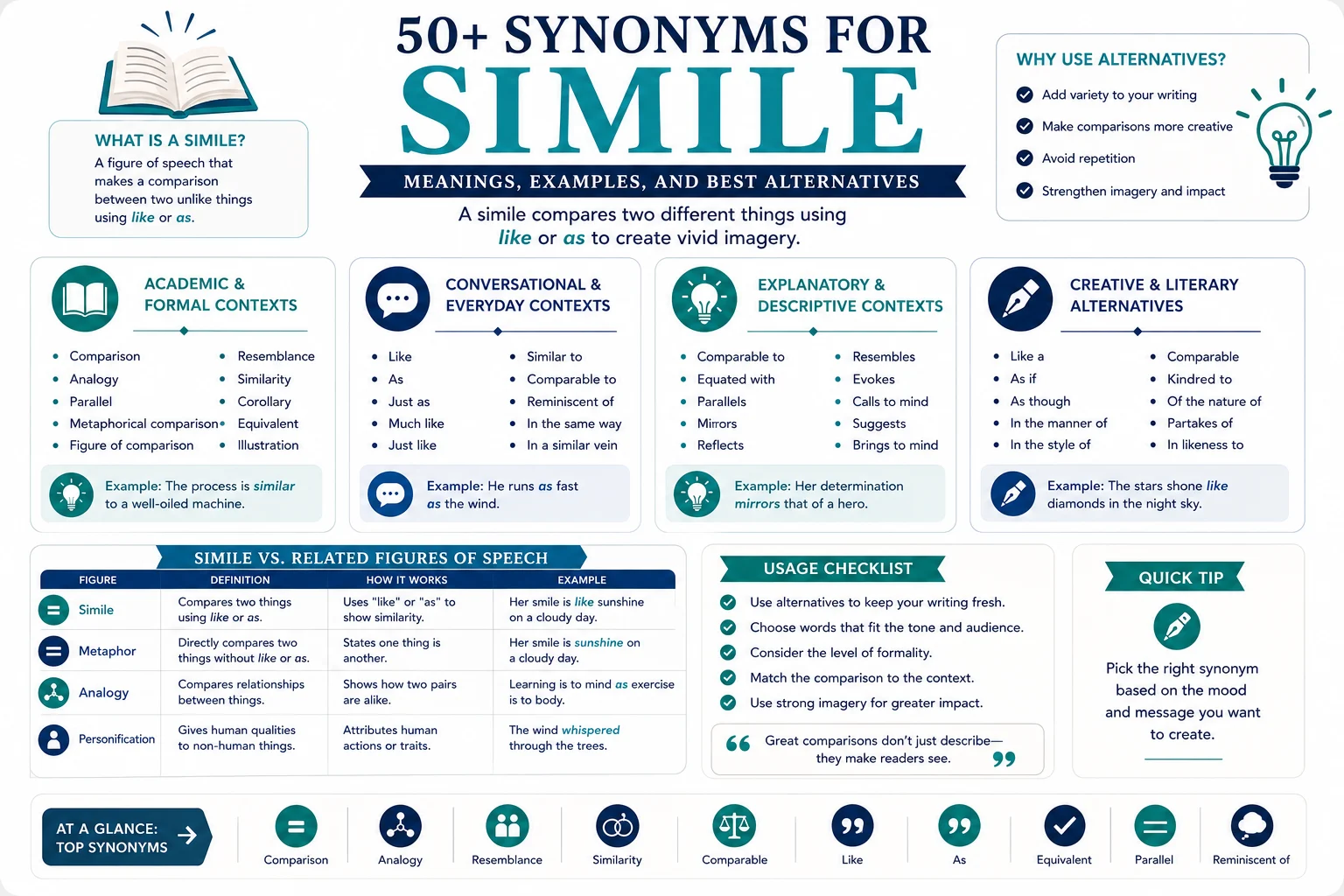
A simile is a figure of speech that draws a comparison between two different things using explicit connecting words like “like” or “as” to make descriptions more vivid and imaginative . While “metaphor” is often considered its closest relative, other alternatives include “analogy,” “comparison,” and “figure of speech” .
Imagine you are a student trying to explain to a friend how a character in a novel feels, or a writer searching for the perfect word to describe a sunset without sounding repetitive.
You know the concept: comparing one thing to another to create a vivid picture. But every time you go to write it down, you find yourself stuck on the same word, “simile.” You know there must be other ways to express this idea, but you just cannot find the right term.
This is a common frustration for students, writers, and professionals alike. Using a rich vocabulary, particularly when discussing literary and rhetorical devices, transforms ordinary analysis into something insightful and impressive .
This guide will provide you with a comprehensive list of synonyms for “simile,” explaining the subtle differences in meaning, tone, and context for each. You will learn how to choose the perfect word for every situation, from academic essays to casual conversations.
Meaning, Tone and Context
Simple Definition
A simile is a figure of speech that makes a comparison between two unlike things, typically using the words “like” or “as” . For example, “He is as brave as a lion” or “Her voice was like velvet.”
Part of Speech
Simile is a noun.
Tone
Neutral to descriptive. Similes are often used to inject creativity and vividness into language . They can make descriptions more engaging, but overuse can make writing feel cliché or forced .
Formality Level
Simile is a standard, widely understood term appropriate for all contexts, from casual conversation to formal literary criticism.
Common Use Cases
Similes are used across various forms of communication to clarify, embellish, or evoke emotion :
- Creative Writing and Poetry: To create vivid imagery and add depth.
- Everyday Speech: To make descriptions relatable and easy to understand (e.g., “I slept like a log”).
- Academic Writing: In literary analysis, to discuss an author’s technique.
- Public Speaking: To make an idea more engaging and memorable for an audience .
Important Word Forms
- Noun: simile
- Adjective: similes (plural) / no common adjectival form
- Verb: to compare, to liken
When and How to Use “Simile”
Use “simile” when you need to explicitly identify or describe the literary device used to make a direct comparison with “like” or “as” . It is the correct technical term for this type of comparison.
Literary Analysis (Academic):
“The poem is rich with figurative language, but the most effective device used is the extended simile in the final stanza, comparing loss to a winter ocean.”
Creative Writing (Description):
“I wanted to use a simile to describe her laugh, something that would capture its bright, infectious quality without resorting to cliché.”
Casual Conversation (Explaining):
“You know what a simile is, right? It’s like saying ‘busy as a bee’ or ‘fast as lightning’.”
Educational (Teaching):
“A great way to teach students about descriptive writing is to start with a simple simile and then help them build their own.”
Resume / Professional (Communications Role):
“Developed marketing copy that used metaphors and similes to make technical products more relatable to a consumer audience.”
Another Word for “Simile”
Choosing the right synonym requires understanding the subtle goal of your comparison.
- General Writing: Comparison, likening
- Academic Writing: Analogy, conceit
- Casual Conversation: Figure of speech
- Rhetorical Analysis: Trope, image
- Explanation: Analogy
- Stronger / More Complex: Allegory
- Specific to Epic Poetry: Homeric simile
- More Direct: Comparison
When Not to Use “Simile”
Do not use “simile” when a comparison is implied rather than stated directly. Those are metaphors . Use “simile” only when the word “like” or “as” is part of the comparison.
Incorrect: “The metaphor ‘time is a thief’ is a type of simile.”
Correct: “The metaphor ‘time is a thief’ is a figure of speech, but it is not a simile because it does not use ‘like’ or ‘as’.”
Words Commonly Confused With “Simile”
Simile vs. Metaphor
A simile uses “like” or “as” to make a comparison (e.g., “Her eyes are like stars”) . A metaphor makes a direct comparison by stating one thing is another (e.g., “Her eyes are stars”) . Metaphor is a broader category, and a simile is considered a specific type of metaphor .
Simile vs. Analogy
An analogy is also a comparison, but its primary purpose is to explain or prove a point. It is often longer and more elaborate than a simile or metaphor, and can even be constructed from a series of similes and metaphors . For example: “What you’re doing is as useful as rearranging deck chairs on the Titanic” is an analogy used to explain why an action is futile .
Simile vs. Allegory
An allegory is a narrative that uses extended symbolism to reveal a hidden meaning or moral lesson. A simile is a single phrase or image. An allegory is a complete story or poem, like George Orwell’s Animal Farm, which is an allegory for the Russian Revolution.
Simile vs. Conceit
A conceit is an elaborate, clever, and often surprising extended metaphor or simile that runs throughout an entire poem or section of a work. It is more complex and intellectual than a standard simile .
Simile vs. Comparison
Comparison is a broad, general term for noting similarities and differences. A simile is a very specific type of comparison used for descriptive effect.
Simile vs. Trope
A trope is any rhetorical or figurative use of language, including metaphor, simile, irony, and hyperbole. Simile is a specific type of trope .
Best Synonym by Context for “Simile”
| Context | Best Synonym | Why It Works | Example |
|---|---|---|---|
| General Use | Comparison | Clear and simple, avoids technical jargon | The entire chapter is built on the comparison between city life and a beehive. |
| Literary Analysis | Metaphor | Used broadly when the line between simile and metaphor is fuzzy | The poem is filled with metaphors that bring the natural world to life. |
| Explanation | Analogy | Best when you need to explain a concept, not just create an image | She used an analogy between the human heart and a pump to explain its function. |
| Formal Rhetoric | Trope | Precise term for any figurative or literary device | The speech was analyzed for its reliance on the trope of the ‘journey.’ |
| Creative Writing | Figure of speech | A good, general term for non-literal language | He used a strange figure of speech to describe his loneliness. |
| Academic Writing | Conceit | For a complex, extended comparison in a poem or text | The speaker’s conceit compares his love to the vastness of the universe. |
| Epic/Long Poetry | Homeric simile | Specifically for the long, elaborate similes in Greek epic poetry | Homer uses an epic simile to describe the army’s march as they gather like a swarm of bees. |
| Basic Teaching | Likening | Simple verb form that is easy for students to grasp | The lesson focused on the device of likening one thing to another for clarity. |
| Intricate/Symbolic | Allegory | When the entire story or poem is the comparison | While a simile is a phrase, the whole novel serves as an allegory for a political system. |
Which Synonym Should You Choose?
Choosing the right synonym for “simile” depends on your goal.
First, define your purpose. Are you simply saying something is similar to something else? Use comparison. Are you trying to explain a complex idea? Use analogy . Are you analyzing a poem’s technique? Use simile, metaphor, or conceit.
Second, consider the formality. Simile, metaphor, and analogy are standard and work across most contexts. Trope is a more formal term used in advanced rhetoric and academic writing.
Third, determine the scope. Are you talking about a single line, or an entire work? A simile is usually a single phrase, a conceit is an extended one, and an allegory is the entire work .
Real Life Examples of “Simile” in Sentences
School Context
“In English class, we are learning about literary devices, and today we focused on the simile. The teacher gave the example, ‘She was as happy as a clam,’ to show how a simile can compare two unlike things.”
Workplace Context
“During the presentation, the project manager used an analogy to explain the new software. He said the old system was like a clogged pipe and the new one was a clear pathway, a comparison far more effective than a simple simile.”
Writing Context
“To improve my descriptive writing, I try to avoid clichés. Instead of using a tired simile like ‘quiet as a mouse,’ I look for a more original comparison that fits the scene I am creating.”
Conversation Context
“You are using a simile right now without realizing it. When you said, ‘My brain feels like a computer with too many tabs open,’ you were making a direct comparison using the word ‘like’.”
Social Media Context
“Every writer has their crutch. What is the most overused simile you see in posts? Mine is ‘hungry as a wolf,’ but I love seeing creative new ones!”
Email Context
“Your feedback was very helpful. When you said my argument was ‘like a house of cards,’ the simile really illustrated the structural weakness I need to address.”
Storytelling Context
“The storyteller described the kingdom in ruin, painting a picture through a powerful analogy. It wasn’t a kingdom but a living, breathing creature left to die. This extended comparison worked better than any single simile could.”
25 Synonyms for “Simile”
| Synonym | Simple Meaning | Best Used For | Example Sentence |
|---|---|---|---|
| Analogy | A comparison to explain an idea or concept | Explanation and teaching | He used the analogy of a garden to explain how a business needs nurturing. |
| Metaphor | A direct comparison without “like” or “as” | Creative writing and analysis | The poet’s key metaphor compares life to a fragmented mirror. |
| Comparison | Noting how two things are alike | General use, all contexts | The comparison between the two characters highlights their shared struggles. |
| Figure of speech | A word or phrase used non-literally | General or broad reference | Puns are a figure of speech that rely on wordplay. |
| Trope | A figurative use of a word or phrase | Formal rhetoric | The trope of the ‘hero’s journey’ is a common literary theme. |
| Conceit | An elaborate, extended metaphor | Academic analysis, poetry | The poet’s central conceit compares his love to a compass. |
| Likening | Describing one thing as similar to another | Basic explanation | The writer is fond of likening human emotions to the weather. |
| Homeric simile | An extended simile in epic poetry | Literature of the ancient world | Homer’s epic simile comparing the troops to a swarm of bees is famous. |
| Allegory | A story with a hidden symbolic meaning | Analysis of narrative works | Animal Farm is an allegory for political corruption. |
| Image | A visual representation created in words | Describing a specific snapshot | The poem’s final image is a powerful comparison to the sea. |
| Resemblance | Having a similar appearance or quality | General use | The character’s resemblance to a fox was more than just physical. |
| Parable | A short story that teaches a moral lesson | Religious or philosophical teaching | The parable of the Good Samaritan is a comparison of neighborly love. |
| Parallel | Something that is similar in some way | Drawing connections | The artist drew a parallel between the dancers and the petals of a flower. |
| Correlation | A mutual relationship or connection | Data-driven contexts | The study showed a clear correlation between the two variables. |
| Corresponding | Having similar function or position | Comparative analysis | The role of the CEO corresponds to that of a general in the military. |
| Similitude | The quality of being similar | Formal writing | There is a noted similitude between the two ancient sculptures. |
| Allegorization | The act of interpreting as an allegory | Critical analysis | The critic’s allegorization of the text revealed hidden political meanings. |
| Allusion | An indirect reference to something else | Creative writing, analysis | The author uses an allusion to the Iliad to add depth to his character. |
| Imagery | Visually descriptive or figurative language | Literary analysis | The poem’s vivid imagery relies heavily on comparisons to nature. |
| Exemplum | An example used to illustrate a point | Formal or academic writing | The author uses a historical exemplum to illustrate his argument. |
| Correspondence | A similarity or connection | Formal writing | There is a close correspondence between the two literary works. |
| Equivocation | Making a comparison through ambiguous language | Rhetoric | The politician’s equivocation compared the two policies without being direct. |
| Collation | The comparison of two texts | Editorial, research | The collation of the two manuscripts revealed significant differences. |
| Contrast | Comparing to show differences | Analysis | The essay’s contrast between the two characters was more interesting than the similarities. |
| Homology | A likeness in structure due to shared origin | Scientific contexts, evolutionary comparisons | The similarity between the two species is a clear homology. |
Synonym Groups and Usage Differences
Professional vs. Personal Synonyms
In professional contexts, terms like analogy and comparison are preferred as they sound clear and intelligent. In personal conversation, you can use simpler terms, but simile itself is widely understood.
Formal vs. Conversational Synonyms
Formal writing uses simile, metaphor, analogy, trope, and conceit. Conversational contexts also use these terms but may prefer the simpler figure of speech or comparison.
Academic Synonyms
Academic writing uses simile, metaphor, analogy, conceit, and allegory to perform precise literary and rhetorical analysis .
Professional and Business Synonyms
Analogy is the most effective synonym in professional settings. It is used to explain concepts, solve problems, and make persuasive arguments .
Creative or Literary Synonyms
Writers favor metaphor, conceit, image, and specific terms like Homeric simile to describe their own creative work or analyze that of others.
Strongest vs. Weaker Synonyms
Mildest: Comparison, correspondence (broad and factual)
Moderate: Simile, metaphor (standard literary terms)
Strong: Analogy, allegory (more elaborate and explanatory)
Intense: Conceit, trope (highly formal and complex)
Emotional vs. Neutral Synonyms
Emotional: Metaphor, image, conceit (can evoke powerful feelings)
Neutral: Comparison, analogy, figure of speech (factual and analytical)
Antonyms of “Simile”
Since a simile is a specific literary device, its exact antonyms are concepts like “literal language.” However, we can list terms that represent the opposite of figurative comparison.
| Antonym | Meaning | Example Sentence |
|---|---|---|
| Literal language | Words that mean exactly what they say | The first draft was dry, using only literal language with no figurative flair. |
| Fact | A statement that can be proven true | A simile is a comparison, whereas a fact is a verifiable piece of information. |
| Reality | The state of things as they actually exist | The author’s work exists far from reality, full of similes and hyperbole. |
| Truth | That which is true or in accordance with fact | While a simile expresses a poetic truth, it is not literal truth. |
| Denotation | The literal meaning of a word | The denotation of a word is its strict dictionary definition, unlike its figurative use in a simile. |
| Direct statement | A statement that is clear and unambiguous | Instead of a simile, she used a direct statement to get her point across. |
Comparison: Simile vs. Similar Words
Simile vs. Metaphor
Main difference: A simile uses “like” or “as”; a metaphor does not .
Which is stronger: Metaphor is often seen as stronger and more poetic .
Which is more formal: Both are formal and used in literary analysis.
Example for simile: “Her voice is like honey.”
Example for metaphor: “Her voice is honey.”
Simile vs. Analogy
Main difference: An analogy is a comparison to explain a point .
Which is more complex: An analogy is typically longer and more elaborate.
Which is more formal: Both can be used formally, but analogy is more common in professional contexts.
Example for simile: “The car is as fast as lightning.”
Example for analogy: “A car is like a human body: the engine is the heart, the wheels are the feet.”
Simile vs. Allegory
Main difference: A simile is a phrase; an allegory is a whole story .
Which is more complex: An allegory is far more complex and complete.
Which is more formal: Both are formal, but allegory is a high-level literary term.
Example for simile: “The kingdom fell like a house of cards.”
Example for allegory: Animal Farm is an allegory for the Russian Revolution.
Common Phrases and Expressions with “Simile”
1. Epic simile
Meaning: A long, detailed simile found in epic poetry .
Example: “The poet’s use of the epic simile to describe the hero’s strength was a masterpiece of classical literature.”
2. Simile for [something]
Meaning: A comparison used to describe something.
Example: “Can you think of a good simile for sadness that is not just ‘sad as rain’?”
3. Mixed simile
Meaning: Using two incompatible comparisons in one statement.
Example: “He’s a genius but a bull in a china shop” is an example of a mixed simile that can be confusing.
4. Work as a simile for
Meaning: The overall point of a work is to act as a comparison for a broader concept.
Example: “The whole project functioned as a simile for the chaotic nature of modern life.”
Common Mistakes to Avoid
1. Calling a metaphor a simile
Similes must use “like” or “as” . A metaphor does not. This is the most common error.
Mistake: “The phrase ‘the world is a stage’ is a simile.”
Better: “The phrase ‘the world is a stage’ is a metaphor.”
2. Using clichéd similes
Overused similes like “busy as a bee” or “pretty as a picture” make writing weak and unoriginal .
Mistake: “The young man was as strong as an ox.”
Better: “The young man was as strong as a locomotive, pulling the heavy cart without effort.”
3. Creating a “like” comparison that doesn’t compare two distinct things
A simile should compare two unlike things to create a vivid image.
Mistake: “The apple was like a fruit.”
Better: “The apple was like a polished ruby, gleaming in the sun.”
4. Confusing simile with hyperbole
A simile makes a comparison; hyperbole is an exaggeration .
Mistake: “I’m so hungry I could eat a horse” is a simile.
Better: “I’m so hungry I could eat a horse” is hyperbole, whereas “I’m as hungry as a horse” is a simile.
FAQs
1. What is the best synonym for simile?
The best synonym for simile is metaphor . However, technically, a simile is a specific type of metaphor, so “comparison” or “analogy” are also excellent choices depending on the context .
2. What is a formal synonym for simile?
A formal synonym for simile is trope . “Conceit” is another formal term for an elaborate, extended metaphor or simile .
3. What is an informal synonym for simile?
In casual conversation, simply using the word comparison or calling it a figure of speech is common and effective.
4. What is another word for simile in professional writing?
Analogy is the best word to use in professional writing, as its primary purpose is to explain an idea or concept .
5. What is the difference between simile and metaphor?
A simile uses explicit connecting words like “like” or “as,” while a metaphor makes the comparison more directly by stating that one thing is another .
6. What is the opposite of simile?
The opposite of a simile is literal language . A simile is a figure of speech, while literal language states facts directly without the use of figurative comparisons.
Conclusion
“Simile” is a fundamental term in the world of language, but it is not the only one. By understanding its relationship to concepts like metaphor, analogy, and comparison, you can communicate with far greater precision.
The best word to use depends entirely on your goal. If you are analyzing a text’s figurative language, “simile” or “metaphor” are essential. If you are trying to explain a complex idea clearly, “analogy” is your most powerful tool .
The key takeaway is to consider the scope and purpose of your comparison. A simile is a single, direct comparison; an analogy is a tool for explanation; and an allegory is an entire story built on symbolic meaning.
The next time you reach for the word “simile,” pause and consider if “analogy,” “metaphor,” or a more specific term like “conceit” might be a better fit. This simple act of selecting a more precise word will make your writing and analysis more nuanced and impressive.
