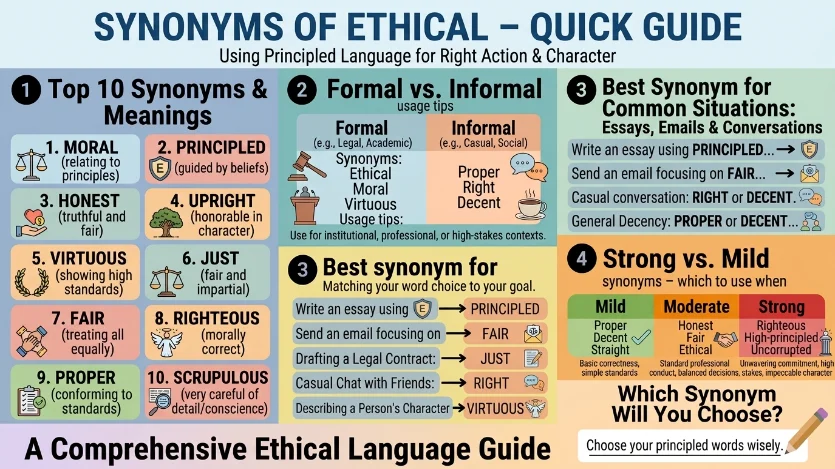
Ethical means following the rules of right and wrong behavior. It describes actions or people that are morally good and honest. The best synonyms are moral, principled, virtuous, honest, and righteous. “Moral” is the most common and natural in everyday English. Each synonym has a slightly different meaning, tone, or context.
Top 10 Synonyms
- Moral
- Principled
- Virtuous
- Honest
- Righteous
- Decent
- Good
- Noble
- Upright
- Just
Have you ever wanted to describe someone’s good character but felt stuck using the same word? Many English learners rely on “ethical” too often. There are many better ways to describe moral behavior and good people.
Learning different synonyms for “ethical” helps you express yourself more clearly. It also makes your English sound more natural and impressive. Whether you’re writing an essay, talking about a leader, or describing a good decision, having the right word matters.
In this guide, you will learn 25 powerful synonyms. You will also discover when to use each one, how formal they are, and common mistakes to avoid. Let’s dive in!
What Does “Ethical” Mean?
Definition
Ethical means relating to what is right and wrong. When we say something is ethical, we mean it follows the rules of good behavior and fairness. An ethical person tries to do what is right. An ethical decision is one that is fair and honest. It’s about knowing the difference between right and wrong and choosing to do the right thing.
Pronunciation
| Feature | Value |
|---|---|
| US IPA | /ˈɛθɪkəl/ |
| UK IPA | /ˈɛθɪkəl/ |
| Syllables | 3 (eth-i-cal) |
| Tip | Stress the first syllable: “ETH-ih-kul” |
Grammar
| Grammar Feature | Information |
|---|---|
| Part of Speech | Adjective |
| Common Position | Before a noun or after a linking verb |
| Typical Pattern | Ethical + noun / Subject + is + ethical |
Examples:
- “The company made an ethical decision.”
- “His behavior was not very ethical.”
- “She works for an ethical organization.”
Note: “Ethical” is often used with words like “issue,” “dilemma,” “standard,” and “principle.” It describes both people and actions.
Word Family
| Word | Part of Speech | Meaning |
|---|---|---|
| Ethic | Noun | A set of moral principles |
| Ethics | Noun (plural) | The study of right and wrong |
| Ethical | Adjective | Following moral rules |
| Ethically | Adverb | In a moral way |
| Unethical | Adjective | Not following moral rules |
10–15 Synonyms of “Ethical”
Moral
Meaning: Relating to the principles of right and wrong behavior, or being a good person.
Best Used For: Everyday conversation, academic writing, describing personal character.
Formality: Neutral
Tone: Serious, Reflective
Frequency: ⭐⭐⭐⭐⭐ (Very Common)
CEFR Level: B1
Example Sentence 1: “She is a highly moral person who always tells the truth.”
Example Sentence 2: “The moral of the story is to always be kind.”
Usage Tip: “Moral” is the most direct synonym and can be used in almost any context. It’s a safe, natural choice. Remember, “morale” (with an ‘e’) means the spirit of a group, and “moral” is about right and wrong.
Common Confusion: Moral vs Ethical – “Moral” is more personal, often based on religious or personal beliefs. “Ethical” is more professional, often based on rules of a profession or society.
Principled
Meaning: A person who has strong beliefs about what is right and wrong and always follows them.
Best Used For: Professional contexts, describing leaders or people of strong character.
Formality: Formal
Tone: Professional, Respectful
Frequency: ⭐⭐⭐⭐ (Common)
CEFR Level: B2
Example Sentence 1: “She is a principled lawyer who never compromises her values.”
Example Sentence 2: “His principled stand on human rights earned him respect worldwide.”
Usage Tip: “Principled” suggests someone who has a clear code of right and wrong. Use this for politicians, leaders, or professionals. It sounds more sophisticated than “ethical” or “moral.”
Virtuous
Meaning: A person who has excellent moral standards and behaves in a very good way.
Best Used For: Formal writing, literary descriptions, historical contexts.
Formality: Formal
Tone: Positive, Literary, Old-fashioned
Frequency: ⭐⭐⭐ (Moderate)
CEFR Level: B2
Example Sentence 1: “The queen was known as a virtuous and wise ruler.”
Example Sentence 2: “He led a virtuous life, always helping those in need.”
Usage Tip: “Virtuous” is a bit old-fashioned. It’s perfect for stories or historical writing. In modern conversation, “moral” is more natural. Don’t use “virtuous” to describe yourself—it can sound boastful!
Honest
Meaning: A person who always tells the truth and does not cheat or steal.
Best Used For: Daily conversation, describing trustworthy people.
Formality: Neutral
Tone: Trustworthy, Simple
Frequency: ⭐⭐⭐⭐⭐ (Very Common)
CEFR Level: A2
Example Sentence 1: “He is the most honest person I know.”
Example Sentence 2: “We need an honest answer, not an excuse.
Usage Tip: “Honest” is more specific than “ethical.” It focuses on truthfulness. While “ethical” is about all moral behavior, “honest” is specifically about truth and not lying.
Righteous
Meaning: A person who behaves morally and justly. It can also mean feeling you are morally right, sometimes with anger.
Best Used For: Religious or serious contexts, describing strong moral anger.
Formality: Formal
Tone: Intense, Emotional, Religious
Frequency: ⭐⭐⭐ (Moderate)
CEFR Level: B2
Example Sentence 1: “He was a righteous man who fought for justice.”
Example Sentence 2: “She felt righteous anger when she saw the unfair treatment.”
Usage Tip: “Righteous” can be positive (a good person) or negative (self-righteous = thinking you are better than others). Use it carefully. In everyday English, “moral” is a safer choice.
Decent
Meaning: A person who is good, kind, and follows generally accepted standards of behavior.
Best Used For: Everyday conversation, describing ordinary good people.
Formality: Neutral
Tone: Warm, Positive
Frequency: ⭐⭐⭐⭐⭐ (Very Common)
CEFR Level: B1
Example Sentence 1: “He’s a decent man who would never harm anyone.”
Example Sentence 2: “We just need to treat each other decently.”
Usage Tip: “Decent” is a great everyday word. It suggests someone is good enough. It’s less heavy than “ethical” and very natural in conversation.
Good
Meaning: A person who behaves well and does what is kind and helpful.
Best Used For: Daily conversation, informal writing.
Formality: Informal
Tone: Simple, Warm
Frequency: ⭐⭐⭐⭐⭐ (Very Common)
CEFR Level: A1
Example Sentence 1: “She has a good heart and always helps others.”
Example Sentence 2: “Being a good person is more important than being rich.
Usage Tip: “Good” is the simplest synonym. It’s great for everyday English. However, it’s very general. Use more specific words like “moral” or “honest” when you want to be more precise.
Noble
Meaning: A person who has very high moral qualities, is generous, and does not put themselves first.
Best Used For: Formal or literary writing, describing heroes or great leaders.
Formality: Formal
Tone: Heroic, Inspiring
Frequency: ⭐⭐⭐ (Moderate)
CEFR Level: B2
Example Sentence 1: “He made the noble decision to sacrifice his own success for the good of the team.
Example Sentence 2: “Her noble actions inspired many people.”
Usage Tip: “Noble” is a powerful word. It’s often used for grand actions or great character. It can sound a bit dramatic, so use it sparingly in everyday conversation.
Upright
Meaning: A person who is completely honest and morally correct.
Best Used For: Formal writing, describing public figures or people in authority.
Formality: Formal
Tone: Respectful, Traditional
Frequency: ⭐⭐⭐ (Moderate)
CEFR Level: B2
Example Sentence 1: “The judge was known as an upright and fair man.”
Example Sentence 2: “He lived an upright life, never cheating anyone.”
Usage Tip: “Upright” is a bit old-fashioned. It’s perfect for formal descriptions of people who are unshakably honest. It comes from the idea of standing tall and straight.
Just
Meaning: Fair and morally right. Also means fair treatment based on law.
Best Used For: Legal contexts, social justice discussions, formal writing.
Formality: Formal
Tone: Legal, Serious
Frequency: ⭐⭐⭐⭐ (Common)
CEFR Level: B1
Example Sentence 1: “Everyone deserves a just and fair trial.”
Example Sentence 2: “It’s not just to blame him for the mistake.”
Usage Tip: “Just” is closely related to “fair” and justice. It’s perfect for legal or serious contexts. It’s often used to describe systems (like the justice system) more than people.
Synonyms Comparison Table
| Synonym | Best Context | Formality | Tone | Frequency |
|---|---|---|---|---|
| Moral | General, Personal | Neutral | Serious | ⭐⭐⭐⭐⭐ |
| Principled | Professional | Formal | Professional | ⭐⭐⭐⭐ |
| Virtuous | Literary, Stories | Formal | Literary | ⭐⭐⭐ |
| Honest | Daily, Truthfulness | Neutral | Trustworthy | ⭐⭐⭐⭐⭐ |
| Righteous | Religious, Serious | Formal | Intense | ⭐⭐⭐ |
| Decent | Daily, People | Neutral | Warm | ⭐⭐⭐⭐⭐ |
| Good | Daily, General | Informal | Simple | ⭐⭐⭐⭐⭐ |
| Noble | Heroes, Leaders | Formal | Heroic | ⭐⭐⭐ |
| Upright | Formal Figures | Formal | Respectful | ⭐⭐⭐ |
| Just | Legal, Fairness | Formal | Legal | ⭐⭐⭐⭐ |
Best Synonyms by Situation
| Situation | Best Synonym | Why It Works |
|---|---|---|
| Daily Conversation | Good or Decent | These are the most natural everyday words. |
| Business Email | Principled | Sounds professional and respectful. |
| Academic Writing | Moral or Principled | These are standard, formal academic terms. |
| School Assignment | Moral | The most common and correct word for school. |
| Professional Meeting | Principled | Shows strong character and integrity. |
| Presentation | Just or Principled | Both sound serious and appropriate. |
| Creative Writing | Virtuous or Noble | Adds a literary, dramatic feel. |
| Social Media | Decent or Honest | These sound natural and not too heavy. |
| Movie Review | Noble or Moral | Good for describing heroic characters. |
| Book Review | Virtuous | Perfect for describing classic characters. |
Formal vs Informal Synonyms
Formal Alternatives
| Synonym | Best Used For |
|---|---|
| Principled | Professional writing, resumes, describing leaders |
| Virtuous | Formal literature, historical writing |
| Righteous | Serious contexts, religious discussions |
| Noble | Describing heroic actions or people |
| Upright | Formal descriptions of character |
| Just | Legal, philosophical, or formal justice contexts |
Neutral Alternatives
| Synonym | Best Used For |
|---|---|
| Moral | Almost any context |
| Honest | Most situations |
| Decent | Everyday conversation |
Informal Alternatives
| Synonym | Best Used For |
|---|---|
| Good | Very informal, daily speech |
| Right | Casual conversation |
Choosing the Right Level: If you are writing a business report, use “principled.” If you are chatting with a friend, “decent” or “good” is perfect. For most formal writing, “moral” is a safe and excellent choice.
Strong vs Mild Synonyms
Mild
- Good: Very simple and mild.
- Decent: Good enough, not too strong.
- Honest: Focuses on truth, not all moral behavior.
Moderate
- Moral: Standard and strong enough for most contexts.
- Principled: Shows firm commitment to values.
- Just: Focuses on fairness.
Strong
- Noble: Suggests heroic, selfless behavior.
- Virtuous: Suggests excellent, almost perfect moral behavior.
- Righteous: Can be very intense, sometimes aggressive.
How Intensity Changes Meaning: Using “noble” makes someone sound like a hero. Using “good” just says they are kind. Choose the word that matches how strong or dramatic you want to sound. Be careful with very strong words—they can sound over-the-top in everyday conversation.
Real-Life Examples
School: “The teacher praised the student for the moral decision to return the lost wallet.”
Office: “The manager made a principled choice to reject the unethical proposal.”
Business Email: “We are looking for a candidate with a strong moral compass.”
Meetings: “The board was praised for its honest and transparent discussion.”
Presentations: “Her presentation focused on the need for more just policies.”
Books: “The novel explores the virtuous life of a small-town family.”
Daily Conversations: “He’s a decent guy, you can trust him.”
Social Media: “She’s the most honest influencer I follow.”
Professional Writing: “The company adopted a principled approach to environmental responsibility.”
Academic Writing: “The philosopher argued that a just society is built on ethical principles.”
Common Collocations
| Common Phrase | Better Alternative |
|---|---|
| Ethical person | Principled or moral person |
| Ethical decision | Just or upright decision |
| Ethical behavior | Virtuous or decent behavior |
| Ethical standard | High moral standard |
| Ethical issue | Moral dilemma |
| Ethical treatment | Fair and just treatment |
Common Phrases
Moral compass: A person’s ability to judge what is right and wrong. (e.g., “She has a strong moral compass.”)
Do the right thing: Means to make the morally correct choice.
Stand up for what’s right: Means to defend good or just behavior.
Clean as a whistle: An informal way to say someone is completely honest and decent.
Good person through and through: Means someone is completely good in every way.
Context Guide
| Situation | Best Synonym | Reason |
|---|---|---|
| Essay | Moral or Principled | These are standard academic terms. |
| Speech | Noble or Just | They sound inspiring and powerful. |
| Business Email | Principled | It sounds professional and strong. |
| Novel | Virtuous or Noble | These add literary depth. |
| Presentation | Principled or Just | They sound serious and appropriate. |
| Conversation | Good or Decent | These are the most natural daily words. |
| Academic Writing | Moral | It is the most commonly used academic term. |
| Marketing Copy | Honest or Principled | These build trust with customers. |
Related Words
Near Synonyms
- Righteous: Closely related, but can be more intense.
- Honorable: Deserves respect and is morally good.
- Trustworthy: Deserving of trust and confidence.
Antonyms
- Unethical: Not following moral rules.
- Immoral: Wrong or not right.
- Dishonest: Not truthful.
- Corrupt: Acting in a morally wrong way, especially for money.
Related Adjectives
- Good: Simple and general.
- Fair: Treating people equally.
- Kind: Showing sympathy and generosity.
- Conscientious: Wanting to do what is right.
Related Nouns
- Integrity: The quality of being honest and having strong moral principles.
- Morality: Beliefs about what is right and wrong.
- Ethics: The study of what is right and wrong.
- Virtue: Morally good behavior.
Related Verbs
- Act: To behave in a particular way.
- Behave: To act in a proper way.
- Conduct: To carry out or manage.
Frequently Asked Questions
What is another word for ethical?
Common synonyms are moral, principled, virtuous, honest, decent, and righteous. “Moral” is the most common and natural choice.
Which synonym sounds the most professional?
Principled is the most professional-sounding synonym. It suggests a person has clear, firm values. It is perfect for business and professional contexts.
What is the strongest synonym?
Noble or righteous are very strong words. Noble suggests heroic goodness, while righteous can be intense and emotional. Use them carefully.
Which synonym is best for essays?
Moral is the best and most common word for essays. It is widely accepted, academic, and clear. Principled is also a very good option.
What’s the difference between moral and ethical?
“Moral” is often more personal and based on personal beliefs. “Ethical” is often more professional and based on the rules of a profession or society. In everyday English, they are often used to mean the same thing.
Which synonym is most common in everyday English?
Good, decent, and moral are the most common. “Good” is the most informal, while “moral” is the most standard neutral choice.
What is the opposite of ethical?
Unethical is the direct opposite. Immoral, dishonest, and corrupt are also common antonyms, with slightly different meanings.
Conclusion
Understanding synonyms for “ethical” helps you describe good character and moral decisions more clearly. As you have learned, each synonym has its own unique tone and best use.
“Moral” is your best all-purpose choice. “Principled” is perfect for professional situations. “Good” and “decent” are best for everyday conversation. For dramatic or literary contexts, “noble” and “virtuous” add depth and emotion.
The key to using these words correctly is paying attention to context and formality. Try using one new synonym each day. Practice describing people and decisions with different words. This will help you build a richer, more natural vocabulary that impresses both teachers and native speakers.
