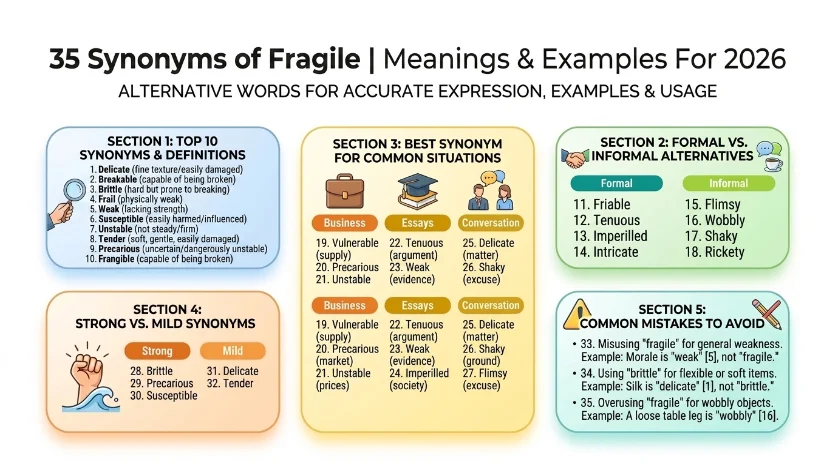
“Fragile” means easily broken, damaged, or weak. The best synonyms are brittle, delicate, breakable, fragile, feeble, and vulnerable. “Delicate” is the most common alternative. Each synonym has a slightly different meaning and context.
Top 10 Synonyms
- Delicate
- Breakable
- Brittle
- Feeble
- Vulnerable
- Weak
- Frail
- Flimsy
- Tender
- Frangible
“Fragile” is a useful word, but using it too much can make your English sound repetitive. You use it for glass, for people’s feelings, for old buildings, and for recovering patients. Each situation deserves a more specific word.
The good news is that English is full of wonderful alternatives. Some words describe physical weakness, like something that breaks easily. Others describe emotional vulnerability or weakness in arguments.
In this guide, you’ll learn 35 powerful synonyms for “fragile.” You’ll discover exactly when to use each one, how formal they are, and what common mistakes to avoid. Let’s begin!
What Does “Fragile” Mean?
Definition
Fragile” means easily broken, damaged, or destroyed. It describes things that are physically delicate, like glass or china. It can also describe people who are weak, vulnerable, or emotionally sensitive. When something is fragile, it needs careful handling.
Pronunciation
| Feature | Value |
|---|---|
| US IPA | /ˈfrædʒəl/ |
| UK IPA | /ˈfrædʒaɪl/ |
| Syllables | 2 (fra-gile) |
| Tip | Stress the first syllable: “FRA-jul” |
Grammar
| Grammar Feature | Information |
|---|---|
| Part of Speech | Adjective |
| Common Position | Before a noun or after a linking verb |
| Typical Pattern | Subject + is/are + fragile / fragile + noun |
Examples:
- “This glass vase is very fragile.” (after verb)
- “Please handle the fragile items carefully.” (before noun)
- “His health remains fragile.” (after verb)
Grammar Note: “Fragile” is an adjective. It describes nouns. You can’t say “I fragile.” You must say “I am fragile” or “It is fragile.”
Word Family
| Word | Part of Speech | Meaning |
|---|---|---|
| Fragile | Adjective | Easily broken or damaged |
| Fragility | Noun | The quality of being fragile |
| Fragilely | Adverb | In a fragile way |
| Frail | Adjective | Weak and delicate |
15 Synonyms of “Fragile”
Delicate
Meaning: Easily broken, damaged, or needing careful handling. Also means gentle and beautiful.
Best Used For: Glass, china, fabrics, feelings, situations.
Formality: Neutral
Tone: Gentle, Careful
Frequency: ⭐⭐⭐⭐⭐ (Very Common)
CEFR Level: B1
Example Sentence 1: “She placed the delicate china cup on the shelf.
Example Sentence 2: “We need to handle this delicate situation carefully.
Usage Tip: “Delicate” is the most common and natural alternative. Use it for physical objects and sensitive situations.
Common Confusion: Delicate vs Fragile. “Delicate” often suggests something is both beautiful and easily damaged. “Fragile” is more direct about the risk of breaking.
Breakable
Meaning: Capable of being broken easily.
Best Used For: Glass, ceramics, toys, any object that can shatter.
Formality: Neutral
Tone: Practical, Direct
Frequency: ⭐⭐⭐⭐ (Common)
CEFR Level: A2
Example Sentence 1: “Please pack the breakable items in bubble wrap.”
Example Sentence 2: “Keep all breakable objects out of reach of children.”
Usage Tip: “Breakable” is very direct and practical. Use it for physical objects that can easily break.
Brittle
Meaning: Hard but easily broken, especially when dry or cold.
Best Used For: Biscuits, nails, hair, bones, old materials.
Formality: Formal
Tone: Technical, Scientific
Frequency: ⭐⭐⭐ (Moderate)
CEFR Level: B2
Example Sentence 1: “The old window frames became brittle with age.”
Example Sentence 2: “Her brittle nails kept breaking.”
Usage Tip: “Brittle” describes things that are hard but snap easily. It’s more technical than “fragile.”
Feeble
Meaning: Weak, not strong, or not effective.
Best Used For: People, arguments, health, efforts.
Formality: Formal
Tone: Weak, Sympathetic
Frequency: ⭐⭐⭐ (Moderate)
CEFR Level: B2
Example Sentence 1: “His feeble attempt to help was not useful.”
Example Sentence 2: “The old man spoke in a feeble voice.”
Usage Tip: “Feeble” is usually for living things or abstract things like arguments. It means weak, not easily broken.
Vulnerable
Meaning: Open to physical or emotional harm.
Best Used For: People, feelings, children, positions of weakness.
Formality: Formal
Tone: Sensitive, Protective
Frequency: ⭐⭐⭐⭐ (Common)
CEFR Level: B2
Example Sentence 1: “Children are especially vulnerable to illness.”
Example Sentence 2: “She felt vulnerable after sharing her feelings.”
Usage Tip: “Vulnerable” focuses on being at risk of harm. Use it for people, emotions, and situations that need protection.
Weak
Meaning: Not strong physically, or lacking power or influence.
Best Used For: People, arguments, materials, systems.
Formality: Neutral
Tone: Neutral, Direct
Frequency: ⭐⭐⭐⭐⭐ (Very Common)
CEFR Level: A2
Example Sentence 1: “His weak argument did not convince anyone.
Example Sentence 2: “After the illness, she felt weak and tired.”
Usage Tip: “Weak” is very common. It can mean not strong in any way—physical, mental, or structural.
Frail
Meaning: Weak and delicate, especially because of old age or illness.
Best Used For: Elderly people, patients, small animals.
Formality: Formal
Tone: Sympathetic, Gentle
Frequency: ⭐⭐⭐ (Moderate)
CEFR Level: B2
Example Sentence 1: “The frail old woman needed assistance to walk.”
Example Sentence 2: “His grandmother is getting increasingly frail.”
Usage Tip: “Frail” is specifically used for people who are weak, often because of age or illness. It’s sympathetic and gentle.
Flimsy
Meaning: Light and weak, or not strongly built.
Best Used For: Materials, arguments, evidence, clothes.
Formality: Neutral
Tone: Critical, Dismissive
Frequency: ⭐⭐⭐ (Moderate)
CEFR Level: B2
Example Sentence 1: “She wore a flimsy dress that wasn’t warm enough.”
Example Sentence 2: “His flimsy excuse was not believable.”
Usage Tip: “Flimsy” suggests something is weak because it’s too thin or poorly made. It often has a negative tone.
Frangible
Meaning: Easily broken or fragile.
Best Used For: Technical contexts, formal writing, military ammunition.
Formality: Very Formal
Tone: Technical, Precise
Frequency: ⭐ (Very Rare)
CEFR Level: C1
Example Sentence 1: “The frangible bullets are designed to break apart on impact.”
Example Sentence 2: “The frangible glass was used for safety purposes.”
Usage Tip: “Frangible” is a rare, technical word. Avoid it in everyday conversation. Use “fragile” or “breakable” instead.
Tender
Meaning: Easily hurt or damaged, sensitive.
Best Used For: Skin, feelings, meat, plants.
Formality: Neutral
Tone: Gentle, Caring
Frequency: ⭐⭐⭐⭐ (Common)
CEFR Level: B1
Example Sentence 1: “Her sunburned skin was very tender.”
Example Sentence 2: “He spoke to her in a tender voice.”
Usage Tip: “Tender” can mean physically sensitive or emotionally gentle. It’s a versatile word.
Tenuous
Meaning: Weak and not solid, easily broken or destroyed.
Best Used For: Arguments, connections, relationships.
Formality: Very Formal
Tone: Intellectual, Analytical
Frequency: ⭐⭐ (Rare)
CEFR Level: C1
Example Sentence 1: “There is only a tenuous connection between the two events.
Example Sentence 2: “Their relationship is quite tenuous.”
Usage Tip: “Tenuous” is very formal and used for abstract connections or arguments that are weak.
Brittle
Meaning: Hard but likely to break easily.
Best Used For: Glass, ceramics, bones, hair, old materials.
Formality: Formal
Tone: Technical, Scientific
Frequency: ⭐⭐⭐ (Moderate)
CEFR Level: B2
Example Sentence 1: “The dry, brittle leaves crumbled in my hand.”
Example Sentence 2: “Her brittle bones made her vulnerable to fractures.”
Usage Tip: “Brittle” describes something that is hard but snaps easily under pressure.
Dainty
Meaning: Small, delicate, and pretty.
Best Used For: Small objects, jewelry, food, women.
Formality: Neutral
Tone: Beautiful, Feminine
Frequency: ⭐⭐ (Rare)
CEFR Level: B2
Example Sentence 1: “She wore a dainty necklace around her neck.”
Example Sentence 2: “He made dainty little sandwiches for the party.”
Usage Tip: “Dainty” suggests something is small, pretty, and delicate. It’s often positive, not negative.
Shaky
Meaning: Not firm or steady.
Best Used For: Hands, arguments, foundation, plans.
Formality: Informal
Tone: Nervous, Unstable
Frequency: ⭐⭐⭐ (Moderate)
CEFR Level: B1
Example Sentence 1: “She wrote with shaky hands from nervousness.”
Example Sentence 2: “Their shaky alliance was about to collapse.”
Usage Tip: “Shaky” suggests instability or lack of confidence. Use it for physical shaking or weak plans.
Unstable
Meaning: Not stable, likely to change or fall.
Best Used For: Structures, people, systems, situations.
Formality: Formal
Tone: Serious, Concerning
Frequency: ⭐⭐⭐⭐ (Common)
CEFR Level: B2
Example Sentence 1: “The unstable bridge was closed for repairs.”
Example Sentence 2: “His emotional state is very unstable.”
Usage Tip: “Unstable” means not firm or secure. It can be physical (a structure) or emotional (a person).
Synonyms Comparison Table
| Synonym | Best Context | Formality | Tone | Frequency |
|---|---|---|---|---|
| Delicate | Objects, feelings | Neutral | Gentle | ⭐⭐⭐⭐⭐ |
| Breakable | Physical objects | Neutral | Direct | ⭐⭐⭐⭐ |
| Weak | People, arguments | Neutral | Neutral | ⭐⭐⭐⭐⭐ |
| Vulnerable | People, feelings | Formal | Protective | ⭐⭐⭐⭐ |
| Frail | Elderly, ill | Formal | Sympathetic | ⭐⭐⭐ |
| Flimsy | Excuses, materials | Neutral | Critical | ⭐⭐⭐ |
| Brittle | Dry materials | Formal | Technical | ⭐⭐⭐ |
| Tender | Skin, feelings | Neutral | Gentle | ⭐⭐⭐⭐ |
| Unstable | Structures, people | Formal | Serious | ⭐⭐⭐⭐ |
Best Synonyms by Situation
| Situation | Best Synonym | Why It Works |
|---|---|---|
| Daily Conversation | Delicate | Natural and versatile |
| Business Email | Vulnerable | Professional and clear |
| Academic Writing | Brittle / Tenuous | Formal and precise |
| School Assignment | Fragile | Direct and clear |
| Professional Meeting | Unstable | Serious and professional |
| Presentation | Delicate | Professional and clear |
| Creative Writing | Frail / Dainty | Adds literary depth |
| Social Media | Vulnerable | Relatable and emotional |
| Medical Context | Frail / Tender | Precise and caring |
Formal vs Informal Synonyms
Formal Alternatives
| Synonym | Best Used For |
|---|---|
| Vulnerable | Risk, harm, protection |
| Tenuous | Connections, arguments |
| Frangible | Technical contexts |
| Brittle | Scientific, technical |
Neutral Alternatives
| Synonym | Best Used For |
|---|---|
| Delicate | Objects, situations |
| Breakable | Physical objects |
| Weak | General weakness |
| Tender | Physical and emotional sensitivity |
Informal Alternatives
| Synonym | Best Used For |
|---|---|
| Flimsy | Excuses, cheap materials |
| Shaky | Nervousness, weak plans |
| Dainty | Small, pretty objects |
Choosing the Right Level: In academic writing, use “tenuous” or “brittle.” In professional contexts, “vulnerable” and “unstable” work well. In casual conversation, “delicate” and “breakable” are most natural.
Strong vs Mild Synonyms
Mild
Suitable for everyday situations with less intensity.
- Breakable
- Tender
- Dainty
Moderate
More specific or serious alternatives.
- Delicate
- Weak
- Flimsy
- Shaky
Strong
High-intensity alternatives suggesting serious weakness.
- Vulnerable (open to harm)
- Frail (extremely weak)
- Unstable (dangerously weak)
- Tenuous (barely holding together)
How Intensity Changes Meaning: “The glass is breakable” is simple. “The old woman is frail” suggests serious weakness. “The situation is tenuous” suggests it’s barely holding together. Choose stronger words for more serious situations.
Real-Life Examples
School: “The student’s understanding of the topic is still weak.”
Office: “The company is in a vulnerable position right now.”
Business Email: “We must protect our vulnerable data systems.”
Meetings: “Our relationship with the client is tenuous.”
Presentations: “Our fragile economy needs careful handling.”
Daily Conversations: “Please be careful, that vase is delicate.”
Social Media: “We all feel vulnerable sometimes, and that’s okay.”
Academic Writing: “The tenuous nature of the evidence weakens the argument.”
Common Collocations
| Common Phrase | Better Alternative |
|---|---|
| Fragile glass | Delicate glass |
| Fragile health | Frail health / Vulnerable health |
| Fragile ego | Vulnerable ego |
| Fragile relationship | Tenuous relationship |
| Fragile balance | Delicate balance |
Common Phrases
Handle with care: Something that needs careful handling. (e.g., “This package contains fragile items, handle with care.”)
Walking on eggshells: Being very careful. (e.g., “He’s so sensitive, I feel like I’m walking on eggshells.”)
Fragile as glass: Very fragile. (e.g., “Her confidence is as fragile as glass.”)
A weak link: The weakest part. (e.g., “Our defenses had a weak link.”)
On shaky ground: In a weak or unstable position. (e.g., “His argument is on shaky ground.”)
Context Guide
| Situation | Best Synonym | Reason |
|---|---|---|
| Essay | Tenuous / Brittle | Academic and formal |
| Speech | Vulnerable / Fragile | Relatable and clear |
| Business Email | Vulnerable / Delicate | Professional and careful |
| Novel | Frail / Dainty | Adds literary depth |
| Presentation | Delicate / Fragile | Clear and professional |
| Conversation | Delicate / Breakable | Natural and casual |
| Academic Writing | Tenuous / Brittle | Intellectual and precise |
| Marketing Copy | Delicate | Positive and careful |
Related Words
Near Synonyms
- Precarious: Unstable and likely to fall. (e.g., “His job is precarious.”)
- Perilous: Full of danger.
- Frail: Weak and delicate.
- Ephemeral: Lasting for a short time.
- Flimsy: Weak and poorly made.
Antonyms
- Strong: Having great physical power.
- Sturdy: Strong and well-built.
- Durable: Long-lasting and strong.
- Robust: Strong and healthy.
- Resilient: Able to withstand challenges.
Related Adjectives
- Frail: Weak and delicate.
- Delicate: Easily broken.
- Weak: Not strong.
- Vulnerable: Open to harm.
- Sensitive: Easily hurt.
Related Nouns
- Fragility: The quality of being fragile.
- Vulnerability: The state of being vulnerable.
- Weakness: The state of being weak.
- Frailness: The quality of being frail.
Related Verbs
- Shatter: To break into pieces.
- Crack: To break but not fall apart.
- Splinter: To break into small pieces.
- Break: To separate into pieces.
Frequently Asked Questions
What is another word for fragile?
Common synonyms include delicate, breakable, brittle, frail, vulnerable, and weak. The best choice depends on whether you’re describing a physical object or a person.
Which synonym sounds the most professional?
Vulnerable and tenuous sound very professional. “Brittle” is also excellent for technical and scientific contexts.
What is the strongest synonym for fragile?
Frail and vulnerable are among the strongest. “Frail” suggests extreme physical weakness. “Vulnerable” suggests being at risk of harm.
Which synonym is best for essays?
Tenuous and brittle are excellent for academic essays. “Vulnerable” is also a strong choice for social science writing.
What’s the difference between fragile and delicate?
“Fragile” is more direct and suggests something is easily broken. “Delicate” often implies beauty or sensitivity as well as fragility.
Which synonym is most common in everyday English?
Delicate” is the most common synonym. “Weak” and “breakable” are also frequently used in everyday speech.
What is the opposite of fragile?
Common opposites are strong, sturdy, durable, and robust. These words describe things that are not easily broken or damaged.
Conclusion
Fragile” is a useful word, but now you have 35 powerful alternatives at your disposal. Each synonym adds a different shade of meaning to your language.
Remember, the key is understanding the context. Use “delicate” for beautiful objects and sensitive situations. Use “breakable” for physical objects. Use “frail” for elderly or ill people. Use “vulnerable” for people at risk. Use “tenuous” for weak connections or arguments.
The best way to improve is practice. Try using one or two new synonyms each day. Listen for these words in conversations, books, and movies. Your vocabulary will become richer and more impressive with time.
