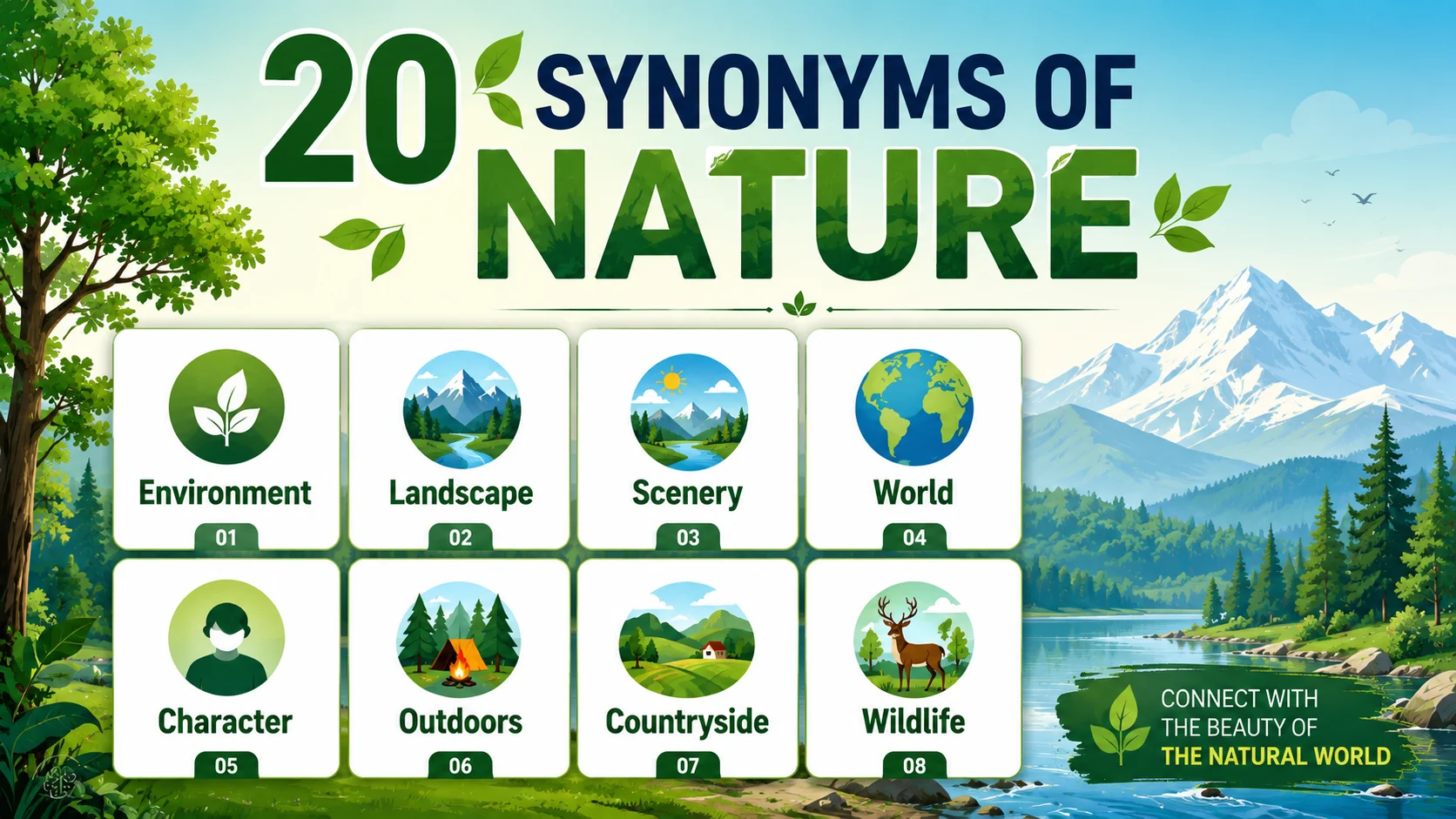
Nature refers to the physical world and everything in it that isn’t made by humans. It also means the basic qualities or character of something. The best synonyms are environment, landscape, scenery, world, and character. Environment is the most common alternative for the physical world, while character works best for describing qualities. Each synonym has a slightly different meaning, tone, or context.
Have you ever noticed how often we use the word “nature”? It’s a versatile word, but using it too much can make your English sound repetitive. Learning synonyms for “nature” helps you describe the world around you more precisely and makes your writing more interesting.
In this guide, you’ll discover 20 useful synonyms for “nature.” We’ll explain what each one means, show you when to use it, and give you real-life examples. Whether you’re writing an essay, having a conversation, or describing a beautiful view, you’ll find the perfect word here.
What Does “Nature” Mean?
Definition
Nature” has two main meanings. First, it means everything in the physical world that isn’t made by people, like trees, animals, oceans, and mountains. Second, it means the basic qualities or character of a person or thing. For example, “the nature of the problem” means the essential characteristics of that problem. It’s a word we use to talk about both the outdoors and the core of something.
Pronunciation
US IPA: /ˈneɪtʃər/
UK IPA: /ˈneɪtʃə/
Syllables: 2 (na-ture)
Tip: Stress the first syllable: NAY-chur.
Grammar
| Feature | Information |
|---|---|
| Part of Speech | Noun (countable and uncountable) |
| Common Position | Subject or object of a sentence |
| Typical Pattern | The nature of + something |
Examples:
- I love spending time in nature.
- The nature of the job requires patience.
- Nature is beautiful in the spring.
Word Family
| Word | Part of Speech | Meaning |
|---|---|---|
| Nature | Noun | The physical world or essential qualities |
| Natural | Adjective | Existing in or caused by nature |
| Naturally | Adverb | In a natural way |
| Naturalist | Noun | A person who studies nature |
| Naturalize | Verb | To make something natural or adapt to a new environment |
50 Synonyms of “Nature”
1. Environment
Meaning: The surroundings or conditions in which a person, animal, or plant lives.
Best Used For: Academic writing, scientific contexts, discussions about ecosystems.
Formality: Formal
Tone: Professional, scientific
Frequency: ⭐⭐⭐⭐⭐ Very Common
CEFR Level: A2
Example Sentence 1: We need to protect our environment for future generations.
Example Sentence 2: The environment in the office is very relaxed.
Usage Tip: “Environment” is a very common and natural synonym for nature when you’re talking about the physical world. It’s also used for non-physical contexts, like a “work environment.” Don’t use it when talking about someone’s character.
2. Landscape
Meaning: All the visible features of an area of countryside or land.
Best Used For: Describing views, travel writing, geography.
Formality: Neutral
Tone: Descriptive, visual
Frequency: ⭐⭐⭐⭐ Very Common
CEFR Level: B1
Example Sentence 1: The landscape of New Zealand is breathtaking.
Example Sentence 2: The political landscape has changed dramatically.
Usage Tip: “Landscape” is perfect for describing what you see when you look at a wide area. It can also be used metaphorically, like “the political landscape.” It’s more specific than “nature” and focuses on visual appearance.
3. Scenery
Meaning: The natural features of a place that you can see.
Best Used For: Travel, tourism, describing views.
Formality: Neutral
Tone: Positive, appreciative
Frequency: ⭐⭐⭐⭐ Very Common
CEFR Level: B1
Example Sentence 1: The scenery along the coast is spectacular.
Example Sentence 2: We stopped to admire the scenery.
Usage Tip: “Scenery” focuses on what you can see, especially beautiful natural views. It’s a great word for travel writing and conversations about holidays. It’s more specific than “nature” and is always about visual experience.
4. World
Meaning: The earth and all its people, or a particular area of activity.
Best Used For: General conversation, creative writing, discussions about life.
Formality: Neutral
Tone: Broad, inclusive
Frequency: ⭐⭐⭐⭐⭐ Very Common
CEFR Level: A1
Example Sentence 1: The natural world is full of amazing creatures.
Example Sentence 2: He lives in a world of his own.
Usage Tip: “World” is a broader word than “nature.” It includes everything on earth, including human-made things. It’s very common and natural in conversation. Use “the natural world” when you want to talk about nature specifically.
5. Character
Meaning: The particular combination of qualities that makes something different from others.
Best Used For: Describing people, writing about products, intellectual discussions.
Formality: Formal
Tone: Analytical, professional
Frequency: ⭐⭐⭐⭐⭐ Very Common
CEFR Level: B1
Example Sentence 1: The character of the city has changed over the years.
Example Sentence 2: What is the nature or character of the problem?
Usage Tip: “Character” is the best synonym for the “essential qualities” meaning of nature. Use it when you want to describe what makes something unique. It’s very common and natural in both speaking and writing.
6. Quality
Meaning: A distinctive attribute or characteristic possessed by something.
Best Used For: Evaluations, reviews, describing features.
Formality: Neutral
Tone: Evaluative, descriptive
Frequency: ⭐⭐⭐⭐ Very Common
CEFR Level: B1
Example Sentence 1: The quality of the product is excellent.
Example Sentence 2: She has many good qualities.
Usage Tip: “Quality” is a good alternative for the “character” meaning of nature. It’s more specific about features or attributes. Use it when you’re evaluating or describing specific traits.
7. Outdoors
Meaning: The natural world outside buildings.
Best Used For: Daily conversation, lifestyle, activities.
Formality: Informal
Tone: Casual, active
Frequency: ⭐⭐⭐⭐⭐ Very Common
CEFR Level: A2
Example Sentence 1: I love spending time in the outdoors.
Example Sentence 2: The outdoors is the best place to relax.
Usage Tip: “Outdoors” is a simple, natural synonym for nature when you’re talking about being outside. It’s very common in everyday conversation. Use it when you want to emphasize being outside, not in a building.
8. Wildlife
Meaning: Animals and plants that live in the wild.
Best Used For: Conservation, biology, documentaries.
Formality: Neutral
Tone: Scientific, appreciative
Frequency: ⭐⭐⭐⭐ Very Common
CEFR Level: B1
Example Sentence 1: The island is famous for its wildlife.
Example Sentence 2: We saw a lot of wildlife on our trip.
Usage Tip: “Wildlife” is more specific than “nature.” It refers specifically to animals and plants, not the whole natural world. Use it when you want to talk about living things in nature.
9. Countryside
Meaning: Land outside cities and towns, with fields, forests, and farms.
Best Used For: Describing rural areas, travel, lifestyle.
Formality: Neutral
Tone: Descriptive, peaceful
Frequency: ⭐⭐⭐⭐ Very Common
CEFR Level: A2
Example Sentence 1: We went for a walk in the countryside.
Example Sentence 2: The countryside is beautiful in autumn.
Usage Tip: “Countryside” is a specific type of nature. It refers to rural areas, not mountains or coasts. It’s a very common and natural word for describing outdoor spaces that people live and work in.
10. Habitat
Meaning: The natural home or environment of an animal, plant, or other organism.
Best Used For: Biology, ecology, conservation.
Formality: Formal
Tone: Scientific, factual
Frequency: ⭐⭐⭐⭐ Very Common
CEFR Level: B1
Example Sentence 1: The forest is the habitat of many species.
Example Sentence 2: We must protect natural habitats.
Usage Tip: “Habitat” is a specialized synonym. It only refers to the place where something lives. It’s not a general synonym for “nature.” Use it in scientific or conservation contexts.
11. Essence
Meaning: The basic or most important quality of something.
Best Used For: Philosophy, literary writing, discussions about meaning.
Formality: Formal
Tone: Philosophical, thoughtful
Frequency: ⭐⭐⭐ Moderate
CEFR Level: B2
Example Sentence 1: The essence of the problem is lack of communication.
Example Sentence 2: Her essence is kindness.
Usage Tip: “Essence” is a deep synonym for the “character” meaning of nature. It suggests the most fundamental quality. Use it when you want to sound thoughtful or philosophical.
12. Temperament
Meaning: A person’s or animal’s nature, especially as it affects their behavior.
Best Used For: Psychology, describing people, animal behavior.
Formality: Formal
Tone: Analytical, psychological
Frequency: ⭐⭐⭐ Moderate
CEFR Level: B2
Example Sentence 1: She has a calm temperament.
Example Sentence 2: The dog’s friendly temperament makes it a great pet.
Usage Tip: “Temperament” is specific to people and animals. It refers to their basic emotional nature. Don’t use it for things or places.
13. Disposition
Meaning: A person’s inherent qualities of mind and character.
Best Used For: Psychology, describing people, behavior analysis.
Formality: Formal
Tone: Analytical, thoughtful
Frequency: ⭐⭐⭐ Moderate
CEFR Level: B2
Example Sentence 1: He has a generous disposition.
Example Sentence 2: Her sunny disposition makes everyone happy.
Usage Tip: “Disposition” is very similar to “temperament.” It refers to someone’s natural mood or attitude. It’s a formal word that sounds natural in professional or psychological contexts.
14. Personality
Meaning: The combination of characteristics that form a person’s distinctive character.
Best Used For: Psychology, everyday conversation, describing people.
Formality: Neutral
Tone: Friendly, descriptive
Frequency: ⭐⭐⭐⭐⭐ Very Common
CEFR Level: A2
Example Sentence 1: She has a wonderful personality.
Example Sentence 2: The personality of the city is vibrant.
Usage Tip: “Personality” is a very common and natural word. It’s the everyday word for “character.” You can use it for people and sometimes for places. It sounds friendly and casual.
15. Type
Meaning: A category of people or things having common characteristics.
Best Used For: Classifying, categorizing, general discussion.
Formality: Neutral
Tone: Practical, straightforward
Frequency: ⭐⭐⭐⭐⭐ Very Common
CEFR Level: A2
Example Sentence 1: What type of animal is that?
Example Sentence 2: I don’t like that type of behavior.
Usage Tip: “Type” is a very common and simple word. It’s a good alternative when you’re classifying things. It’s less formal than “nature” or “character” and works well in everyday conversation.
16. Kind
Meaning: A group of people or things having similar characteristics.
Best Used For: General conversation, classifying, everyday use.
Formality: Informal
Tone: Casual, simple
Frequency: ⭐⭐⭐⭐⭐ Very Common
CEFR Level: A1
Example Sentence 1: What kind of music do you like?
Example Sentence 2: I don’t like that kind of attitude.
Usage Tip: “Kind” is the simplest and most common synonym for “type.” It’s very informal and natural in conversation. Use it when you want to be casual and easy to understand.
17. Sort
Meaning: A category of people or things with shared characteristics.
Best Used For: General conversation, informal writing.
Formality: Informal
Tone: Casual, conversational
Frequency: ⭐⭐⭐⭐⭐ Very Common
CEFR Level: A2
Example Sentence 1: What sort of food do you like?
Example Sentence 2: It’s that sort of problem.
Usage Tip: “Sort” is very similar to “kind” and “type.” It’s a friendly, informal word. Use it in conversation or casual writing. It’s a great everyday alternative.
18. Makeup
Meaning: The composition or structure of something.
Best Used For: Analysis, describing systems, explaining how things work.
Formality: Neutral
Tone: Analytical, professional
Frequency: ⭐⭐⭐ Moderate
CEFR Level: B2
Example Sentence 1: The makeup of the team is diverse.
Example Sentence 2: The chemical makeup of water is H2O.
Usage Tip: “Makeup” is a useful synonym for “nature” when you’re talking about what something is made of or how it’s structured. It’s very natural in professional and analytical contexts.
19. Constitution
Meaning: The composition or structure of something.
Best Used For: Formal writing, scientific contexts, official documents.
Formality: Very Formal
Tone: Official, scientific
Frequency: ⭐⭐ Rare
CEFR Level: C1
Example Sentence 1: The constitution of the committee was reviewed.
Example Sentence 2: His physical constitution is very strong.
Usage Tip: “Constitution” is a more formal synonym for “makeup” or “structure.” It can be used for both physical and organizational structures. It’s quite formal and less common in everyday use.
20. Ecology
Meaning: The relationship between living things and their environment.
Best Used For: Scientific writing, environmental discussions, activism.
Formality: Formal
Tone: Scientific, environmental
Frequency: ⭐⭐⭐⭐ Very Common
CEFR Level: B2
Example Sentence 1: The ecology of the forest is complex.
Example Sentence 2: We need to study marine ecology.
Usage Tip: “Ecology” refers to the science of how living things interact with nature. It’s not a direct synonym for “nature,” but it’s closely related. Use it in scientific or environmental contexts.
Synonyms Comparison Table
| Synonym | Best Context | Formality | Tone | Frequency |
|---|---|---|---|---|
| Environment | All contexts | Neutral to Formal | Professional | ⭐⭐⭐⭐⭐ |
| Landscape | Describing views | Neutral | Descriptive | ⭐⭐⭐⭐ |
| Scenery | Travel, views | Neutral | Positive | ⭐⭐⭐⭐ |
| World | General use | Neutral | Broad | ⭐⭐⭐⭐⭐ |
| Character | Describing qualities | Formal | Analytical | ⭐⭐⭐⭐⭐ |
| Outdoors | Activities | Informal | Casual | ⭐⭐⭐⭐⭐ |
| Countryside | Rural areas | Neutral | Peaceful | ⭐⭐⭐⭐ |
| Wildlife | Animals, plants | Neutral | Scientific | ⭐⭐⭐⭐ |
| Personality | Describing people | Neutral | Friendly | ⭐⭐⭐⭐⭐ |
| Kind | Everyday talk | Informal | Casual | ⭐⭐⭐⭐⭐ |
Best Synonyms by Situation
| Situation | Best Synonym | Why It Works |
|---|---|---|
| Daily Conversation | Nature or Outdoors | Simple and natural |
| Business Email | Character or Environment | Professional and clear |
| Academic Writing | Environment or Ecology | Formal and precise |
| School Assignment | Nature or Environment | Easy to understand |
| Professional Meeting | Character or Quality | Direct and appropriate |
| Presentation | Environment or Landscape | Visual and engaging |
| Creative Writing | Landscape or World | Descriptive and rich |
| Social Media | Nature or Outdoors | Relatable and human |
| Movie Review | Character or Quality | Evaluative and clear |
| Book Review | Character or World | Analytical and thoughtful |
Formal vs Informal Synonyms
Formal Alternatives
| Synonym | Best Used For |
|---|---|
| Environment | Academic writing, professional reports |
| Character | Analysis, evaluations |
| Ecology | Scientific writing |
| Constitution | Official documents |
Neutral Alternatives
| Synonym | Best Used For |
|---|---|
| Landscape | Most professional contexts |
| Scenery | Travel, geography |
| Countryside | Describing rural areas |
Informal Alternatives
| Synonym | Best Used For |
|---|---|
| Outdoors | Casual conversations |
| Kind | Everyday talk |
| Sort | Informal discussions |
When to choose which: Choose formal synonyms for academic writing, official documents, and professional analysis. Choose neutral synonyms for most business contexts. Choose informal synonyms when you’re talking with friends or writing social media posts.
Strong vs Mild Synonyms
Mild
Nature, Outdoors, Kind – These are everyday words suitable for any situation. They’re safe and natural choices that everyone understands.
Moderate
Environment, Landscape, Character, World – These are more specific and give you more precision. They’re appropriate for most professional and academic contexts.
Strong
Essence, Constitution, Disposition, Temperament – These have strong connotations and are very specific. Use them carefully in formal or specialized contexts.
How intensity changes meaning: Mild words are safe and universally understood. Moderate words give you more precision. Strong words are very specific and can sound powerful or formal. Match the intensity to your context.
Real-Life Examples
In a business email:
“The character of the project has changed since our last meeting.”
In a presentation:
“Our company values a positive work environment.”
In an academic essay:
“The landscape of Europe was transformed during the Industrial Revolution.”
In a travel blog:
“The scenery in the Scottish Highlands is absolutely breathtaking.”
In daily conversation:
“I love being in the outdoors on weekends.”
In a book review:
“The world the author creates feels incredibly real.”
In a psychology paper:
“Her temperament is naturally calm and patient.”
In a conservation discussion:
“Protecting wildlife habitats is crucial for biodiversity.”
Common Collocations
| Common Phrase | Better Alternative |
|---|---|
| Beautiful nature | Stunning landscape |
| Natural scenery | Breathtaking scenery |
| Wild nature | Untamed wilderness |
| The nature of | The character of or The essence of |
| Natural world | Environment or Ecosystem |
Common Phrases
“Force of nature” – A person with a very strong personality.
- Better alternative: Powerful personality (less dramatic)
“Nature vs nurture” – The debate about genetics versus environment.
- Use this phrase in academic contexts.
“Second nature” – Something that feels completely natural.
- Better alternative: Habit (simpler)
“Mother Nature” – Nature personified as a woman.
- Use this in cultural or poetic contexts.
Context Guide
| Situation | Best Synonym | Reason |
|---|---|---|
| Essay | Environment or Ecology | Academic and precise |
| Speech | Nature or Outdoors | Accessible and engaging |
| Business Email | Character or Quality | Professional and direct |
| Novel | World or Landscape | Literary and descriptive |
| Presentation | Environment | Professional and clear |
| Conversation | Nature or Outdoors | Simple and natural |
| Academic Writing | Ecology or Environment | Formal and scientific |
| Marketing Copy | Environment or Natural | Relatable and appealing |
Related Words
Near Synonyms
Environment, Landscape, Scenery, World – These are the closest synonyms to “nature” and can often be used interchangeably with the correct context.
Antonyms
- Artificial – Made by humans
- Civilization – Human society
- Urban – Relating to cities
Related Adjectives
- Natural – Existing in or caused by nature
- Organic – Living or grown without chemicals
- Wild – Not tamed or domesticated
Related Nouns
- Ecosystem – A community of living things
- Biome – A major ecological community
- Wilderness – Undeveloped land
Related Verbs
- Naturalize – To become natural
- Preserve – To protect nature
- Conserve – To keep and protect
Frequently Asked Questions
What is another word for nature?
Common synonyms include environment, landscape, scenery, world, character, and outdoors. Your choice depends on whether you mean the physical world or essential qualities.
Which synonym sounds the most professional?
“Environment” and “character” sound the most professional. They’re widely used in business and academic contexts and are clear and natural.
What is the strongest synonym for nature?
Essence” is a strong synonym for the “character” meaning of nature. It suggests the most fundamental quality. “Wilderness” is strong for the physical meaning.
Which synonym is best for academic writing?
“Environment” and “ecology” are best for academic writing. They’re precise and widely used in scientific contexts. “Character” is good for philosophical analysis.
What is the most common synonym in everyday English?
“Outdoors” and “environment” are very common in everyday English. “World” is also widely used, especially in phrases like “the natural world.”
What is the opposite of nature?
The closest opposites are “artificial,” “civilization,” and “urban.” These words describe things made by humans rather than the natural world.
Conclusion
“Nature” is a rich word with two main meanings: the physical world and essential qualities. When you need alternatives, think about which meaning you’re using. For the physical world, consider “environment,” “landscape,” or “outdoors.” For essential qualities, think about “character,” “essence,” or “quality.”
The best synonym depends on your context, tone, and audience. In daily conversation, “nature” or “outdoors” works perfectly. In professional writing, “environment” or “character” is better. For creative writing, “landscape” or “world” adds beauty.
Don’t be afraid to experiment with different words as you practice. The more you use these synonyms, the more natural they’ll feel. Remember, the goal is to communicate clearly and precisely. Choose the word that best fits your meaning and your audience.
