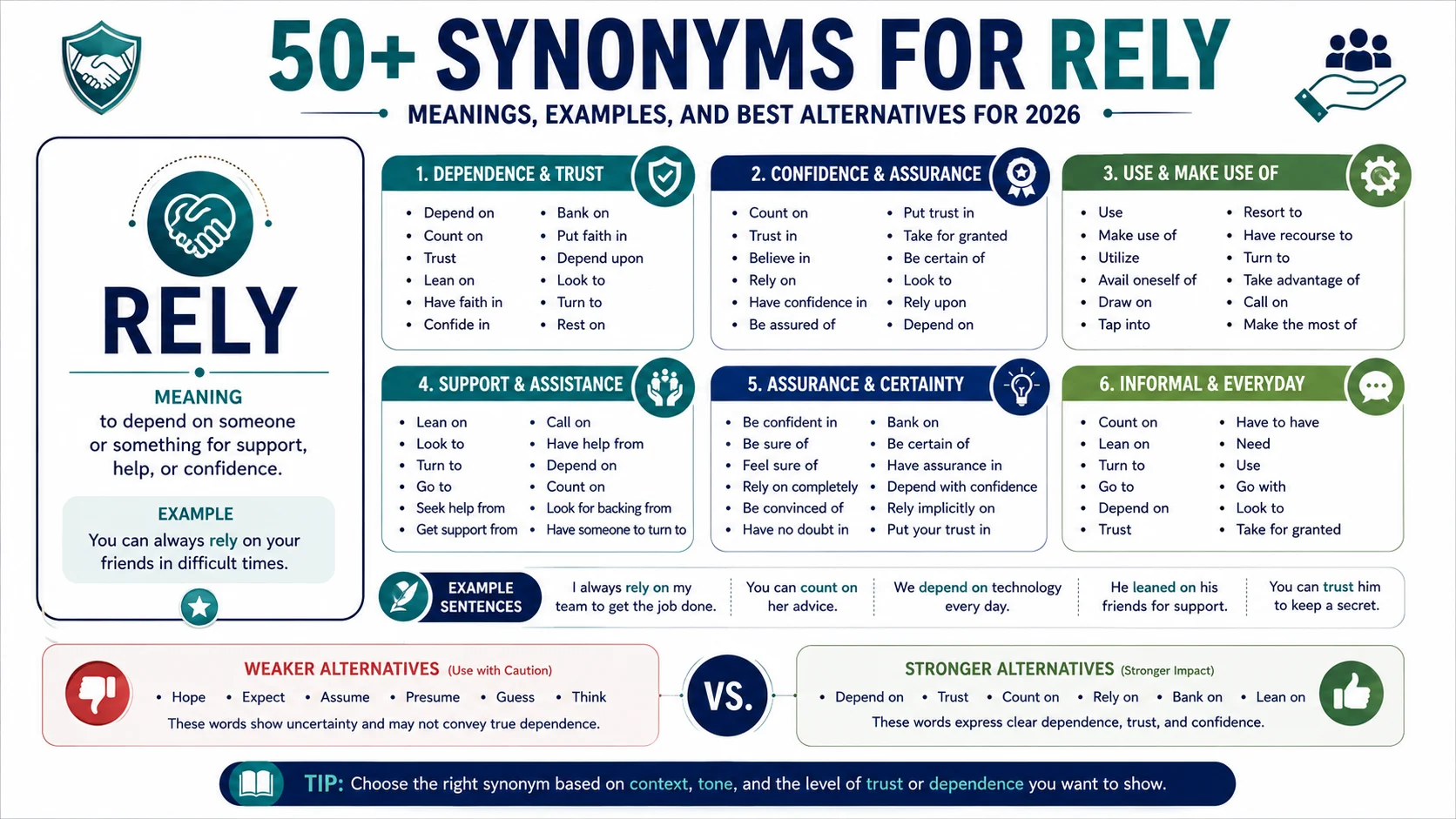
Rely means to depend on someone or something with confidence, trust, or necessity . The best synonym depends on context: use depend for general use, count on for casual trust, trust for emotional confidence, hinge on for outcomes, and lean on for support.
Have you ever caught yourself using the word “rely” repeatedly in an email, essay, or presentation?
You are not alone. Most writers, students, and professionals fall into the trap of overusing this useful word without realizing how many powerful alternatives exist.
Imagine you are writing a cover letter and you keep saying, “I rely on my experience.” Or you are composing an email and every other sentence repeats the same phrase.
This is exactly the scenario we will solve together.
A rich vocabulary transforms ordinary writing into something memorable and precise. When you master synonyms for rely, you gain the ability to express trust, dependence, and confidence with nuance.
This comprehensive guide will show you exactly how to choose the right synonym for rely in any situation. You will learn the subtle differences between depend, count on, trust, lean on, and many other alternatives.
Meaning, Tone and Context
Simple Definition
To rely on someone or something means to have confidence and trust in them, or to be dependent on them for support, help, or success .
Part of Speech
Rely is an intransitive verb. It is almost always followed by the preposition “on” or “upon” .
Tone
Neutral to positive. The tone becomes positive when expressing trust and confidence in someone or something. It can become slightly vulnerable when expressing dependence, but it remains neutral in most contexts.
Formality Level
Rely is standard English suitable for all contexts, from casual conversation to formal writing. It is appropriate for academic essays, professional emails, and everyday speech.
Common Use Cases
- Expressing trust in a person: “I rely on my team.”
- Indicating dependence on a resource: “The project relies on funding.”
- Showing confidence in an outcome: “We rely on good weather.”
- Describing support systems: “She relies on her family.”
- Stating essential conditions: “Success relies on preparation.”
Important Word Forms
- Verb: rely, relies, relying, relied
- Adjective: reliable (able to be trusted), reliant (dependent on)
- Noun: reliance (the state of depending on something), reliability (the quality of being dependable)
When and How to Use “Rely”
Use rely when you want to express trust, dependence, or confidence in someone or something. It works best when you need to communicate that you are counting on support or that a result depends on certain factors.
Professional example:
“Our marketing strategy relies heavily on social media engagement to reach our target audience.”
Personal example:
“I rely on my morning coffee to get through the first few hours of the day.”
Academic example:
“The research findings rely on data collected from over one thousand participants.”
Emotional example:
“You are the one person I can truly rely on when life gets difficult.”
Creative example:
“The old lighthouse keeper relied on nothing but the stars and his instincts to guide ships home.”
Social media example:
“Creators often rely on engagement metrics to understand what their audience wants to see.”
Resume example:
“Managed a team of twelve professionals who relied on me for guidance and strategic direction.”
Casual example:
“You can rely on Jake to bring snacks to every game night.”
Another Word for “Rely”
The best single replacement depends entirely on your context and what you want to emphasize.
- Professional writing: Depend on
- Academic writing: Draw upon, rest on
- Casual conversation: Count on
- Emotional writing: Trust in
- Creative writing: Lean on
- Resume or workplace: Leverage, utilize
- Social media captions: Bank on
- Stronger meaning: Hinge upon
- Softer meaning: Turn to
When Not to Use “Rely”
Rely sounds too general when you need to specify exactly what kind of dependence or trust you mean.
Too vague: “Our company relies on technology.”
More precise: “Our company depends on cloud computing infrastructure for daily operations.”
Too casual: “The research relies on previous studies.”
More academic: “The research builds upon the foundational work of earlier scholars.”
Too weak: “I rely on my team.”
Stronger: “I place complete trust in my team’s abilities.”
Too general: “Our success relies on customers.”
More specific: “Our success depends on building lasting relationships with customers.”
Words Commonly Confused With “Rely”
Rely vs. Depend
These are often used interchangeably, but there is a subtle difference. Rely emphasizes trust and confidence, while depend emphasizes necessity and needing something to function . You rely on a friend for emotional support, but you depend on oxygen to breathe.
Rely vs. Count On
Count on is more casual and implies expectation. It suggests you are certain something will happen. Rely can be stronger and implies trust. You count on your team to show up on time, but you rely on them to make critical decisions.
Rely vs. Trust
Trust is more emotional and personal. It focuses on belief in someone’s honesty and integrity. Rely focuses on practical dependence and confidence. You trust your partner with secrets, but you rely on your colleague to complete their portion of the project.
Rely vs. Lean On
Lean on suggests seeking support during a difficult time. It has emotional weight. Rely is more neutral and businesslike. You lean on friends during a crisis, but you rely on your skills to succeed in your career.
Rely vs. Bank On
Bank on is informal and suggests strong confidence, almost certainty. It often relates to expected outcomes. Rely is more general and formal. You bank on good weather for your outdoor wedding, but you rely on your assistant to manage your schedule.
Rely vs. Hinge On
Hinge on suggests that the entire outcome depends on a single factor. It is more dramatic and specific. Rely is broader and less intense. The success of the project hinges on final approval from the board.
Best Synonym by Context for “Rely”
| Context | Best Synonym | Why It Works | Example |
|---|---|---|---|
| Formal writing | Depend on | Standard and professional without being casual | The findings depend on accurate data collection. |
| Academic writing | Draw upon | Shows intellectual engagement with sources | The author draws upon decades of previous research. |
| Professional use | Count on | Clear and confident in workplace settings | We count on your expertise to guide this initiative. |
| Resume writing | Leverage | Demonstrates strategic use of resources | Leveraged team strengths to exceed quarterly goals. |
| Casual conversation | Count on | Friendly and natural in everyday speech | You can count on me to bring snacks. |
| Creative writing | Lean on | Adds emotional depth and imagery | She leaned on her grandmother’s wisdom for comfort. |
| Emotional tone | Trust in | Expresses personal faith and confidence | I trust in your judgment completely. |
| Strong intensity | Hinge upon | Shows critical dependence on one factor | The entire deal hinges upon final approval. |
| Soft tone | Turn to | Gentle way to show seeking support | Many students turn to their professors for guidance. |
| Social media | Bank on | Modern and conversational | Bank on this recipe for your next dinner party. |
| US usage | Count on | More common in American English | You can count on us to deliver on time. |
| UK usage | Depend on | Used broadly in both but slightly more formal in UK contexts | The project depends on securing additional resources. |
Which Synonym Should You Choose?
Choosing the right synonym for rely depends on four key factors.
First, consider your meaning. Are you expressing trust in someone, or are you indicating necessity and dependence? Trust calls for words like trust in or rely on, while necessity suggests depend on or hinge upon.
Second, think about formality. Academic and professional writing requires words like depend on or draw upon, while casual communication welcomes count on or bank on.
Third, evaluate emotional intensity. Do you need a word with deep emotional resonance such as lean on or trust in? Or do you need something neutral and factual like depend on?
Fourth, consider your audience. Business stakeholders appreciate depend on and rely upon. Friends and family understand count on and trust in perfectly.
Remember the simple rule: when in doubt, depend on is the safest, most versatile choice for almost any context.
Real Life Examples of “Rely” in Sentences
School Context
“In academic writing, students rely heavily on peer-reviewed journals to support their arguments. Those who rely solely on internet sources often miss critical scholarly perspectives.”
Workplace Context
“Our department relies on weekly status reports to track project progress. We also rely on each other to meet tight deadlines and support collaborative goals.”
Writing Context
“Good storytelling relies on creating characters that readers truly care about. Authors rely on dialogue, description, and plot to maintain engagement throughout the narrative.”
Conversation Context
“I can always rely on my best friend to give honest advice. Many people rely on their families for guidance during major life decisions.”
Social Media Context
“Content creators rely on analytics to understand their audience preferences. Businesses increasingly rely on social media platforms to build brand awareness.”
Email Context
“Please confirm that we can rely on the delivery by Friday. We rely on your confirmation before finalizing our internal schedule.”
Storytelling Context
“The village relied on the river for drinking water and irrigation. Generations had relied on its steady flow until the drought changed everything.”
25 Synonyms for “Rely”
| Synonym | Simple Meaning | Best Used For | Example Sentence |
|---|---|---|---|
| Depend on | Be controlled or determined by | General use, all contexts | Our success depends on teamwork. |
| Count on | Be certain that someone will help | Casual, personal, professional | You can count on me to support you. |
| Trust in | Have confidence in someone or something | Emotional, personal, faith based | I trust in your ability to lead the team. |
| Lean on | Seek support during difficulty | Emotional, personal, creative | During the crisis, she leaned on her family. |
| Bank on | Be confident about an outcome | Informal, social media, predictions | Bank on our team to deliver excellent results. |
| Hinge upon | Depend entirely on one factor | Formal, academic, dramatic | The proposal hinges upon board approval. |
| Rest on | Be based on a particular thing | Academic, professional, formal | The argument rests on solid evidence. |
| Turn to | Seek help or information from | Soft, personal, supportive | Many students turn to online resources for help. |
| Build upon | Use as a foundation for further work | Academic, professional, creative | Our research builds upon previous studies. |
| Draw upon | Use knowledge or experience | Academic, intellectual, professional | The author draws upon years of expertise. |
| Reckon on | Expect or plan on something | British English, formal | We reckon on completion by next month. |
| Calculate on | Plan based on an assumption | Formal, mathematical, business | The budget calculates on stable market conditions. |
| Place reliance on | Trust formally | Very formal, legal, official | The contract places reliance on supplier performance. |
| Confide in | Share secrets or trust deeply | Personal, emotional, intimate | She confided in her closest friend about the decision. |
| Believe in | Have faith in someone or something | Emotional, inspirational, personal | I believe in your potential to succeed. |
| Entrust | Assign responsibility to someone | Professional, formal, serious | I entrust this project to your capable team. |
| Hope in | Look forward with confidence | Emotional, inspirational, personal | We hope in better outcomes next quarter. |
| Expect from | Count on receiving something | Professional, casual, direct | We expect from our suppliers consistent quality. |
| Bet on | Be sure about an outcome | Casual, informal, modern | Bet on her to win the competition. |
| Fall back on | Use something when other options fail | Practical, resourceful, strategic | She can fall back on her savings if needed. |
| Resort to | Use something as a last option | Strategic, survival, pragmatic | We may resort to alternative solutions. |
| Adhere to | Follow or believe in strongly | Formal, professional, committed | We adhere to our core values. |
| Cling to | Hold onto desperately | Emotional, literary, intense | She clung to the hope of reconciliation. |
| Recline on | Rely for physical or metaphorical support | Literary, creative, descriptive | The argument reclines on shaky assumptions. |
| Look to | Expect help or guidance from | Professional, personal, hopeful | We look to our mentors for wisdom. |
Synonym Groups and Usage Differences
Professional vs. Personal Synonyms
Professional contexts favor depend on, count on, and entrust. These words sound competent and confident in workplace communications. Personal contexts welcome trust in, lean on, and confide in, which build emotional connection and trust in relationships .
Formal vs. Conversational Synonyms
Formal writing uses depend on, hinge upon, rest on, and place reliance on. These words appear in reports, essays, speeches, and official documents. Conversational contexts use count on, bank on, and bet on for texts, emails, and everyday speech.
Academic Synonyms
Academic writing benefits from draw upon, build upon, rest on, and depend on. These words show intellectual rigor and precise thinking. They work well in research papers, essays, and scholarly articles where accuracy and formal tone matter.
Professional and Business Synonyms
Business communication favors depend on, count on, leverage, and rely upon. These words appear in emails, reviews, resumes, presentations, and workplace meetings. They project confidence and strategic thinking.
Creative or Literary Synonyms
Creative writing uses lean on, cling to, rest on, and recline on. These words add imagery, emotional depth, and descriptive richness to narratives, poetry, and storytelling. They bring scenes and characters to life.
Slang or Modern Synonyms
Bank on and bet on work in casual contexts, social media captions, and modern conversations. They are acceptable with friends and on platforms where informal language fits the tone. They are too casual for academic essays, formal reports, or professional documents.
Strongest vs. Weaker Synonyms
Mild: Turn to, look to (soft and gentle)
Moderate: Depend on, count on (standard and reliable)
Strong: Hinge upon, rest on (showing critical importance)
Intense: Cling to, entrust (deep commitment and vulnerability)
Emotional vs. Neutral Synonyms
Emotional: Lean on, confide in, cling to, trust in (express vulnerability, faith, and personal connection)
Neutral: Depend on, count on, rely upon (factual, businesslike, and professional)
Antonyms of “Rely”
Comparison: Rely vs. Similar Words
Rely vs. Depend
Main difference: Rely emphasizes trust and confidence, while depend focuses on necessity and being controlled by something .
Which is stronger: Depend is slightly stronger because it implies actual need.
Which is more formal: Both are formal, but depend appears more frequently in academic writing.
Example with rely: “You can rely on me to support your decision.”
Example with depend: “Our ability to meet the deadline depends on everyone’s cooperation.”
Rely vs. Count On
Main difference: Count on is more casual and suggests expectation. Rely is broader and implies deeper trust .
Which is stronger: Rely is stronger in terms of trust and confidence.
Which is more formal: Rely is more formal and professional.
Example with rely: “We rely on our team’s expertise for critical decisions.”
Example with count on: “You can count on me to bring my presentation on time.”
Rely vs. Trust
Main difference: Trust focuses on belief in someone’s honesty and integrity. Rely focuses on practical dependence.
Which is stronger: Trust is stronger emotionally and personally.
Which is more formal: Rely is more formal and businesslike.
Example with rely: “I rely on my assistant to manage my schedule.”
Example with trust: “I trust you with my deepest secrets and concerns.”
Rely vs. Lean On
Main difference: Lean on suggests seeking support during difficulty. Rely is neutral and general.
Which is stronger: Lean on is stronger emotionally.
Which is more formal: Rely is more formal.
Example with rely: “The project relies on your contributions.”
Example with lean on: “During tough times, she leaned on her friends for support.”
Rely vs. Bank On
Main difference: Bank on is informal and suggests near certainty. Rely is more general and formal.
Which is stronger: Bank on expresses stronger confidence or certainty.
Which is more formal: Rely is more formal.
Example with rely: “We rely on historical data to predict trends.”
Example with bank on: “Bank on my vote; you have my full support.”
Rely vs. Hinge On
Main difference: Hinge on suggests that everything depends on a single factor. Rely is broader and less dramatic.
Which is stronger: Hinge on is stronger and more dramatic.
Which is more formal: Both are formal, but hinge on is more literary.
Example with rely: “We rely on several factors for success.”
Example with hinge on: “The entire deal hinges on final board approval.”
Common Phrases and Expressions with “Rely”
1. Rely on someone’s word
Meaning: To trust what a person says.
Example: “My entire decision relies on his word, so I hope he is telling the truth.”
2. Rely heavily on
Meaning: To depend a great deal on something or someone.
Example: “The organization relies heavily on volunteer contributions to function effectively.”
3. Can rely on
Meaning: Someone or something is trustworthy and dependable.
Example: “She is someone you can always rely on when things get complicated.”
4. Rely on the kindness of strangers
Meaning: To depend on help from people you do not know.
Example: “Traveling alone means you often rely on the kindness of strangers for directions.
5. Rely solely on
Meaning: To depend completely on one thing or person without alternatives.
Example: “You should not rely solely on one skill for career advancement.”
6. Rely upon (formal alternative)
Meaning: To depend on or trust formally.
Example: “The organization relies upon government funding for its operations.”
7. Rely on past experience
Meaning: To use previous knowledge to guide current decisions.
Example: “Good leaders rely on past experience to navigate new challenges.”
Common Mistakes to Avoid
1. Using rely when a more precise synonym is better
Rely is often too general. Choose depend on for necessity, lean on for emotional support, and hinge upon for critical dependence.
Mistake: “Our success relies on customers.”
Better: “Our success depends on building lasting customer relationships.”
2. Confusing rely with support
Rely and support are not synonyms. You rely on support from others. They are two sides of the same relationship .
Mistake: “I rely your help.” (Missing preposition)
Better: “I rely on your help.”
3. Using casual synonyms in formal writing
Bank on and bet on are too casual for academic essays and professional reports.
Mistake: “The research banks on accurate data collection.”
Better: “The research depends on accurate data collection.”
4. Using overly dramatic synonyms for simple situations
Hinge on and cling to can sound exaggerated when the situation does not warrant such intensity.
Mistake: “My breakfast hinges on having coffee.”
Better: “I rely on coffee to start my day.”
5. Repeating rely too often in writing
Overusing any word weakens your writing. Vary your vocabulary with appropriate synonyms.
Repetitive: “We rely on our team. We rely on our systems. We rely on our partners.”
Varied: “We depend on our team, count on our systems, and trust our partners.”
6. Choosing a synonym with the wrong emotional tone
Using lean on in a business report may sound too personal, while using depend on in a personal message may sound too formal.
Mistake: “I lean on my manager for guidance.” (Too emotional for professional context)
Better: “I depend on my manager for guidance.”
7. Using slang in academic or professional writing
Bank on and bet on are unacceptable in scholarly articles, formal proposals, and official correspondence.
Mistake: “The study banks on participant responses.”
Better: “The study relies on participant responses.”
FAQs
1. What is the best synonym for rely?
The best synonym for rely is depend on. It works in almost all contexts, from casual conversation to professional writing, and captures the same essential meaning of trust and necessity .
2. What is a formal synonym for rely?
A formal synonym for rely is hinge upon or rest on. These words add weight and precision to formal writing, academic essays, and legal documents.
3. What is an informal synonym for rely?
An informal synonym for rely is count on or bank on. These words are natural in casual conversation, texts, and social media posts .
4. What is another word for rely in professional writing?
Another word for rely in professional writing is depend on or leverage. These words sound confident and strategic in business communications and resumes.
5. What is the difference between rely and depend?
Rely emphasizes trust and confidence, while depend emphasizes necessity and being controlled by something. You rely on a friend’s support, but you depend on oxygen to breathe .
6. What is the opposite of rely?
The opposite of rely is distrust, mistrust, or doubt. These words express lack of confidence or suspicion .
Conclusion
Rely is a powerful verb that expresses trust, dependence, and confidence. Its true strength emerges when you choose the right synonym for your specific context.
Use depend on for general situations, count on for casual trust, trust in for emotional confidence, and lean on for support during difficult times. Academic writing demands draw upon and rest on, while professional communication favors depend on and leverage.
Understanding tone and context transforms your vocabulary from adequate to excellent. A precise synonym makes your writing clear, engaging, and memorable.
The next time you type “rely,” pause and consider which alternative serves your message best. You might choose depend on for its clarity, trust in for its warmth, or hinge upon for its drama. This simple habit will elevate every email, essay, and conversation you write.
Start applying these synonyms today. Your readers will notice the difference.
