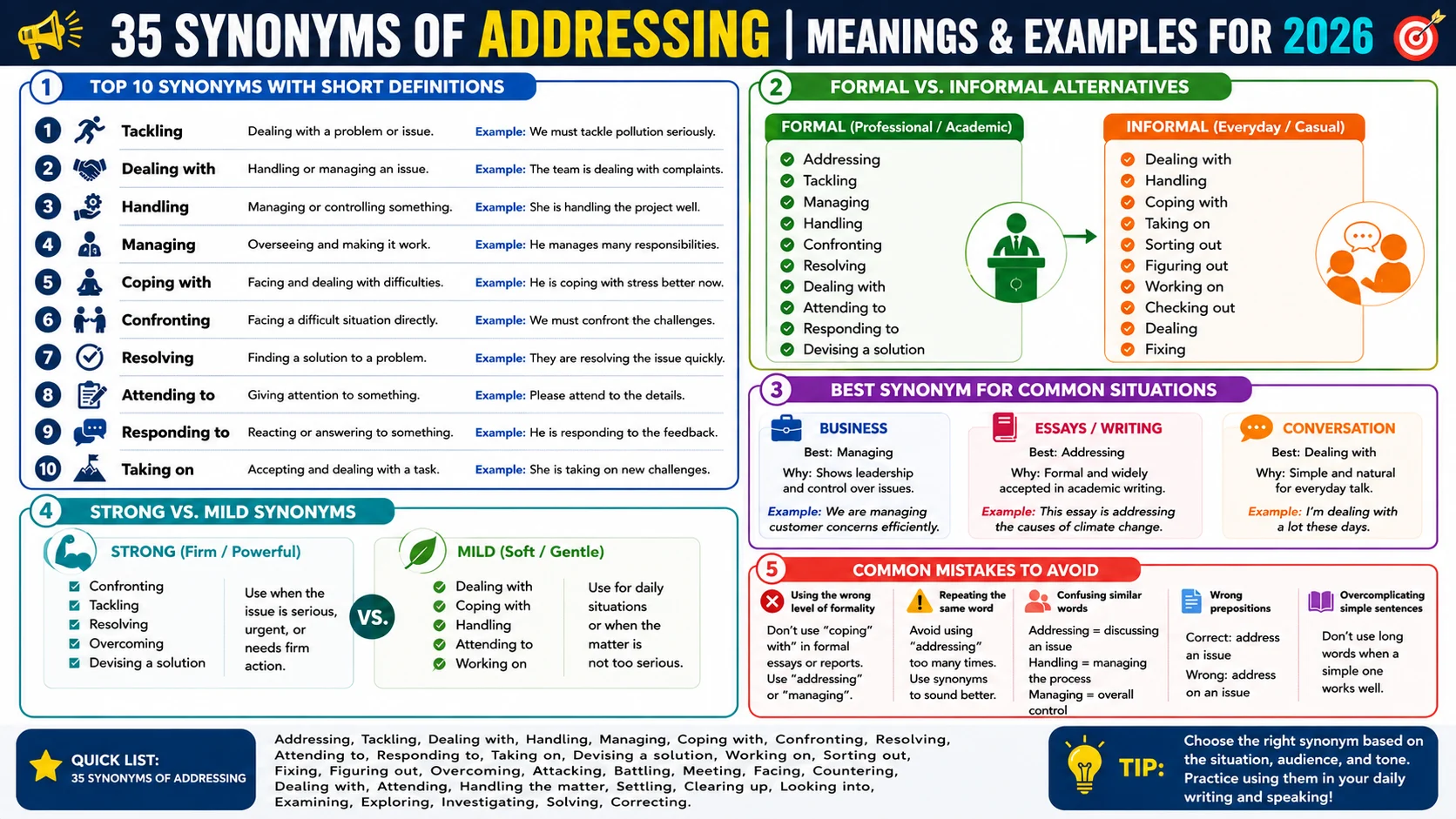
“Addressing” means dealing with a problem, speaking to someone, or directing attention to something. The best synonyms are tackling, handling, managing, dealing with, and approaching. “Tackling” is the most common natural alternative for problem-solving contexts. Each synonym has a slightly different meaning and context where it fits best.
Top 10 Synonyms
- Tackling
- Handling
- Managing
- Dealing with
- Approaching
- Confronting
- Facing
- Attending to
- Directing
- Speaking to
“Addressing” is a versatile word. You can address a problem, address an audience, address a letter, or address an issue. But using it too often can make your English feel repetitive and vague.
Think about it. Addressing a complaint, addressing a crowd, addressing a challenge, or addressing a package. Each situation might need a different word that captures the specific action more clearly.
In this guide, you’ll learn 35 powerful synonyms for “addressing.” You’ll discover exactly when to use each one, how formal they are, and what common mistakes to avoid. Let’s begin!
What Does “Addressing” Mean?
Definition
Addressing” has three main meanings. First, it means dealing with or handling a problem or issue. Second, it means speaking directly to someone or a group. Third, it means writing a destination on a letter or package. It’s about directing attention, action, or communication toward something or someone.
Pronunciation
| Feature | Value |
|---|---|
| US IPA | /əˈdrɛsɪŋ/ |
| UK IPA | /əˈdrɛsɪŋ/ |
| Syllables | 3 (ad-dress-ing) |
| Tip | Stress the second syllable: “uh-DRESS-ing” |
Grammar
| Grammar Feature | Information |
|---|---|
| Part of Speech | Verb (gerund/participle) |
| Common Position | After a subject, before an object |
| Typical Pattern | Addressing + object / Addressing + someone |
Examples:
- “The manager is addressing the complaints.” (dealing with)
- “She was addressing the crowd.” (speaking to)
- “We are addressing the issue.” (handling)
Grammar Note: “Addressing” is the present participle form of the verb “address.” It can be used in continuous tenses or as a gerund.
Word Family
| Word | Part of Speech | Meaning |
|---|---|---|
| Address | Verb/Noun | To deal with or speak to |
| Addressing | Gerund | The act of dealing with or speaking to |
| Addressed | Past Verb | Dealt with or spoken to |
| Addressable | Adjective | Able to be addressed |
15 Synonyms of “Addressing”
Tackling
Meaning: Taking on a difficult problem or challenge with determination.
Best Used For: Problems, challenges, difficult tasks.
Formality: Informal
Tone: Determined, Action-oriented
Frequency: ⭐⭐⭐⭐ (Common)
CEFR Level: B2
Example Sentence 1: “The team is tackling the budget issues head-on.”
Example Sentence 2: “We are tackling climate change through innovation.”
Usage Tip: “Tackling” suggests taking on a challenge with energy and determination. Use it for problems and difficult situations.
Common Confusion: Tackling vs Addressing. “Tackling” is more energetic and suggests direct confrontation. “Addressing” is more neutral.
Handling
Meaning: Managing or dealing with a situation or problem.
Best Used For: Problems, customers, stressful situations.
Formality: Neutral
Tone: Competent, Capable
Frequency: ⭐⭐⭐⭐⭐ (Very Common)
CEFR Level: B1
Example Sentence 1: “She is handling the customer complaints professionally.
Example Sentence 2: “The team handled the crisis effectively.”
Usage Tip: “Handling” suggests competent management. Use it for managing people, situations, or problems.
Managing
Meaning: Controlling or dealing with something successfully.
Best Used For: People, projects, resources, situations.
Formality: Neutral
Tone: Professional, Controlled
Frequency: ⭐⭐⭐⭐⭐ (Very Common)
CEFR Level: B1
Example Sentence 1: “He is managing the project with great skill.”
Example Sentence 2: “She is managing the difficult situation calmly.”
Usage Tip: “Managing” suggests control and organization. Use it for projects, teams, and complex situations.
Dealing with
Meaning: Taking action to handle a problem or situation.
Best Used For: Problems, people, difficult situations.
Formality: Neutral
Tone: Practical, Direct
Frequency: ⭐⭐⭐⭐⭐ (Very Common)
CEFR Level: A2
Example Sentence 1: “We are dealing with the issue right now.”
Example Sentence 2: “She is dealing with difficult customers today.”
Usage Tip: “Dealing with” is a very common phrasal verb. Use it for handling problems or managing people.
Approaching
Meaning: Starting to deal with or think about a problem.
Best Used For: Problems, tasks, projects, situations.
Formality: Neutral
Tone: Strategic, Thoughtful
Frequency: ⭐⭐⭐⭐ (Common)
CEFR Level: B2
Example Sentence 1: “We need to approach this problem carefully.
Example Sentence 2: “She is approaching the project from a new angle.”
Usage Tip: “Approaching” suggests a methodical way of starting to deal with something. Use it for planning and strategy.
Confronting
Meaning: Facing a difficult situation directly.
Best Used For: Problems, fears, challenges.
Formality: Formal
Tone: Direct, Brave
Frequency: ⭐⭐⭐ (Moderate)
CEFR Level: B2
Example Sentence 1: “We need to confront this problem before it grows.”
Example Sentence 2: “She is confronting her fears.”
Usage Tip: “Confronting” suggests facing something directly, often something difficult or uncomfortable.
Facing
Meaning: Having to deal with a difficult situation.
Best Used For: Challenges, problems, difficulties.
Formality: Neutral
Tone: Direct, Brave
Frequency: ⭐⭐⭐⭐ (Common)
CEFR Level: B1
Example Sentence 1: “We are facing many challenges this year.”
Example Sentence 2: “The company is facing financial difficulties.”
Usage Tip: “Facing” suggests confronting something, often a challenge or difficulty.
Attending to
Meaning: Giving attention to or dealing with something.
Best Used For: Tasks, duties, customers.
Formality: Formal
Tone: Careful, Professional
Frequency: ⭐⭐⭐ (Moderate)
CEFR Level: B2
Example Sentence 1: “The staff is attending to customer needs.”
Example Sentence 2: “He is attending to the paperwork.”
Usage Tip: “Attending to” suggests giving careful attention. Use it for tasks, duties, and customers.
Directing
Meaning: Aiming something at someone or something.
Best Used For: Attention, energy, resources.
Formality: Formal
Tone: Focused, Intentional
Frequency: ⭐⭐⭐ (Moderate)
CEFR Level: B2
Example Sentence 1: “We are directing our efforts toward the problem.”
Example Sentence 2: “She is directing her attention to the issue.”
Usage Tip: “Directing” suggests focusing something toward a target.
Speaking to
Meaning: Talking to someone formally or in an official capacity.
Best Used For: Audiences, groups, formal conversations.
Formality: Neutral
Tone: Formal, Official
Frequency: ⭐⭐⭐⭐ (Common)
CEFR Level: A2
Example Sentence 1: “The principal is speaking to the students.”
Example Sentence 2: “She was speaking to the board of directors.”
Usage Tip: “Speaking to” is the most natural way to describe addressing an audience.
Discussing
Meaning: Talking about something with someone.
Best Used For: Issues, ideas, problems.
Formality: Neutral
Tone: Collaborative, Open
Frequency: ⭐⭐⭐⭐⭐ (Very Common)
CEFR Level: A2
Example Sentence 1: “We are discussing the budget issues.”
Example Sentence 2: “The team is discussing possible solutions.”
Usage Tip: “Discussing” suggests two-way conversation. Use it for talking through problems.
Treating
Meaning: Dealing with or handling something in a particular way.
Best Used For: People, patients, problems.
Formality: Neutral
Tone: Caring, Professional
Frequency: ⭐⭐⭐⭐ (Common)
CEFR Level: B1
Example Sentence 1: “The doctor is treating the patient.”
Example Sentence 2: “We need to treat this issue with care.”
Usage Tip: “Treating” is often used for medical care or handling something carefully.
Resolving
Meaning: Finding a solution to a problem.
Best Used For: Problems, conflicts, issues.
Formality: Formal
Tone: Solution-focused, Final
Frequency: ⭐⭐⭐⭐ (Common)
CEFR Level: B2
Example Sentence 1: “They are resolving the conflict peacefully.”
Example Sentence 2: “We are resolving the technical issues.”
Usage Tip: “Resolving” suggests finding a solution and ending a problem.
Contenting with
Meaning: Dealing with or having to handle a problem.
Best Used For: Problems, difficulties, challenges.
Formality: Formal
Tone: Struggling, Managing
Frequency: ⭐⭐ (Rare)
CEFR Level: C1
Example Sentence 1: “The company is contending with rising costs.”
Example Sentence 2: “She is contending with many challenges.”
Usage Tip: “Contending with” suggests struggling against something difficult.
Addressing (the word itself)
Meaning: The act of dealing with or speaking to.
Best Used For: Problems, audiences, letters.
Formality: Formal
Tone: Professional, Direct
Frequency: ⭐⭐⭐ (Moderate)
CEFR Level: B2
Example Sentence 1: “He is addressing the meeting.”
Example Sentence 2: “We are addressing the complaints.”
Usage Tip: Use “addressing” for professional contexts and formal communication.
Synonyms Comparison Table
| Synonym | Best Context | Formality | Tone | Frequency |
|---|---|---|---|---|
| Tackling | Problems, challenges | Informal | Determined | ⭐⭐⭐⭐ |
| Handling | Situations, people | Neutral | Capable | ⭐⭐⭐⭐⭐ |
| Managing | Projects, teams | Neutral | Professional | ⭐⭐⭐⭐⭐ |
| Dealing with | Problems, people | Neutral | Practical | ⭐⭐⭐⭐⭐ |
| Discussing | Ideas, issues | Neutral | Collaborative | ⭐⭐⭐⭐⭐ |
| Approaching | Problems, tasks | Neutral | Strategic | ⭐⭐⭐⭐ |
| Facing | Challenges | Neutral | Brave | ⭐⭐⭐⭐ |
| Confronting | Difficult problems | Formal | Direct | ⭐⭐⭐ |
| Resolving | Conflicts, issues | Formal | Solution-focused | ⭐⭐⭐⭐ |
Best Synonyms by Situation
| Situation | Best Synonym | Why It Works |
|---|---|---|
| Daily Conversation | Handling | Natural and common |
| Business Email | Addressing | Professional and clear |
| Academic Writing | Confronting | Formal and direct |
| School Assignment | Dealing with | Clear and simple |
| Professional Meeting | Tackling | Sounds energetic |
| Presentation | Addressing | Professional and clear |
| Creative Writing | Facing | Adds drama and depth |
| Social Media | Dealing with | Casual and relatable |
| Customer Service | Handling | Professional and capable |
Formal vs Informal Synonyms
Formal Alternatives
| Synonym | Best Used For |
|---|---|
| Confronting | Difficult issues |
| Attending to | Duties, customers |
| Resolving | Conflicts, problems |
| Contending with | Challenges |
| Directing | Attention, resources |
Neutral Alternatives
| Synonym | Best Used For |
|---|---|
| Handling | Most situations |
| Dealing with | Problems, people |
| Managing | Projects, teams |
| Approaching | Problems, tasks |
Informal Alternatives
| Synonym | Best Used For |
|---|---|
| Tackling | Problems, challenges |
| Taking on | Responsibilities |
| Facing | Challenges |
| Dealing with | Most situations |
Choosing the Right Level: Use “confronting” and “resolving” for formal writing. Use “handling” and “dealing with” for most situations. Use “tackling” for energetic, informal contexts.
Strong vs Mild Synonyms
Mild
Suitable for everyday situations with less intensity.
- Handling
- Managing
- Dealing with
Moderate
More focused or strategic alternatives.
- Approaching
- Attending to
- Discussing
- Facing
Strong
High-intensity alternatives suggesting serious confrontation.
- Tackling (energetic challenge)
- Confronting (direct approach)
- Resolving (finding solution)
- Contending with (struggling against)
How Intensity Changes Meaning: “We are handling the problem” is calm. “We are tackling the problem” sounds more energetic. Choose stronger words when you want to emphasize determination.
Real-Life Examples
School: “The teacher is handling the classroom issues.”
Office: “We need to address the budget concerns immediately.”
Business Email: “I am addressing your questions in this email.”
Meetings: “We are tackling the productivity issues this quarter.”
Presentations: “Today we are addressing the key challenges.”
Daily Conversations: “I’m dealing with a difficult situation right now.”
Social Media: “We’re taking on the challenge!”
Academic Writing: “The paper confronts the issue of climate change.”
Common Collocations
| Common Phrase | Better Alternative |
|---|---|
| Addressing problems | Tackling problems |
| Addressing issues | Handling issues |
| Addressing concerns | Confronting concerns |
| Addressing questions | Discussing questions |
| Addressing complaints | Handling complaints |
Common Phrases
Take on: To accept a challenge. (e.g., “We’re taking on the project.”)
Deal with: To handle. (e.g., “I’ll deal with it.”)
Face head-on: To confront directly. (e.g., “We’re facing the problem head-on.”)
Tackle something: To take on a challenge. (e.g., “Let’s tackle this together.”)
See to: To attend to. (e.g., “I’ll see to the arrangements.”)
Context Guide
| Situation | Best Synonym | Reason |
|---|---|---|
| Essay | Confronting | Academic and formal |
| Speech | Addressing | Professional and clear |
| Business Email | Addressing | Professional and direct |
| Novel | Facing | Adds literary depth |
| Presentation | Tackling | Energetic and clear |
| Conversation | Handling | Natural and relatable |
| Academic Writing | Resolving | Precise and formal |
| Marketing Copy | Taking on | Engaging and confident |
Related Words
Near Synonyms
- Dealing with: Handling.
- Tackling: Taking on.
- Confronting: Facing directly.
- Resolving: Finding solutions.
- Approaching: Starting to deal with.
Antonyms
- Ignoring: Paying no attention to.
- Avoiding: Staying away from.
- Neglecting: Not giving care to.
- Overlooking: Missing or ignoring.
- Dismissing: Rejecting as unimportant.
Related Adjectives
- Proactive: Taking action early.
- Responsive: Quick to respond.
- Diligent: Careful and persistent.
- Thorough: Complete and careful.
- Systematic: Methodical.
Related Nouns
- Address: A formal speech or direction.
- Handling: The act of managing.
- Management: The process of handling.
- Resolution: The solution to a problem.
Related Verbs
- Handle: To manage or deal with.
- Tackle: To take on a challenge.
- Confront: To face directly.
- Resolve: To find a solution.
- Approach: To begin to deal with.
Frequently Asked Questions
What is another word for addressing?
Common synonyms include tackling, handling, managing, dealing with, and approaching. “Handling” is the most common and versatile alternative.
Which synonym sounds the most professional?
Addressing and confronting sound very professional. “Resolving” is excellent for problem-solving contexts.
What is the strongest synonym for addressing?
Tackling and confronting are among the strongest synonyms. “Resolving” is also strong for finding solutions.
Which synonym is best for essays?
Confronting is the best choice for academic essays. “Resolving” is also excellent for problem-focused writing.
What’s the difference between addressing and tackling?
“Addressing” is more general and neutral. “Tackling” suggests taking on a challenge with energy and determination.
Which synonym is most common in everyday English?
“Handling” and “dealing with” are the most common in everyday speech. “Managing” is also frequently used.
What is the opposite of addressing?
Common opposites are ignoring, avoiding, neglecting, and overlooking. These words describe not dealing with something.
Conclusion
“Addressing” is a useful word, but now you have 35 fantastic alternatives. Each synonym adds a different shade of meaning to your language.
Remember, the key is understanding the context. Use “handling” for general management. Use “tackling” for energetic problem-solving. Use “confronting” for direct approach. Use “resolving” for finding solutions.
The best way to improve is practice. Try using one or two new synonyms each day. Listen for these words in conversations and books. Your vocabulary will become richer and more impressive with time.
