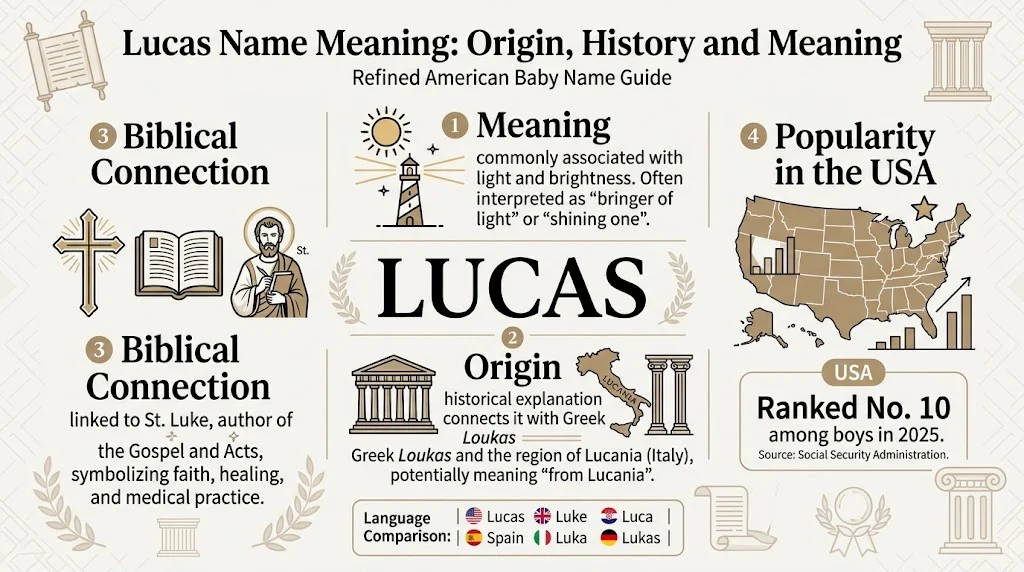
Lucas name meaning is commonly explained through the Latin and Greek name tradition associated with Luke. It is often linked with “light” and “bright,” while another established explanation connects Lucas with Lucania, an ancient region of southern Italy.
Lucas’ name meaning is closely associated with light, brightness, and the ancient name tradition behind Luke. The name has a long history across Latin, Greek, Christian, and European naming traditions. It also remains highly recognizable in modern American naming culture.
However, one detail needs careful explanation. Many baby name websites simply define Lucas as “light” or “bringer of light.” The historical picture is more nuanced. Reference material connects Lucas with the Greek Loukas, while Luke is traced to the Greek Loukanos, meaning “from Lucania,” an ancient region in southern Italy. Another possible connection leads toward the Latin name Lucius and the Latin word lux, meaning “light.”
Therefore, the name carries two closely related ideas in modern interpretation. One is geographical and historical. The other is symbolic and linguistic.
Today, Lucas feels familiar without sounding outdated. It works naturally in English and also appears across Spanish, Portuguese, French, Dutch, Scandinavian, and other European naming traditions.
In the United States, the name also has strong contemporary visibility. Social Security Administration data places Lucas at No. 10 among boys born in 2025. It ranked No. 8 across the 2020 through 2025 period.
So, whether you are researching a baby name, family name, biblical connection, pronunciation, or cultural history, Lucas offers several layers of meaning.
QUICK ANSWER BOX
| Meaning | Context | Primary Platforms | Example | Tone |
| Light or brightness | Modern symbolic interpretation | Baby name sites, search, social media | “Lucas means light.” | Positive |
| From Lucania | Historical linguistic explanation | Name references and dictionaries | “Lucas may refer to someone from Lucania.” | Historical |
| Form of Luke | Biblical and European naming tradition | Christian and cultural contexts | “Lucas is related to Luke.” | Traditional |
| Lucas | Modern personal name | English and multilingual communities | “Lucas is my son’s name.” | Familiar |
| Bright, light associated | Contemporary interpretation | Baby naming discussions | “We chose Lucas for its association with light.” | Warm |
What Does Lucas Name Meaning Mean?
The most common modern interpretation connects the name with light or brightness. That interpretation comes from the wider family of names associated with Latin lux, meaning “light.”
Yet, the historical etymology deserves more precision.
Behind the Name identifies Lucas as the Latin form of the Greek Λουκᾶς, Loukas, and also notes that it is used in Biblical Latin and several European languages.
The related English name Luke has a more specific etymological explanation. It comes from Latin Lucas, from Greek Loukas. Loukas is probably a shortened form of Loukanos, which means “from Lucania.” Lucania was an ancient region in southern Italy.
There is also another proposed route. Luke may have a connection with Latin Lucius, a Roman given name derived from lux, meaning “light.”
This creates an important distinction.
| Explanation | What it suggests |
| Light | Symbolic association with brightness |
| Bright | A modern interpretive meaning |
| From Lucania | Historical geographical origin |
| Related to Luke | Connection with the biblical name |
| Related to Lucius | Possible Latin linguistic pathway |
Because the etymology has more than one proposed explanation, it is better to say that Lucas is associated with light and Luke, rather than claiming that every historical source proves one single literal meaning.
The Latin Connection
Latin plays an important role in the history of Lucas.
The Latin word lux means “light.” It is also the root listed for a broad family of names and words. Behind the Name identifies lux as an Ancient Roman name element meaning “light.”
Names associated with this element include Lucius, Lucia, Luciana, Lucianus, and several related forms.
That connection helps explain why modern sources often associate Lucas with brightness.
Still, linguistic similarity does not automatically prove that every related name developed from exactly the same root. Historical names often passed through Greek, Latin, regional, and Christian naming traditions.
The Lucania Explanation
Lucania provides another important piece of the story.
Lucania was an ancient region of southern Italy. The Greek name Loukanos is generally connected with the idea of being from Lucania.
This explanation is particularly relevant when discussing Luke and Lucas historically.
Consequently, a careful definition should avoid presenting “bringer of light” as an uncontested ancient translation.
Lucas and the Name Luke
Lucas and Luke are closely connected.
Behind the Name describes Luke as the English form of Latin Lucas. It also lists Lucas as a variant of Luke in English.
The relationship becomes clearer across languages.
| Language or tradition | Related form |
| English | Luke, Lucas |
| Latin | Lucas |
| Greek | Loukas |
| Italian | Luca |
| Spanish | Lucas |
| Portuguese | Lucas |
| Croatian | Luka |
| Russian | Luka |
| French | Luc, Lucas |
| German | Lukas, Lucas |
| Polish | Łukasz |
These variations show how one naming tradition developed differently across linguistic communities.
Contextual Dynamics and Nuances of the Name
A name can have a historical meaning and a modern emotional meaning at the same time.
That distinction matters with Lucas.
Historically, the name belongs to a long European naming tradition. In modern American culture, however, people often encounter Lucas simply as a familiar first name.
Therefore, the emotional meaning may differ from the strict etymological meaning.
Someone choosing the name may associate it with:
- Light
- Hope
- Brightness
- Warmth
- Classic style
- Biblical heritage
- European heritage
- Simplicity
- Strength
- Familiarity
These associations are cultural interpretations rather than dictionary definitions.
Is Lucas a Biblical Name?
Lucas has a strong biblical connection through Luke, one of the names associated with the New Testament.
According to Behind the Name, Luke was a doctor who traveled with the apostle Paul. Christian tradition also identifies him with the author of the Gospel of Luke and Acts, although historical questions around authorship and biography should be treated carefully.
The name became widespread in Christian Europe because of the reputation and veneration of Saint Luke. Different spellings developed across languages.
Consequently, Lucas can carry a biblical or Christian association even when parents choose it primarily for its sound.
Is Lucas a Boy’s Name?
In contemporary American naming data, Lucas is used as a boy’s name.
The Social Security Administration ranked Lucas 10th among boys born in the United States in 2025. It appeared in the top 10 for that year.
Across the 2020 through 2025 period, Lucas ranked eighth among boys, with 65,795 recorded occurrences in the SSA dataset.
That makes the name highly established in contemporary American naming culture.
Lucas in American Naming Culture
The name has strong visibility in the United States.
SSA data shows that Lucas ranked ninth in 2024 and tenth in 2025.
The slight movement does not change its broader status. It remained within the national top 10 for boys in both years.
State level data also shows substantial regional use. For example, Lucas appeared among the five most frequent boy names in several states in 2025, including Delaware, Florida, Maryland, New Jersey, and New York.
Real Life Conversation Examples Using Lucas Name Meaning
Because Lucas is a personal name rather than internet slang, people generally discuss its meaning in naming conversations.
The following examples show natural American English usage.
Example 1: Choosing a Baby Name
Emma: We are thinking about naming the baby Lucas.
Sarah: I love that name. Do you know what it means?
Emma: I read that it is associated with light and is related to Luke.
Sarah: That gives it a really nice meaning.
Here, the phrase refers to the symbolic meaning of the personal name.
Example 2: Asking About Family Heritage
Daniel: Your son is named Lucas, right?
Michael: Yes.
Daniel: Is there a family reason behind it?
Michael: Partly. We liked the connection with Luke and the traditional European forms.
The conversation focuses on family and cultural associations.
Example 3: A Name Research Conversation
Alex: What does Lucas actually mean?
Jordan: There are a couple of explanations.
Alex: Really?
Jordan: Yes. It is connected with Luke and may refer historically to someone from Lucania. It is also commonly associated with light.
This is a more accurate way to explain the name because it acknowledges the etymological uncertainty.
Example 4: Social Media Discussion
Maya: I saw your baby announcement. Lucas is such a great name.
Olivia: Thank you!
Maya: Did you choose it because of the meaning?
Olivia: Yes. We liked the association with light and the classic sound.
This reflects a common modern naming conversation.
Example 5: Casual Texting
Chris: Why did you pick Lucas?
Ben: We wanted something classic but not too formal.
Chris: Makes sense.
Ben: We also liked the meaning and the connection to Luke.
The name functions normally here. It does not operate as slang or coded internet terminology.
Platform Specific Breakdown
Lucas can appear across social platforms, but its meaning does not fundamentally change from one platform to another.
A search for the name on social media may produce usernames, baby name discussions, personal profiles, fictional characters, celebrities, memes, or ordinary references to people named Lucas.
Therefore, context matters more than the platform.
How It Is Used on Snapchat
On Snapchat, Lucas may appear as:
- A person’s display name
- A username
- A friend’s name
- A story caption
- A reference to a friend or celebrity
- A baby name discussion
- A nickname
If someone writes, “Lucas is coming tonight,” the word is simply a person’s name.
However, if someone posts “Why we chose Lucas,” the conversation may concern baby naming and name symbolism.
The platform does not create a special slang definition for Lucas.
The Role of Lucas Name Meaning on TikTok
TikTok frequently turns names into searchable content themes.
Creators may post videos about:
- Baby names
- Name meanings
- Name origins
- Personality associations
- Name pronunciation
- Biblical names
- Popular American names
- European names
- Baby naming trends
Therefore, Lucas can appear in videos about name meaning and popularity.
However, viral videos sometimes simplify etymology. A creator may state that Lucas literally means “light” without discussing the alternative Lucania explanation.
For accurate research, compare simplified social content with established reference sources.
The Social Security Administration also provides a useful source for American popularity data. Its 2025 data places Lucas at number 10 among boys.
Instagram and Texting Dynamics
Instagram uses names in several ordinary ways.
A post might say:
Welcome to the world, Lucas.
Another might say:
We chose Lucas because we loved its connection with light.
A text message could simply say:
Is Lucas coming tonight?
The meaning comes from context.
This distinction is important because search users sometimes assume every frequently searched phrase is slang. A personal name can generate significant search interest without functioning as slang.
Alternative Meanings
Search engines may interpret several phrases as closely related to the same topic.
Common variations include:
| Search variation | Likely intent |
| Lucas meaning | Basic definition |
| Meaning of Lucas | Name research |
| Lucas name origin | Etymology |
| What does Lucas mean | Quick answer |
| Lucas biblical meaning | Christian context |
| Lucas origin | Historical background |
| Lucas baby name meaning | Naming research |
| Lucas meaning in Latin | Linguistic research |
| Lucas meaning in Greek | Greek connection |
| Lucas name history | Historical research |
| Is Lucas a biblical name | Religious naming question |
| Lucas pronunciation | Speech and naming |
| Lucas nicknames | Naming options |
These variations help explain why content about the name should address several related search intents.
Lucas and Light
The strongest modern symbolic association is light.
That association connects Lucas with the wider Latin family involving lux. The Latin word lux means “light.”
This is why descriptions such as “bright” and “light” appear frequently in baby naming resources.
However, “bringer of light” should be treated as a modern interpretive phrase rather than an unquestionable literal translation.
Lucas and Lucania
The Lucania interpretation focuses on geography.
The Greek Loukas is probably a shortened form of Loukanos, which means “from Lucania.”
This explanation is especially useful for readers researching the historical relationship between Lucas and Luke.
Lucas and Related Names
Lucas belongs to a large international naming family.
Related forms include Luca, Luka, Luke, Lukas, Luc, and Łukasz.
Some related names have their own independent histories. Therefore, they should not automatically be treated as exact translations.
Misinterpretations:
The biggest misunderstanding is treating Lucas as internet slang.
It is not necessary to interpret the word as slang simply because it appears in a TikTok caption, Snapchat message, or Instagram post.
If the sentence says:
Lucas just texted me.
Lucas almost certainly functions as a person’s name.
If the sentence says:
We are thinking about naming our baby Lucas.
The topic is naming.
If the sentence says:
What does Lucas mean?
The user is asking about etymology or symbolism.
Context resolves the ambiguity.
Do Not Treat Every Name Association as a Literal Definition
A common naming article may say that Lucas means “light.”
Another source may explain the name through Lucania.
Both can appear in search results because the historical etymology has more than one proposed pathway.
Therefore, avoid claiming that one simplified phrase completely settles linguistic history.
Do Not Confuse Lucas With Every Luv Name
Lucas, Luke, Lucius, Lucia, Lucy, Luca, and Lucian are related within a broader naming family.
However, related does not always mean identical.
For example, Behind the Name identifies Lucius as a Roman praenomen derived from Latin lux. It separately identifies Lucas as the Latin form of Greek Loukas.
That distinction improves factual accuracy.
Do Not Assume Personality From a Name
A name’s meaning does not scientifically determine personality.
Descriptions such as “strong,” “bright,” “kind,” or “successful” may appear in naming content. They are symbolic associations rather than evidence about people who carry the name.
Consequently, name meaning can provide cultural symbolism without predicting character.
How to Respond in Chat Comfortably
When someone asks about Lucas, the best response depends on their intent.
If Someone Asks “What Does Lucas Mean?”
A natural response is:
“Lucas is commonly associated with light or brightness. Historically, it is connected with the Greek name Loukas and may mean someone from Lucania.”
That answer is short but nuanced.
If Someone Asks “Is Lucas Biblical?”
You can say:
“Yes. Lucas is closely related to Luke, the New Testament name. The Latin form Lucas appears in the Christian naming tradition.”
The historical details can then be expanded if needed.
If Someone Asks About Popularity
You can give current American data:
“Lucas ranked No. 10 among boys born in the United States in 2025, according to the Social Security Administration.”
That is more useful than simply saying the name is popular.
If Someone Asks Why the Name Is Popular
Avoid presenting a single cause as fact.
Popularity can reflect many influences, including sound, cultural familiarity, family traditions, media exposure, and naming trends.
Without specific evidence, it is better to describe these as possible influences rather than established causes.
FAQs
1. What does Lucas mean?
Lucas is commonly associated with light and brightness. Historically, it is the Latin form of the Greek Loukas and is connected with Luke. Another established explanation connects Loukas with Lucania in southern Italy.
2. Is Lucas a biblical name?
Lucas has a biblical connection through Luke. The name appears in the Christian naming tradition through the Latin form Lucas. Luke is associated with the New Testament and early Christian tradition.
3. What is the origin of the name Lucas?
Lucas has Greek and Latin naming connections. Behind the Name describes it as the Latin form of Greek Loukas and a form used in several European languages.
4. Does Lucas mean light?
Lucas is commonly associated with “light” in modern naming resources. The association relates to the Latin word lux. However, the historical etymology also includes the explanation that Loukas may mean “from Lucania.”
5. Is Lucas a popular name in America?
Yes. According to the Social Security Administration, Lucas ranked tenth among boys born in the United States in 2025.
6. What is the difference between Lucas and Luke?
Luke is the English form of Latin Lucas. Lucas remains the form used in several languages and traditions.
7. Is Luca related to Lucas?
Yes. Luca is an Italian and Romanian form of Lucas according to Behind the Name. The form is also used in several modern naming cultures.
8. How do you pronounce Lucas?
In standard American English, Lucas is generally pronounced LOO kəs, with the first syllable receiving the main stress. The pronunciation changes across languages. Behind the Name lists distinct pronunciations for English, Spanish, Portuguese, French, and Dutch.
9. What are common nicknames for Lucas?
Common informal forms can include Luke and Lu. However, nickname preferences vary by family, language, and individual.
Luke is historically connected with Lucas rather than being merely a modern abbreviation.
10. Is Lucas an old or modern name?
Lucas has ancient linguistic and Christian roots, but it remains highly current. In the United States, it ranked tenth for boys born in 2025, showing that its historical roots coexist with strong modern usage.
Conclusion:
Lucas is not primarily an internet slang term. It is an established personal name with a long linguistic and cultural history.
The simplest modern explanation connects it with light and brightness. However, a deeper historical explanation points toward the Greek Loukas and the possibility of a connection with Lucania, an ancient region of southern Italy. Another linguistic pathway connects related names with the Latin word lux, meaning “light.”
That combination explains why different sources can provide slightly different descriptions.
The name also has a strong relationship with Luke. Latin Lucas became part of a broader European naming tradition, producing forms such as Luca, Luka, Lukas, and other regional variants.
In the United States, Lucas remains firmly established. Social Security Administration data ranks it tenth among boys born in 2025. It also ranked eighth across the 2020 through 2025 period.
For parents, researchers, and anyone exploring the name, the most accurate takeaway is straightforward: Lucas is a traditional international name with a strong modern association with light, a close relationship with Luke, and a historical etymology that includes the “from Lucania” explanation.
That nuance matters.
A good name guide should distinguish established linguistic evidence from simplified symbolic interpretations. Lucas provides an excellent example of how names can preserve ancient history while continuing to feel natural in modern American culture.
