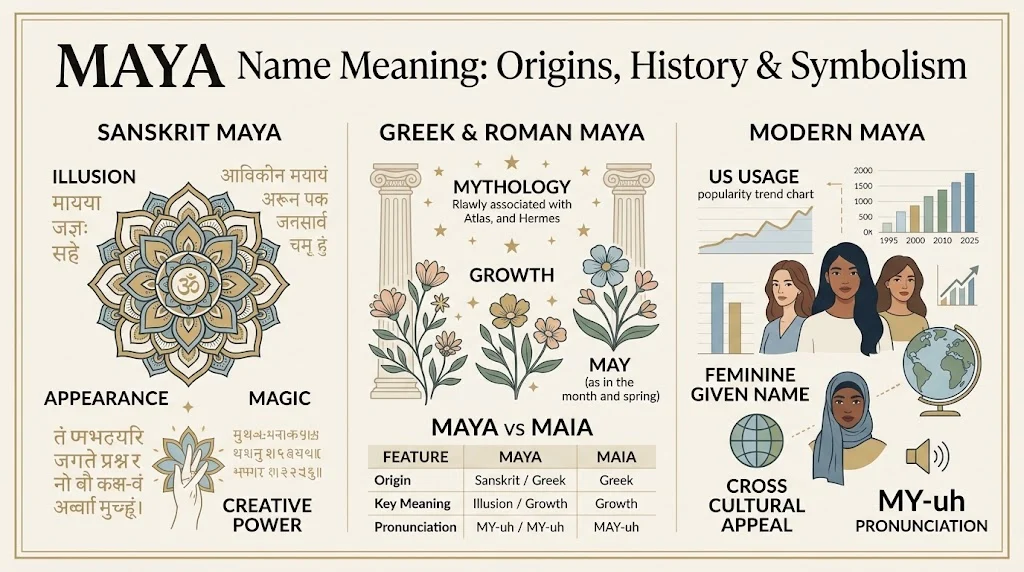
The Maya name’s meaning depends on its cultural origin. In Sanskrit, Maya can mean “illusion” or “magic.” In Greek and Roman tradition, Maia is linked to a mother figure and the spring season. The name also has other cultural interpretations.
Maya name meaning varies across cultures, languages, and naming traditions, which makes this short name unusually rich in history and symbolism. In the United States, Maya is widely recognized as a feminine given name. However, its meaning does not come from one single linguistic source.
The name appears in several independent traditions. For example, Sanskrit māyā is associated with concepts such as illusion, appearance, magic, and the power through which reality is perceived. Meanwhile, Maia appears in ancient Greek and Roman mythology. In Roman tradition, Maia became associated with growth and the month of May.
As a result, parents may choose Maya because of its sound, cultural heritage, spiritual associations, historical background, or modern style. The name also works well across different languages.
Furthermore, Maya has a simple spelling and a familiar pronunciation in American English. That combination gives it strong cross cultural appeal.
This guide explores the linguistic roots, cultural interpretations, symbolism, pronunciation, social usage, variations, and common questions surrounding the name.
Quick Answer Box
| Category | Answer |
| Meaning | Depends on origin; commonly associated with illusion, magic, or the Greek and Roman Maya tradition |
| Context | Baby names, personal names, literature, mythology, culture |
| Primary Platforms | Baby naming sites, social media, genealogy, parenting communities |
| Example | “We chose Maya because we loved its sound and cultural history.” |
| Tone | Elegant, modern, multicultural, feminine |
What Does Maya Name Mean?
The Maya name’s meaning cannot be reduced to one universal definition. Several cultures have names or words that are represented by Maya or the closely related form Maia.
The most frequently discussed origin is Sanskrit. In Sanskrit philosophy and religious literature, māyā has a complex meaning. It can refer to illusion, appearance, magic, creative power, or the way reality is experienced.
That meaning requires context.
In everyday baby name descriptions, Maya is sometimes simplified as “illusion” or “magic.” However, the philosophical concept is much deeper. In different Indian philosophical traditions, māyā can describe the apparent nature of the material world or the power associated with manifestation and perception.
Therefore, calling Maya simply “illusion” can miss important cultural nuances.
Sanskrit Roots
The Sanskrit word māyā is written माया in Devanagari. Its meaning developed through a long history of Indian religious and philosophical texts.
The concept appears in Hindu traditions and has also influenced broader Indian philosophical thought.
Depending on context, translations can include:
- Illusion
- Appearance
- Magic
- Creative power
- Extraordinary power
- The perceived nature of reality
However, these translations are not interchangeable in every philosophical context.
For parents researching the name, this distinction matters. A baby name website may provide a short dictionary style definition. Academic or religious sources may explain the term much more broadly.
Greek and Roman Connections
Another important root is Maia, a name found in Greek mythology and later Roman mythology.
In Greek tradition, Maia is associated with the Pleiades and is described as the mother of Hermes. Roman tradition also developed its own Maia figure and connected her with growth.
The Roman month of May is traditionally associated with Maia.
Because Maya and Maia have similar sounds, modern naming discussions sometimes group them together. Yet they are not simply two spellings of one historical word.
The distinction is useful when researching the name’s heritage.
Different Origins Can Produce Similar Names
Names can develop independently in different languages. Similar pronunciation does not automatically prove a shared origin.
Maya is a good example.
A family may select Maya because of Sanskrit heritage. Another may prefer it because of Greek or Roman mythology. Someone else may simply like the modern sound.
Consequently, the meaning attached to the name can depend heavily on family history and intended cultural reference.
Contextual Dynamics and Nuances of the Name
Names carry more than dictionary definitions. They can also communicate cultural identity, family connections, aesthetics, religious associations, or personal values.
Maya has several layers of interpretation.
Maya as a Modern American Name
In the United States, Maya is generally perceived as a familiar feminine given name.
Its pronunciation is straightforward for many English speakers. The common English pronunciation sounds like “MY uh.”
That simplicity gives the name strong usability in everyday settings.
It can appear on:
- Birth announcements
- School records
- Professional profiles
- Social media accounts
- Sports rosters
- Creative portfolios
- Family trees
- Fictional characters
Furthermore, Maya does not strongly depend on one specific age group. It can suit a child, teenager, or adult equally well.
Maya as a Cross Cultural Name
One reason the name attracts attention is its presence across multiple cultures.
A name with several cultural associations can feel both distinctive and familiar. Maya has that quality.
For example, one family may connect it to Indian heritage. Another may connect it to ancient mythology. A third may simply appreciate its short, graceful sound.
Therefore, the personal meaning of Maya can be different from its historical meaning.
Spiritual Interpretations
The Sanskrit concept of māyā gives the name a philosophical dimension.
Some people interpret it through ideas of mystery, transformation, perception, or the distinction between appearance and reality.
Still, these interpretations should not be presented as the only meaning of the name.
The original philosophical concept is more complex than a positive baby name description.
Symbolism Associated With Maia
The Greek and Roman Maya tradition creates a different symbolic direction.
Associations with motherhood, growth, nature, spring, and May can appear in modern discussions.
These associations are especially appealing to parents who prefer names connected with nature or classical mythology.
Real Life Conversation Examples Using Maya Name Meaning
The phrase “Maya name meaning” usually appears in research conversations rather than ordinary casual dialogue. People might use it when discussing baby names, genealogy, culture, or naming decisions.
Here are five natural examples.
Example 1: Choosing a Baby Name
A: We are thinking about naming our daughter Maya.
B: That’s beautiful. Did you look up the Maya name’s meaning?
A: Yes. I found several origins, including Sanskrit and Greek traditions.
B: I like that it has more than one cultural connection.
Example 2: Discussing the Sanskrit Meaning
A: What does Maya mean in Sanskrit?
B: It is connected with māyā, which can refer to illusion, appearance, or a powerful creative force.
A: So the simple “illusion” definition does not tell the whole story?
B: Exactly. The philosophical meaning is much more complicated.
Example 3: Comparing Maya and Maia
A: Is Maya the same name as Maia?
B: Not necessarily. They have different historical roots, although modern names can overlap in pronunciation and usage.
A: That makes sense. I was looking at mythology when I found Maia.
Example 4: Family Heritage
A: Why did you choose Maya?
B: We wanted a short name that worked well in English and connected with our family heritage.
A: That’s a great reason. Did you find a specific Maya name meaning you liked?
B: Yes. We liked the Sanskrit associations, but the sound was also important to us.
Example 5: Social Media Discussion
A: Someone asked me what my name means.
B: What did you tell them?
A: I said Maya has several origins, so there isn’t one universal meaning.
B: That’s probably the most accurate answer.
Platform Specific Breakdown
The name Maya appears in many online environments. However, its use changes depending on the platform and audience.
Search behavior also varies.
Someone searching Google may want a historical definition. Someone on TikTok may be looking for aesthetic baby names. A parent on Instagram may be comparing spelling variations.
Therefore, context matters when discussing the name online.
How It Is Used on Snapchat
Snapchat does not give Maya a special meaning as a platform specific term.
If someone named Maya appears in a Snapchat conversation, the word usually functions simply as a person’s name.
For example:
“Maya sent me the photo.”
Here, Maya identifies a person. It is not slang.
Likewise, usernames can incorporate the name in creative ways. Those variations may include numbers, initials, punctuation, or descriptive words.
However, a username does not automatically change the historical meaning of the name.
The Role of Maya Name Meaning on TikTok
TikTok can influence how baby names are discussed.
Creators often publish short videos about:
- Baby name meanings
- Name origins
- Unique girl names
- Vintage names
- Mythological names
- Indian names
- Multicultural names
- Name pronunciation
- Name aesthetics
Consequently, the phrase Maya name meaning may appear in captions, searches, comments, or educational videos.
Still, viral content can simplify complicated etymology.
For example, a short video might describe Maya as meaning only “magic.” Another creator might call it exclusively “illusion.” Both descriptions may reflect one interpretation or naming tradition.
Therefore, viewers should distinguish popular summaries from detailed linguistic research.
Instagram and Texting Dynamics
On Instagram, Maya normally functions as a personal name.
It may appear in:
- Profile names
- Captions
- Baby announcements
- Wedding posts
- Birthday posts
- Family photographs
- Name announcement graphics
In texting, the same principle applies.
A message such as “Maya is coming at 7” uses the word as a person’s name.
It does not represent internet slang.
That distinction is important because not every frequently searched phrase is slang. Some search terms describe ordinary names, meanings, or cultural references.
Alternative Meanings
Search engines can interpret several closely related phrases as part of the same semantic topic.
These variations may include:
- Maya meaning
- Meaning of Maya
- What does Maya mean?
- Maya baby name meaning
- Maya girl name meaning
- Maya name origin
- Origin of the name Maya
- Maya name definition
- Maya Sanskrit meaning
- Maya Greek mythology
- Maia name meaning
- Maya spiritual meaning
- Maya biblical meaning
- Maya meaning in different cultures
- Maya name history
These expressions do not always refer to exactly the same linguistic question.
For instance, “Maya Sanskrit meaning” points toward the Indian philosophical term. “Maia Greek mythology” points toward classical mythology.
Maya Versus Maia
Spelling deserves special attention.
Maya and Maia can sound similar in English. However, spelling does not establish that they share a single historical origin.
Maia is strongly associated with Greek and Roman mythology.
Maya also has the Sanskrit māyā tradition.
Meanwhile, modern parents may select either spelling for aesthetic reasons.
Maya Versus Mya
Mya is another modern spelling variation.
It is shorter visually, although pronunciation can vary depending on the speaker.
Unlike Maya, Mya does not automatically carry every historical association connected with the traditional forms.
Therefore, parents should research the specific spelling they intend to use.
Maya and Cultural Interpretation
The same written name can carry different associations for different families.
A person with Indian heritage may understand Maya through Sanskrit traditions.
Someone interested in classical mythology may connect the name with Maia.
Another person may know Maya primarily as a contemporary American given name.
All three experiences can coexist.
Misinterpretations: When Not to Use Maya Name Meaning
The phrase is useful when discussing the meaning or origin of the name. However, several common assumptions can create confusion.
Do Not Treat One Definition as Universal
The biggest mistake is presenting one short definition as the complete answer.
Maya has multiple linguistic and cultural associations.
Therefore, statements such as “Maya always means X” can be misleading.
Do Not Automatically Call It Slang
Maya is a personal name.
It is not inherently internet slang, Snapchat slang, TikTok slang, or texting slang.
A social media post may discuss the name, but that does not turn the name itself into slang.
Do Not Confuse Maya With Every Similar Name
Several names look or sound similar.
These include:
- Maia
- Mya
- Mayah
- May
- Amaya
- Amayah
Similarity does not prove identical etymology.
Each form deserves separate research.
Do Not Overstate Religious Meaning
The Sanskrit term māyā has an important place in Indian philosophical and religious traditions.
However, modern use of Maya as a baby name does not automatically indicate a particular religious belief.
Parents may choose it for sound, heritage, family reasons, mythology, or personal preference.
Do Not Assume One Cultural Background
A person named Maya does not necessarily have a specific ethnic or cultural background.
Names travel between cultures.
Modern naming patterns are especially diverse.
How to Respond in Chat Comfortably
If someone asks, “What does Maya mean?” A short answer works well.
You could say:
“It has several origins. In Sanskrit, māyā is associated with illusion, appearance, and creative power. Maia is also a figure in Greek and Roman mythology.”
That answer is concise but avoids oversimplification.
If someone asks specifically about the Sanskrit meaning, narrow the response.
“In Sanskrit, māyā has a complex philosophical meaning. It can be translated as illusion or appearance, but those translations do not capture the entire concept.”
If someone asks whether Maya and Maia are the same name, clarify the distinction.
“They can overlap in modern naming, but they have different historical traditions.”
A Casual Texting Response
For a friend, you can be more relaxed:
“Maya has a few different origins, which is pretty cool. The Sanskrit version is linked with illusion and creative power, while Maia comes from Greek and Roman mythology.”
A Family Discussion
For a baby naming conversation, focus on the practical issue:
“Maya is easy to pronounce in English and has several cultural associations. The meaning depends on which historical origin you want to emphasize.”
This approach keeps the discussion accurate without making the name seem more complicated than it is.
FAQs
1. What is the Maya name meaning?
The Maya name’s meaning depends on its cultural and linguistic origin. Sanskrit māyā is associated with illusion, appearance, magic, and creative power. Maia has separate Greek and Roman associations.
2. Is Maya a popular girl name?
Maya is a well recognized feminine given name in the United States. Its familiarity comes from both long standing cultural use and modern naming trends.
3. Is Maya an Indian name?
Maya can be connected with Sanskrit and Indian cultural traditions. However, the name also has other historical associations, so it should not be treated as exclusively Indian.
4. What does Maya mean in Sanskrit?
In Sanskrit, māyā has a complex meaning. Common translations include illusion, appearance, magic, or creative power. Its precise philosophical meaning depends on context and tradition.
5. Is Maya the same as Maia?
Not necessarily. Maya and Maia have overlapping modern pronunciations in some languages, but they have different historical traditions. Maia is strongly associated with Greek and Roman mythology.
6. Is Maya a biblical name?
Maya is not generally classified as a traditional biblical name. Some baby naming resources may connect similar names with biblical languages or interpretations, but those claims should be checked against the specific historical spelling and source.
7. What is the spiritual meaning of Maya?
The spiritual interpretation is usually connected with the Sanskrit concept māyā. It can involve ideas of appearance, perception, illusion, manifestation, and the nature of reality.
8. How do you pronounce Maya?
In common American English usage, Maya is usually pronounced “MY uh.” Pronunciation can differ across languages and individual naming traditions.
9. Is Maya a modern name?
Maya has a modern feel in the United States, but its underlying linguistic and mythological associations are much older. Its contemporary popularity does not mean the name itself is historically new.
10. What names are similar to Maya?
Similar names include Maia, Mya, Mayah, Amaya, and Amayah. However, similar spelling or sound does not guarantee identical origin or meaning.
Conclusion:
The Maya name’s meaning is best understood as a collection of cultural and linguistic traditions rather than one fixed definition.
The Sanskrit māyā tradition provides one major interpretation. It connects the word with ideas such as illusion, appearance, magic, creative power, and perception. However, the philosophical concept is more nuanced than any single English translation.
The Greek and Roman Maia tradition provides another historical pathway. It brings associations with mythology, motherhood, growth, and the month of May.
Modern American naming adds another layer.
Today, Maya can function simply as a familiar feminine given name. Parents may choose it because of its sound, spelling, heritage, mythology, symbolism, or international usability.
Furthermore, the name demonstrates how language changes across cultures. A name can move between regions, acquire new associations, and become familiar to new generations.
That is why the most accurate answer to a question about Maya should include context.
Rather than claiming one universal definition, it is better to identify the relevant linguistic tradition first. Then, explain the meaning within that tradition.
Ultimately, Maya is a short name with a remarkably broad cultural footprint. Its history reaches into Sanskrit language and philosophy, classical mythology, and modern American naming culture.
That combination gives the name both historical depth and contemporary appeal.
