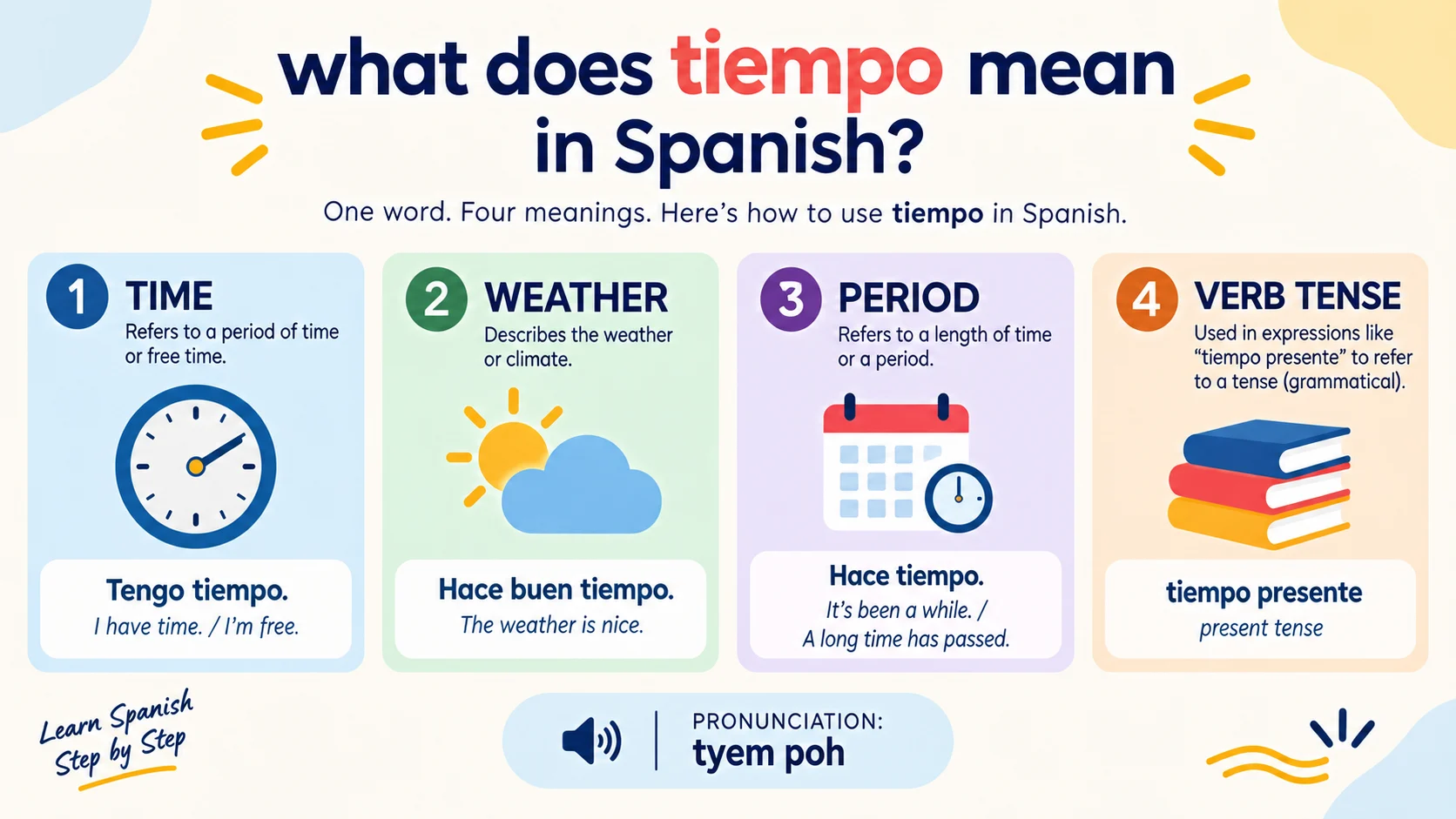
Tiempo is a Spanish noun that most commonly means “time.” Depending on context, it can also mean “weather,” “period,” “tense,” or “tempo.” For example, ¿Qué tiempo hace? means “What is the weather like?”
What does tiempo mean in Spanish is a question with more than one simple answer. Most often, tiempo translates to “time,” but Spanish speakers also use it for weather, periods, grammatical tense, and musical or rhythmic timing. Therefore, the surrounding words determine the intended meaning.
For English speakers, this word can feel confusing at first. After all, English normally separates “time” and “weather.” Spanish does not always make that same distinction. Instead, tiempo can describe both concepts.
For example, No tengo tiempo means “I don’t have time.” However, Hace buen tiempo means “The weather is nice.” The spelling stays exactly the same, while the meaning changes with context.
This guide explains those meanings in practical American English. It also covers pronunciation, common phrases, texting, social media, grammar, and conversational examples. Consequently, you can recognize the word without relying on a literal translation every time.
QUICK ANSWER BOX
| Meaning | Context | Primary Platforms | Example | Tone |
| Time | Daily life, schedules, duration | Conversation, texting | No tengo tiempo | Neutral |
| Weather | Conditions outside | Conversation, texting | Hace buen tiempo | Casual |
| Period | A stretch or amount of time | Conversation, writing | Durante mucho tiempo | Neutral |
| Tense | Spanish grammar | School, language learning | El tiempo pasado | Formal |
| Tempo | Music or rhythm | Music, performance | El tiempo de la canción | Technical |
What Does tiempo Mean in Spanish?
The most common answer to what tiempo means in Spanish is “time.” It is a masculine Spanish noun, so you will usually see it with masculine articles such as el and un.
The basic form is:
| Spanish | English |
| el tiempo | the time |
| un tiempo | a time or a period |
| mucho tiempo | a lot of time |
| poco tiempo | little time |
| cuánto tiempo | how much time / how long |
However, the word has several important meanings.
Tiempo as “time”
This is the meaning English learners encounter most often.
For example:
No tengo tiempo.
This means:
“I don’t have time.”
Similarly:
¿Cuánto tiempo necesitas?
means:
“How much time do you need?”
The word can describe duration, availability, or the passage of time. Therefore, you will hear it constantly in everyday Spanish.
Another common expression is:
Tengo tiempo.
That means:
“I have time.”
Meanwhile:
No tengo mucho tiempo.
means:
“I don’t have much time.”
Tiempo as “weather”
Spanish also uses tiempo to talk about weather conditions.
For example:
¿Qué tiempo hace?
Literally, the sentence refers to “what weather it makes,” but natural English translates it as:
“What’s the weather like?”
Likewise:
Hace buen tiempo.
means:
“The weather is nice.”
And:
Hace mal tiempo.
means:
“The weather is bad.”
This usage can surprise English speakers. English usually uses weather, while Spanish often uses tiempo.
Context makes the distinction clear.
Tiempo as a period
The noun can also refer to a period or stretch of time.
For example:
Durante mucho tiempo.
This means:
“For a long time.”
Another example is:
Hace tiempo que no te veo.
A natural translation is:
“I haven’t seen you in a long time.”
Therefore, the word does not always describe a precise clock measurement. It can describe an extended period.
Tiempo in grammar
Spanish learners also encounter tiempo when studying verb grammar.
For example:
tiempo presente
means:
“present tense.”
Similarly:
tiempo pasado
means:
“past tense.”
And:
tiempo futuro
means:
“future tense.”
Here, the word has a technical grammatical meaning. It does not refer to weather or a clock.
Tiempo in music
In musical contexts, tiempo can refer to tempo, timing, or a musical beat or measure, depending on the context.
For example, a musician might discuss the tiempo of a piece. In that setting, translating it simply as “time” may sound incomplete in English.
Therefore, specialized fields can create additional meanings.
Contextual Dynamics and Nuances of the Term
The best way to understand what tiempo means in Spanish is to examine the words around it. Spanish relies heavily on context.
Common expressions with tiempo
Several expressions appear frequently in everyday Spanish.
| Spanish expression | Natural English meaning |
| a tiempo | on time / in time |
| con el tiempo | over time |
| de vez en cuando | from time to time |
| mucho tiempo | a long time / lots of time |
| poco tiempo | little time |
| al mismo tiempo | at the same time |
| por mucho tiempo | for a long time |
| durante mucho tiempo | for a long time |
| hace tiempo | some time ago / a while ago |
| a tiempo completo | full time |
| a tiempo parcial | part time |
These expressions show why a dictionary translation alone can be misleading.
For example, a tiempo does not always mean simply “at time.” It commonly means “on time” or “in time.”
“Hace tiempo” versus “hace buen tiempo”
These two expressions look similar. However, they have completely different meanings.
Hace tiempo que vivo aquí.
This means:
“I have lived here for a while.”
But:
Hace buen tiempo.
means:
“The weather is nice.”
The first construction discusses duration. The second describes weather.
Therefore, you should examine the entire sentence rather than isolate one word.
“Qué tiempo” can have different interpretations
The phrase qué tiempo can refer to weather when used with hacer.
¿Qué tiempo hace?
This means:
“What’s the weather like?”
However, qué tiempo in another grammatical setting could relate to duration or a time period.
Consequently, the verb and surrounding nouns matter.
“Al mismo tiempo”
The phrase al mismo tiempo means “at the same time.”
For example:
Podemos hacerlo al mismo tiempo.
Natural English:
“We can do it at the same time.”
This expression appears frequently in both casual speech and formal writing.
“Con el tiempo”
Con el tiempo means “over time” or “as time goes by.”
For example:
Con el tiempo, aprendí español.
A natural translation is:
“Over time, I learned Spanish.”
The phrase often describes gradual change. Therefore, it appears in stories, advice, explanations, and personal conversations.
Real Life Conversation Examples Using what does tiempo mean in spanish
Understanding a translation is useful. However, seeing the word in authentic sentences is much more effective.
Conversation 1: Asking about availability
Alex: ¿Tienes tiempo esta tarde?
Maria: Sí, tengo tiempo después de las seis.
Alex: Perfecto. ¿Quieres tomar un café?
Maria: Claro.
Here, tiempo clearly means time or availability.
The first sentence asks:
“Do you have time this afternoon?”
The response says:
“Yes, I have time after six.”
Conversation 2: Talking about weather
Alex: ¿Qué tiempo hace hoy?
Maria: Hace mucho calor y está soleado.
Alex: Entonces vamos a la playa.
Maria: Buena idea.
Here, tiempo means weather.
Notice the important structure:
¿Qué tiempo hace?
This construction signals a weather question.
Conversation 3: Discussing duration
Alex: ¿Cuánto tiempo llevas estudiando español?
Maria: Llevo dos años estudiando español.
Alex: ¡Qué bien!
Here, tiempo asks about duration.
The question means:
“How long have you been studying Spanish?”
Conversation 4: Being late
Alex: ¿Llegaste a tiempo?
Maria: Sí, llegué justo a tiempo.
Alex: Perfecto. La película empieza en cinco minutos.
Here, a tiempo means “on time” or “in time,” depending on context.
The phrase justo a tiempo usually means “just in time.”
Conversation 5: Talking about the past
Alex: Hace tiempo que no hablamos.
Maria: Sí, ha pasado mucho tiempo.
Alex: Tenemos que ponernos al día.
Maria: Definitivamente.
Here, the word refers to an elapsed period.
The first sentence naturally means:
“We haven’t talked in a long time.”
These examples demonstrate why translation should follow context.
Platform Specific Breakdown
Social platforms can create confusion because users often mix languages, abbreviations, memes, and regional expressions. However, tiempo does not have a special Snapchat, TikTok, or Instagram slang definition that changes its standard Spanish meanings.
How It Is Used on Snapchat
On Snapchat, Spanish speakers can use tiempo in ordinary conversations, captions, or replies.
For example:
No tengo tiempo hoy.
A natural translation is:
“I don’t have time today.”
A weather-related Snap might say:
Qué buen tiempo.
That can mean:
“What nice weather.”
Meanwhile, a personal message could contain:
Hace tiempo que no hablamos.
That means:
“We haven’t talked in a while.”
Therefore, Snapchat does not automatically give the word a new meaning. The surrounding message still controls interpretation.
The Role of what does tiempo mean in spanish on TikTok
TikTok adds another layer because Spanish-language videos often use captions, comments, music, and regional slang.
Still, the basic meanings remain stable.
A creator discussing weather might write:
Este tiempo está loco.
Depending on regional context, this can refer to unpredictable weather.
Another creator might say:
No tengo tiempo para eso.
That means:
“I don’t have time for that.”
A music-focused video could use tiempo in a musical sense.
Consequently, TikTok context matters more than the platform itself.
If you encounter the phrase in a comment, examine the video first. Then consider the caption. Finally, look at nearby comments.
Instagram and Texting Dynamics
Instagram messages generally follow the same rules as ordinary Spanish.
For example:
¿Tienes tiempo mañana?
means:
“Do you have time tomorrow?”
A caption such as:
Con el tiempo todo cambia.
means:
“Over time, everything changes.”
Text messages may also shorten sentences. Nevertheless, the meaning usually remains obvious from context.
For example:
Nos vemos a tiempo.
could relate to arriving on time, while:
Hace buen tiempo.
clearly concerns weather.
Therefore, social media does not require a completely different dictionary definition.
Alternative Meanings and NLP Variations of the Phrase
Search engines may encounter several ways users ask the same question. Understanding those variations helps clarify the semantic field.
Common English variations include:
- What does tiempo mean in Spanish?
- What is the meaning of tiempo?
- What does the Spanish word tiempo mean?
- Tiempo meaning in English
- What does tiempo translate to?
- What does tiempo mean?
- Spanish word for time
- Spanish word for weather
- Meaning of tiempo in Spanish
These queries point toward related but slightly different intentions.
Time related meanings
When the topic involves schedules, duration, deadlines, or waiting, tiempo usually refers to time.
Examples include:
- Tengo tiempo.
- No tengo tiempo.
- ¿Cuánto tiempo?
- Necesito más tiempo.
Weather related meanings
When the sentence uses hacer with weather descriptions, tiempo often means weather.
Examples include:
- Hace buen tiempo.
- Hace mal tiempo.
- ¿Qué tiempo hace?
Period related meanings
Expressions involving long or short periods can use the same noun.
Examples include:
- mucho tiempo
- poco tiempo
- durante mucho tiempo
- hace tiempo
Grammatical meanings
Language instruction uses tiempo for verb tense.
Examples include:
- tiempo presente
- tiempo pasado
- tiempo futuro
Therefore, a Spanish learner might encounter the word in a grammar textbook and see a meaning unrelated to clocks or weather.
Regional considerations
Spanish varies across countries and communities. Vocabulary, pronunciation, and preferred expressions can differ between Spain, Mexico, Argentina, Colombia, the Caribbean, and other Spanish-speaking regions.
However, the major meanings of tiempo remain widely recognizable.
Regional differences usually affect the surrounding expression rather than eliminating the core meanings.
Misinterpretations:
A major learning mistake involves translating every instance of tiempo as “time.”
That approach fails in weather contexts.
Do not automatically translate “hace tiempo” as “it makes time”
Spanish expressions rarely translate word for word.
For example:
Hace tiempo que vivo aquí.
Natural English:
“I have lived here for a while.”
Trying to translate each word independently creates an unnatural sentence.
Do not confuse weather with climate
Tiempo often describes short term weather conditions.
For example:
Hace mal tiempo hoy.
means:
“The weather is bad today.”
Climate is a broader concept. Spanish commonly uses clima when discussing long term climate patterns.
For example:
El clima de California es diverso.
means:
“California’s climate is diverse.”
Therefore, tiempo and clima overlap conceptually but are not interchangeable in every context.
Do not assume “tiempo” means “weather” everywhere
If someone says:
No tengo tiempo.
They are not discussing weather.
They mean:
“I don’t have time.”
The words surrounding the noun provide the clue.
Do not treat it as internet slang
There is no general social media rule that turns tiempo into a secret Snapchat or TikTok code.
If a post uses the word, start with its standard Spanish meaning. Then inspect the surrounding content for slang or an inside joke.
This approach reduces unnecessary confusion.
Do not confuse “tiempo” with “vez”
English speakers sometimes use “time” for both duration and individual occasions.
Spanish often separates these concepts.
For example:
Te llamé tres veces.
means:
“I called you three times.”
Here, veces means times as in repeated occasions.
By contrast:
Esperé tres horas.
means:
“I waited three hours.”
And:
Esperé mucho tiempo.
means:
“I waited a long time.”
Therefore, English “time” does not always map directly to tiempo.
How to Respond in Chat Comfortably
If someone sends you a Spanish sentence containing tiempo, do not translate the word in isolation.
Instead, read the full sentence.
If someone asks about time
If someone writes:
¿Tienes tiempo?
You can respond:
Sí, dime.
That means:
“Yes, tell me.”
Or:
Ahora no, pero después sí.
That means:
“Not now, but later, yes.”
If someone asks about weather
If someone says:
¿Qué tiempo hace por allí?
You can respond with a weather description.
For example:
Hace frío y está lloviendo.
That means:
“It’s cold and raining.”
If someone mentions a long period
If someone writes:
Hace tiempo que no hablamos.
You can answer:
Sí, ha pasado mucho tiempo.
That means:
“Yes, it’s been a long time.”
You could also say:
Sí, tenemos que hablar pronto.
That means:
“Yes, we need to talk soon.”
If you are unsure
Context provides the safest answer.
Look at the verbs first. Then examine nearby adjectives and nouns.
For example, hace buen tiempo strongly suggests weather. Meanwhile, tener tiempo strongly suggests available time.
This simple pattern recognition method works better than memorizing isolated translations.
10 High Intent FAQs About the Slang
1. What does tiempo mean in Spanish?
The most common meaning is “time.” However, Spanish also uses the word for weather, a period, grammatical tense, and musical timing. The sentence determines which meaning applies.
2. Does tiempo mean time or weather?
It can mean either one. Tengo tiempo means “I have time,” while Hace buen tiempo means “The weather is nice.” Therefore, context is essential.
3. Why does Spanish use the same word for time and weather?
Spanish developed usage patterns that allow tiempo to describe both temporal conditions and atmospheric conditions. English separates these concepts more clearly with “time” and “weather.”
4. What does tiempo mean in Spanish on Snapchat?
There is no universal Snapchat specific definition. The word normally keeps its standard Spanish meanings. A message about scheduling likely means “time,” while a message about conditions outside likely means “weather.”
5. What does tiempo mean in Spanish on TikTok?
TikTok does not give tiempo a single special meaning. Spanish creators can use it for time, weather, duration, grammar, music, or other context specific meanings.
6. What does “hace tiempo” mean?
Hace tiempo commonly means “some time ago,” “a while ago,” or “for some time,” depending on the complete sentence.
For example:
Hace tiempo que no te veo.
means:
“I haven’t seen you in a while.”
7. What does “a tiempo” mean?
A tiempo commonly means “on time” or “in time.”
For example:
Llegué a tiempo.
means:
“I arrived on time.”
8. What is the difference between tiempo and clima?
Tiempo commonly describes current or short term weather. Clima generally refers to climate or longer term weather patterns.
For example:
Hace buen tiempo hoy.
means:
“The weather is nice today.”
Meanwhile:
El clima es seco.
means:
“The climate is dry.”
9. Is tiempo masculine or feminine?
Tiempo is masculine.
Therefore, you use:
el tiempo
and:
un tiempo
not la tiempo por un tiempo.
10. How do I know which meaning of tiempo applies?
Look at the surrounding words.
If you see tener tiempo, the meaning is usually “time.” If you see hacer buen tiempo, it usually means “weather.” If you see tiempo presente, it means “tense.”
Image SEO Architecture
Infographic Featured Image Prompt
Suggested Image Alt Text
Infographic explaining the Spanish word tiempo and its meanings of time, weather, period, and tense.
Suggested Image File Name
tiempo-spanish-meaning-guide.png
Suggested Image Caption
The Spanish word tiempo has several common meanings, including time, weather, period, and grammatical tense.
Conclusion: The Evolution of Modern Internet Slang
The answer to what tiempo means in Spanish depends on context. Most commonly, tiempo means “time.” However, it can also refer to weather, a period, grammatical tense, or musical timing.
The easiest way to identify the intended meaning is to examine the surrounding phrase.
For example:
Tengo tiempo.
means:
“I have time.”
Meanwhile:
Hace buen tiempo.
means:
“The weather is nice.”
And:
Hace tiempo que no hablamos.
means:
“We haven’t talked in a while.”
This contextual approach also works on Snapchat, TikTok, Instagram, and text messages. Although social media can introduce slang, tiempo itself does not have one universal internet slang definition.
For English speakers, the biggest lesson is simple: do not translate Spanish words mechanically. Instead, look at the complete expression, the verb, and the conversation topic.
Once you recognize those patterns, tiempo becomes a straightforward and highly useful Spanish word.
