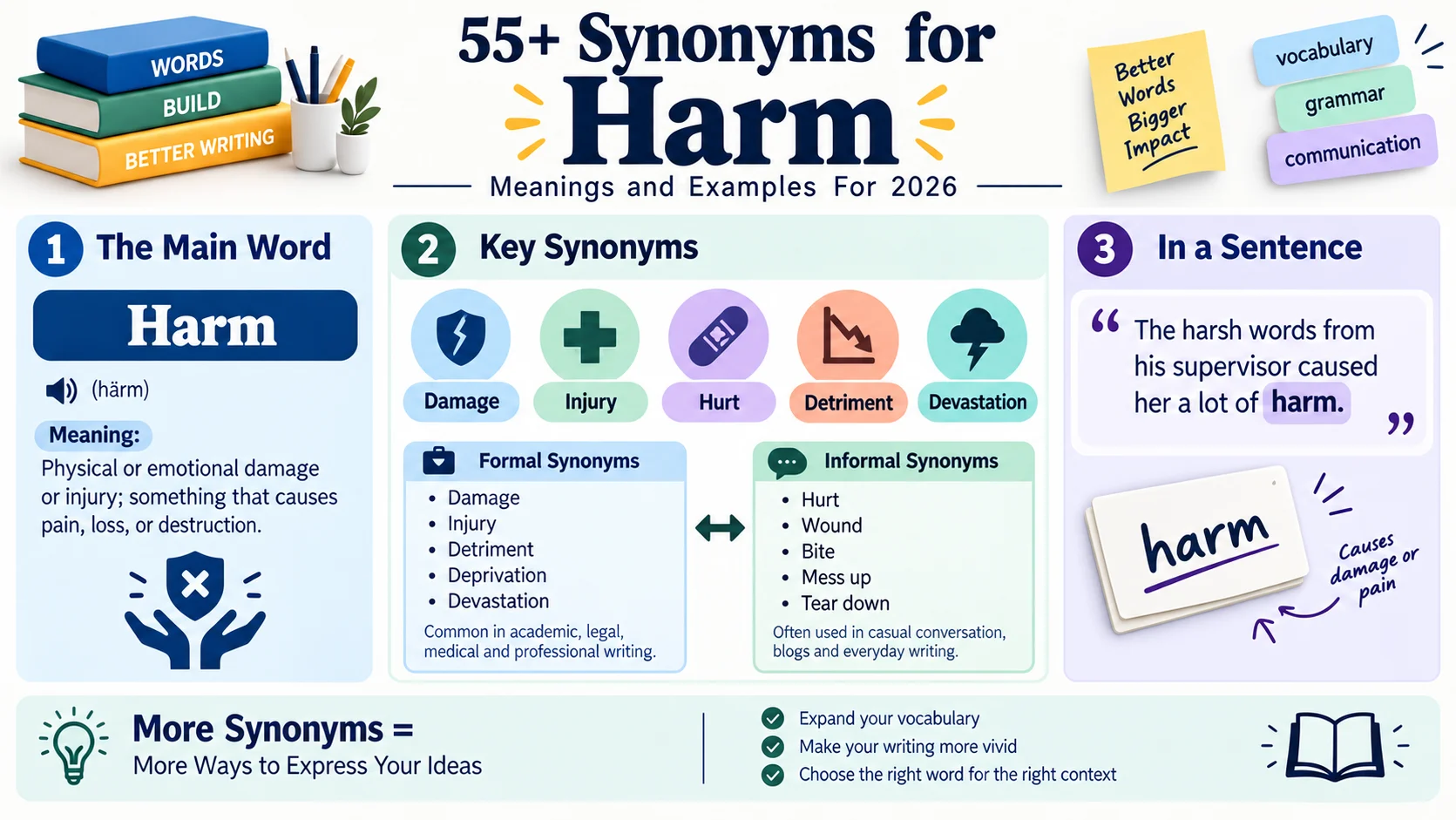
Harm means physical injury, emotional damage, or any negative effect on a person or thing. The best synonyms by context include “damage” for general use, “injury” for physical harm, “detriment” for formal writing, “hurt” for emotional pain, and “mischief” for playful or minor trouble.
Meaning, Tone and Context
The word “harm” is a versatile noun and verb that describes any kind of negative impact. It can refer to physical injury, emotional suffering, financial loss, or damage to reputation. The tone is generally negative or neutral, depending on how it is used.
1. Simple Definition: Harm is physical injury, emotional damage, or any negative consequence that makes a person or thing worse off.
2. Part of Speech: Harm functions as both a noun and a verb.
- Noun: “The storm caused significant harm to the coastal village.”
- Verb: “Smoking can harm your lungs.”
3. Tone: The tone is negative or neutral. It describes something undesirable. It is rarely positive, though in legal contexts it can be used in a neutral, factual way.
4. Formality: “Harm” is a neutral word. It works in both casual conversation and formal writing. For very formal contexts, consider “detriment” or “adverse effect.”
5. Common Use Cases: You will encounter “harm” in many situations.
- Health and Safety: “Excessive sun exposure can cause harm to your skin.”
- Legal Contexts: “The defendant was accused of causing grievous bodily harm.”
- Environmental Discussions: “Pollution causes harm to marine life.”
- Personal Relationships: “His words caused her emotional harm.”
6. Important Word Forms:
- Adjective: harmful. “Smoking is harmful to your health.”
- Adjective: harmless. “The spider looks scary but is actually harmless.”
- Noun: harmfulness. “The harmfulness of the chemical was well documented.”
- Adverb: harmfully. “The substance was harmfully toxic.”
When and How to Use “Harm”
Knowing when to use “harm” is about understanding its scope and weight. Here are several scenarios where it is the perfect choice.
- Professional Context: To discuss risks, safety issues, or negative consequences in a formal way.
Example: “The report outlined the potential harm to the company’s reputation if the product recall was mishandled.” - Personal Context: To describe emotional or physical pain caused by someone’s actions.
Example: “She did not realize the harm her words caused until she saw her friend crying.” - Academic Context: To discuss the negative effects of a policy or phenomenon.
Example: “The study examined the harm caused by prolonged exposure to social media.” - Legal Context: To describe injury or damage in a formal, precise manner.
Example: “The lawsuit sought compensation for the harm suffered by the plaintiffs.” - Environmental Writing: To discuss damage to ecosystems or natural resources.
Example: “Plastic waste causes immense harm to ocean wildlife.” - Social Media Captions: To warn about a product or share a cautionary tale.
Example: “This seemingly harmless habit can actually cause serious harm over time.” - Professional Email: To raise concerns about a decision or action.
Example: “I am concerned about the potential harm this decision could cause to team morale.” - Storytelling: To describe a character’s suffering or the consequences of an action.
Example: “The villain’s plan was to cause as much harm as possible before he was stopped.”
Another Word for “Harm”
Choosing the best replacement for “harm” depends on your context. Here are the most effective single word alternatives categorized by use.
- Professional Writing: “Damage” or “Detriment.” “The scandal caused significant damage to the company’s brand.”
- Academic Writing: “Adverse effect” or “Negative impact.” “The policy had an adverse effect on low income families.”
- Casual Conversation: “Hurt” or “Trouble.” “I never meant to cause you any hurt.”
- Emotional Writing: “Suffering” or “Pain.” “The emotional suffering she endured was unimaginable.”
- Creative Writing: “Ruin” or “Wreckage.” “The war left nothing but wreckage in its path.”
- Resume or Workplace: “Risk” or “Liability.” “The new safety protocols reduced the risk of injury.”
- Social Media Captions: “Damage” or “Toll.” “The stress finally took its toll on my health.”
- Stronger Meaning: “Devastation” or “Destruction.” “The hurricane caused widespread devastation.”
- Softer Meaning: “Nuisance” or “Inconvenience.” “The noise was more of a nuisance than anything else.”
When Not to Use “Harm”
While “harm” is a useful word, it can be too vague or weak in certain situations. Using a more precise synonym can improve clarity and impact.
- When You Need Precision: If you are describing physical injury, “injury” or “wound” is more specific than “harm.” “He suffered a serious injury” is clearer than “He suffered serious harm.”
- When You Need Legal Precision: In legal writing, “damages” or “injury” is more precise. “The court awarded damages” is standard, while “The court awarded harm” is awkward.
- When You Need Strong Emotion: “Harm” can sound clinical. “Devastation” or “anguish” carries more emotional weight. “The devastation caused by the fire was heartbreaking” is stronger than “The harm caused by the fire was significant.”
- When Discussing Minor Issues: “Harm” can sound too serious for small problems. “The inconvenience was minor” is better than “The harm was minor.”
Example of Precision: Compare these two sentences.
- Vague: “The policy caused harm to the community.”
- Precise: “The policy caused significant economic damage to the community.”
The second sentence is more specific and impactful.
Words Commonly Confused With “Harm”
Understanding the differences between these related words will significantly refine your English.
- Harm vs. Damage: “Damage” usually refers to physical or material destruction. “Harm” is broader and can include emotional or abstract injury. You would say “The car sustained damage,” but “The insult caused her emotional harm.”
- Harm vs. Injury: “Injury” specifically refers to physical harm to a person or animal. “Harm” can be physical, emotional, or financial. “He suffered a leg injury” is precise. “He suffered harm” is vague.
- Harm vs. Hurt: “Hurt” is often used for emotional pain or physical soreness. It is more informal than “harm.” “My feelings were hurt” is common. “Harm” is more formal and serious.
- Harm vs. Detriment: “Detriment” is a formal word meaning harm or damage, often to reputation or interests. “He acted to the detriment of his own career.” It is very formal.
- Harm vs. Mischief: “Mischief” refers to playful or minor trouble. It is less serious than “harm.” “The children were up to mischief” is playful. “Harm” implies real negative consequences.
- Harm vs. Ruin: “Ruin” suggests complete destruction or loss. It is much stronger than “harm.” “The scandal ruined his career.” “Harm” suggests some damage, but not total destruction.
Best Synonym by Context for “Harm”
| Context | Best Synonym | Why It Works | Example |
|---|---|---|---|
| Formal Writing | Detriment | It sounds sophisticated and precise. | “The new regulations were to the detriment of small businesses.” |
| Academic Writing | Adverse Effect | It is precise and widely accepted in research. | “The study found an adverse effect of the drug on liver function.” |
| Professional/Business | Damage | It is clear, professional, and widely understood. | “The data breach caused significant damage to our reputation.” |
| Resume | Risk | It focuses on safety and prevention. | “My role was to minimize risk and ensure workplace safety.” |
| Casual Conversation | Hurt | It is simple, emotional, and easily understood. | “I am sorry for any hurt I caused you.” |
| Creative Writing | Ruin or Wreckage | It adds dramatic, visual imagery. | “The flood left nothing but wreckage in its wake.” |
| Emotional Tone | Suffering or Anguish | It conveys deep emotional pain. | “The anguish in her eyes was unmistakable.” |
| Strong Intensity | Devastation | It implies complete and widespread destruction. | “The earthquake caused devastation across the region.” |
| Soft/Moderate Tone | Nuisance | It describes a minor annoyance. | “The construction noise was a nuisance, but not harmful.” |
| Social Media Captions | Toll | It is modern and impactful. | “The stress of the year took a serious toll on my health.” |
| US/UK Usage | Injury or Damage | Both are common in all English dialects. | “The victim suffered a serious injury.” |
Which Synonym Should You Choose?
Choosing the right word is about matching the word to your goal, audience, and the message you want to send.
- Is your message about physical injury? Use “injury,” “wound,” or “trauma.” These words are specific and clear.
- Is your message about emotional pain? Use “hurt,” “suffering,” or “anguish.” These words carry emotional weight.
- Is your message about financial or reputational loss? Use “damage,” “detriment,” or “loss.” These words are appropriate for business and legal contexts.
- Is your message about widespread destruction? Use “devastation,” “destruction,” or “ruin.” These words are strong and dramatic.
- Is your message about a minor issue? Use “nuisance,” “inconvenience,” or “trouble.” These words are lighter and less serious.
- Are you writing for an academic audience? Use “adverse effect,” “negative impact,” or “detriment.” These words are formal and precise.
Real Life Examples of “Harm” in Sentences
Here are examples of how “harm” and its synonyms can be used in different real world scenarios.
- School: “The teacher explained the harm caused by bullying and encouraged students to speak up.”
- Workplace: “The safety training focused on preventing harm to employees in the factory.” Stronger: “The safety training focused on preventing injury to employees.”
- Writing: “The article discussed the harm caused by misinformation online.” Stronger: “The article discussed the damage caused by misinformation.”
- Conversation: “I never meant to cause you any harm.” Stronger: “I never meant to cause you any hurt.”
- Social Media: “This trend might seem fun, but it can cause real harm to your skin.” Stronger: “This trend might seem fun, but it can cause real damage to your skin.”
- Resume: “I implemented safety protocols that reduced the risk of harm in the workplace.” Stronger: “I implemented safety protocols that reduced the risk of injury.”
- Email: “We are writing to inform you about potential harm associated with this product.” Stronger: “We are writing to inform you about potential risks associated with this product.”
- Storytelling: “The villain’s actions caused immense harm to the kingdom.” Stronger: “The villain’s actions caused immense devastation across the kingdom.”
25 Synonyms for “Harm”
The following table lists 25 accurate and practical synonyms for “harm.”
| Synonym | Simple Meaning | Best Used For | Example Sentence |
|---|---|---|---|
| Damage | Physical or material destruction. | General use, professional. | “The storm caused significant damage to the house.” |
| Injury | Physical harm to a person or animal. | Medical, legal, safety contexts. | “He suffered a serious injury in the accident.” |
| Hurt | Emotional or physical pain. | Casual, emotional writing. | “Her words caused him a lot of hurt.” |
| Detriment | Harm or damage to interests or reputation. | Formal writing, legal. | “He worked long hours to the detriment of his health.” |
| Adverse Effect | A negative impact or consequence. | Academic, scientific writing. | “The drug had an adverse effect on patients.” |
| Negative Impact | A harmful influence or result. | Business, academic writing. | “The policy had a negative impact on the economy.” |
| Suffering | Severe emotional or physical pain. | Emotional, literary writing. | “The refugees endured unimaginable suffering.” |
| Anguish | Extreme emotional pain. | Literary, emotional writing. | “She cried out in anguish when she heard the news.” |
| Devastation | Widespread destruction or damage. | Dramatic, news writing. | “The hurricane caused devastation across the coast.” |
| Destruction | The act of destroying something. | General, dramatic writing. | “The fire caused total destruction of the building.” |
| Ruin | Complete loss or destruction. | Literary, dramatic writing. | “The scandal brought ruin to his career.” |
| Wreckage | The remains of something destroyed. | Literary, descriptive writing. | “The wreckage of the plane was scattered across the field.” |
| Trauma | Severe emotional or physical shock. | Medical, psychological contexts. | “She suffered trauma after the accident.” |
| Wound | A physical injury, especially a cut. | Medical, literary contexts. | “The soldier had a deep wound on his arm.” |
| Loss | The fact of losing something. | Business, personal writing. | “The company reported a significant financial loss.” |
| Injustice | Unfair treatment or harm. | Social, political writing. | “The protesters fought against racial injustice.” |
| Mischief | Playful or minor trouble. | Casual, literary writing. | “The children were up to mischief in the garden.” |
| Nuisance | A minor annoyance or inconvenience. | Casual, everyday writing. | “The noise from the construction was a nuisance.” |
| Inconvenience | Minor trouble or difficulty. | Polite, everyday writing. | “We apologize for any inconvenience this may cause.” |
| Toll | The negative effect or cost of something. | Modern, journalistic writing. | “The stress took a toll on her mental health.” |
| Liability | A person or thing that causes harm. | Business, legal contexts. | “The faulty wiring was a liability for the company.” |
| Risk | The possibility of harm or loss. | Business, health, safety. | “Smoking increases the risk of lung cancer.” |
| Peril | Serious and immediate danger. | Literary, dramatic writing. | “The sailors were in great peril during the storm.” |
| Jeopardy | Danger of loss or harm. | Formal, legal writing. | “His actions put the entire project in jeopardy.” |
| Malice | The intention to do harm. | Legal, formal writing. | “The attack was carried out with malice.” |
Synonym Groups and Usage Differences
Professional vs. Personal Synonyms
In a professional setting, choose “damage,” “detriment,” or “liability.” These words sound polished and appropriate for business communication. In a personal setting, “hurt” or “trouble” are more natural and friendly. For example, you would tell a colleague “The delay caused significant damage to the project,” but a friend “I am sorry for any hurt I caused.”
Formal vs. Conversational Synonyms
Formal Synonyms: “Detriment,” “adverse effect,” and “jeopardy” are perfect for academic papers, legal documents, or formal speeches.
Conversational Synonyms: “Hurt,” “trouble,” and “nuisance” are the best choices for everyday conversations and emails to friends.
Academic Synonyms
In essays and research papers, “adverse effect” and “negative impact” are powerful words. They allow you to discuss consequences in a precise, objective way. “Detriment” is also useful for discussing harm to reputation or interests.
Professional and Business Synonyms
“Damage” is a safe and professional choice for almost any workplace communication. “Liability” is effective when discussing legal or financial risks. “Risk” is a great word for discussing potential harm in safety contexts.
Creative or Literary Synonyms
These words add a layer of artistry to your descriptions.
- Ruin: Suggests complete and dramatic loss.
- Wreckage: Creates a vivid image of destruction.
- Anguish: Conveys deep emotional suffering.
Slang or Modern Synonyms
“Toll” is a modern and effective synonym for harm, especially in journalism and social media. It is acceptable in casual writing but should be avoided in formal academic or professional writing.
Strongest vs. Weaker Synonyms
Here is an intensity scale from mild to strongest:
- Nuisance, Inconvenience: Very mild, minor annoyances.
- Mischief, Trouble: Mild, playful or minor issues.
- Harm, Hurt, Risk: Moderate, general negative effects.
- Damage, Injury, Loss: Strong, serious negative effects.
- Devastation, Destruction, Ruin: Strongest, complete and widespread harm.
Emotional vs. Neutral Synonyms
Emotional Synonyms: “Suffering,” “anguish,” and “trauma” carry strong emotional weight.
Neutral Synonyms: “Damage,” “injury,” “adverse effect,” and “risk” are factual and free of emotional charge.
Antonyms of “Harm”
Here are 15 clear antonyms for “harm,” which are words that mean the opposite: benefit, help, or protection.
| Antonym | Meaning | Example Sentence |
|---|---|---|
| Benefit | An advantage or positive effect. | “The new policy will benefit small businesses.” |
| Help | Assistance or support. | “Your advice was a great help to me.” |
| Advantage | A favorable circumstance or condition. | “Speaking two languages is a major advantage.” |
| Protection | The act of keeping someone or something safe. | “The law offers protection to workers.” |
| Safety | The condition of being protected from harm. | “Safety is our top priority in the workplace.” |
| Benefit | Something that promotes well being. | “Regular exercise has many health benefits.” |
| Gain | A positive improvement or increase. | “The company reported a significant financial gain.” |
| Improvement | A positive change or development. | “The new software is a big improvement.” |
| Boon | Something that is helpful or beneficial. | “The rain was a boon for local farmers.” |
| Blessing | A beneficial thing for which one is grateful. | “The sunny weather was a blessing for the event.” |
| Favor | An act of kindness or approval. | “He did me a favor by helping with the move.” |
| Service | An act of help or assistance. | “The organization provides a valuable service to the community.” |
| Support | Assistance or encouragement. | “She gave me a lot of support during a difficult time.” |
| Cure | A remedy or solution to a problem. | “The new drug offers a cure for the disease.” |
| Healing | The process of becoming healthy again. | “The healing process took several weeks.” |
Comparison: “Harm” vs. Similar Words
Harm vs. Damage
Main Difference: “Damage” usually refers to physical or material destruction. “Harm” is broader and can include emotional or abstract injury.
Which One Is Stronger: “Damage” is stronger when referring to physical destruction.
Which One Is More Formal: Both are neutral. “Damage” is often used in legal and insurance contexts.
Example Sentence with Harm: “The emotional harm caused by the bullying was severe.”
Example Sentence with Damage: “The car sustained significant damage in the crash.”
Harm vs. Injury
Main Difference: “Injury” specifically refers to physical harm to a person or animal. “Harm” can be physical, emotional, or financial.
Which One Is Stronger: “Injury” is more specific and often more serious.
Which One Is More Formal: “Injury” is formal and commonly used in medical and legal contexts.
Example Sentence with Harm: “The policy caused harm to the community.”
Example Sentence with Injury: “He suffered a serious injury to his knee.”
Harm vs. Hurt
Main Difference: “Hurt” is often used for emotional pain or physical soreness. It is more informal than “harm.”
Which One Is Stronger: “Hurt” is usually less formal but can be very emotional.
Which One Is More Formal: “Harm” is more formal and serious.
Example Sentence with Harm: “The decision caused significant harm to the company.”
Example Sentence with Hurt: “Her words caused him a lot of hurt.”
Harm vs. Detriment
Main Difference: “Detriment” is a formal word meaning harm or damage, often to reputation or interests.
Which One Is Stronger: “Detriment” is stronger and more formal.
Which One Is More Formal: “Detriment” is very formal and often used in legal or academic writing.
Example Sentence with Harm: “The scandal caused harm to his reputation.”
Example Sentence with Detriment: “He acted to the detriment of his own career.”
Harm vs. Mischief
Main Difference: “Mischief” refers to playful or minor trouble. It is less serious than “harm.”
Which One Is Stronger: “Harm” is much stronger and more serious.
Which One Is More Formal: “Mischief” is more casual and playful.
Example Sentence with Harm: “The vandalism caused harm to public property.”
Example Sentence with Mischief: “The children were up to mischief in the backyard.”
Harm vs. Ruin
Main Difference: “Ruin” suggests complete destruction or loss. It is much stronger than “harm.”
Which One Is Stronger: “Ruin” is much stronger and more dramatic.
Which One Is More Formal: “Ruin” is literary and dramatic.
Example Sentence with Harm: “The mistake caused some harm to the project.”
Example Sentence with Ruin: “The scandal brought ruin to his political career.”
Common Phrases and Expressions with “Harm”
1. Do More Harm Than Good
Meaning: To have a negative effect rather than a positive one.
Example Sentence: “Taking too much medicine can do more harm than good.”
2. No Harm Done
Meaning: Nothing bad happened, so there is no need to worry.
Example Sentence: “You forgot your keys? No harm done, I have a spare.”
3. Harm Reduction
Meaning: Policies or actions that aim to reduce the negative consequences of risky behavior.
Example Sentence: “The city introduced a harm reduction program for drug users.”
4. Grievous Bodily Harm
Meaning: Serious physical injury, often used in legal contexts.
Example Sentence: “He was charged with causing grievous bodily harm.”
5. Harm’s Way
Meaning: In a position of danger or risk.
Example Sentence: “The firefighters put themselves in harm’s way to save the family.”
6. Come to Harm
Meaning: To be injured or damaged.
Example Sentence: “The children were warned not to come to any harm while playing outside.”
7. Out of Harm’s Way
Meaning: In a safe position.
Example Sentence: “Please keep all valuables out of harm’s way during the storm.”
8. Actual Harm
Meaning: Real, measurable damage or injury.
Example Sentence: “The court required proof of actual harm before awarding damages.”
Common Mistakes to Avoid
1. Using “Harm” When a More Precise Synonym Is Better
Mistake: “The accident caused harm to his leg.”
Better: “The accident caused an injury to his leg.” “Injury” is more precise for physical damage.
2. Confusing “Harm” with “Hurt”
Mistake: “He caused harm to her feelings.”
Better: “He hurt her feelings.” “Hurt” is the natural choice for emotional pain.
3. Using a Casual Synonym in Formal Writing
Mistake: “The policy caused a lot of trouble for investors.”
Better: “The policy caused significant detriment to investors.” “Trouble” is too casual for formal writing.
4. Using an Overly Dramatic Synonym for a Simple Situation
Mistake: “The rain caused devastation to our picnic.”
Better: “The rain ruined our picnic.” “Devastation” is too strong for a minor inconvenience.
5. Repeating the Same Word Too Often
Mistake: “The storm caused harm. The flood caused harm. The wind caused harm.”
Better: “The storm caused damage. The flood caused destruction. The wind caused injury.” This variation makes the writing more engaging.
6. Choosing a Synonym with the Wrong Emotional Tone
Mistake: “I appreciate your mischief regarding my performance.”
Better: “I appreciate your feedback regarding my performance.” “Mischief” has a playful connotation that is inappropriate here.
7. Using Slang in Academic or Professional Writing
Mistake: “The project took a big toll on the budget.”
Better: “The project had a significant negative impact on the budget.” “Toll” is too casual for formal writing.
FAQs
1. What is the best synonym for harm?
The best synonym depends on your context. “Damage” is a safe general choice. “Injury” works for physical harm. “Detriment” is best for formal writing. “Hurt” is best for emotional pain.
2. What is a formal synonym for harm?
A formal synonym for harm is “detriment.” “Adverse effect” and “negative impact” are also excellent formal choices. These words are appropriate for legal, academic, and professional writing.
3. What is an informal synonym for harm?
An informal synonym for harm is “hurt.” “Trouble” is also a good casual choice. These words are perfect for everyday conversation and friendly emails.
4. What is another word for harm in professional writing?
In professional writing, “damage” is an excellent choice. “Detriment” is also effective when discussing harm to reputation or interests. “Liability” is useful for discussing legal or financial risk.
5. What is the difference between harm and damage?
“Harm” is a broad term for any negative effect. “Damage” usually refers to physical or material destruction. You can cause emotional harm, but physical objects sustain damage.
6. What is the opposite of harm?
The opposite of harm is “benefit,” “help,” or “advantage.” These words describe positive effects or outcomes, in contrast to the negative effects of harm.
Conclusion
The word “harm” is a powerful and versatile part of the English language. It allows us to describe negative effects, whether they are physical, emotional, or financial. Understanding its many synonyms is key to becoming a more precise and effective communicator.
Choosing the best synonym depends entirely on your context and audience. For professional settings, “damage” or “detriment” work well. For formal writing, “adverse effect” is an excellent choice. In casual conversation, “hurt” or “trouble” are natural and friendly. For dramatic or literary writing, “devastation” or “ruin” add emotional weight.
The best advice is to think about your purpose before you choose a word. Do you want to be precise, formal, emotional, or casual? Matching your word to your intention will make your communication more effective and your English more sophisticated.
A practical vocabulary tip: Try replacing “harm” with a more specific synonym in your writing this week. If you are discussing physical injury, use “injury.” If you are analyzing a policy, use “adverse effect.” This small change will significantly improve the clarity and impact of your English.
