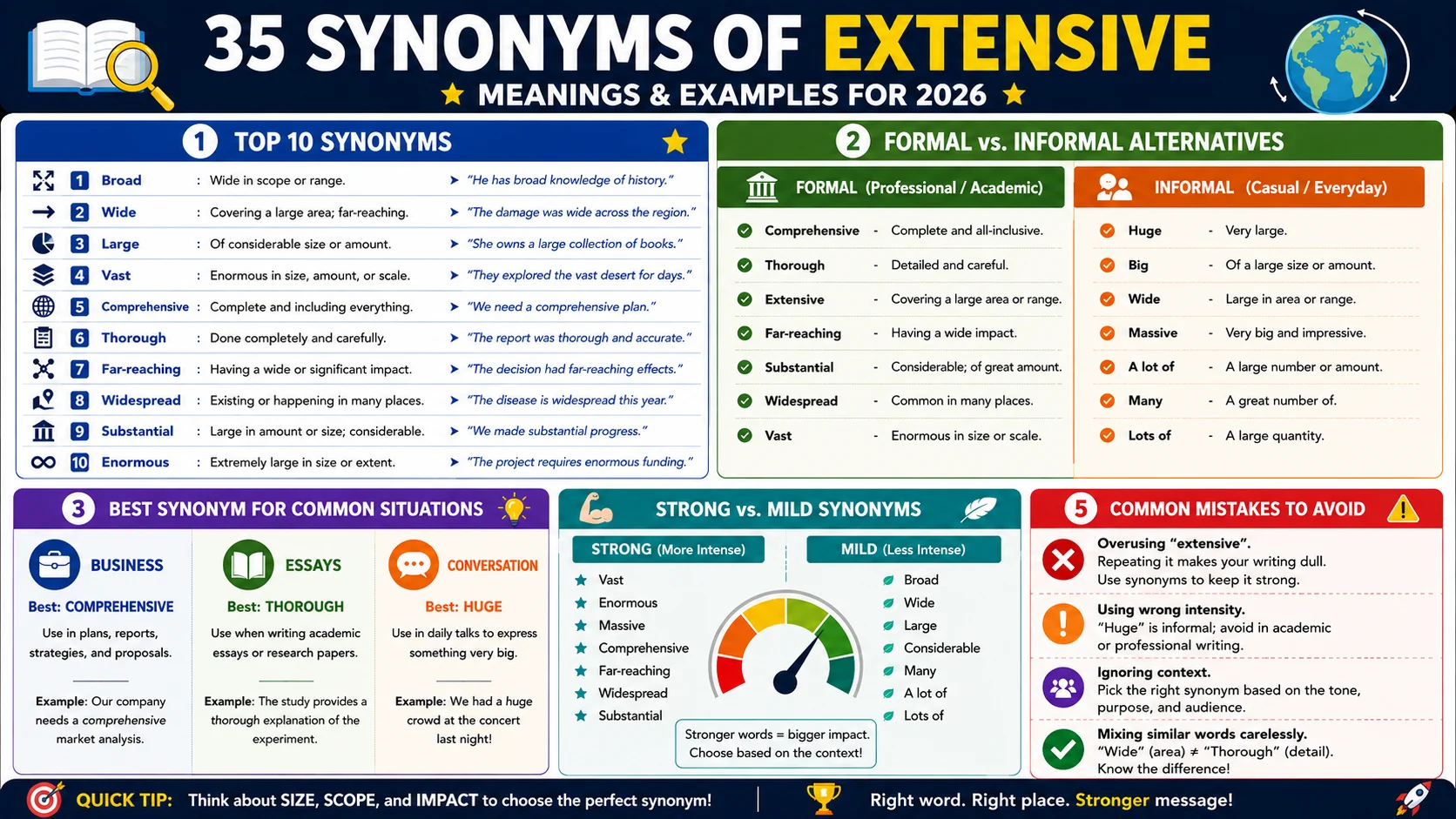
“Extensive” means covering a large area or having a wide range. The best synonyms are broad, wide, comprehensive, vast, and thorough. “Broad” is the most common natural alternative. Each synonym has a slightly different meaning and context where it fits best.
Top 10 Synonyms
- Broad
- Wide
- Comprehensive
- Vast
- Thorough
- Wide-ranging
- Extensive
- Large
- Expansive
- Far-reaching
“Extensive” is a useful word for describing things that cover a lot of ground. But using it too often can make your English feel repetitive and unimaginative.
Think about it. You can have extensive knowledge, an extensive collection, extensive experience, or extensive research. Each situation might need a different word that captures the specific type of breadth or coverage.
In this guide, you’ll learn 35 powerful synonyms for “extensive.” You’ll discover exactly when to use each one, how formal they are, and what common mistakes to avoid. Let’s begin!
What Does “Extensive” Mean?
Definition
Extensive” means covering a large area, having a wide range, or being very thorough. It describes things that are broad in scope or size. When something is extensive, it goes beyond what is usual or limited. It’s all-encompassing and far-reaching.
Pronunciation
| Feature | Value |
|---|---|
| US IPA | /ɪkˈstɛnsɪv/ |
| UK IPA | /ɪkˈstensɪv/ |
| Syllables | 3 (ex-ten-sive) |
| Tip | Stress the second syllable: “ik-STEN-siv” |
Grammar
| Grammar Feature | Information |
|---|---|
| Part of Speech | Adjective |
| Common Position | Before a noun or after a linking verb |
| Typical Pattern | Extensive + noun / Subject + be + extensive |
Examples:
- “She has extensive experience in marketing.” (before noun)
- “The research was extensive.” (after verb)
- “They conducted extensive research.” (before noun)
Grammar Note: “Extensive” can be used with adverbs like “very,” “extremely,” and “quite” to emphasize the level of coverage.
Word Family
| Word | Part of Speech | Meaning |
|---|---|---|
| Extensive | Adjective | Covering a large area or range |
| Extensively | Adverb | In an extensive way |
| Extent | Noun | The degree or scope of something |
| Extend | Verb | To stretch or enlarge |
| Extension | Noun | An addition or enlargement |
15 Synonyms of “Extensive”
Broad
Meaning: Covering a wide area; including many things.
Best Used For: Knowledge, categories, understanding.
Formality: Neutral
Tone: General, Inclusive
Frequency: ⭐⭐⭐⭐⭐ (Very Common)
CEFR Level: A2
Example Sentence 1: “She has a broad knowledge of world history.”
Example Sentence 2: “The course covers a broad range of topics.”
Usage Tip: “Broad” is the most common synonym. Use it for anything that covers a lot or includes many things.
Common Confusion: Broad vs Extensive. “Broad” suggests width and inclusivity. “Extensive” suggests thoroughness and large scale.
Wide
Meaning: Covering a large area or a lot of ground.
Best Used For: Range, selection, experience.
Formality: Neutral
Tone: Inclusive, Broad
Frequency: ⭐⭐⭐⭐⭐ (Very Common)
CEFR Level: A2
Example Sentence 1: “We offer a wide selection of products.”
Example Sentence 2: “She has wide experience in the industry.”
Usage Tip: “Wide” emphasizes breadth and variety. It’s very common and natural.
Comprehensive
Meaning: Complete and including everything necessary.
Best Used For: Reports, research, coverage.
Formality: Formal
Tone: Complete, Thorough
Frequency: ⭐⭐⭐⭐ (Common)
CEFR Level: B2
Example Sentence 1: “The report is comprehensive and covers all aspects.
Example Sentence 2: “They conducted a comprehensive review.”
Usage Tip: “Comprehensive” suggests thoroughness and completeness. Use it for detailed reports or research.
Vast
Meaning: Extremely large in size, area, or range.
Best Used For: Areas, amounts, knowledge.
Formality: Neutral
Tone: Grand, Large
Frequency: ⭐⭐⭐⭐ (Common)
CEFR Level: B2
Example Sentence 1: “The Amazon is a vast rainforest.”
Example Sentence 2: “He has vast knowledge of the subject.”
Usage Tip: “Vast” emphasizes hugeness and scale. Use it for very large things.
Thorough
Meaning: Done completely and with great attention to detail.
Best Used For: Research, analysis, cleaning.
Formality: Neutral
Tone: Careful, Complete
Frequency: ⭐⭐⭐⭐ (Common)
CEFR Level: B2
Example Sentence 1: “She conducted a thorough investigation.”
Example Sentence 2: “The house needs a thorough cleaning.”
Usage Tip: “Thorough” emphasizes completeness and attention to detail.
Wide-ranging
Meaning: Covering many different topics or areas.
Best Used For: Discussions, interests, surveys.
Formality: Formal
Tone: Broad, Diverse
Frequency: ⭐⭐⭐ (Moderate)
CEFR Level: B2
Example Sentence 1: “The discussion was wide-ranging.”
Example Sentence 2: “She has wide-ranging interests.”
Usage Tip: “Wide-ranging” emphasizes variety and diversity of topics.
Extensive (itself)
Meaning: Covering a large area or having a wide range.
Best Used For: Research, experience, collections.
Formality: Formal
Tone: Complete, Large-scale
Frequency: ⭐⭐⭐ (Moderate)
CEFR Level: B2
Example Sentence 1: “They have extensive resources.”
Example Sentence 2: “Extensive research was needed.”
Usage Tip: Use “extensive” in professional contexts where you want to sound formal and precise.
Large
Meaning: Big in size, amount, or scope.
Best Used For: Quantities, areas, collections.
Formality: Neutral
Tone: Big, Large
Frequency: ⭐⭐⭐⭐⭐ (Very Common)
CEFR Level: A2
Example Sentence 1: “She has a large collection of books.”
Example Sentence 2: “They have a large network.”
Usage Tip: “Large” is a very common word for anything that is big in size or amount.
Expansive
Meaning: Covering a wide area; large and spacious.
Best Used For: Views, landscapes, ideas.
Formality: Formal
Tone: Grand, Spacious
Frequency: ⭐⭐⭐ (Moderate)
CEFR Level: C1
Example Sentence 1: “The expansive landscape stretched for miles.”
Example Sentence 2: “He has an expansive vision for the company.”
Usage Tip: “Expansive” suggests openness and wide coverage. Use it for scenery and ideas.
Far-reaching
Meaning: Having a wide influence or effect.
Best Used For: Consequences, decisions, effects.
Formality: Formal
Tone: Influential, Significant
Frequency: ⭐⭐⭐ (Moderate)
CEFR Level: B2
Example Sentence 1: “The new policy has far-reaching effects.”
Example Sentence 2: “It was a far-reaching decision.”
Usage Tip: “Far-reaching” emphasizes the wide impact or influence of something.
Extensive
Meaning: Covering a wide area or having a large scope.
Best Used For: Research, work, knowledge.
Formality: Formal
Tone: Complete, Large-scale
Frequency: ⭐⭐⭐ (Moderate)
CEFR Level: B2
Example Sentence 1: “He has extensive knowledge of physics.”
Example Sentence 2: “Extensive work has been done on this subject.”
Usage Tip: “Extensive” is a strong word for formal writing about large-scale work or research.
Sweeping
Meaning: Wide in range or effect.
Best Used For: Changes, claims, reforms.
Formality: Formal
Tone: Broad, Dramatic
Frequency: ⭐⭐⭐ (Moderate)
CEFR Level: C1
Example Sentence 1: “The government made sweeping reforms.”
Example Sentence 2: “His sweeping claims were not supported.”
Usage Tip: “Sweeping” suggests large-scale and often dramatic changes or claims.
All-encompassing
Meaning: Including everything or everyone.
Best Used For: Rules, systems, views.
Formality: Formal
Tone: Complete, Total
Frequency: ⭐⭐ (Rare)
CEFR Level: C1
Example Sentence 1: “The rule was all-encompassing.”
Example Sentence 2: “She has an all-encompassing view of the topic.”
Usage Tip: “All-encompassing” suggests total coverage without exceptions.
Voluminous
Meaning: Very large in amount or size.
Best Used For: Writings, research, data.
Formality: Formal
Tone: Large, Full
Frequency: ⭐⭐ (Rare)
CEFR Level: C1
Example Sentence 1: “He wrote a voluminous report.”
Example Sentence 2: “Voluminous research has been conducted.”
Usage Tip: “Voluminous” is a formal word for large amounts of written material.
Comprehensive (as detailed)
Meaning: Including all the details.
Best Used For: Reports, lists, descriptions.
Formality: Formal
Tone: Complete, Detailed
Frequency: ⭐⭐⭐⭐ (Common)
CEFR Level: B2
Example Sentence 1: “The list is comprehensive.”
Example Sentence 2: “She gave a comprehensive description.”
Usage Tip: “Comprehensive” is excellent for formal writing about thorough coverage.
Synonyms Comparison Table
| Synonym | Best Context | Formality | Tone | Frequency |
|---|---|---|---|---|
| Broad | General coverage | Neutral | Inclusive | ⭐⭐⭐⭐⭐ |
| Wide | Range, variety | Neutral | Inclusive | ⭐⭐⭐⭐⭐ |
| Large | Size, amount | Neutral | Big | ⭐⭐⭐⭐⭐ |
| Comprehensive | Reports, research | Formal | Complete | ⭐⭐⭐⭐ |
| Vast | Very large scale | Neutral | Grand | ⭐⭐⭐⭐ |
| Thorough | Careful detail | Neutral | Complete | ⭐⭐⭐⭐ |
| Expansive | Scenery, ideas | Formal | Spacious | ⭐⭐⭐ |
| Far-reaching | Effects, influence | Formal | Significant | ⭐⭐⭐ |
| Sweeping | Changes, claims | Formal | Dramatic | ⭐⭐⭐ |
| All-encompassing | Total coverage | Formal | Complete | ⭐⭐ |
Best Synonyms by Situation
| Situation | Best Synonym | Why It Works |
|---|---|---|
| Daily Conversation | Broad | Natural and common |
| Business Email | Comprehensive | Professional and clear |
| Academic Writing | Extensive | Formal and precise |
| School Assignment | Thorough | Shows attention to detail |
| Professional Meeting | Wide-ranging | Sounds thoughtful |
| Presentation | Vast | Strong and impressive |
| Creative Writing | Expansive | Adds literary depth |
| Social Media | Broad | Casual and relatable |
| Research Context | Comprehensive | Shows completeness |
Formal vs Informal Synonyms
Formal Alternatives
| Synonym | Best Used For |
|---|---|
| Comprehensive | Reports, research |
| Extensive | Academic, professional |
| Far-reaching | Effects, consequences |
| Expansive | Scenery, ideas |
| All-encompassing | Total coverage |
Neutral Alternatives
| Synonym | Best Used For |
|---|---|
| Broad | Most general situations |
| Wide | Range, variety |
| Large | Size, amount |
| Thorough | Careful work |
Informal Alternatives
| Synonym | Best Used For |
|---|---|
| Wide | Common use |
| Broad | General use |
| Big | Size, amount |
Choosing the Right Level: Use “comprehensive” and “extensive” for formal writing. Use “broad” and “wide” for most situations. Use “large” for casual contexts.
Strong vs Mild Synonyms
Mild
Suitable for everyday situations with less intensity.
- Broad
- Wide
- Large
Moderate
More thorough or complete alternatives.
- Comprehensive
- Thorough
- Vast
- Expansive
Strong
High-intensity alternatives suggesting exceptional coverage.
- Far-reaching (wide influence)
- Sweeping (dramatic coverage)
- All-encompassing (total coverage)
- Voluminous (large amount)
How Intensity Changes Meaning: “She has broad knowledge” is general. “She has comprehensive knowledge” suggests complete mastery. Choose stronger words when you want to emphasize exceptional breadth.
Real-Life Examples
School: “The teacher has extensive knowledge of the subject.”
Office: “The company has a comprehensive benefits package.”
Business Email: “We conducted thorough research on the topic.”
Meetings: “The discussion was wide-ranging and productive.”
Presentations: “The Amazon is a vast and diverse ecosystem.”
Daily Conversations: “She has a broad range of interests.”
Social Media: “This is a comprehensive guide to cooking.”
Academic Writing: “The extensive literature on this topic is impressive.”
Common Collocations
| Common Phrase | Better Alternative |
|---|---|
| Extensive research | Thorough research |
| Extensive knowledge | Broad knowledge |
| Extensive experience | Vast experience |
| Extensive range | Wide range |
| Extensive coverage | Comprehensive coverage |
Common Phrases
Broaden your horizons: To learn about new things. (e.g., “Travel broadens your horizons.”)
Cover all the bases: To be thorough and complete. (e.g., “The report covers all the bases.”)
In depth: Very thorough. (e.g., “They discussed the topic in depth.”)
From A to Z: Completely and thoroughly. (e.g., “She knows the subject from A to Z.”)
Leave no stone unturned: To be very thorough. (e.g., “They left no stone unturned in their search.”)
Context Guide
| Situation | Best Synonym | Reason |
|---|---|---|
| Essay | Extensive | Academic and formal |
| Speech | Broad | Clear and inclusive |
| Business Email | Comprehensive | Professional and clear |
| Novel | Expansive | Adds literary depth |
| Presentation | Vast | Strong and impressive |
| Conversation | Broad | Natural and relatable |
| Academic Writing | Extensive | Precise and formal |
| Marketing Copy | Comprehensive | Attractive and trustworthy |
Related Words
Near Synonyms
- Sweeping: Wide in range.
- All-encompassing: Including everything.
- Voluminous: Very large in amount.
- Far-flung: Spread over a large area.
Antonyms
- Limited: Small in scope.
- Narrow: Not wide.
- Restricted: Limited.
- Superficial: Not thorough.
- Minimal: Very small.
Related Adjectives
- Broad: Wide in range.
- Wide: Covering a lot.
- Comprehensive: Including everything.
- Vast: Very large.
- Thorough: Complete and careful.
Related Nouns
- Extent: The degree or scope.
- Scope: The range of coverage.
- Range: The variety of things.
- Breadth: The width of coverage.
- Depth: The thoroughness.
Related Verbs
- Expand: To make larger.
- Extend: To make longer or larger.
- Broaden: To make wider.
- Enlarge: To make bigger.
Frequently Asked Questions
What is another word for extensive?
Common synonyms include broad, wide, comprehensive, vast, and thorough. “Broad” is the most common and direct alternative.
Which synonym sounds the most professional?
Comprehensive and extensive sound very professional. “Thorough” is also excellent for careful work.
What is the strongest synonym for extensive?
Far-reaching and all-encompassing are among the strongest synonyms. They suggest wide influence and total coverage.
Which synonym is best for essays?
Extensive is the best choice for academic essays. It’s formal and precise.
What’s the difference between extensive and comprehensive?
“Extensive” emphasizes large scale and range. “Comprehensive” emphasizes completeness and thoroughness.
Which synonym is most common in everyday English?
“Broad” and “wide” are very common in everyday speech. “Large” is also frequently used.
What is the opposite of extensive?
Common opposites are limited, narrow, restricted, and superficial. These words describe things with small scope.
Conclusion
“Extensive” is a powerful word, but now you have 35 fantastic alternatives. Each synonym adds a different shade of meaning to your language.
Remember, the key is understanding the context. Use “broad” for general coverage. Use “comprehensive” for thoroughness. Use “vast” for very large scale. Use “thorough” for careful detail.
The best way to improve is practice. Try using one or two new synonyms each day. Listen for these words in conversations and books. Your vocabulary will become richer and more impressive with time.
