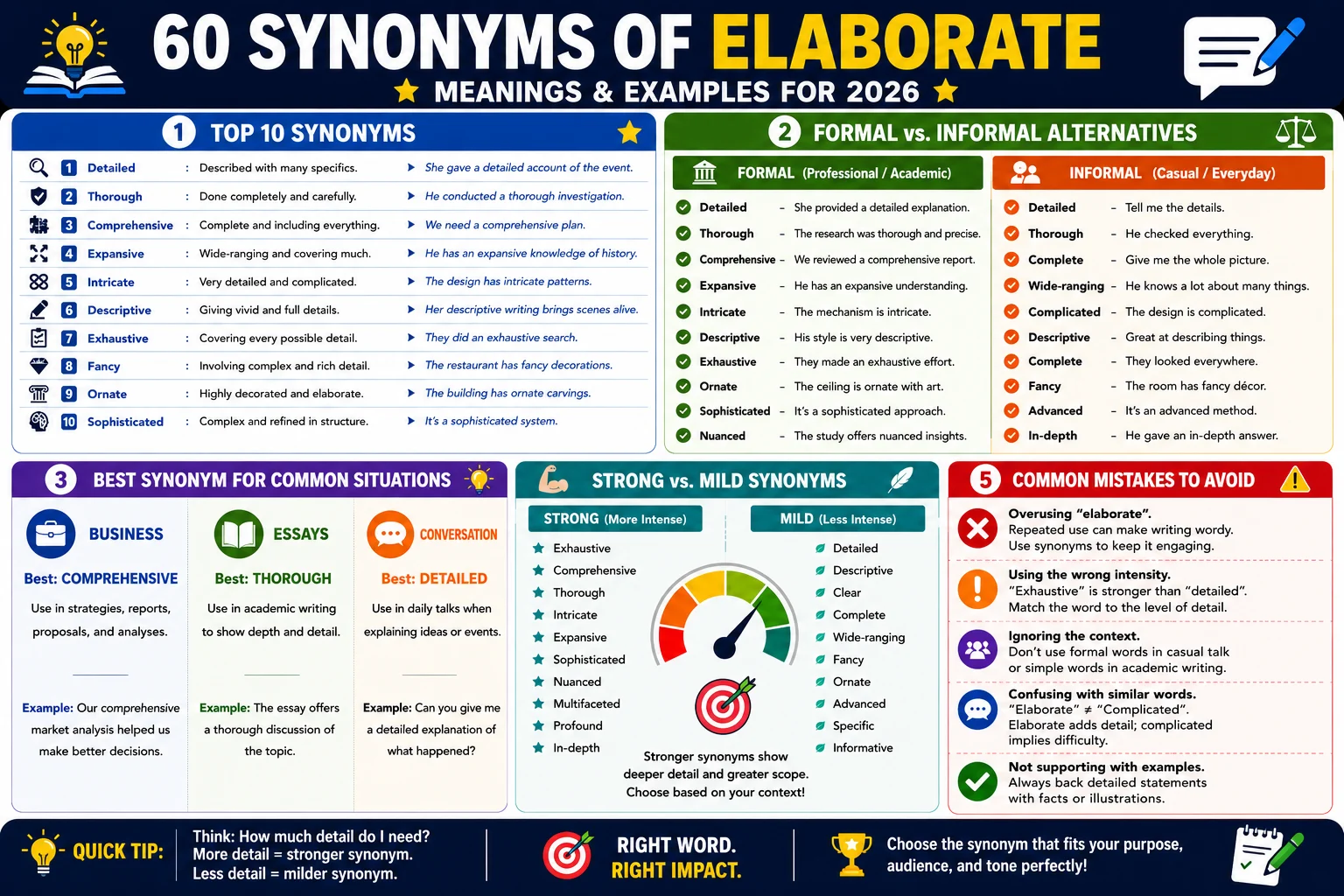
“Elaborate” means to explain in detail or to make something more complex and detailed. The best synonyms are expand, develop, detail, refine, and embellish. “Expand” is the most common natural alternative. Each synonym has a slightly different meaning and context where it fits best.
Top 10 Synonyms
- Expand
- Develop
- Detail
- Refine
- Embellish
- Enlarge
- Amplify
- Enhance
- Improve
- Broaden
“Elaborate” is a wonderful word. It means adding detail and making things more complete. But using it too often can make your English feel repetitive and one-dimensional.
Think about it. You can elaborate on an idea, elaborate a plan, elaborate a story, or elaborate instructions. Each situation might need a different word that captures the specific type of detail or development.
In this guide, you’ll learn 35 powerful synonyms for “elaborate.” You’ll discover exactly when to use each one, how formal they are, and what common mistakes to avoid. Let’s begin!
What Does “Elaborate” Mean?
Definition
Elaborate” means to explain or describe something in more detail. It can also mean to develop or make something more complex and detailed. When you elaborate, you add more information or make something richer and fuller.
Pronunciation
| Feature | Value |
|---|---|
| US IPA | /ɪˈlæbərət/ (adj) /ɪˈlæbəreɪt/ (verb) |
| UK IPA | /ɪˈlæbərət/ (adj) /ɪˈlæbəreɪt/ (verb) |
| Syllables | 4 (e-lab-o-rate) |
| Tip | For verb, stress the first syllable: “ih-LAB-uh-rate” |
Grammar
| Grammar Feature | Information |
|---|---|
| Part of Speech | Verb (and adjective) |
| Common Position | After the subject |
| Typical Pattern | Subject + elaborate + on/upon + something |
Examples:
- “Could you elaborate on your idea?” (verb)
- “She elaborated her plan carefully.” (verb)
- “The elaborate design was beautiful.” (adjective)
Grammar Note: As a verb, “elaborate” is often used with “on” or “upon” when explaining something in more detail.
Word Family
| Word | Part of Speech | Meaning |
|---|---|---|
| Elaborate | Verb/Adj | To explain in detail / Complex |
| Elaborately | Adverb | In an elaborate way |
| Elaboration | Noun | The act of elaborating |
15 Synonyms of “Elaborate”
Expand
Meaning: To make something larger or more detailed.
Best Used For: Ideas, explanations, stories.
Formality: Neutral
Tone: Informative, Clear
Frequency: ⭐⭐⭐⭐⭐ (Very Common)
CEFR Level: B1
Example Sentence 1: “Could you expand on that point?”
Example Sentence 2: “She expanded her initial idea into a full proposal.”
Usage Tip: “Expand” is the most direct and common synonym. Use it for adding more detail.
Common Confusion: Expand vs Elaborate. “Expand” is more general. “Elaborate” often suggests adding rich detail.
Develop
Meaning: To grow or make something more advanced and detailed.
Best Used For: Ideas, skills, plans.
Formality: Neutral
Tone: Progressive, Positive
Frequency: ⭐⭐⭐⭐⭐ (Very Common)
CEFR Level: A2
Example Sentence 1: “We need to develop this concept further.
Example Sentence 2: “She developed her argument with examples.
Usage Tip: “Develop” suggests building up over time. Use it for gradual growth and improvement.
Detail
Meaning: To describe something thoroughly and in full.
Best Used For: Instructions, descriptions, processes.
Formality: Neutral
Tone: Precise, Clear
Frequency: ⭐⭐⭐⭐ (Common)
CEFR Level: B1
Example Sentence 1: “Please detail the steps in the process.”
Example Sentence 2: “She detailed every event of the day.
Usage Tip: “Detail” emphasizes being thorough and specific. Use it when you want every part explained.
Refine
Meaning: To improve something by making small changes.
Best Used For: Ideas, skills, designs.
Formality: Formal
Tone: Precise, Careful
Frequency: ⭐⭐⭐⭐ (Common)
CEFR Level: B2
Example Sentence 1: “We need to refine our strategy.”
Example Sentence 2: “She refined her speech before the presentation.”
Usage Tip: “Refine” suggests polishing and perfecting. Use it for improving quality.
Embellish
Meaning: To add extra details to make something more interesting.
Best Used For: Stories, descriptions, designs.
Formality: Formal
Tone: Creative, Decorative
Frequency: ⭐⭐⭐ (Moderate)
CEFR Level: B2
Example Sentence 1: “She embellished the story with colorful details.”
Example Sentence 2: “He embellished his report with extra facts.
Usage Tip: “Embellish” often suggests making something more interesting or attractive, sometimes with extra detail.
Enlarge
Meaning: To make something larger or more extensive.
Best Used For: Ideas, scope, physical objects.
Formality: Neutral
Tone: Expansive, Growth
Frequency: ⭐⭐⭐ (Moderate)
CEFR Level: B2
Example Sentence 1: “We need to enlarge the scope of the project.”
Example Sentence 2: “She enlarged on her earlier comments.”
Usage Tip: “Enlarge” focuses on making something bigger in scope or size.
Amplify
Meaning: To make something stronger or more detailed.
Best Used For: Ideas, arguments, sounds.
Formality: Formal
Tone: Intensifying, Clear
Frequency: ⭐⭐⭐ (Moderate)
CEFR Level: B2
Example Sentence 1: “Let me amplify that point with evidence.”
Example Sentence 2: “She amplified her argument with examples.”
Usage Tip: “Amplify” suggests making something stronger and clearer. It’s often used for arguments or points.
Enhance
Meaning: To improve the quality or value of something.
Best Used For: Skills, products, experiences.
Formality: Formal
Tone: Improving, Positive
Frequency: ⭐⭐⭐⭐ (Common)
CEFR Level: B2
Example Sentence 1: “We can enhance our presentation with visuals.”
Example Sentence 2: “She enhanced the design with new colors.”
Usage Tip: “Enhance” focuses on improving quality, not just adding detail.
Improve
Meaning: To make something better or more detailed.
Best Used For: Skills, plans, quality.
Formality: Neutral
Tone: Positive, Growth
Frequency: ⭐⭐⭐⭐⭐ (Very Common)
CEFR Level: A2
Example Sentence 1: “We need to improve our proposal.”
Example Sentence 2: “She improved the explanation with examples.”
Usage Tip: “Improve” is a general word for making something better. It’s very common and natural.
Broaden
Meaning: To make something wider or more inclusive.
Best Used For: Knowledge, understanding, experience.
Formality: Neutral
Tone: Expansive, Open
Frequency: ⭐⭐⭐⭐ (Common)
CEFR Level: B2
Example Sentence 1: “Read widely to broaden your understanding.”
Example Sentence 2: “She broadened the discussion to include all viewpoints.
Usage Tip: “Broaden” suggests expanding range or scope. Use it for making things more comprehensive.
Extend
Meaning: To make something longer or greater.
Best Used For: Ideas, time, scope.
Formality: Neutral
Tone: Expanding, Growth
Frequency: ⭐⭐⭐⭐ (Common)
CEFR Level: B2
Example Sentence 1: “We need to extend our thinking on this issue.
Example Sentence 2: “She extended her explanation for clarity.”
Usage Tip: “Extend” suggests making something longer or stretching it further.
Elaborate
Meaning: To explain in detail (the word itself).
Best Used For: Ideas, explanations, responses.
Formality: Formal
Tone: Detailed, Thorough
Frequency: ⭐⭐⭐ (Moderate)
CEFR Level: B2
Example Sentence 1: “Could you elaborate on your answer?”
Example Sentence 2: “She elaborated the proposal extensively.”
Usage Tip: Use “elaborate” when you want a formal word for adding detail.
Unfold
Meaning: To reveal or develop gradually.
Best Used For: Stories, events, explanations.
Formality: Neutral
Tone: Gradual, Revealing
Frequency: ⭐⭐⭐ (Moderate)
CEFR Level: B2
Example Sentence 1: “The story unfolded with many twists.”
Example Sentence 2: “He unfolded his plan step by step.
Usage Tip: “Unfold” suggests revealing something gradually, like a story unfolding.
Simplify (as contrast)
Meaning: To make something easier to understand. (Opposite of elaborate)
Best Used For: Instructions, explanations, concepts.
Formality: Neutral
Tone: Clear, Easy
Frequency: ⭐⭐⭐⭐ (Common)
CEFR Level: B1
Example Sentence 1: “We need to simplify the instructions.”
Example Sentence 2: “She simplified the concept for beginners.”
Usage Tip: While this is the opposite, it’s often useful to know when you shouldn’t elaborate.
Interpret
meaning: To explain the meaning of something.
Best Used For: Data, texts, ideas.
Formality: Formal
Tone: Analytical, Explanatory
Frequency: ⭐⭐⭐ (Moderate)
CEFR Level: B2
Example Sentence 1: “Can you interpret these results?
Example Sentence 2: “She interpreted his silence as agreement.”
Usage Tip: “Interpret” suggests explaining meaning, not just adding detail.
Synonyms Comparison Table
| Synonym | Best Context | Formality | Tone | Frequency |
|---|---|---|---|---|
| Expand | Adding detail | Neutral | Clear | ⭐⭐⭐⭐⭐ |
| Develop | Building up | Neutral | Positive | ⭐⭐⭐⭐⭐ |
| Improve | Making better | Neutral | Growth | ⭐⭐⭐⭐⭐ |
| Detail | Thorough description | Neutral | Precise | ⭐⭐⭐⭐ |
| Refine | Polishing | Formal | Careful | ⭐⭐⭐⭐ |
| Embellish | Creative detail | Formal | Creative | ⭐⭐⭐ |
| Amplify | Strengthening | Formal | Clear | ⭐⭐⭐ |
| Broaden | Expanding scope | Neutral | Open | ⭐⭐⭐⭐ |
| Elaborate | Formal explanation | Formal | Thorough | ⭐⭐⭐ |
Best Synonyms by Situation
| Situation | Best Synonym | Why It Works |
|---|---|---|
| Daily Conversation | Expand | Natural and common |
| Business Email | Elaborate | Professional and clear |
| Academic Writing | Develop | Formal and precise |
| School Assignment | Detail | Shows thoroughness |
| Professional Meeting | Refine | Sounds careful |
| Presentation | Amplify | Strong and clear |
| Creative Writing | Embellish | Adds literary depth |
| Social Media | Expand | Casual and relatable |
| Storytelling | Unfold | Adds drama |
Formal vs Informal Synonyms
Formal Alternatives
| Synonym | Best Used For |
|---|---|
| Elaborate | Formal explanations |
| Amplify | Arguments, points |
| Refine | Polishing work |
| Embellish | Stories, creative work |
| Interpret | Explaining meaning |
Neutral Alternatives
| Synonym | Best Used For |
|---|---|
| Expand | Adding detail |
| Develop | Building up |
| Detail | Thorough explanation |
| Broaden | Widening scope |
Informal Alternatives
| Synonym | Best Used For |
|---|---|
| Improve | Making better |
| Flesh out | Adding detail (idiom) |
| Go into | Explore in detail |
Choosing the Right Level: Use “elaborate” and “amplify” for formal writing. Use “expand” and “develop” for most situations. Use “flesh out” and “go into” with friends.
Strong vs Mild Synonyms
Mild
Suitable for everyday situations with less intensity.
- Expand
- Improve
- Broaden
Moderate
More thoughtful or detailed alternatives.
- Develop
- Detail
- Refine
- Enhance
Strong
High-intensity alternatives suggesting deep detail or complexity.
- Amplify (make much stronger)
- Embellish (rich detail)
- Elaborate (formal thoroughness)
- Interpret (explain meaning)
How Intensity Changes Meaning: “I expanded on it” is simple. “I elaborated on it thoroughly” sounds much more formal. Choose stronger words when you want to emphasize depth and detail.
Real-Life Examples
School: “Could you elaborate on your answer?” asked the teacher.
Office: “We need to refine our presentation before the meeting.”
Business Email: “Please detail the steps you plan to take.”
Meetings: “Let me expand on that point.”
Presentations: “I’ll amplify this idea with examples.”
Daily Conversations: “Can you go into more detail?”
Social Media: “I’ll expand on this in my next post.”
Academic Writing: “This section will elaborate on the findings.”
Common Collocations
| Common Phrase | Better Alternative |
|---|---|
| Elaborate on an idea | Expand on an idea |
| Elaborate a plan | Develop a plan |
| Elaborate details | Refine details |
| Elaborate a story | Embellish a story |
| Elaborate an answer | Detail an answer |
Common Phrases
Flesh out: To add detail and make complete. (e.g., “We need to flesh out this idea.”)
Go into detail: To explain thoroughly. (e.g., “Let’s go into detail about this.”)
Get into the nitty-gritty: To discuss details. (e.g., “Let’s get into the nitty-gritty.”)
Spell out: To explain clearly and in detail. (e.g., “Please spell out what you mean.”)
Fill in the gaps: To add missing details. (e.g., “Can you fill in the gaps?”)
Context Guide
| Situation | Best Synonym | Reason |
|---|---|---|
| Essay | Elaborate | Academic and formal |
| Speech | Amplify | Strong and clear |
| Business Email | Refine | Professional |
| Novel | Embellish | Literary and creative |
| Presentation | Expand | Clear and effective |
| Conversation | Expand | Natural and relatable |
| Academic Writing | Elaborate | Precise and formal |
| Marketing Copy | Enhance | Attractive and clear |
Related Words
Near Synonyms
- Expatiate: To speak or write at length (very formal).
- Enumerate: To list details one by one.
- Specify: To be exact and clear.
- Clarify: To make clearer.
- Explicate: To analyze in detail (formal).
Antonyms
- Summarize: To make brief.
- Abridge: To shorten.
- Condense: To make shorter.
- Simplify: To make easier.
- Outline: To give the main points.
Related Adjectives
- Elaborate: Complex and detailed.
- Detailed: Full of details.
- Thorough: Complete and careful.
- Comprehensive: Covering everything.
- Complex: Having many parts.
Related Nouns
- Elaboration: The act of elaborating.
- Detail: A small piece of information.
- Development: Growth and progress.
- Refinement: Improvement through polishing.
Related Verbs
- Explain: To make clear.
- Describe: To tell about.
- Clarify: To make clearer.
- Specify: To be exact.
Frequently Asked Questions
What is another word for elaborate?
Common synonyms include expand, develop, detail, refine, and embellish. “Expand” is the most common and direct alternative.
Which synonym sounds the most professional?
Elaborate and amplify sound very professional. “Refine” is also excellent for business contexts.
What is the strongest synonym for elaborate?
Amplify is one of the strongest synonyms. It suggests making something much stronger and clearer. “Embellish” is strong for creative detail.
Which synonym is best for essays?
Elaborate is the best choice for academic essays. It’s formal and precise.
What’s the difference between elaborate and expand?
“Expand” is more general and simply means making something bigger. “Elaborate” specifically means adding rich detail.
Which synonym is most common in everyday English?
“Expand” and “develop” are very common in everyday speech. “Improve” is also frequently used.
What is the opposite of elaborate?
Common opposites are summarize, simplify, abridge, and condense. These words describe making something shorter or simpler.
Conclusion
“Elaborate” is a wonderful word, but now you have 35 fantastic alternatives. Each synonym adds a different shade of meaning to your language.
Remember, the key is understanding the context. Use “expand” for general addition of detail. Use “develop” for gradual building up. Use “refine” for polishing. Use “embellish” for creative detail.
The best way to improve is practice. Try using one or two new synonyms each day. Listen for these words in conversations and books. Your vocabulary will become richer and more expressive with time.
