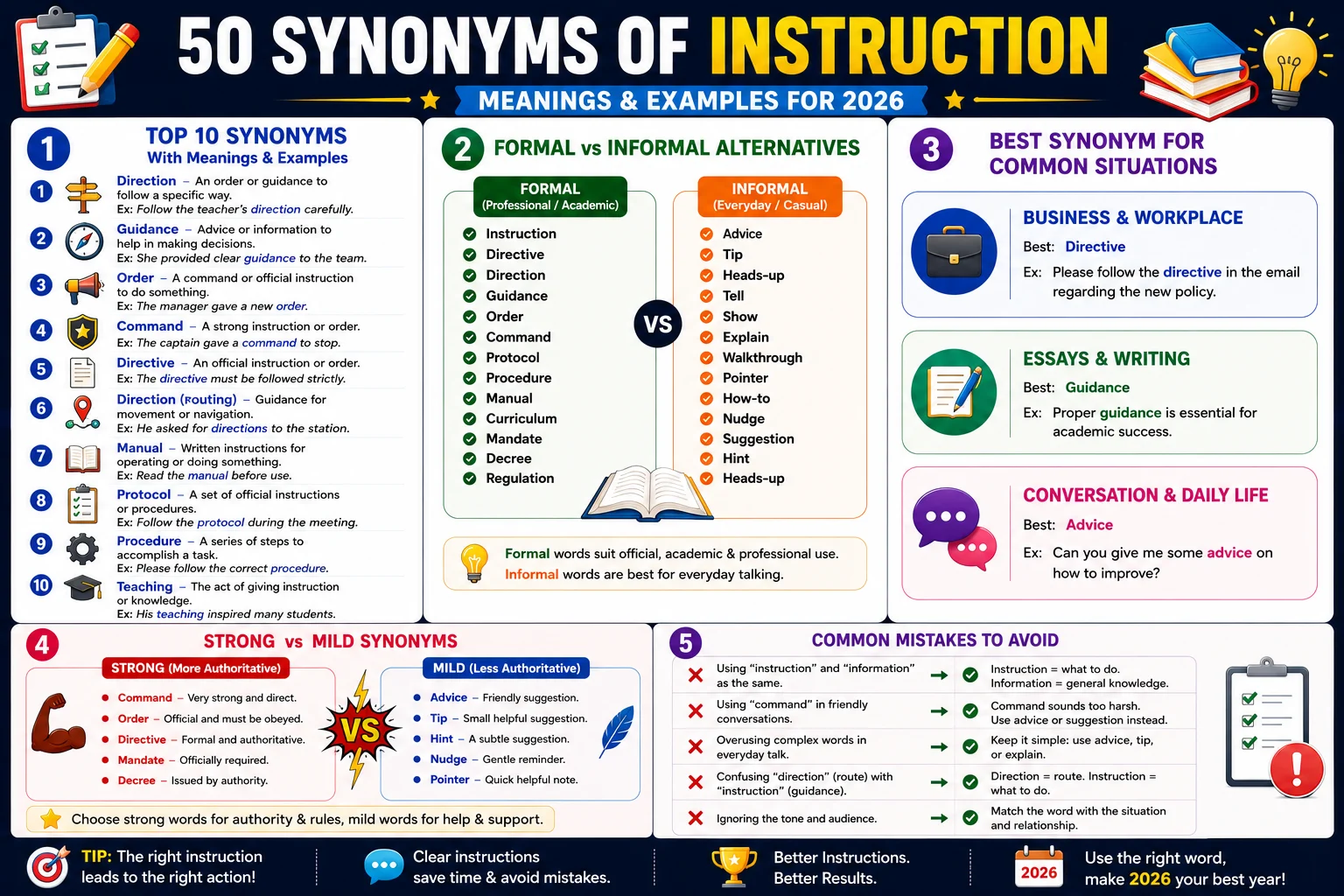
“Instruction” means guidance, directions, or information about how to do something. The best synonyms are direction, guidance, order, command, and directive. “Direction” is the most common and natural alternative. Each synonym has a slightly different meaning and context.
Top 10 Synonyms
- Direction
- Guidance
- Order
- Command
- Directive
- Briefing
- Tutoring
- Coaching
- Training
- Education
Finding the right synonyms of instruction can make your writing clearer, more natural, and more professional. The word “instruction” can mean different things depending on the context. You might use it for a simple direction, a workplace guideline, a learning task, or a formal order. Choosing the right alternative helps you communicate your exact meaning without sounding repetitive.
In this guide, you’ll discover practical synonyms of instruction with clear meanings, examples, and usage tips. The alternatives are selected based on how native English speakers use these words in everyday, academic, workplace, and formal communication. You’ll see when words such as direction, guidance, command, order, advice, and guideline fit best and when they don’t.
Whether you’re improving your vocabulary, writing an email, studying English, or polishing professional content, this guide will help you choose the right word with confidence.
What Does “Instruction” Mean?
Definition
Instruction” means the act of teaching, guiding, or telling someone how to do something. It can be verbal or written. It can be simple directions, like how to assemble furniture, or complex teaching, like how to play an instrument. It’s about sharing knowledge to help others learn or complete a task.
Pronunciation
| Feature | Value |
|---|---|
| US IPA | /ɪnˈstrʌkʃən/ |
| UK IPA | /ɪnˈstrʌkʃən/ |
| Syllables | 3 (in-struc-tion) |
| Tip | Stress the second syllable: “in-STRUK-shun” |
Grammar
| Grammar Feature | Information |
|---|---|
| Part of Speech | Noun |
| Common Position | Subject or object |
| Typical Pattern | Instruction + for + action / instruction + to + person |
Examples:
- “The instructions were easy to follow.” (directions)
- “She received instruction in piano.” (teaching)
- “Follow the instructions carefully.” (written guidance)
Grammar Note: “Instruction” is often countable when referring to specific directions (“the instructions”) and uncountable when referring to the general act of teaching (“instruction in music”).
Word Family
| Word | Part of Speech | Meaning |
|---|---|---|
| Instruct | Verb | To teach or give directions |
| Instruction | Noun | The act of teaching or guiding |
| Instructor | Noun | A person who teaches |
| Instructive | Adjective | Providing useful information |
| Instructively | Adverb | In a way that teaches |
15 Synonyms of “Instruction”
Direction
Meaning: Instructions about where to go or what to do.
Best Used For: General guidance, giving orders, telling someone how to do something.
Formality: Neutral
Tone: Practical, Clear
Frequency: ⭐⭐⭐⭐⭐ (Very Common)
CEFR Level: A2
Example Sentence 1: “The teacher gave clear directions for the assignment.”
Example Sentence 2: “Follow the directions on the package.”
Usage Tip: “Direction” is the most common and natural alternative. Use it for everyday guidance and instructions.
Common Confusion: Direction vs Instruction. “Direction” often refers to the path or basic guidance. “Instruction” is more formal and often more detailed.
Guidance
Meaning: Help and advice about how to do something or make decisions.
Best Used For: Mentoring, counseling, general advice.
Formality: Formal
Tone: Supportive, Helpful
Frequency: ⭐⭐⭐⭐⭐ (Very Common)
CEFR Level: B1
Example Sentence 1: “She offered guidance to the new employees.”
Example Sentence 2: “Students need guidance in choosing their careers.
Usage Tip: “Guidance” implies ongoing support and wisdom. It’s less about step-by-step instructions and more about overall help.
Order
Meaning: A command or instruction given by someone in authority.
Best Used For: Military, formal commands, giving clear and direct instructions.
Formality: Formal
Tone: Authoritative, Direct
Frequency: ⭐⭐⭐⭐⭐ (Very Common)
CEFR Level: A2
Example Sentence 1: “The general gave orders to his troops.”
Example Sentence 2: “She followed the doctor’s orders carefully.”
Usage Tip: “Order” is a strong word for instructions from authority figures. It implies that compliance is expected.
Command
Meaning: An official order that must be obeyed.
Best Used For: Military, computers, authority figures.
Formality: Formal
Tone: Authoritative, Strong
Frequency: ⭐⭐⭐⭐ (Common)
CEFR Level: B1
Example Sentence 1: “The captain issued a command to the crew.”
Example Sentence 2: “Type a command into the computer.”
Usage Tip: “Command” is very formal and authoritative. Use it for orders that must be followed without question.
Directive
Meaning: An official instruction or order, often from an authority.
Best Used For: Business, government, official communications.
Formality: Very Formal
Tone: Official, Authoritative
Frequency: ⭐⭐⭐ (Moderate)
CEFR Level: C1
Example Sentence 1: “The company issued a directive about safety procedures.”
Example Sentence 2: “The new directive must be followed by all staff.”
Usage Tip: “Directive” is a very formal word. Use it for official business and government instructions.
Briefing
Meaning: A meeting or document that gives instructions or information.
Best Used For: Work, military, meetings, project introductions.
Formality: Formal
Tone: Professional, Informative
Frequency: ⭐⭐⭐ (Moderate)
CEFR Level: B2
Example Sentence 1: “The manager gave a briefing to the team.
Example Sentence 2: “We received a briefing on the new policy.”
Usage Tip: “Briefing” is a formal word for giving instructions or information, often in a meeting.
Tutoring
Meaning: Teaching or giving private instruction to an individual or small group.
Best Used For: Education, one-on-one teaching.
Formality: Neutral
Tone: Educational, Personalized
Frequency: ⭐⭐⭐ (Moderate)
CEFR Level: B1
Example Sentence 1: “She offers tutoring in mathematics.”
Example Sentence 2: “The tutoring helped him pass the exam.”
Usage Tip: “Tutoring” specifically means individual or small group teaching. Use it for educational contexts.
Coaching
Meaning: Training or teaching to improve performance.
Best Used For: Sports, professional development, personal growth.
Formality: Neutral
Tone: Motivating, Supportive
Frequency: ⭐⭐⭐⭐ (Common)
CEFR Level: B1
Example Sentence 1: “The coach provided excellent coaching to the team.
Example Sentence 2: “She offers career coaching to professionals.
Usage Tip: “Coaching” is about improving skills and performance. It’s common in sports and professional development.
Training
Meaning: The process of teaching someone the skills they need for a job or activity.
Best Used For: Jobs, sports, skill development.
Formality: Neutral
Tone: Practical, Skill-building
Frequency: ⭐⭐⭐⭐⭐ (Very Common)
CEFR Level: A2
Example Sentence 1: “New employees receive training on day one.”
Example Sentence 2: “She completed training as a nurse.
Usage Tip: “Training” emphasizes skill development over a period of time. It’s broader than “instruction.”
Education
Meaning: The process of learning and receiving knowledge.
Best Used For: Formal schooling, lifelong learning, academic contexts.
Formality: Formal
Tone: Academic, Enriching
Frequency: ⭐⭐⭐⭐⭐ (Very Common)
CEFR Level: A2
Example Sentence 1: “Education is the key to a better future.”
Example Sentence 2: “She received a great education at the university.”
Usage Tip: “Education” is the broadest term. It refers to the entire process of learning, not just individual instructions.
Teaching
Meaning: The act of giving knowledge or skill to others.
Best Used For: Schools, any learning environment.
Formality: Neutral
Tone: Educational, Helpful
Frequency: ⭐⭐⭐⭐⭐ (Very Common)
CEFR Level: A2
Example Sentence 1: “His teaching made math fun and interesting.”
Example Sentence 2: “Teaching requires patience and dedication.”
Usage Tip: “Teaching” is the most common word for the act of instructing others. It’s broad and works in any educational context.
Lesson
Meaning: A period of instruction or a unit of learning.
Best Used For: Education, music, skill development.
Formality: Neutral
Tone: Educational, Practical
Frequency: ⭐⭐⭐⭐⭐ (Very Common)
CEFR Level: A2
Example Sentence 1: “The piano lesson was challenging but rewarding.”
Example Sentence 2: “The teacher prepared a lesson about grammar.
Usage Tip: “Lesson” refers to a single unit of instruction. It’s a specific, smaller part of teaching.
Explanation
Meaning: Details that make something clear or easy to understand.
Best Used For: Clarifying, describing processes.
Formality: Neutral
Tone: Clear, Helpful
Frequency: ⭐⭐⭐⭐ (Common)
CEFR Level: B1
Example Sentence 1: “She gave a clear explanation of the task.”
Example Sentence 2: “His explanation made everything easier to understand.”
Usage Tip: “Explanation” focuses on making things clear. It’s about providing understanding, not just commands.
Drill
Meaning: Repeated practice or exercises to learn a skill.
Best Used For: Language learning, music, sports, military.
Formality: Neutral
Tone: Repetitive, Skill-focused
Frequency: ⭐⭐⭐ (Moderate)
CEFR Level: B1
Example Sentence 1: “The teacher used drills to improve pronunciation.”
Example Sentence 2: “Fire drills are important for safety.
Usage Tip: “Drill” involves repeated practice. Use it for skill development through repetition.
Mandate
Meaning: An official order that must be followed.
Best Used For: Government, laws, official requirements.
Formality: Very Formal
Tone: Authoritative, Legal
Frequency: ⭐⭐⭐ (Moderate)
CEFR Level: C1
Example Sentence 1: “The government issued a mandate about vaccinations.”
Example Sentence 2: “The new mandate requires all employees to be trained.”
Usage Tip: “Mandate” is a very formal word for an official order, often with legal authority.
Synonyms Comparison Table
| Synonym | Best Context | Formality | Tone | Frequency |
|---|---|---|---|---|
| Direction | General guidance | Neutral | Practical | ⭐⭐⭐⭐⭐ |
| Guidance | Support and advice | Formal | Helpful | ⭐⭐⭐⭐⭐ |
| Order | Authority commands | Formal | Authoritative | ⭐⭐⭐⭐⭐ |
| Teaching | Education | Neutral | Educational | ⭐⭐⭐⭐⭐ |
| Education | Formal learning | Formal | Academic | ⭐⭐⭐⭐⭐ |
| Training | Skills development | Neutral | Practical | ⭐⭐⭐⭐⭐ |
| Command | Military, computers | Formal | Authoritative | ⭐⭐⭐⭐ |
| Coaching | Performance improvement | Neutral | Motivating | ⭐⭐⭐⭐ |
| Directive | Official instructions | Very Formal | Official | ⭐⭐⭐ |
| Briefing | Meetings, projects | Formal | Professional | ⭐⭐⭐ |
Best Synonyms by Situation
| Situation | Best Synonym | Why It Works |
|---|---|---|
| Daily Conversation | Direction | Natural and common |
| Business Email | Directive | Professional and official |
| Academic Writing | Education | Formal and precise |
| School Assignment | Lesson | Clear and educational |
| Professional Meeting | Briefing | Professional and clear |
| Presentation | Guidance | Supportive and clear |
| Creative Writing | Command | Adds drama and authority |
| Social Media | Tips | Casual and helpful |
| Military Context | Order | Authoritative and direct |
Formal vs Informal Synonyms
Formal Alternatives
| Synonym | Best Used For |
|---|---|
| Directive | Official business, government |
| Mandate | Legal, official requirements |
| Education | Academic contexts |
| Briefing | Professional meetings |
| Command | Military, computer systems |
Neutral Alternatives
| Synonym | Best Used For |
|---|---|
| Direction | General guidance |
| Guidance | Support and advice |
| Teaching | Educational contexts |
| Training | Skill development |
Informal Alternatives
| Synonym | Best Used For |
|---|---|
| Tips | Casual advice |
| Pointers | Helpful guidance |
| How-to | Practical instructions |
| Walkthrough | Step-by-step guidance |
Choosing the Right Level: Use “directive” and “mandate” for official contexts. Use “guidance” and “direction” for most professional situations. Use “tips” and “pointers” for casual conversations.
Strong vs Mild Synonyms
Mild
Suitable for everyday situations with less intensity.
- Tips
- Pointers
- Guidance
Moderate
More professional or specific alternatives.
- Direction
- Teaching
- Training
- Lesson
Strong
High-intensity alternatives suggesting authority or expertise.
- Command (absolute authority)
- Order (must be followed)
- Directive (official requirement)
- Mandate (legal requirement)
How Intensity Changes Meaning: “I gave guidance” is helpful. “I issued a command” is authoritative. Choose stronger words when you want to emphasize authority or official requirements.
Real-Life Examples
School: “The teacher gave clear instructions for the science experiment.”
Office: “We received training on the new software system.”
Business Email: “Please follow the directive regarding safety protocols.”
Meetings: “The manager gave a briefing on the quarterly goals.”
Presentations: “Let me provide some guidance on this process.”
Daily Conversations: “I need directions to get to your house.”
Social Media: “Here are some tips for better cooking.”
Academic Writing: “Education is the foundation of social progress.”
Common Collocations
| Common Phrase | Better Alternative |
|---|---|
| Give instructions | Provide guidance |
| Instructions manual | User manual |
| Follow instructions | Follow directions |
| Instructional video | Tutorial video |
| Classroom instruction | Classroom teaching |
| Written instructions | Written directions |
Common Phrases
Step-by-step: Detailed instructions for beginners. (e.g., “The manual has step-by-step instructions.”)
Walk through: To explain something step by step. (e.g., “Let me walk you through the process.”)
How-to: A guide on how to do something. (e.g., “I found a how-to video online.”)
User manual: A book of instructions for a product.
Point someone in the right direction: To give helpful guidance.
Context Guide
| Situation | Best Synonym | Reason |
|---|---|---|
| Essay | Education | Academic and formal |
| Speech | Guidance | Inspiring and supportive |
| Business Email | Directive | Professional and official |
| Novel | Command | Adds drama |
| Presentation | Guidance | Clear and professional |
| Conversation | Direction | Natural and clear |
| Academic Writing | Education | Precise and formal |
| Marketing Copy | Tips | Engaging and helpful |
Related Words
Near Synonyms
- Advisory: Giving advice or guidance.
- Tutorial: A lesson or guide.
- Lesson plan: A teacher’s plan for instruction.
- Curriculum: The subjects taught in a course.
Antonyms
- Disobedience: Refusing to follow instructions.
- Ignorance: Lack of knowledge.
- Confusion: Not understanding.
- Misinformation: Wrong information.
Related Adjectives
- Instructive: Providing useful information.
- Educational: Relating to learning.
- Informative: Providing helpful facts.
- Directive: Giving instructions.
- Advisory: Giving advice.
Related Nouns
- Teacher: A person who instructs.
- Instructor: A person who teaches.
- Mentor: A trusted guide.
- Tutor: A private teacher.
Related Verbs
- Instruct: To teach or give directions.
- Teach: To share knowledge.
- Guide: To lead and advise.
- Train: To teach skills.
- Coach: To train and mentor.
Frequently Asked Questions
What is another word for instruction?
Common synonyms include direction, guidance, order, command, and directive. “Direction” is the most common and natural alternative.
Which synonym sounds the most professional?
Directive and guidance sound very professional. “Briefing” is excellent for business contexts.
What is the strongest synonym for instruction?
Command is one of the strongest synonyms. It suggests absolute authority. “Mandate” is also strong, implying official legal authority.
Which synonym is best for essays?
Education is the best choice for academic essays. “Instruction” itself is also appropriate for formal writing.
What’s the difference between instruction and direction?
“Instruction” is more formal and often more detailed. “Direction” is broader and often refers to general guidance or path.
Which synonym is most common in everyday English?
“Direction” and “guidance” are very common in everyday speech. “Teaching” is also frequently used.
What is the opposite of instruction?
Common opposites include disobedience, ignorance, and confusion. These words describe the lack of instruction or understanding.
Conclusion
“Instruction” is a useful word, but now you have 35 fantastic alternatives. Each synonym adds a different shade of meaning to your language.
Remember, the key is understanding the context. Use “direction” for general guidance. Use “guidance” for supportive advice. Use “command” for authoritative orders. Use “teaching” for education. Use “training” for skill development.
The best way to improve is practice. Try using one or two new synonyms each day. Listen for these words in conversations, books, and movies. Your vocabulary will become richer and more impressive with time.
