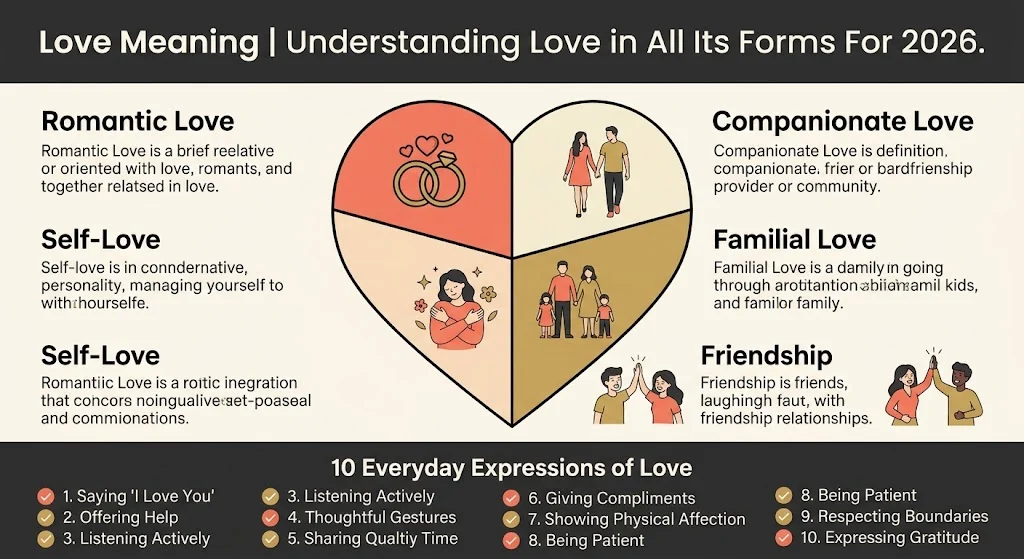
Love is a complex emotion involving affection, care, and attachment. Psychology defines it through intimacy, passion, and commitment, which combine to create different types of love, including romantic, companionate, and compassionate love.
What is love meaning? It is the question behind countless songs, poems, and late-night conversations. It is the word we use for our partners, our children, our parents, our closest friends, and sometimes our favorite places and pets. We say it easily, yet defining it feels almost impossible.
Love meaning has fascinated philosophers for thousands of years. Plato and Aristotle debated its nature. The ancient Greeks needed multiple words to capture what English squeezes into one. Modern psychologists have spent decades studying how love forms, how it changes, and why it matters so deeply for human well-being.
This guide explores love meaning from several angles. It examines psychological definitions, ancient philosophical categories, practical signs of love in daily life, and honest advice for recognizing and expressing love. Whether you are trying to understand a current relationship or simply curious about one of humanity’s oldest questions, this exploration offers clarity without oversimplification.
What Is Love: Psychological and Philosophical Definitions
Love resists a single definition because it operates on multiple levels. A parent’s love for a child differs from a partner’s romantic love, which differs again from the love between lifelong friends. Scholars have approached this complexity from different directions.
Psychologist Robert Sternberg proposed the triangular theory of love, identifying three core components: intimacy, passion, and commitment . Intimacy involves emotional closeness and trust. Passion refers to physical attraction and romantic excitement. Commitment is the decision to maintain the relationship over time. Different combinations of these three create distinct love types, from infatuation (passion alone) to companionate love (intimacy and commitment without passion).
Earlier, psychologist Zick Rubin identified three elements of romantic love: intimacy, need or attachment, and caring . His work helped establish love as a legitimate subject of scientific study.
Ancient Greek philosophy offered its own framework. Plato emphasized eros as passionate desire for beauty and truth, while Aristotle focused on philia as friendship built on shared virtue and goodwill . The Greeks also recognized storge (familial affection) and agape (selfless, giving love). These categories remain useful for understanding the different ways love manifests in human life.
10 Ways Love Shows Up in Everyday Life
1. Choosing to Stay Through Difficulty
Love meaning becomes clearest not during easy times but during hard ones. Staying present when a partner is ill, when finances are tight, or when grief arrives is one of the most direct expressions of love. This kind of commitment reflects the “commitment” component of Sternberg’s model. It is a decision made repeatedly, not a feeling that happens once.
Similar expressions: loyalty, devotion, steadfastness, fidelity, constancy
Why it matters today: In a culture that celebrates newness and instant gratification, deliberate commitment stands out as a quiet but powerful form of love.
2. Listening Without Trying to Fix
True listening is an act of love. It means giving someone your full attention, hearing what they actually say, and resisting the urge to immediately offer solutions or judgments. The philosopher J. David Velleman described love as a special kind of paying attention that celebrates a person’s individuality .
Similar expressions: attentiveness, presence, understanding, empathy, receptivity
Why it matters today: Most people feel unheard. Genuine listening is rare and deeply healing.
3. Showing Up Consistently
Love is not a grand gesture performed once. It is the accumulation of small, reliable acts: remembering a favorite meal, checking in after a difficult meeting, being where you said you would be. Consistency builds the trust that love depends on.
Similar expressions: reliability, dependability, faithfulness, steadiness, trustworthiness
Why it matters today: Consistency is quieter than romance but more foundational. It is how love becomes a safe place to rest.
4. Supporting Another Person’s Growth
Aristotle believed that the best friendships, and by extension the best loves, involve people who admire one another and help each other become their best selves . Love that stifles growth is not love at its fullest. Real love wants the other person to flourish, even if that growth means change.
Similar expressions: encouragement, mentorship, advocacy, nurturing, empowerment
Why it matters today: Many people confuse control with care. Supporting growth requires releasing the need to shape someone into what you want.
5. Being Honest Even When It Is Hard
Honesty is a form of respect. Love that cannot speak truth is fragile. This does not mean brutal bluntness. It means caring enough about the relationship to address problems directly rather than letting resentment build. The Episcopal Church’s teaching on agape love emphasizes that real love sometimes requires setting boundaries and refusing to enable harm .
Similar expressions: candor, integrity, transparency, directness, trust
Why it matters today: Avoidance feels safer in the short term but erodes connection over time. Honest love endures.
6. Practicing Physical Affection
For many people, physical touch is a primary way love is felt and expressed. Holding hands, hugging, sitting close, or a hand on the shoulder communicate care in ways words cannot. Physical affection releases oxytocin, a hormone associated with bonding and trust.
Similar expressions: warmth, tenderness, closeness, intimacy, embrace
Why it matters today: In digital lives, physical presence and touch are increasingly precious. They ground love in the body.
7. Remembering the Small Things
Remembering that someone takes their coffee a certain way, that they had a difficult meeting scheduled, or that they mentioned wanting to read a particular book is a quiet form of attention. It says: I was listening. I remembered. You matter to me.
Similar expressions: thoughtfulness, attentiveness, consideration, mindfulness, care
Why it matters today: Small acts of remembering build a web of connection that sustains relationships through larger challenges.
8. Making Time
Time is finite. Choosing to spend it with someone is a concrete declaration of priority. Quality time does not require expensive activities. It requires presence. Putting down the phone, sitting together without distraction, and being fully there is one of the most valuable gifts love can offer.
Similar expressions: prioritization, presence, availability, attention, dedication
Why it matters today: Attention is increasingly fragmented. Deliberate, undistracted time together is a powerful statement of value.
9. Forgiving Without Erasing
Forgiveness is not pretending harm did not happen. It is choosing not to let past hurt define the future. This kind of love requires honesty about what went wrong and a willingness to move forward without weaponizing old wounds. It is difficult and often imperfect.
Similar expressions: grace, mercy, reconciliation, acceptance, release
Why it matters today: Holding grudges is easy. Forgiveness requires strength and a commitment to the relationship’s future over its past.
10. Loving Yourself First
The Christian tradition teaches “love your neighbor as yourself,” implying that self-love is a baseline, not a luxury . Psychology agrees. People who cannot extend basic care and compassion to themselves struggle to offer healthy love to others. Self-love is not selfishness. It is the foundation from which generous love flows.
Similar expressions: self-respect, self-care, self-compassion, acceptance, worthiness
Why it matters today: Burnout and self-criticism are common. Learning to treat yourself with the same kindness you offer others is essential for sustainable love.
Quick Comparison Table
| Expression of Love | Core Meaning | Style | Best For | Vibe |
|---|---|---|---|---|
| Staying through difficulty | Commitment | Steady, loyal | Long-term relationships | Grounded |
| Listening without fixing | Attention | Patient, present | Emotional support | Calm |
| Showing up consistently | Reliability | Quiet, faithful | Building trust | Safe |
| Supporting growth | Encouragement | Generous, freeing | Partners and children | Expansive |
| Honest communication | Respect | Direct, caring | Healthy conflict | Clear |
| Physical affection | Connection | Warm, embodied | Romantic and familial bonds | Tender |
| Remembering small things | Thoughtfulness | Observant, kind | Everyday care | Attentive |
| Making time | Priority | Deliberate, present | All relationships | Valued |
| Forgiving without erasing | Grace | Strong, honest | Repairing connection | Healing |
| Self-love | Foundation | Compassionate, necessary | Personal well-being | Whole |
How to Recognize Love in Your Life
Love meaning becomes clearer when you examine how it operates in your actual relationships. Consider these questions:
Does this person’s well-being matter to you beyond what they do for you? Love includes genuine care for the other person’s happiness and safety, independent of personal benefit.
Can you be honest with them about difficult things? Love that cannot hold truth is incomplete. If you fear being honest, the relationship may lack the safety love requires.
Do you feel more yourself around them, or less? Healthy love supports individuality. It does not require shrinking or performing.
Are they consistent? Love shows up. It does not appear only when convenient or when they need something.
Can you disagree without fear? Conflict is inevitable. Love does not eliminate disagreement but provides a context where it can be navigated without threat.
Do you support each other’s growth? Love that limits growth is not love at its fullest. Ask whether you both encourage each other to become more fully yourselves.
Is there reciprocity? Love does not require perfect equality at every moment. But over time, healthy love involves mutual giving and receiving, not one person consistently draining the other.
Classic and Modern Understandings of Love
Ancient Greek philosophy divided love into distinct categories. Eros described passionate desire. Philia referred to friendship and shared virtue. Storge meant familial affection. Agape represented selfless, unconditional love, later central to Christian theology . These categories remain useful today for distinguishing the different kinds of love we experience.
Modern psychology has built on these foundations. Sternberg’s triangular theory and Hatfield’s distinction between passionate and companionate love offer frameworks for understanding how love evolves . Research shows that companionate love, characterized by deep affection and trust, often becomes more central to relationship satisfaction over time, while the intensity of passionate love naturally decreases.
Contemporary thinkers add another dimension. Philosopher Erich Fromm argued that love is not primarily a feeling but a practice, a skill that requires patience, discipline, and active attention . This view aligns with the everyday expressions listed above. Love meaning, from this perspective, is found not in what you feel but in what you do.
Query Fan-Out
1. What is the true meaning of love?
True love involves a deep, lasting bond built on care, respect, and commitment. It goes beyond initial attraction and involves choosing to support another person through change and difficulty, not just experiencing strong feelings.
2. What are the different types of love?
Psychology distinguishes romantic love (passion plus intimacy), companionate love (intimacy plus commitment), and compassionate love (caregiving). The ancient Greeks identified eros, philia, storge, and agape, each describing distinct forms of affection and attachment.
3. Is love a feeling or a choice?
Love begins as a feeling but develops into a choice. Philosophers and psychologists agree that while attraction may be involuntary, maintaining love requires deliberate action, attention, and commitment over time .
4. What are the signs of true love?
Signs include genuine care for the other person’s well-being, willingness to compromise, comfort in silence together, honest communication, and supporting each other’s growth without expecting something in return.
5. How does psychology define love?
Psychologist Robert Sternberg’s triangular theory defines love through three components: intimacy (emotional closeness), passion (physical attraction), and commitment (decision to stay). Different combinations create distinct love types .
6. What is unconditional love?
Unconditional love means caring for someone without conditions or expectations of return. It does not mean accepting harmful behavior. Healthy unconditional love includes boundaries and honest concern for the other person’s well-being.
7. What are the five love languages?
Gary Chapman’s five love languages are words of affirmation, quality time, receiving gifts, acts of service, and physical touch. Understanding your partner’s preferred language helps express care effectively.
8. How does love change over time?
Love often shifts from passionate to companionate over time. Early intensity may fade, but deeper trust, shared history, and mutual support replace it. This transition is normal and can strengthen relationships
FAQ
1. What is the true meaning of love?
True love involves a deep bond built on care, respect, and commitment. It goes beyond initial attraction and includes choosing to support another person through change and difficulty. Love is both a feeling and a practice that requires ongoing attention and effort.
2. What are the different types of love?
Psychology distinguishes romantic love (passion plus intimacy), companionate love (intimacy plus commitment), and compassionate love (caregiving). The ancient Greeks identified eros, philia, storge, and agape, each describing distinct forms of affection and attachment.
3. Is love a feeling or a choice?
Love begins as a feeling but develops into a choice. Philosophers and psychologists agree that while attraction may be involuntary, maintaining love requires deliberate action, attention, and commitment over time .
4. What are the signs of true love?
Signs include genuine care for the other person’s well-being, willingness to compromise, comfort in silence together, honest communication, and supporting each other’s growth without expecting something in return.
5. How does psychology define love?
Psychologist Robert Sternberg’s triangular theory defines love through three components: intimacy (emotional closeness), passion (physical attraction), and commitment (decision to stay). Different combinations create distinct love types .
6. What is unconditional love?
Unconditional love means caring for someone without conditions or expectations of return. It does not mean accepting harmful behavior. Healthy unconditional love includes boundaries and honest concern for the other person’s well-being.
7. What are the five love languages?
Gary Chapman’s five love languages are words of affirmation, quality time, receiving gifts, acts of service, and physical touch. Understanding your partner’s preferred language helps express care effectively.
8. How does love change over time?
Love often shifts from passionate to companionate over time. Early intensity may fade, but deeper trust, shared history, and mutual support replace it. This transition is normal and can strengthen relationships.
Conclusion
Love meaning is not a single answer but a landscape of possibilities. It is the passion that draws two people together and the commitment that keeps them there. It is the quiet attention of listening, the steadiness of showing up, and the courage of honesty. Psychology offers frameworks for understanding it, philosophy offers categories for distinguishing it, and everyday life offers countless opportunities to practice it.
- The ancient Greeks knew that one word could not hold all that love contains. They gave us eros, philia, storge, and agape. Modern psychology gives us intimacy, passion, and commitment. Together, they remind us that love meaning is both simple and endlessly complex. It is a feeling and a choice. It is given and received. It is the foundation of our closest relationships and, at its best, a practice that makes us more fully human.
