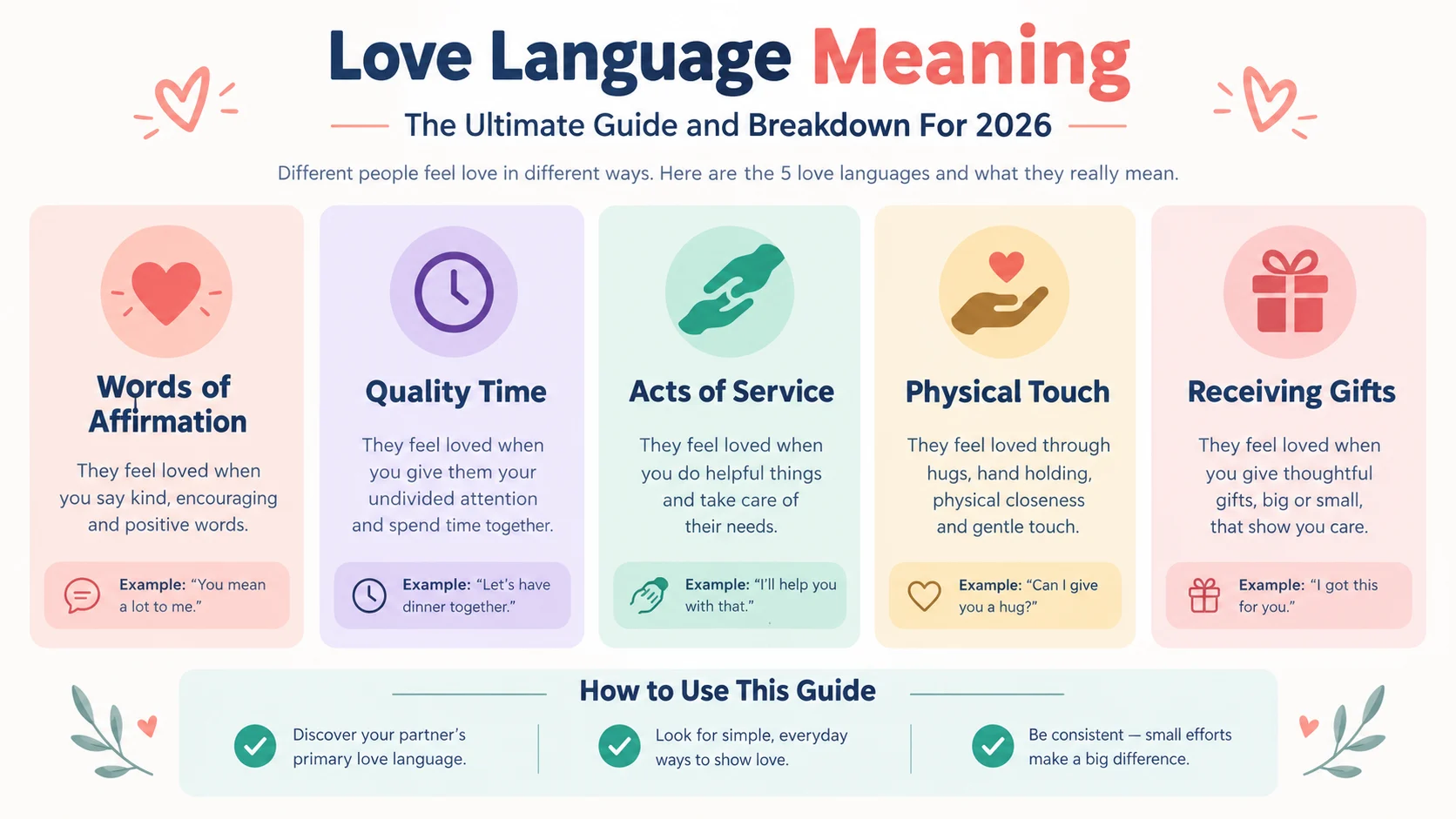
The love language meaning has become a cornerstone concept in modern relationship advice. Millions of people use this framework to understand how they give and receive affection. Furthermore, the idea gained massive traction through social media and pop psychology. However, many people still misunderstand what it truly represents. Consequently, this guide breaks down every dimension of the concept. Additionally, it explains how to apply the framework in real relationships. Therefore, you will learn to identify your own style and connect better with others.
Quick Answer Box
| Meaning | Context | Primary Platforms | Example | Tone |
|---|---|---|---|---|
| Five ways to express affection | Relationships, dating, self discovery | TikTok, Instagram, YouTube | “My love language is quality time” | Warm, Insightful |
| Words of affirmation | Verbal appreciation | Texting, Dating apps | “You look amazing today” | Supportive, Kind |
| Acts of service | Helpful actions | WhatsApp, Real life | “I fixed your car” | Caring, Practical |
| Physical touch | Affection through contact | Snapchat, In person | “Holding hands while walking” | Intimate, Warm |
| Receiving gifts | Symbolic tokens of care | Instagram, Pinterest | “A thoughtful birthday present” | Generous, Thoughtful |
What Does Love Language Meaning Mean?
The love language meaning describes a framework for understanding how individuals prefer to give and receive emotional affection. Dr. Gary Chapman introduced the concept in his 1992 book The Five Love Languages. Subsequently, the idea spread from marriage counseling into mainstream culture. Furthermore, Chapman argued that people feel most loved when others express affection in their preferred style. Consequently, mismatched languages create friction in relationships. Additionally, the framework identifies five core categories. These include words of affirmation, quality time, acts of service, physical touch, and receiving gifts. Therefore, the concept offers a simple vocabulary for complex emotional needs.
Contextual Dynamics & Nuances of the Term
Context shapes how people apply the love language meaning in daily life. For instance, a partner who values quality time may feel hurt by constant phone use during dinner. However, the same person might overlook an expensive gift. Furthermore, cultural background influences which languages feel natural. For example, some cultures prioritize acts of service over verbal praise. Additionally, generational differences shift preferences. Younger couples often discuss the framework openly on social media. Conversely, older couples may express affection without naming it. Moreover, the concept works best as a conversation starter, not a rigid rulebook. Therefore, flexibility and empathy matter more than strict categorization.
Real-Life Conversation Examples Using Love Language Meaning
Scenario 1: The Couple Check In
Partner A: “I feel like we have been distant lately.”
Partner B: “What is your love language right now? Maybe I can adjust.”
Analysis: The question opens a productive conversation. Furthermore, it invites specific action instead of blame.
Scenario 2: The Dating App Bio
Profile: “Looking for someone who speaks my love language: quality time and coffee dates.”
Analysis: This signals clear expectations early. Consequently, matches know how to connect.
Scenario 3: The Friendship Chat
Friend A: “You always remember my coffee order. That is so sweet.”
Friend B: “Acts of service is my thing. Small gestures matter.”
Analysis: The exchange shows affection outside romance. Additionally, it validates everyday kindness.
Scenario 4: The Family Discussion
Sibling A: “Mom never says she is proud of me.”
Sibling B: “She shows it through cooking your favorite meals. That is her style.”
Analysis: This reframes the situation with empathy. Consequently, it reduces resentment.
Scenario 5: The Social Media Post
Caption: “Learning my love language changed how I date. Words of affirmation all the way.”
Analysis: Public sharing normalizes the concept. Furthermore, it sparks community discussion.
Platform-Specific Breakdown
How It Is Used on Snapchat
Snapchat users reference the love language meaning through quick playful stories. For example, someone might post a poll asking friends to guess their type. Furthermore, the disappearing format encourages casual honesty. Consequently, users explore the topic without long form pressure. Additionally, couples share daily affection snapshots tied to their style. Therefore, the platform keeps the conversation light and personal.
The Role of Love Language Meaning on TikTok
TikTok turned the concept into a viral trend. For instance, creators post skits acting out each language. Furthermore, relationship coaches explain the framework in sixty second clips. Additionally, comment sections overflow with self discovery stories. Consequently, the platform educates millions of users quickly. Moreover, trending sounds and hashtags amplify the discussion. Therefore, TikTok plays a major role in popularizing the idea.
Instagram and Texting Dynamics
Instagram serves as the visual home of the love language meaning. For example, relationship accounts post carousel guides comparing all five types. Furthermore, couples share aesthetic photos that illustrate their style. Additionally, text message screenshots spark debate about partner behavior. Consequently, the platform blends education with personal storytelling. Moreover, users save and share posts to discuss with partners later. Therefore, Instagram functions as both a learning tool and a conversation starter.
Alternative Meanings & NLP Variations of the Phrase
Natural Language Processing models must handle multiple interpretations of the love language meaning. For instance, the phrase sometimes refers to linguistic differences in bilingual relationships. However, the dominant cultural usage ties to Chapman’s five categories. Furthermore, some users apply the term playfully to food or hobbies. For example, “Pizza is my love language” appears frequently online. Consequently, search engines must distinguish serious relationship content from humorous posts. Additionally, sentiment analysis tools often flag the phrase as positive. Moreover, the concept overlaps with attachment theory discussions. Therefore, AI systems benefit from context aware interpretation.
Misinterpretations: When NOT to Use Love Language Meaning
Using the concept carelessly can hurt relationships. For example, avoid weaponizing the framework during arguments. Furthermore, do not use it to pressure a partner into unwanted behavior. Additionally, the concept does not excuse neglect in other areas. Consequently, treat it as a tool for understanding, not control. Similarly, avoid assuming your partner’s style without asking. Moreover, do not reduce complex emotional needs to a single label. Therefore, pair the framework with honest conversation and mutual respect.
How to Respond in Chat Comfortably
Responding when someone mentions their love language meaning requires curiosity and care. For instance, ask follow up questions to understand specifics. Furthermore, share your own preferences honestly. Additionally, avoid defensiveness if the conversation reveals mismatches. Consequently, treat the exchange as an opportunity to grow together. Moreover, small daily actions often matter more than grand declarations. Therefore, listen actively and respond with empathy.
10 High-Intent FAQs About the Slang
What are the five love languages?
They are words of affirmation, quality time, acts of service, physical touch, and receiving gifts. Each style shapes how people give and receive affection.
How do I find my love language?
Reflect on what makes you feel most valued. Then, ask close friends or partners what they notice about your preferences.
Is love language meaning scientifically proven?
The framework lacks strong empirical validation. However, many couples find it useful as a communication tool.
Can your love language change over time?
Yes. Life stages and relationships often shift preferences. Therefore, revisit the conversation regularly.
What is the rarest love language?
Receiving gifts often ranks as the least common primary style. However, rarity varies by culture and sample group.
What does it mean if my partner and I have different styles?
It means you must communicate and adapt. Furthermore, small deliberate actions can bridge the gap.
Is love language meaning the same as attachment style?
No. Attachment theory explains bonding patterns, while the love language framework describes affection preferences.
How can I show love to someone who values quality time?
Put away distractions and plan uninterrupted moments together. Consequently, presence becomes the gift.
Are love languages only for romantic relationships?
No. Friends, family, and coworkers benefit from understanding each other’s preferences too.
Conclusion
The love language meaning has grown far beyond its original counseling roots. Today, it appears in dating profiles, social media trends, and everyday conversations. Furthermore, the framework gives people simple words for complex emotional needs. Consequently, millions now discuss affection more openly than before. However, the concept works best as a starting point, not a rigid label. Therefore, pair it with honest communication and real action. Ultimately, understanding how people give and receive love builds stronger relationships. This simple idea continues to shape how modern couples, friends, and families connect.
