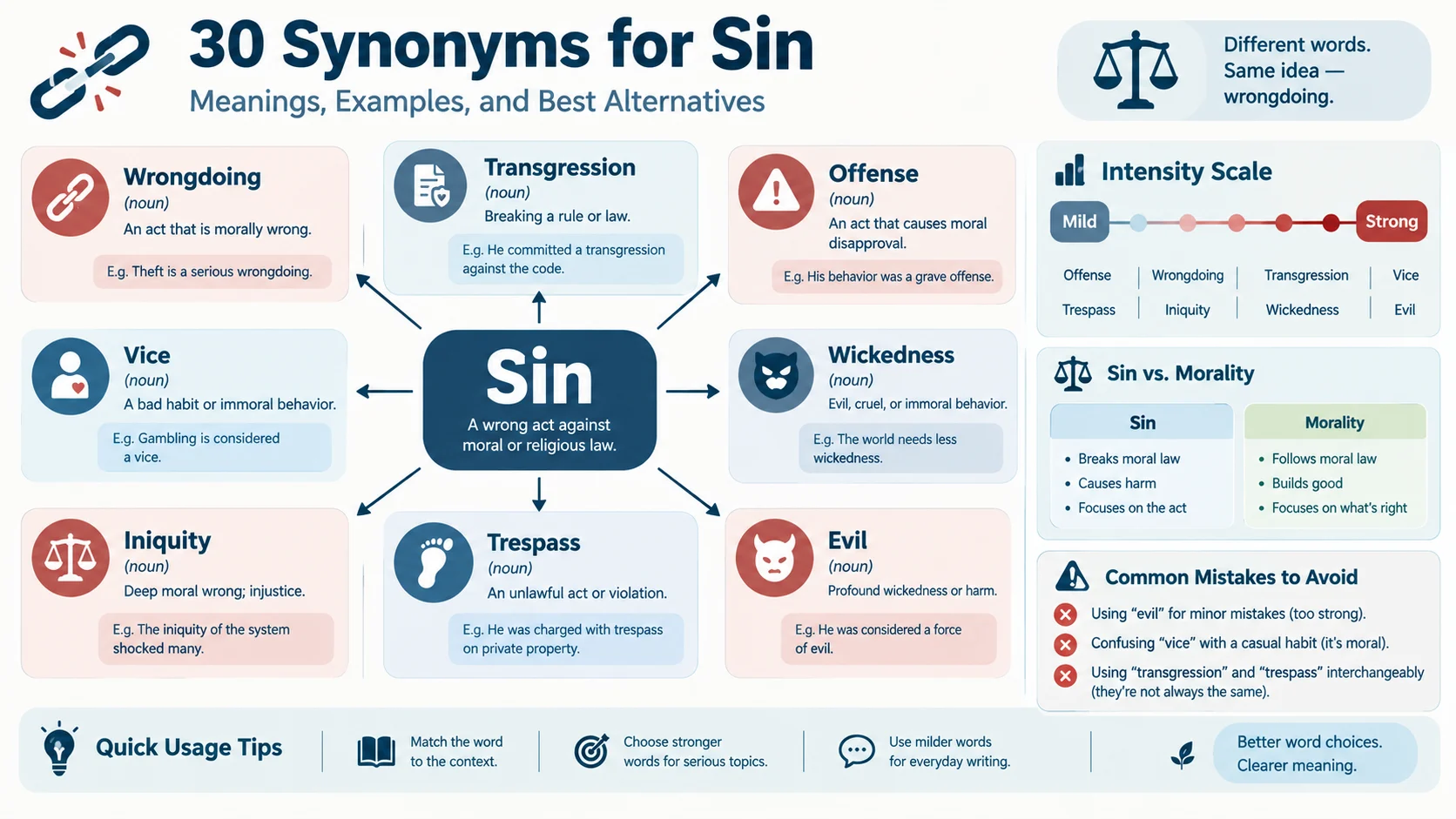
Sin means an act that breaks a moral or religious law. The best synonym depends on context: use wrongdoing for general moral issues, transgression for religious or formal writing, and offense for legal or everyday situations.Top 10 Synonyms:
- Wrongdoing
- Transgression
- Offense
- Misdeed
- Immorality
- Vice
- Wickedness
- Iniquity
- Trespass
- Evil
Every synonym carries a slightly different weight, tone, or context. Choosing carefully makes your writing more precise and powerful.
Have you ever been writing about morality, religion, or human behavior and found yourself stuck on the word “sin”?
You are not alone. This small but powerful word appears everywhere, from religious texts to everyday conversations about ethics and mistakes. But repeating it too often weakens your writing and makes it sound flat.
Imagine you are writing an essay about moral failure in literature. Or you are discussing a character’s wrongdoing in a novel. Or you are having a thoughtful conversation about right and wrong with a friend. Each situation calls for a different synonym.
This guide will teach you exactly which synonym for sin to use in every context. You will learn the subtle differences between wrongdoing, transgression, offense, vice, and many other powerful alternatives. By the end, you will never struggle to find the right word again.
What Does “Sin” Mean?
Definition
Sin refers to any action, thought, or behavior that goes against moral, ethical, or religious principles. In religious contexts, sin is often seen as a violation of divine law. In everyday use, it describes something considered morally wrong or deeply unacceptable.
The word carries strong moral weight. It suggests not just a mistake, but a deliberate choice that harms yourself, others, or your relationship with a higher power. That is why sin feels heavier than words like “error” or “mistake.”
Understanding this weight is the key to choosing the right synonym. Some alternatives soften the meaning. Others make it even stronger.
Pronunciation
US IPA: /sɪn/
UK IPA: /sɪn/
Syllables: 1
Tip: The word rhymes with “win” and “bin.” Keep the vowel short. Do not stretch it into “seen.”
Grammar
| Grammar Feature | Information |
|---|---|
| Part of Speech | Noun (countable and uncountable), also a verb |
| Common Position | Subject, object, or object of a preposition |
| Typical Pattern | Commit a sin OR sin against someone |
Example sentences:
- “Pride is often considered a serious sin in many religious traditions.”
- “He felt he had sinned against his own values.”
- “They confessed their sins and sought forgiveness.”
Grammar note: As a noun, sin can be countable (“a sin,” “many sins”) or uncountable (“the concept of sin”). As a verb, it is usually intransitive and means to commit a sin.
Word Family
| Word | Part of Speech | Meaning |
|---|---|---|
| Sin | Noun | An act that breaks moral or religious law |
| Sin | Verb | To commit a sin |
| Sinner | Noun | A person who commits sins |
| Sinful | Adjective | Full of sin or morally wrong |
| Sinfully | Adverb | In a sinful manner |
| Sinfulness | Noun | The state of being sinful |
| Sinless | Adjective | Free from sin |
12 Synonyms of “Sin”
Wrongdoing
Meaning: Any action that is morally or legally wrong.
Best Used For: General moral discussions, legal writing, professional contexts.
Formality: Neutral
Tone: Neutral, Serious
Frequency: ⭐⭐⭐⭐ Common
CEFR Level: B2
Example Sentence 1: “The investigation uncovered serious wrongdoing within the organization.”
Example Sentence 2: “She refused to participate in any wrongdoing, even when pressured.”
Usage Tip: Wrongdoing is the safest and most versatile synonym for sin in non-religious contexts. It works in legal, professional, and everyday writing. Native speakers often prefer it when they want to sound serious without sounding preachy.
Transgression
Meaning: An act that breaks a rule, law, or moral code.
Best Used For: Formal writing, religious texts, academic discussions, literature.
Formality: Formal
Tone: Serious, Academic
Frequency: ⭐⭐⭐ Moderate
CEFR Level: C1
Example Sentence 1: “His transgression against community norms shocked everyone who knew him.”
Example Sentence 2: “The novel explores the consequences of a single moral transgression.”
Usage Tip: Transgression sounds more formal and literary than sin. It is excellent for essays and religious writing. Avoid it in casual conversation, where it can sound overly dramatic or academic.
Offense
Meaning: A breach of law or a morally wrong act.
Best Used For: Legal contexts, everyday situations, sports, and general writing.
Formality: Neutral
Tone: Neutral, Factual
Frequency: ⭐⭐⭐⭐⭐ Very Common
CEFR Level: B1
Example Sentence 1: “Lying to a friend is a minor offense compared to betrayal.”
Example Sentence 2: “The player was penalized for a serious offense during the match.”
Usage Tip: Offense is broader than sin and works in both legal and personal contexts. It is a good choice when you want to sound factual rather than moralizing. Note that British English often spells it “offence.”
Misdeed
Meaning: A wrong or wicked act.
Best Used For: Storytelling, moral discussions, formal writing, journalism.
Formality: Formal
Tone: Serious, Literary
Frequency: ⭐⭐⭐ Moderate
CEFR Level: B2
Example Sentence 1: “The politician’s misdeeds eventually came to light.”
Example Sentence 2: “She regretted her youthful misdeeds and worked hard to change.”
Usage Tip: Misdeed is a strong, slightly old-fashioned word that carries moral weight. It works well in storytelling and news writing. In casual conversation, it can sound a bit formal or dramatic.
Immorality
Meaning: Behavior that goes against accepted moral standards.
Best Used For: Academic writing, philosophy, religious discussions, formal essays.
Formality: Formal
Tone: Serious, Moralistic
Frequency: ⭐⭐⭐ Moderate
CEFR Level: C1
Example Sentence 1: “The philosopher argued that immorality harms both the individual and society.”
Example Sentence 2: “The novel depicts the immorality of a corrupt ruling class.”
Usage Tip: Immorality refers to the broader concept of moral wrongness, not a single act. Use it when discussing themes and ideas rather than specific actions. It can sound judgmental, so use it carefully in neutral writing.
Vice
Meaning: A moral weakness or bad habit.
Best Used For: Moral discussions, character descriptions, literature, casual writing.
Formality: Neutral
Tone: Negative, Casual
Frequency: ⭐⭐⭐⭐ Common
CEFR Level: B2
Example Sentence 1: “Gambling was his greatest vice, and it cost him everything.”
Example Sentence 2: “The seven deadly vices appear throughout medieval literature.”
Usage Tip: Vice often refers to a habit or character flaw rather than a single act. It is closely tied to the idea of temptation. Native speakers use it to describe personal weaknesses, like a love of sweets or shopping.
Wickedness
Meaning: The quality of being morally evil or deeply wrong.
Best Used For: Religious writing, literature, dramatic storytelling, formal speeches.
Formality: Formal
Tone: Strong, Emotional, Moralistic
Frequency: ⭐⭐⭐ Moderate
CEFR Level: B2
Example Sentence 1: “The tale contrasts the wickedness of the villain with the goodness of the hero.”
Example Sentence 2: “He was shocked by the sheer wickedness of the crime.”
Usage Tip: Wickedness is a powerful word that describes extreme moral evil. Use it when you want to emphasize the depth of wrongdoing. It can sound old-fashioned or biblical, so it fits religious and literary writing best.
Iniquity
Meaning: Gross injustice or wickedness.
Best Used For: Religious texts, formal writing, literature, speeches.
Formality: Formal
Tone: Strong, Literary, Biblical
Frequency: ⭐⭐ Rare
CEFR Level: C1
Example Sentence 1: “The prophet spoke out against the iniquity of the ruling class.”
Example Sentence 2: “Generations suffered because of the iniquity of their leaders.”
Usage Tip: Iniquity is a rare, powerful word with strong biblical and literary roots. Use it in formal or religious writing when you want to emphasize deep injustice. Avoid it in casual conversation.
Trespass
Meaning: An act of entering without permission or breaking a moral boundary.
Best Used For: Religious writing, legal contexts, formal apologies.
Formality: Formal
Tone: Serious, Religious
Frequency: ⭐⭐⭐ Moderate
CEFR Level: B2
Example Sentence 1: “Forgive us our trespasses, as we forgive those who trespass against us.”
Example Sentence 2: “The company sued the neighbor for trespass on private property.”
Usage Tip: Trespass works in both religious and legal contexts. In religion, it means a moral or spiritual violation. In law, it refers to entering someone’s property without permission. Keep the context clear to avoid confusion.
Evil
Meaning: Profound immorality or something that causes great harm.
Best Used For: Storytelling, philosophy, religious writing, dramatic discussions.
Formality: Neutral
Tone: Strong, Emotional
Frequency: ⭐⭐⭐⭐⭐ Very Common
CEFR Level: B1
Example Sentence 1: “The story explores the battle between good and evil.”
Example Sentence 2: “He believed that true evil exists in the world.”
Usage Tip: Evil is broader than sin. It refers to a force, idea, or quality rather than a single act. Use it when discussing large moral themes. Native speakers use it in both serious and casual contexts.
Infraction
Meaning: A minor violation of a rule or law.
Best Used For: Legal writing, business contexts, sports, formal reports.
Formality: Formal
Tone: Neutral, Factual
Frequency: ⭐⭐⭐ Moderate
CEFR Level: B2
Example Sentence 1: “The referee called an infraction that changed the game’s outcome.”
Example Sentence 2: “Parking in a no-parking zone is a minor infraction.”
Usage Tip: Infraction is much softer than sin. It refers to breaking rules, not moral laws. Use it in legal, professional, or sports contexts. Never use it for deep moral wrongdoing.
Indiscretion
Meaning: A careless act that shows poor judgment.
Best Used For: Formal writing, journalism, polite discussions of mistakes.
Formality: Formal
Tone: Soft, Polite
Frequency: ⭐⭐⭐ Moderate
CEFR Level: C1
Example Sentence 1: “The minister resigned after a personal indiscretion became public.”
Example Sentence 2: “She dismissed her comment as a youthful indiscretion.”
Usage Tip: Indiscretion is a gentle, polite way to describe a moral lapse. It softens the judgment compared to sin. It is perfect for formal writing when you want to discuss mistakes without sounding harsh or moralistic.
Synonyms Comparison Table
| Synonym | Best Context | Formality | Tone | Frequency |
|---|---|---|---|---|
| Wrongdoing | General moral discussions | Neutral | Serious | ⭐⭐⭐⭐ |
| Transgression | Formal, religious, academic | Formal | Academic | ⭐⭐⭐ |
| Offense | Legal and everyday | Neutral | Factual | ⭐⭐⭐⭐⭐ |
| Misdeed | Storytelling, journalism | Formal | Literary | ⭐⭐⭐ |
| Immorality | Philosophy, religion | Formal | Moralistic | ⭐⭐⭐ |
| Vice | Character flaws, habits | Neutral | Casual | ⭐⭐⭐⭐ |
| Wickedness | Religious, literary | Formal | Strong | ⭐⭐⭐ |
| Iniquity | Religious, literary | Formal | Biblical | ⭐⭐ |
| Trespass | Religious, legal | Formal | Serious | ⭐⭐⭐ |
| Evil | Storytelling, philosophy | Neutral | Strong | ⭐⭐⭐⭐⭐ |
| Infraction | Legal, sports, rules | Formal | Factual | ⭐⭐⭐ |
| Indiscretion | Polished, polite writing | Formal | Soft | ⭐⭐⭐ |
Best Synonyms by Situation
| Situation | Best Synonym | Why It Works |
|---|---|---|
| Daily Conversation | Wrongdoing or Mistake | Natural and easy to understand. |
| Business Email | Infraction or Violation | Sounds professional and factual. |
| Academic Writing | Transgression or Immorality | Demonstrates precision and depth. |
| School Assignment | Wrongdoing or Offense | Clear and appropriate for students. |
| Professional Meeting | Violation or Wrongdoing | Communicates seriousness without preaching. |
| Presentation | Wrongdoing or Misconduct | Audience-friendly and clear. |
| Creative Writing | Wickedness or Iniquity | Adds literary weight and drama. |
| Social Media | Vice or Bad Behavior | Casual and relatable. |
| Movie Review | Evil or Transgression | Captures moral themes in film. |
| Book Review | Immorality or Wickedness | Fits literary analysis perfectly. |
Formal vs Informal Synonyms
Formal Alternatives
| Synonym | Best Used For |
|---|---|
| Transgression | Academic and religious writing |
| Immorality | Philosophical discussions |
| Wickedness | Formal literary analysis |
| Iniquity | Religious texts and speeches |
| Trespass | Religious and legal documents |
| Indiscretion | Polished, polite journalism |
Neutral Alternatives
| Synonym | Best Used For |
|---|---|
| Wrongdoing | General moral discussions |
| Offense | Legal and everyday contexts |
| Vice | Personal character flaws |
| Evil | Storytelling and philosophy |
| Infraction | Rules and regulations |
Informal Alternatives
| Synonym | Best Used For |
|---|---|
| Bad behavior | Casual conversations |
| Screw-up | Very casual contexts |
| No-no | Playful or lighthearted talk |
Choosing the right level of formality: Match your word choice to your audience. Formal writing calls for transgression or iniquity. Everyday conversations are better served by wrongdoing or bad behavior. When in doubt, choose a neutral synonym like offense or wrongdoing.
Strong vs Mild Synonyms
Mild
These are gentle alternatives for small or everyday mistakes.
- Infraction
- Indiscretion
- Offense
Moderate
These carry real moral weight without sounding extreme.
- Wrongdoing
- Transgression
- Misdeed
- Vice
Strong
These are intense words for serious moral failure.
- Wickedness
- Iniquity
- Evil
How intensity changes meaning: Choosing a stronger synonym raises the emotional and moral stakes of your sentence. Calling a small mistake a “wickedness” sounds extreme. Calling a serious crime an “indiscretion” sounds too soft. Always match the intensity to the actual severity of the act.
Real-Life Examples
School Context:
“The teacher explained that cheating on a test is a serious transgression, not just a minor infraction.”
Office Context:
“HR investigated the wrongdoing and found that the employee had violated company policy.”
Business Email:
“We take any infraction of our code of conduct very seriously and will follow up accordingly.”
Professional Meeting:
“The team discussed how to prevent future misdeeds and improve internal controls.”
Presentation:
“Throughout history, societies have struggled to define and punish moral transgressions.”
Creative Writing:
“The village whispered about his wickedness, but no one dared to confront him directly.”
Daily Conversation:
“Eating the last slice of cake without asking is a minor sin in our house.”
Social Media:
“Ice cream at midnight is my favorite vice, and I refuse to apologize for it.”
Common Collocations
| Common Phrase | Better Alternative |
|---|---|
| Commit a sin | Commit a transgression, Commit a wrongdoing |
| Mortal sin | Serious transgression, Grave wrongdoing |
| Original sin | Inherited guilt, Foundational transgression |
| Sinful behavior | Immoral behavior, Wrongful conduct |
| Deadly sin | Grave vice, Cardinal transgression |
| Forgive a sin | Pardon a wrongdoing, Absolve a transgression |
| Confess a sin | Admit a wrongdoing, Acknowledge a transgression |
Common Phrases
A sin against nature
Meaning: Something deeply unnatural or morally wrong.
Stronger alternative: “A violation of natural law.”
Example: “Many considered the act a sin against nature.”
Live in sin
Meaning: An old-fashioned phrase for living together without being married.
Stronger alternative: “Cohabit.”
Example: “The phrase ‘living in sin’ is rarely used today.”
Cardinal sin
Meaning: A very serious mistake or moral failure.
Stronger alternative: “Grave error” or “Serious transgression.”
Example: “In journalism, plagiarism is considered a cardinal sin.”
Sin of omission
Meaning: Failing to do something you should have done.
Stronger alternative: “Negligence” or “Failure to act.”
Example: “Ignoring the problem was a sin of omission, not a direct action.”
Context Guide
| Situation | Best Synonym | Reason |
|---|---|---|
| Essay | Transgression | Formal and precise |
| Speech | Wrongdoing or Evil | Clear and impactful |
| Business Email | Infraction or Violation | Professional and factual |
| Novel | Wickedness or Iniquity | Literary and dramatic |
| Presentation | Wrongdoing or Misconduct | Audience-friendly |
| Conversation | Wrongdoing or Vice | Natural and relaxed |
| Academic Writing | Immorality or Transgression | Demonstrates precision |
| Marketing Copy | Vice or Guilty Pleasure | Relatable and modern |
Related Words
Near Synonyms
Offense, wrongdoing, misdeed, violation, fault, error
These words all describe actions that break rules or moral standards.
Antonyms
- Virtue
- Goodness
- Righteousness
- Piety
- Innocence
- Morality
Related Adjectives
- Sinful
- Immoral
- Wicked
- Evil
- Corrupt
- Unrighteous
Related Nouns
- Sinner
- Transgressor
- Wrongdoer
- Offender
- Guilt
- Repentance
Related Verbs
- Sin
- Transgress
- Offend
- Violate
- Repent
- Atone
Frequently Asked Questions
What is another word for sin?
The best synonym depends on context. Use wrongdoing for general moral issues, transgression for formal or religious writing, and offense for legal or everyday situations. Vice works well for personal weaknesses or bad habits.
Which synonym sounds most professional?
Wrongdoing and infraction sound most professional. Both are used in business, legal, and formal settings. They communicate seriousness without sounding overly religious or emotional.
What is the strongest synonym for sin?
Wickedness, iniquity, and evil are the strongest synonyms. They carry deep moral and emotional weight. Use them in literary, religious, or dramatic writing where the seriousness of the act demands powerful language.
Which synonym is best for essays?
Transgression and immorality work best in academic essays. Both sound formal and precise. They show that you understand the moral dimensions of the topic without sounding preachy.
What is the difference between sin and transgression?
Sin has strong religious meaning and refers to breaking divine law. Transgression is broader and more formal. It can refer to breaking any rule, law, or moral code, religious or not.
What is the opposite of sin?
The opposite of sin is virtue. Other opposites include goodness, righteousness, innocence, and morality. These words describe behavior that aligns with moral or ethical standards.
Conclusion
Sin is a heavy word with deep moral and religious meaning. It describes actions that break sacred or ethical laws, and it carries a weight that many other words do not.
The best synonym depends entirely on your context. Choose wrongdoing for everyday moral discussions. Choose transgression for formal or religious writing. Choose vice for personal weaknesses. Choose infraction for legal or rule-based situations. Choose wickedness or iniquity when you need to convey serious moral evil.
Paying attention to formality and intensity is just as important as meaning. A small mistake should not be called a “wickedness.” A serious moral failure should not be softened to an “indiscretion.” Matching your word to the weight of the act makes your writing trustworthy and precise.
The next time you reach for the word “sin,” pause and ask which synonym best fits your tone, audience, and purpose. That small habit will sharpen your writing and deepen your vocabulary.
