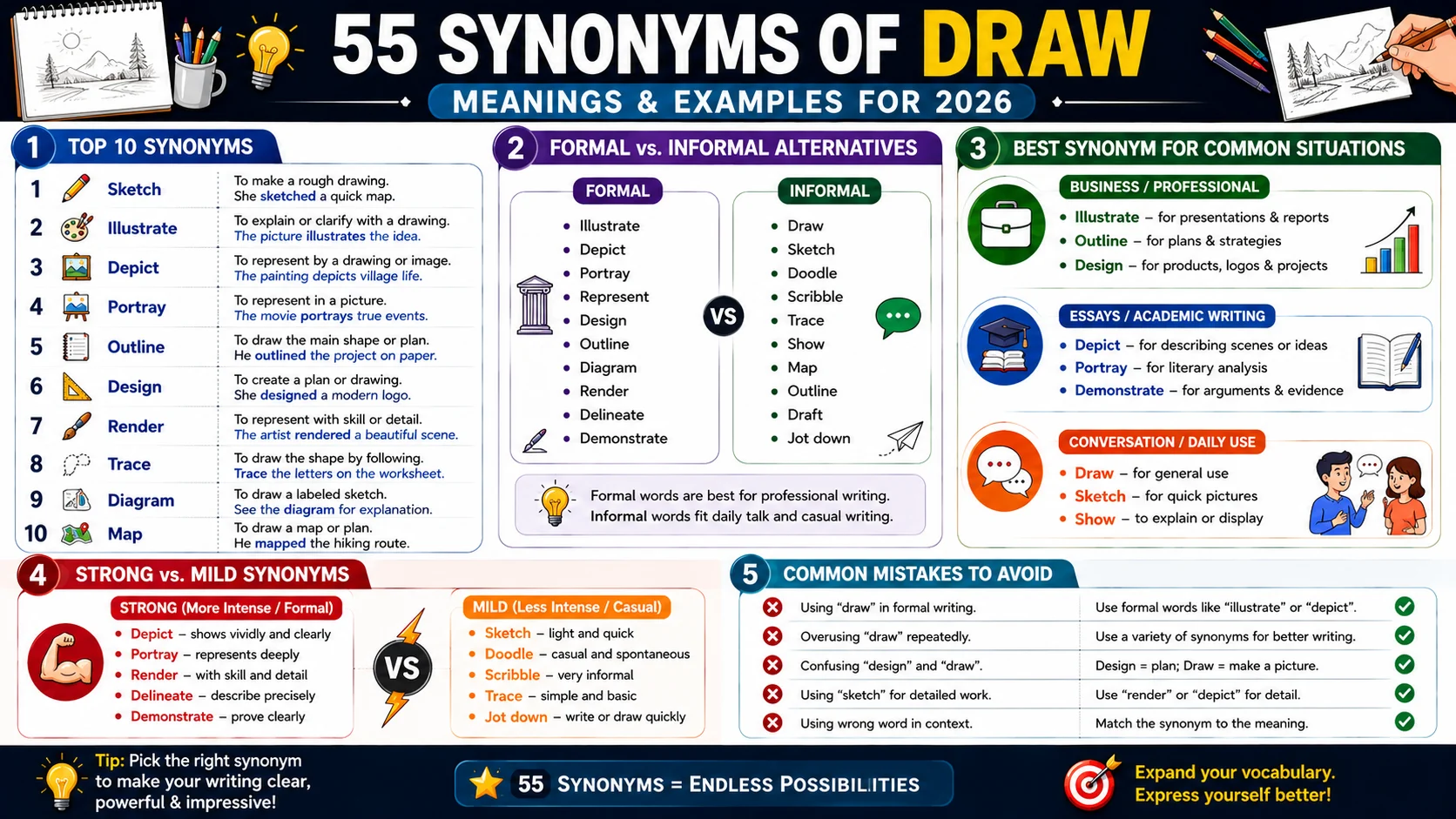
“Draw” has multiple meanings: to create a picture, to pull or attract, or to reach a conclusion. The best synonyms are sketch, attract, pull, depict, and derive. “Sketch” is the most common natural alternative for artistic drawing. Each synonym has a different meaning and context where it fits best.
Top 10 Synonyms
- Sketch
- Attract
- Pull
- Depict
- Derive
- Illustrate
- Outline
- Picture
- Portray
- Describe
“Draw” is one of the most versatile words in English. You can draw a picture, draw attention, draw a conclusion, or draw a curtain. It’s incredibly useful, but using it too often can make your English feel repetitive and imprecise.
Think about it. You can draw a portrait, draw in customers, draw a map, or draw a line. Each situation might need a different word that captures the specific type of drawing.
In this guide, you’ll learn 35 powerful synonyms for “draw.” You’ll discover exactly when to use each one, how formal they are, and what common mistakes to avoid. Let’s begin!
What Does “Draw” Mean?
Definition
Draw” has several related meanings. It can mean to make a picture with a pencil or pen. It can mean to pull something or someone toward you. It can mean to attract attention or interest. It can also mean to reach a conclusion or get something from a source. It’s a versatile word used in many contexts.
Pronunciation
| Feature | Value |
|---|---|
| US IPA | /drɔ/ |
| UK IPA | /drɔː/ |
| Syllables | 1 |
| Tip | Rhymes with “saw” and “law” |
Grammar
| Grammar Feature | Information |
|---|---|
| Part of Speech | Verb (and Noun) |
| Common Position | After the subject |
| Typical Pattern | Subject + draw + object + from/for/with |
Examples:
- “She draws beautiful portraits.” (artistic)
- “The store draws many customers.” (attract)
- “He drew a conclusion from the evidence.” (derive)
Grammar Note: “Draw” is an irregular verb. Past tense: drew. Past participle: drawn.
Word Family
| Word | Part of Speech | Meaning |
|---|---|---|
| Draw | Verb/Noun | To create a picture, pull, or derive |
| Drawing | Noun | A picture made with a pencil or pen |
| Drawn | Adjective | Tired-looking or pulled |
| Drawer | Noun | Someone who draws |
| Drawl | Noun/Verb | A slow way of speaking |
15 Synonyms of “Draw”
Sketch
Meaning: To make a quick, rough drawing.
Best Used For: Artistic drawing, quick outlines, planning.
Formality: Neutral
Tone: Creative, Quick
Frequency: ⭐⭐⭐⭐⭐ (Very Common)
CEFR Level: B1
Example Sentence 1: “She sketched the landscape in her notebook.”
Example Sentence 2: “He quickly sketched a plan for the project.”
Usage Tip: “Sketch” is the most direct synonym for drawing. Use it for quick, rough drawings.
Common Confusion: Sketch vs Draw. “Sketch” implies a quick, rough drawing. “Draw” can be more detailed or any type of drawing.
Attract
Meaning: To make people or things come to a place or pay attention.
Best Used For: Business, marketing, social situations.
Formality: Neutral
Tone: Appealing, Magnetic
Frequency: ⭐⭐⭐⭐⭐ (Very Common)
CEFR Level: B2
Example Sentence 1: “The new museum attracts many visitors.”
Example Sentence 2: “Her smile attracts attention wherever she goes.”
Usage Tip: “Attract” is about pulling people’s interest or attention. Use it for drawing in customers or attention.
Pull
Meaning: To move something toward yourself or in a particular direction.
Best Used For: Physical pulling, influence, attraction.
Formality: Neutral
Tone: Physical, Direct
Frequency: ⭐⭐⭐⭐⭐ (Very Common)
CEFR Level: A2
Example Sentence 1: “Pull the door to close it.”
Example Sentence 2: “The gravity of the planet pulls objects toward it.”
Usage Tip: “Pull” is the most direct synonym for the physical action of drawing something toward you.
Depict
Meaning: To show or represent something in a picture or description.
Best Used For: Art, literature, descriptions.
Formality: Formal
Tone: Artistic, Descriptive
Frequency: ⭐⭐⭐ (Moderate)
CEFR Level: B2
Example Sentence 1: “The painting depicts a beautiful sunset.
Example Sentence 2: “The book depicts life in the 1800s.”
Usage Tip: “Depict” is a formal word for showing something through art or words.
Derive
Meaning: To get something from a source.
Best Used For: Information, conclusions, benefits.
Formality: Formal
Tone: Analytical, Logical
Frequency: ⭐⭐⭐ (Moderate)
CEFR Level: B2
Example Sentence 1: “She derived great satisfaction from her work.”
Example Sentence 2: “The word derives from Latin.”
Usage Tip: “Derive” is about getting something from a source. Use it for conclusions or benefits.
Illustrate
Meaning: To explain or show with examples or pictures.
Best Used For: Books, presentations, explanations.
Formality: Formal
Tone: Explanatory, Clear
Frequency: ⭐⭐⭐⭐ (Common)
CEFR Level: B2
Example Sentence 1: “The book is illustrated with beautiful pictures.”
Example Sentence 2: “Her examples illustrate the point perfectly.”
Usage Tip: “Illustrate” emphasizes explaining or clarifying. Use it for adding pictures or examples.
Outline
Meaning: To give a general description or draw the outer edge of something.
Best Used For: Plans, summaries, drawing edges.
Formality: Neutral
Tone: General, Summary
Frequency: ⭐⭐⭐⭐ (Common)
CEFR Level: B2
Example Sentence 1: “He outlined the main points of his speech.
Example Sentence 2: “She outlined the shape of the flower.”
Usage Tip: “Outline” works for both drawing edges and summarizing plans.
Portray
Meaning: To show or describe someone or something in a particular way.
Best Used For: Characters, emotions, representations.
Formality: Neutral
Tone: Artistic, Descriptive
Frequency: ⭐⭐⭐⭐ (Common)
CEFR Level: B2
Example Sentence 1: “She portrayed the queen as a strong leader.”
Example Sentence 2: “The actor portrayed the role brilliantly.”
Usage Tip: “Portray” is about representing in a specific way. Use it for characters and images.
Describe
Meaning: To give a detailed account of something in words.
Best Used For: Experiences, people, places.
Formality: Neutral
Tone: Explanatory, Detailed
Frequency: ⭐⭐⭐⭐⭐ (Very Common)
CEFR Level: A2
Example Sentence 1: “She described her trip to Egypt in detail.”
Example Sentence 2: “Can you describe what the man looked like?”
Usage Tip: “Describe” is about creating a picture with words. Use it for detailed accounts.
Picture
Meaning: To imagine or show something in a certain way.
Best Used For: Imagining, visualizing, describing.
Formality: Informal
Tone: Visual, Imaginative
Frequency: ⭐⭐⭐⭐⭐ (Very Common)
CEFR Level: A2
Example Sentence 1: “Picture yourself on a sunny beach.”
Example Sentence 2: “The article pictures the city as vibrant and exciting.”
Usage Tip: “Picture” is informal and conversational. Use it for creating mental images.
Paint
Meaning: To create a picture using paint, or to describe vividly.
Best Used For: Artistic work, vivid descriptions.
Formality: Neutral
Tone: Vivid, Creative
Frequency: ⭐⭐⭐ (Moderate)
CEFR Level: B2
Example Sentence 1: “She paints beautiful landscapes.”
Example Sentence 2: “The author paints a vivid picture of life in the village.”
Usage Tip: “Paint” suggests colorful, vivid work. Use it for art and creative descriptions.
Attract (again)
Meaning: To draw attention or interest.
Best Used For: Marketing, people, situations.
Formality: Neutral
Tone: Appealing, Interesting
Frequency: ⭐⭐⭐⭐⭐ (Very Common)
CEFR Level: B2
Example Sentence 1: “The color of the flowers attracts butterflies.”
Example Sentence 2: “His writing attracts readers from around the world.”
Usage Tip: “Attract” is perfect for pulling in attention, interest, or people.
Trace
Meaning: To copy a drawing by following lines, or to follow a path.
Best Used For: Copying, following, tracking.
Formality: Neutral
Tone: Careful, Following
Frequency: ⭐⭐⭐ (Moderate)
CEFR Level: B2
Example Sentence 1: “The child traced the picture from the book.”
Example Sentence 2: “The police traced the call to a local number.”
Usage Tip: “Trace” suggests following or copying exactly. Use it for careful copying or tracking.
Evoke
Meaning: To bring a feeling, memory, or image to mind.
Best Used For: Emotions, memories, atmospheres.
Formality: Formal
Tone: Emotional, Memory
Frequency: ⭐⭐⭐ (Moderate)
CEFR Level: C1
Example Sentence 1: “The painting evokes feelings of sadness.”
Example Sentence 2: “Her words evoked memories of childhood.”
Usage Tip: “Evoke” is about calling feelings to mind. Use it for emotional responses.
Render
Meaning: To show or produce something, often in an artistic or technical way.
Best Used For: Art, technology, music.
Formality: Formal
Tone: Technical, Artistic
Frequency: ⭐⭐⭐ (Moderate)
CEFR Level: C1
Example Sentence 1: “The artist rendered the scene in beautiful detail.”
Example Sentence 2: “The software rendered the 3D image.”
Usage Tip: “Render” is used in art and technology. Use it for creating visual or audio representations.
Synonyms Comparison Table
| Synonym | Best Context | Formality | Tone | Frequency |
|---|---|---|---|---|
| Sketch | Quick art | Neutral | Creative | ⭐⭐⭐⭐⭐ |
| Attract | Interest, attention | Neutral | Appealing | ⭐⭐⭐⭐⭐ |
| Pull | Physical action | Neutral | Direct | ⭐⭐⭐⭐⭐ |
| Depict | Art, description | Formal | Artistic | ⭐⭐⭐ |
| Derive | Conclusions | Formal | Analytical | ⭐⭐⭐ |
| Illustrate | Explanations | Formal | Clear | ⭐⭐⭐⭐ |
| Outline | Summaries | Neutral | General | ⭐⭐⭐⭐ |
| Portray | Characters | Neutral | Artistic | ⭐⭐⭐⭐ |
| Describe | Word accounts | Neutral | Detailed | ⭐⭐⭐⭐⭐ |
| Picture | Imagining | Informal | Visual | ⭐⭐⭐⭐⭐ |
Best Synonyms by Situation
| Situation | Best Synonym | Why It Works |
|---|---|---|
| Daily Conversation | Sketch/Describe | Natural and common |
| Business Email | Attract | Professional and clear |
| Academic Writing | Depict/Derive | Formal and precise |
| School Assignment | Describe | Clear and simple |
| Professional Meeting | Outline | Sounds professional |
| Presentation | Illustrate | Clear and engaging |
| Creative Writing | Portray/Paint | Adds literary depth |
| Social Media | Sketch | Casual and relatable |
| Art Review | Depict | Formal and appropriate |
Formal vs Informal Synonyms
Formal Alternatives
| Synonym | Best Used For |
|---|---|
| Depict | Art, literature, descriptions |
| Derive | Conclusions, benefits |
| Illustrate | Explanations, examples |
| Portray | Characters, representations |
| Render | Art, technology |
Neutral Alternatives
| Synonym | Best Used For |
|---|---|
| Sketch | Quick drawings |
| Describe | Word accounts |
| Outline | Summaries, edges |
| Attract | Interest, attention |
| Pull | Physical action |
Informal Alternatives
| Synonym | Best Used For |
|---|---|
| Picture | Imagining, casual description |
| Draw | General use |
| Trace | Careful copying |
Choosing the Right Level: Use “depict” and “derive” for formal writing. Use “sketch” and “describe” for most situations.
Strong vs Mild Synonyms
Mild
Suitable for everyday situations with less intensity.
- Sketch
- Outline
- Describe
Moderate
More descriptive or purposeful alternatives.
- Portray
- Illustrate
- Picture
- Attract
Strong
High-intensity alternatives suggesting vivid representation.
- Depict (artistic)
- Render (technical/artistic)
- Evoke (emotional)
- Derive (analytical)
How Intensity Changes Meaning: “I sketched the scene” is simple. “I depicted the scene in great detail” is more powerful. Choose stronger words when you want to emphasize artistry or detail.
Real-Life Examples
School: “The students drew pictures of their families.”
Office: “We need to attract more clients this quarter.”
Business Email: “Please outline the main points of the proposal.”
Meetings: “The graph illustrates our growth over the year.”
Presentations: “This slide depicts the current market situation.”
Daily Conversations: “Can you sketch what you saw?”
Social Media: “This painting portrays a beautiful sunset.”
Academic Writing: “The researcher derived conclusions from the data.”
Common Collocations
| Common Phrase | Better Alternative |
|---|---|
| Draw a picture | Sketch a picture |
| Draw attention | Attract attention |
| Draw a conclusion | Derive a conclusion |
| Draw a map | Sketch a map |
| Draw in customers | Attract customers |
Common Phrases
Draw the line: To set a limit. (e.g., “You need to draw the line somewhere.”)
Draw back: To retreat. (e.g., “He drew back when he saw the danger.”)
Draw out: To make someone talk. (e.g., “She drew him out of his shell.”)
Draw up: To prepare a document. (e.g., “They drew up a contract.”)
Draw on: To use a resource. (e.g., “He drew on his experience.”)
Context Guide
| Situation | Best Synonym | Reason |
|---|---|---|
| Essay | Depict/Derive | Academic and formal |
| Speech | Describe | Clear and inspiring |
| Business Email | Attract | Professional and clear |
| Novel | Portray | Adds literary depth |
| Presentation | Illustrate | Clear and engaging |
| Conversation | Sketch | Natural and relatable |
| Academic Writing | Depict | Precise and formal |
| Marketing Copy | Attract | Engaging and persuasive |
Related Words
Near Synonyms
- Delineate: To describe or outline precisely.
- Narrate: To tell a story.
- Relate: To give an account of.
- Picture: To imagine or show.
- Charcoal: A drawing medium.
Antonyms
- Hide: To conceal.
- Repel: To push away.
- Push: To move away.
- Ignore: To pay no attention.
- Conceal: To keep secret.
Related Adjectives
- Artistic: Related to art.
- Visual: Related to sight.
- Descriptive: Giving a detailed account.
- Illustrative: Serving as an example.
- Representational: Showing things as they are.
Related Nouns
- Drawing: A picture.
- Sketch: A quick drawing.
- Illustration: A picture or example.
- Portrayal: A representation.
- Depiction: A representation.
Related Verbs
- Sketch: To draw quickly.
- Portray: To represent.
- Illustrate: To show with examples.
- Describe: To give an account.
- Picture: To imagine or show.
Frequently Asked Questions
What is another word for draw?
Common synonyms depend on the meaning: sketch (art), attract (attention), pull (physical), depict (represent), and derive (conclusion). “Sketch” is the most common for drawing pictures.
Which synonym sounds the most professional?
Depict and derive sound very professional. “Illustrate” is also excellent for professional contexts.
What is the strongest synonym for draw?
Depict and render are among the strongest synonyms. “Render” suggests artistic or technical skill. “Depict” suggests careful representation.
Which synonym is best for essays?
Depict or derive is the best choice for academic essays. They are formal and precise.
What’s the difference between draw and sketch?
“Sketch” implies a quick, rough drawing. “Draw” can be any type of drawing, from quick to detailed.
Which synonym is most common in everyday English?
“Sketch” and “describe” are very common in everyday speech. “Pull” is also frequently used.
What is the opposite of draw?
Common opposites depend on the meaning: hide (opposite of depict), repel (opposite of attract), push (opposite of pull).
Conclusion
“Draw” is a wonderfully versatile word, but now you have 35 fantastic alternatives. Each synonym adds a different shade of meaning to your language.
Remember, the key is understanding the context. Use “sketch” for quick artistic drawings. Use “attract” for drawing attention or interest. Use “depict” for formal representations. Use “derive” for drawing conclusions. Use “illustrate” for explaining with examples.
The best way to improve is practice. Try using one or two new synonyms each day. Listen for these words in conversations and books. Your vocabulary will become richer and more expressive with time.
