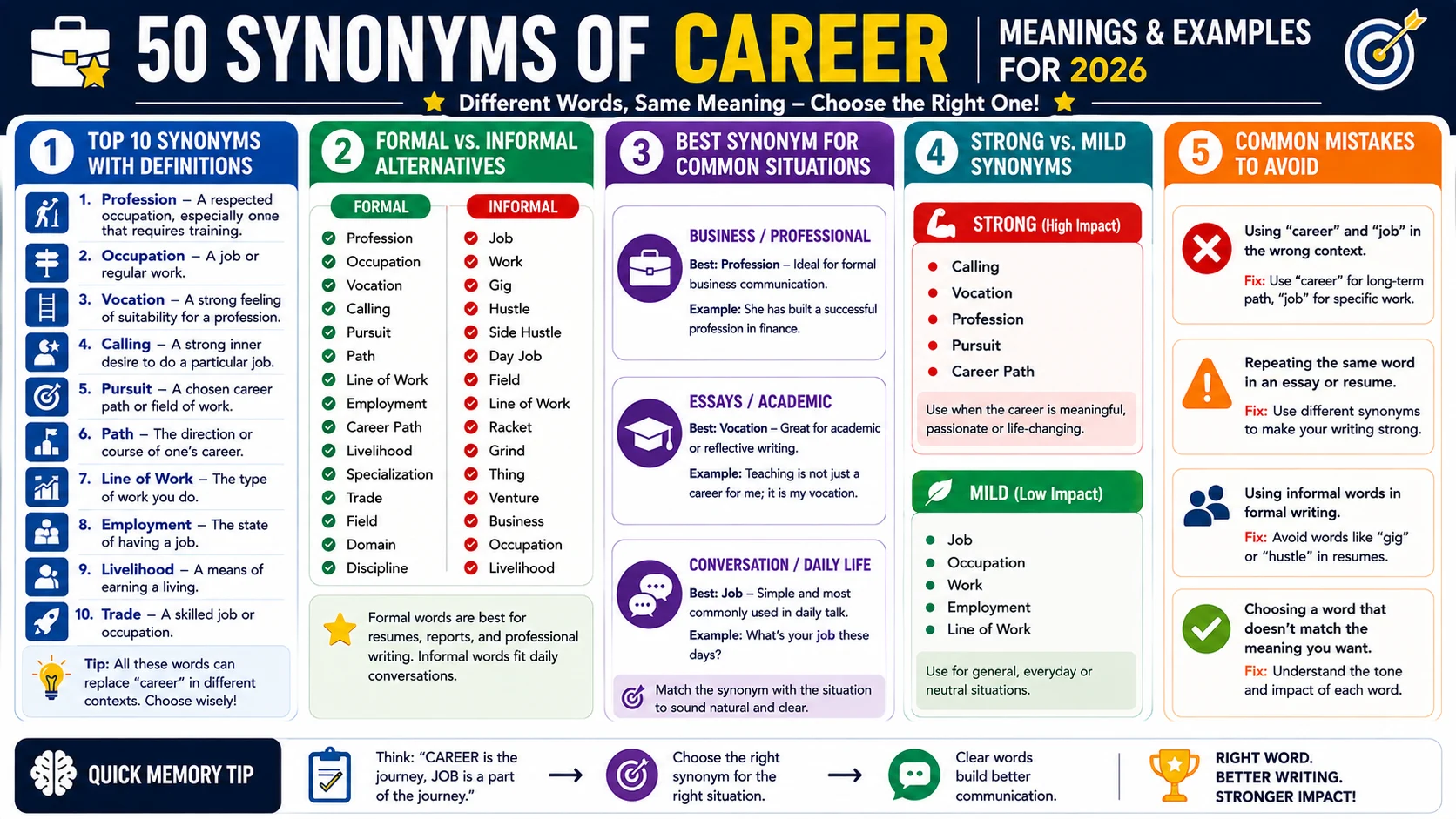
“Career” means the job or profession you do for a long time, often with chances to grow. The best synonyms are profession, occupation, vocation, calling, and work. “Profession” is the most common natural alternative. Each synonym has a slightly different meaning and context where it fits best.
Top 10 Synonyms
- Profession
- Occupation
- Vocation
- Calling
- Work
- Job
- Trade
- Craft
- Pursuit
- Line of work
“Career” is a word we use throughout our lives. It describes our professional journey, our chosen work, and our ambitions. But using it too often can make your English feel repetitive.
Think about it. You can have a career in medicine, a career in teaching, a career in business, or a career in the arts. Each situation might need a different word that captures the specific type of professional life.
In this guide, you’ll learn 35 powerful synonyms for “career.” You’ll discover exactly when to use each one, how formal they are, and what common mistakes to avoid. Let’s begin!
What Does “Career” Mean?
Definition
Career” means the job or profession you do for a long period of your life. It’s not just one job—it’s your entire professional journey. A career often includes training, education, and progression. It’s what you do to earn a living and build your professional identity.
Pronunciation
| Feature | Value |
|---|---|
| US IPA | /kəˈrɪr/ |
| UK IPA | /kəˈrɪə/ |
| Syllables | 2 (ca-reer) |
| Tip | Stress the second syllable: “kuh-REER” |
Grammar
| Grammar Feature | Information |
|---|---|
| Part of Speech | Noun |
| Common Position | Subject or object |
| Typical Pattern | Career + in + field / Career + as + role |
Examples:
- “She has a career in medicine.”
- “His career as a teacher spans twenty years.”
- “Building a career takes time and effort.”
Grammar Note: “Career” is often used with “in” (a career in law) or “as” (a career as a teacher).
Word Family
| Word | Part of Speech | Meaning |
|---|---|---|
| Career | Noun | A person’s professional journey |
| Careerist | Noun | Someone focused on career advancement |
| Career-driven | Adjective | Motivated by career success |
| Careerism | Noun | The pursuit of career advancement |
15 Synonyms of “Career”
Profession
Meaning: A paid occupation that requires special training and education.
Best Used For: Doctors, lawyers, teachers, accountants.
Formality: Formal
Tone: Professional, Respectable
Frequency: ⭐⭐⭐⭐⭐ (Very Common)
CEFR Level: B2
Example Sentence 1: “She chose a profession in nursing after much thought.”
Example Sentence 2: “Teaching is a rewarding profession.”
Usage Tip: “Profession” suggests a respected job requiring advanced education. Use it for formal contexts.
Common Confusion: Profession vs Career. “Profession” emphasizes the field and training. “Career” emphasizes the long-term journey.
Occupation
Meaning: A person’s regular job or profession.
Best Used For: General situations, forms, official documents.
Formality: Neutral
Tone: Neutral, Formal
Frequency: ⭐⭐⭐⭐⭐ (Very Common)
CEFR Level: B1
Example Sentence 1: “Please state your occupation on the form.”
Example Sentence 2: “Her occupation is graphic design.”
Usage Tip: “Occupation” is neutral and common. Use it for forms, official contexts, and general situations.
Vocation
Meaning: A strong feeling that you’re meant to do a particular job.
Best Used For: Teaching, nursing, social work, helping professions.
Formality: Formal
Tone: Passionate, Purposeful
Frequency: ⭐⭐⭐ (Moderate)
CEFR Level: B2
Example Sentence 1: “She felt a strong vocation to help others.”
Example Sentence 2: “Teaching is more than a job; it’s a vocation.”
Usage Tip: “Vocation” suggests a calling or a job you feel strongly about. It’s more meaningful than “job.”
Calling
Meaning: A strong urge to follow a particular profession or way of life.
Best Used For: Ministry, social work, teaching, helping professions.
Formality: Formal
Tone: Spiritual, Deep
Frequency: ⭐⭐⭐ (Moderate)
CEFR Level: C1
Example Sentence 1: “He felt a calling to become a doctor.”
Example Sentence 2: “Her calling was to help underprivileged children.”
Usage Tip: “Calling” is similar to “vocation.” It suggests a deep, often spiritual sense of purpose.
Work
Meaning: The activities you do to earn money.
Best Used For: General contexts, daily conversation.
Formality: Neutral
Tone: Practical, Direct
Frequency: ⭐⭐⭐⭐⭐ (Very Common)
CEFR Level: A1
Example Sentence 1: “I’m looking for work in the tech industry.”
Example Sentence 2: “She does meaningful work as a social worker.
Usage Tip: “Work” is the most general term. Use it for almost any paid activity.
Job
Meaning: A specific paid position of employment.
Best Used For: General contexts, specific roles.
Formality: Neutral
Tone: Practical, Direct
Frequency: ⭐⭐⭐⭐⭐ (Very Common)
CEFR Level: A1
Example Sentence 1: “He got a job at a marketing firm.”
Example Sentence 2: “Her job requires a lot of travel.”
Usage Tip: “Job” is specific—it’s one position. “Career” is the bigger picture.
Trade
Meaning: A skilled job that requires manual skills and training.
Best Used For: Plumbers, electricians, carpenters, mechanics.
Formality: Neutral
Tone: Skilled, Practical
Frequency: ⭐⭐⭐⭐ (Common)
CEFR Level: B1
Example Sentence 1: “He learned his trade as an electrician.”
Example Sentence 2: “The building trade has many opportunities.”
Usage Tip: “Trade” is for skilled manual work. Use it for hands-on professions.
Craft
Meaning: A skill or profession that requires artistic or manual skill.
Best Used For: Artists, writers, makers, artisans.
Formality: Neutral
Tone: Artistic, Skilled
Frequency: ⭐⭐⭐ (Moderate)
CEFR Level: B2
Example Sentence 1: “Writing is a craft that takes years to master.”
Example Sentence 2: “He practiced his craft as a woodworker.”
Usage Tip: “Craft” emphasizes skill and artistry. Use it for creative or handmade work.
Pursuit
Meaning: An activity that you spend time doing.
Best Used For: Careers, hobbies, interests.
Formality: Formal
Tone: Ambitious, Serious
Frequency: ⭐⭐⭐ (Moderate)
CEFR Level: B2
Example Sentence 1: “His chosen pursuit is environmental science.”
Example Sentence 2: “Her pursuit of a medical career took years.”
Usage Tip: “Pursuit” is formal. It suggests dedicated effort toward a goal.
Line of work
Meaning: The type of work or industry you’re in.
Best Used For: General conversation, describing your industry.
Formality: Informal
Tone: Casual, Direct
Frequency: ⭐⭐⭐⭐ (Common)
CEFR Level: B1
Example Sentence 1: “What line of work are you in?”
Example Sentence 2: “I’m in the same line of work as my father.”
Usage Tip: “Line of work” is casual and common. Use it in conversation to ask about someone’s job.
Field
Meaning: A particular area of study or work.
Best Used For: Academic subjects, industries, areas of expertise.
Formality: Neutral
Tone: Specific, Professional
Frequency: ⭐⭐⭐⭐⭐ (Very Common)
CEFR Level: B1
Example Sentence 1: “She works in the medical field.”
Example Sentence 2: “He’s an expert in his field.”
Usage Tip: “Field” is great for describing your area of work or study.
Specialty
Meaning: A particular area of expertise.
Best Used For: Medicine, law, skilled professions.
Formality: Formal
Tone: Expert, Specific
Frequency: ⭐⭐⭐ (Moderate)
CEFR Level: B2
Example Sentence 1: “Her specialty is heart surgery.”
Example Sentence 2: “Criminal law is his specialty.”
Usage Tip: “Specialty” is formal and specific. Use it for focused expertise.
Practice
Meaning: The professional work of a doctor, lawyer, or similar professional.
Best Used For: Medicine, law, architecture.
Formality: Formal
Tone: Professional, Established
Frequency: ⭐⭐⭐ (Moderate)
CEFR Level: B2
Example Sentence 1: “She opened her own law practice.”
Example Sentence 2: “His medical practice is very successful.”
Usage Tip: “Practice” is formal and used for established professionals.
Vocation (as distinct from avocation)
Meaning: A person’s main occupation or calling.
Best Used For: Formal contexts, describing one’s life work.
Formality: Formal
Tone: Serious, Committed
Frequency: ⭐⭐⭐ (Moderate)
CEFR Level: B2
Example Sentence 1: “Teaching is both a profession and a vocation.”
Example Sentence 2: “He found his vocation in environmental law.”
Usage Tip: “Vocation” suggests a deeper commitment than just a job.
Métier
Meaning: A person’s trade or profession, especially one they are good at.
Best Used For: Literary contexts, formal writing.
Formality: Formal/Literary
Tone: Sophisticated, Artistic
Frequency: ⭐ (Very Rare)
CEFR Level: C1
Example Sentence 1: “Writing poetry was his true métier.”
Example Sentence 2: “She found her métier as a graphic designer.”
Usage Tip: “Métier” is a sophisticated, literary word. Use it in formal or creative writing.
Synonyms Comparison Table
| Synonym | Best Context | Formality | Tone | Frequency |
|---|---|---|---|---|
| Profession | Formal jobs | Formal | Professional | ⭐⭐⭐⭐⭐ |
| Occupation | General, forms | Neutral | Neutral | ⭐⭐⭐⭐⭐ |
| Work | General use | Neutral | Practical | ⭐⭐⭐⭐⭐ |
| Job | Specific role | Neutral | Practical | ⭐⭐⭐⭐⭐ |
| Vocation | Meaningful work | Formal | Passionate | ⭐⭐⭐ |
| Calling | Deep purpose | Formal | Spiritual | ⭐⭐⭐ |
| Trade | Skilled manual work | Neutral | Skilled | ⭐⭐⭐⭐ |
| Field | Area of work | Neutral | Specific | ⭐⭐⭐⭐⭐ |
Best Synonyms by Situation
| Situation | Best Synonym | Why It Works |
|---|---|---|
| Daily Conversation | Work/Job | Natural and common |
| Business Email | Profession | Professional and clear |
| Academic Writing | Vocation | Formal and meaningful |
| School Assignment | Occupation | Clear and simple |
| Professional Meeting | Profession | Sounds professional |
| Presentation | Career | Clear and effective |
| Creative Writing | Calling | Adds literary depth |
| Social Media | Work | Casual and relatable |
| Job Application | Profession | Professional and respectful |
Formal vs Informal Synonyms
Formal Alternatives
| Synonym | Best Used For |
|---|---|
| Profession | Respected jobs requiring education |
| Vocation | Meaningful, purpose-driven work |
| Calling | Deep sense of purpose |
| Pursuit | Dedicated effort toward goals |
| Métier | Trade or profession (literary) |
Neutral Alternatives
| Synonym | Best Used For |
|---|---|
| Occupation | General, official contexts |
| Work | Most situations |
| Job | Specific positions |
| Field | Areas of work |
Informal Alternatives
| Synonym | Best Used For |
|---|---|
| Line of work | Casual conversation |
| Craft | Artistic, skilled work |
| Trade | Skilled manual work |
Choosing the Right Level: Use “profession” and “vocation” for formal writing. Use “occupation” and “work” for most situations. Use “line of work” with friends.
Strong vs Mild Synonyms
Mild
Suitable for everyday situations with less intensity.
- Job
- Work
- Occupation
Moderate
More professional or meaningful alternatives.
- Profession
- Trade
- Field
- Line of work
Strong
High-intensity alternatives suggesting deep purpose.
- Vocation (meaningful calling)
- Calling (deep purpose)
- Pursuit (dedicated effort)
- Métier (true trade)
How Intensity Changes Meaning: “I have a job” is simple. “I have found my calling” is much deeper. Choose stronger words when you want to emphasize purpose or passion.
Real-Life Examples
School: “She is exploring career options in science.”
Office: “His profession as an architect is highly respected.”
Business Email: “I’m interested in pursuing a career in marketing.”
Meetings: “We discussed career development opportunities.”
Presentations: “Finding your vocation is important for happiness.”
Daily Conversations: “What line of work are you in?”
Social Media: “Working hard on my career goals!”
Academic Writing: “The pursuit of a medical career requires dedication.”
Common Collocations
| Common Phrase | Better Alternative |
|---|---|
| Career path | Professional path |
| Career change | Change of profession |
| Career goals | Professional goals |
| Career development | Professional growth |
| Career choice | Career decision |
Common Phrases
Career ladder: The steps of advancement. (e.g., “She’s climbing the career ladder.”)
Career move: A decision affecting your career. (e.g., “Changing jobs was a good career move.”)
Work your way up: To progress through promotion. (e.g., “He worked his way up in the company.”)
Find your calling: To discover what you’re meant to do. (e.g., “She finally found her calling.”)
Make a living: To earn enough money. (e.g., “He makes a living as a writer.”)
Context Guide
| Situation | Best Synonym | Reason |
|---|---|---|
| Essay | Vocation | Academic and meaningful |
| Speech | Calling | Inspiring and deep |
| Business Email | Profession | Professional and clear |
| Novel | Calling | Adds literary depth |
| Presentation | Career | Clear and effective |
| Conversation | Work/Job | Natural and relatable |
| Academic Writing | Vocation | Precise and formal |
| Marketing Copy | Profession | Professional and trusted |
Related Words
Near Synonyms
- Avocation: A hobby or secondary occupation.
- Livelihood: The means of earning a living.
- Life’s work: The main work of a lifetime.
- Mission: A person’s important purpose.
- Craft: A skill or trade.
Antonyms
- Hobby: An activity done for fun.
- Pastime: A leisure activity.
- Avocation: A secondary occupation.
- Idleness: Being unemployed.
Related Adjectives
- Professional: Related to a profession.
- Occupational: Related to occupation.
- Vocational: Related to a vocation.
- Career-minded: Focused on career success.
- Ambitious: Wanting to succeed.
Related Nouns
- Profession: A paid occupation.
- Occupation: A job or profession.
- Vocation: A calling.
- Work: Paid activity.
- Employment: Paid work.
Related Verbs
- Work: To do a job.
- Pursue: To follow or seek.
- Practice: To work in a profession.
- Career: To move quickly (rare verb usage).
Frequently Asked Questions
What is another word for career?
Common synonyms include profession, occupation, vocation, calling, work, and job. “Profession” is the most common formal alternative.
Which synonym sounds the most professional?
Profession and vocation sound very professional. Calling” is also excellent for meaningful work.
What is the strongest synonym for career?
Vocation and calling are among the strongest synonyms. They suggest deep purpose and meaning.
Which synonym is best for essays?
Vocation is the best choice for academic essays. It’s formal and suggests deeper meaning.
What’s the difference between career and job?
A “job” is one specific position. A “career” is your entire professional journey over time.
Which synonym is most common in everyday English?
“Work” and “job” are the most common in everyday speech. “Profession” is also frequently used.
What is the opposite of career?
Common opposites include hobby, pastime, and avocation. These are activities done for pleasure, not for money.
Conclusion
“Career” is a word we use throughout our professional lives. Now you have 35 fantastic alternatives. Each synonym adds a different shade of meaning to your language.
Remember, the key is understanding the context. Use “profession” for formal, respected jobs. Use “vocation” for meaningful, purpose-driven work. Use “job” for specific positions. Use “occupation” for general contexts.
The best way to improve is practice. Try using one or two new synonyms each day. Listen for these words in conversations and books. Your vocabulary will become richer and more impressive with time.
