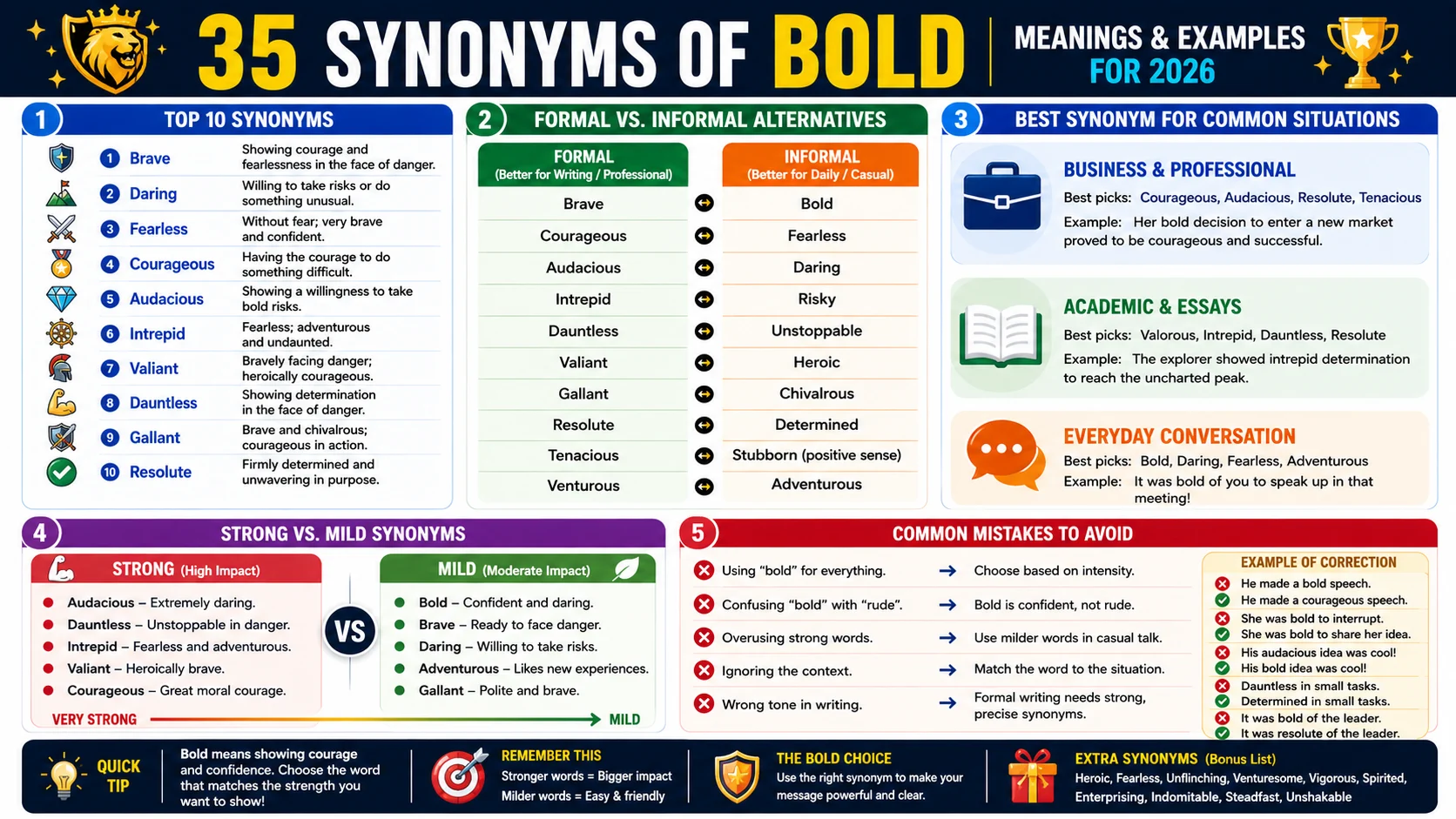
“Bold” means brave, confident, or not afraid to take risks. The best synonyms are brave, courageous, daring, fearless, and adventurous. “Brave” is the most common natural alternative. Each synonym has a slightly different meaning and context where it fits best.
Top 10 Synonyms
- Brave
- Courageous
- Daring
- Fearless
- Adventurous
- Audacious
- Confident
- Intrepid
- Valiant
- Heroic
“Bold” is a powerful word. It describes people who are brave, confident, and willing to take risks. But using it too often can make your English feel repetitive and one-dimensional.
Think about it. You can describe a bold decision, a bold move, a bold person, or a bold idea. Each situation might need a different word that captures the specific type of courage or confidence.
In this guide, you’ll learn 35 powerful synonyms for “bold.” You’ll discover exactly when to use each one, how formal they are, and what common mistakes to avoid. Let’s begin!
What Does “Bold” Mean?
Definition
Bold” means brave, confident, and willing to take risks. A bold person is not afraid to try new things or face danger. A bold decision is one that takes courage. When something is bold, it stands out and shows strength.
Pronunciation
| Feature | Value |
|---|---|
| US IPA | /boʊld/ |
| UK IPA | /bəʊld/ |
| Syllables | 1 |
| Tip | Rhymes with “old” and “cold” |
Grammar
| Grammar Feature | Information |
|---|---|
| Part of Speech | Adjective |
| Common Position | Before a noun or after a linking verb |
| Typical Pattern | Bold + noun / Subject + be + bold |
Examples:
- “She made a bold decision.” (before noun)
- “His actions were bold.” (after verb)
- “That was a bold move.” (before noun)
Grammar Note: “Bold” can be used with words like “very,” “extremely,” and “incredibly” to emphasize the level of courage.
Word Family
| Word | Part of Speech | Meaning |
|---|---|---|
| Bold | Adjective | Brave and confident |
| Boldly | Adverb | In a bold way |
| Boldness | Noun | The quality of being bold |
| Bolden | Verb | To make bold (rare) |
15 Synonyms of “Bold”
Brave
Meaning: Ready to face danger or pain without fear.
Best Used For: People, actions, decisions.
Formality: Neutral
Tone: Courageous, Strong
Frequency: ⭐⭐⭐⭐⭐ (Very Common)
CEFR Level: A2
Example Sentence 1: “The firefighters were brave in the face of danger.”
Example Sentence 2: “She made a brave decision to start her own business.”
Usage Tip: “Brave” is the most common synonym. Use it for courage in dangerous situations.
Common Confusion: Brave vs Bold. “Brave” often relates to facing fear or danger. Bold” can also mean confident and not shy .
Courageous
Meaning: Having or showing courage in difficult situations .
Best Used For: People, actions, overcoming challenges.
Formality: Formal
Tone: Inspiring, Strong
Frequency: ⭐⭐⭐⭐ (Common)
CEFR Level: B2
Example Sentence 1: “She gave a courageous speech against injustice.”
Example Sentence 2: “His courageous actions saved the child.”
Usage Tip: “Courageous” emphasizes bravery in the face of adversity. Use it for serious, challenging situations.
Daring
Meaning: Willing to take risks and try new things.
Best Used For: Adventures, challenges, bold decisions.
Formality: Neutral
Tone: Exciting, Risky
Frequency: ⭐⭐⭐⭐ (Common)
CEFR Level: B2
Example Sentence 1: “He made a daring escape from the burning building.”
Example Sentence 2: “The daring plan was risky but exciting.”
Usage Tip: “Daring” emphasizes taking risks, often for excitement or adventure .
Fearless
Meaning: Not afraid of anything; without fear.
Best Used For: People, actions, attitudes.
Formality: Neutral
Tone: Strong, Confident
Frequency: ⭐⭐⭐⭐ (Common)
CEFR Level: B2
Example Sentence 1: “She is fearless when it comes to trying new things.”
Example Sentence 2: “The fearless explorer climbed the highest mountain.”
Usage Tip: “Fearless” suggests absolutely no fear. It’s a powerful, confident word.
Adventurous
Meaning: Willing to take risks and try new experiences.
Best Used For: People, lifestyles, trips.
Formality: Neutral
Tone: Exciting, Fun
Frequency: ⭐⭐⭐⭐ (Common)
CEFR Level: B2
Example Sentence 1: “She has an adventurous spirit.”
Example Sentence 2: “The adventurous trip was unforgettable.”
Usage Tip: “Adventurous” emphasizes a love for new experiences and risks.
Audacious
Meaning: Showing a willingness to take surprisingly bold risks.
Best Used For: Actions, plans, behavior.
Formality: Formal
Tone: Bold, Daring
Frequency: ⭐⭐⭐ (Moderate)
CEFR Level: C1
Example Sentence 1: “His audacious plan shocked everyone.”
Example Sentence 2: “She made an audacious move in the business world.”
Usage Tip: “Audacious” suggests boldness that is almost shocking. Use it for extreme boldness.
Confident
Meaning: Feeling sure about your abilities or decisions.
Best Used For: People, behavior, actions.
Formality: Neutral
Tone: Sure, Self-assured
Frequency: ⭐⭐⭐⭐⭐ (Very Common)
CEFR Level: B1
Example Sentence 1: “She is confident in her abilities.”
Example Sentence 2: “He gave a confident presentation.”
Usage Tip: “Confident” emphasizes self-belief. Use it for people who are sure of themselves.
Intrepid
Meaning: Fearless and adventurous.
Best Used For: Explorers, journalists, adventurers.
Formality: Formal
Tone: Adventurous, Brave
Frequency: ⭐⭐ (Rare)
CEFR Level: C1
Example Sentence 1: “The intrepid explorer traveled to the Arctic.”
Example Sentence 2: “Intrepid journalists report from dangerous places.”
Usage Tip: “Intrepid” is a formal word for brave adventurers. Use it in literary or formal contexts.
Valiant
Meaning: Showing courage or determination.
Best Used For: People, efforts, actions.
Formality: Formal
Tone: Heroic, Brave
Frequency: ⭐⭐⭐ (Moderate)
CEFR Level: C1
Example Sentence 1: “The valiant soldiers fought bravely.”
Example Sentence 2: “She made a valiant effort to save the project.”
Usage Tip: “Valiant” suggests heroic courage. Use it for noble and brave actions.
Heroic
Meaning: Showing great bravery or courage.
Best Used For: Actions, people, efforts.
Formality: Formal
Tone: Inspiring, Brave
Frequency: ⭐⭐⭐ (Moderate)
CEFR Level: B2
Example Sentence 1: “His heroic actions saved many lives.”
Example Sentence 2: “She made a heroic effort to help others.”
Usage Tip: “Heroic” suggests the bravery of a hero. Use it for exceptional courage.
Adventurous
Meaning: Willing to take risks and try new things.
Best Used For: People, activities, experiences.
Formality: Neutral
Tone: Exciting, Fun
Frequency: ⭐⭐⭐⭐ (Common)
CEFR Level: B2
Example Sentence 1: “She is always adventurous in her travels.
Example Sentence 2: “The adventurous activity was thrilling.”
Usage Tip: “Adventurous” is about loving new experiences and taking risks.
Plucky
Meaning: Having courage and determination.
Best Used For: People, underdogs, small but brave.
Formality: Informal
Tone: Strong, Determined
Frequency: ⭐⭐ (Rare)
CEFR Level: C1
Example Sentence 1: “The plucky little girl stood up to the bully.”
Example Sentence 2: “His plucky spirit inspired everyone.”
Usage Tip: “Plucky” is an informal word for someone who is small but brave and determined.
Gutsy
Meaning: Brave and determined; having courage.
Best Used For: People, decisions, actions.
Formality: Informal
Tone: Strong, Bold
Frequency: ⭐⭐⭐ (Moderate)
CEFR Level: B2
Example Sentence 1: “She made a gutsy move in the competition.”
Example Sentence 2: “His gutsy decision paid off.”
Usage Tip: “Gutsy” is informal. Use it in casual contexts for brave decisions.
Spirited
Meaning: Full of energy, courage, and determination.
Best Used For: People, performances, efforts.
Formality: Neutral
Tone: Energetic, Brave
Frequency: ⭐⭐⭐ (Moderate)
CEFR Level: B2
Example Sentence 1: “She gave a spirited performance.”
Example Sentence 2: “The spirited debate was lively.”
Usage Tip: “Spirited” combines energy with courage. Use it for lively, brave efforts.
Undaunted
Meaning: Not discouraged by difficulties.
Best Used For: People, efforts, attitudes.
Formality: Formal
Tone: Determined, Brave
Frequency: ⭐⭐⭐ (Moderate)
CEFR Level: C1
Example Sentence 1: “She remained undaunted despite the challenges.”
Example Sentence 2: “His undaunted spirit inspired the team.”
Usage Tip: “Undaunted” means not giving up even when things are hard. Use it for persistence.
Synonyms Comparison Table
| Synonym | Best Context | Formality | Tone | Frequency |
|---|---|---|---|---|
| Brave | General courage | Neutral | Courageous | ⭐⭐⭐⭐⭐ |
| Confident | Self-assurance | Neutral | Sure | ⭐⭐⭐⭐⭐ |
| Courageous | Serious challenges | Formal | Strong | ⭐⭐⭐⭐ |
| Daring | Taking risks | Neutral | Exciting | ⭐⭐⭐⭐ |
| Fearless | No fear | Neutral | Confident | ⭐⭐⭐⭐ |
| Adventurous | New experiences | Neutral | Exciting | ⭐⭐⭐⭐ |
| Audacious | Extreme boldness | Formal | Daring | ⭐⭐⭐ |
| Intrepid | Adventurers | Formal | Brave | ⭐⭐ |
| Valiant | Heroic efforts | Formal | Heroic | ⭐⭐⭐ |
| Gutsy | Informal courage | Informal | Bold | ⭐⭐⭐ |
Best Synonyms by Situation
| Situation | Best Synonym | Why It Works |
|---|---|---|
| Daily Conversation | Brave | Natural and common |
| Business Email | Confident | Professional and clear |
| Academic Writing | Courageous | Formal and precise |
| School Assignment | Brave | Simple and clear |
| Professional Meeting | Confident | Sounds professional |
| Presentation | Confident | Clear and inspiring |
| Creative Writing | Audacious | Adds literary depth |
| Social Media | Daring | Casual and engaging |
| Adventure Story | Intrepid | Fits the theme |
Formal vs Informal Synonyms
Formal Alternatives
| Synonym | Best Used For |
|---|---|
| Courageous | Serious, challenging situations |
| Audacious | Extreme boldness |
| Intrepid | Explorers, adventurers |
| Valiant | Heroic efforts |
| Undaunted | Persistence despite difficulty |
Neutral Alternatives
| Synonym | Best Used For |
|---|---|
| Brave | Most general situations |
| Confident | Self-assurance |
| Daring | Taking risks |
| Adventurous | New experiences |
Informal Alternatives
| Synonym | Best Used For |
|---|---|
| Gutsy | Casual boldness |
| Plucky | Determined courage |
| Fearless | No fear |
Choosing the Right Level: Use “courageous” and “audacious” for formal writing. Use “brave” and “confident” for most situations. Use “gutsy” and “plucky” with friends.
Strong vs Mild Synonyms
Mild
Suitable for everyday situations with less intensity.
- Brave
- Confident
- Adventurous
Moderate
More serious or noticeable alternatives.
- Courageous
- Daring
- Fearless
- Spirited
Strong
High-intensity alternatives suggesting extreme boldness.
- Audacious (shocking boldness)
- Intrepid (fearless adventure)
- Valiant (heroic courage)
- Undaunted (persistent bravery)
How Intensity Changes Meaning: “He is brave” is general. “He is audacious” suggests shocking boldness. Choose stronger words when you want to emphasize extreme courage.
Real-Life Examples
School: “The brave student spoke up against injustice.”
Office: “She made a confident presentation to the board.”
Business Email: “We need courageous leadership in times of change.”
Meetings: “That’s a daring approach to the problem.”
Presentations: “The company took a bold step into new markets.”
Daily Conversations: “You’re so adventurous!”
Social Media: “Living life boldly!”
Academic Writing: “The courageous act inspired others.”
Common Collocations
| Common Phrase | Better Alternative |
|---|---|
| Bold decision | Courageous decision |
| Bold move | Daring move |
| Bold person | Brave person |
| Bold statement | Bold statement (unchanged) |
| Bold action | Decisive action |
Common Phrases
Bold as brass: Very confident and not shy. (e.g., “He walked in bold as brass.”)
Stick your neck out: To take a bold risk. (e.g., “She stuck her neck out for the team.”)
Go out on a limb: To take a bold risk. (e.g., “He went out on a limb for the project.”)
Take a leap of faith: A bold decision based on trust. (e.g., “She took a leap of faith.”)
Bite the bullet: To face a difficult situation bravely. (e.g., “He bit the bullet and spoke up.”)
Context Guide
| Situation | Best Synonym | Reason |
|---|---|---|
| Essay | Courageous | Academic and formal |
| Speech | Brave | Clear and inspiring |
| Business Email | Confident | Professional and clear |
| Novel | Audacious | Adds literary depth |
| Presentation | Bold | Clear and effective |
| Conversation | Brave | Natural and relatable |
| Academic Writing | Courageous | Precise and formal |
| Marketing Copy | Bold | Engaging and confident |
Related Words
Near Synonyms
- Intrepid: Fearless and adventurous.
- Undaunted: Not discouraged.
- Plucky: Small but brave.
- Gutsy: Brave (informal).
- Heroic: Showing hero-like courage.
Antonyms
- Cowardly: Not brave.
- Timid: Lacking confidence.
- Fearful: Full of fear.
- Shy: Not confident.
- Nervous: Easily worried.
Related Adjectives
- Brave: Having courage.
- Confident: Believing in oneself.
- Fearless: Without fear.
- Courageous: Showing courage.
- Daring: Risk-taking.
Related Nouns
- Boldness: The quality of being bold.
- Courage: The ability to face danger.
- Bravery: Courage.
- Confidence: Self-belief.
- Daring: Risk-taking.
Related Verbs
- Dare: To be brave enough.
- Challenge: To confront bravely.
- Confront: To face boldly.
- Risk: To take a chance.
- Venture: To go boldly.
Frequently Asked Questions
What is another word for bold?
Common synonyms include brave, courageous, daring, fearless, and adventurous. “Brave” is the most common and direct alternative.
Which synonym sounds the most professional?
Courageous and audacious sound very professional. “Confident” is also excellent for business contexts.
What is the strongest synonym for bold?
Audacious is one of the strongest synonyms. It suggests shocking, extreme boldness. “Intrepid” and “valiant” are also strong.
Which synonym is best for essays?
Courageous is the best choice for academic essays. It’s formal and precise.
What’s the difference between bold and brave?
“Brave” often relates to facing fear or danger. “Bold” is broader and includes confidence and willingness to take risks.
Which synonym is most common in everyday English?
“Brave” and “confident” are very common in everyday speech. “Daring” is also frequently used.
What is the opposite of bold?
Common opposites are cowardly, timid, fearful, and shy. These words describe a lack of courage or confidence.
Conclusion
“Bold” is a powerful word, but now you have 35 fantastic alternatives. Each synonym adds a different shade of meaning to your language.
Remember, the key is understanding the context. Use “brave” for facing danger. Use “confident” for self-assurance. Use “daring” for taking risks. Use “courageous” for formal contexts.
The best way to improve is practice. Try using one or two new synonyms each day. Listen for these words in conversations and books. Your vocabulary will become richer and more impressive with time.
