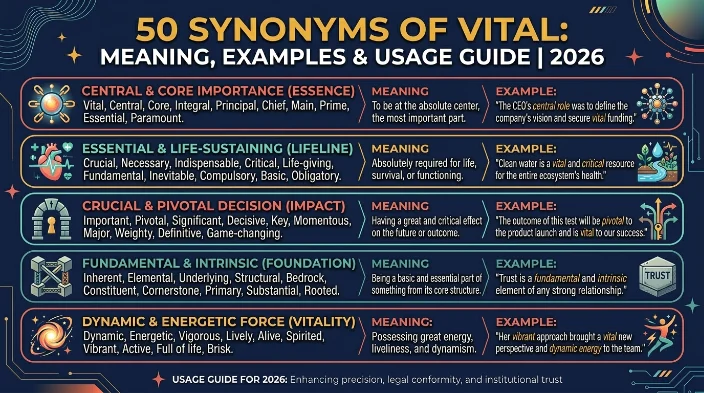
Vital means absolutely necessary or extremely important. The best synonyms include essential, crucial, critical, paramount, indispensable, key, fundamental, and imperative. The most common everyday synonym is essential, while crucial works best for describing make-or-break situations. Each synonym has a slightly different meaning, tone, or context.
Top 10 Synonyms
- Essential
- Crucial
- Critical
- Paramount
- Indispensable
- Key
- Fundamental
- Imperative
- Necessary
- Required
Every synonym has a slightly different meaning, tone, or context, so choose carefully based on your situation.
Do you keep using “vital” to describe everything important? While it’s a powerful word, overusing it makes your writing sound repetitive and less impactful.
Learning synonyms for “vital” helps you express importance with more precision. Whether you’re writing a business report, describing a life-saving procedure, or explaining why something matters, having the right word makes your message stronger.
In this guide, you’ll discover 35 powerful alternatives to “vital.” You’ll learn their meanings, when to use them, and which ones native speakers prefer in different situations. Let’s begin!
What Does “Vital” Mean?
Definition
Vital means something is absolutely necessary or extremely important for survival, success, or existence. It comes from the Latin word “vita” meaning “life.
In everyday terms, think of vital things as those you cannot live or succeed without. Oxygen is vital for breathing. A good education is vital for career success. The word emphasizes that something is not just helpful—it’s essential.
Vital can describe:
- Necessities (“Water is vital for life”)
- Critical moments (“This is a vital decision”)
- Key components (“He plays a vital role in the team”)
Pronunciation
| Feature | Value |
|---|---|
| US IPA | /ˈvaɪ.t̬əl/ |
| UK IPA | /ˈvaɪ.təl/ |
| Syllables | 2 (vi-tal) |
| Tip | Stress the first syllable: VI-tal |
Grammar
| Grammar Feature | Information |
|---|---|
| Part of Speech | Adjective |
| Common Position | Before a noun or after a linking verb |
| Typical Pattern | vital + to/for + noun/gerund |
Example Sentences:
- “Good communication is vital for team success.”
- “She plays a vital role in the project.”
- “It’s vital that we finish on time.”
Grammar Notes: “Vital” can be used with “to” or “for.” Both are correct. Vital” is usually not used in comparative forms (more vital) because it already means extremely important.
Word Family
| Word | Part of Speech | Meaning |
|---|---|---|
| Vital | Adjective | Absolutely necessary; extremely important |
| Vitality | Noun | Energy and liveliness |
| Vitalize | Verb | To give strength and energy |
| Vitally | Adverb | In a way that is extremely important |
| Avital | Adjective | Lacking vitality (rare) |
50 Synonyms of “Vital”
1. Essential
Meaning: Absolutely necessary; cannot be done without.
Best Used For: Everyday conversation, general use, describing necessities.
Formality: Neutral
Tone: Practical, Clear
Frequency: ⭐⭐⭐⭐⭐ Very Common
CEFR Level: B1
Example Sentence 1: “Water is essential for survival.”
Example Sentence 2: “Good communication skills are essential for this job.”
Usage Tip: “Essential” is the closest and most common synonym to “vital.” Use it when something is necessary but not life-threatening. It’s safe for almost any situation.
Common Confusion: “Essential” vs “Vital” – Both mean necessary. “Vital” is slightly stronger and often relates to life or survival. “Essential” is more general.
2. Crucial
Meaning: Extremely important; decisive or critical.
Best Used For: Make-or-break situations, decisions, moments.
Formality: Neutral
Tone: Serious, Decisive
Frequency: ⭐⭐⭐⭐⭐ Very Common
CEFR Level: B2
Example Sentence 1: “This is a crucial moment for the company.”
Example Sentence 2: “Her support was crucial to our success.”
Usage Tip: “Crucial” suggests something is decisive. Use it for moments, decisions, or factors that determine success or failure. It’s stronger than “important.”
3. Critical
Meaning: Of decisive importance; at a point of crisis.
Best Used For: Serious situations, medical contexts, urgent matters.
Formality: Neutral to Formal
Tone: Serious, Urgent
Frequency: ⭐⭐⭐⭐⭐ Very Common
CEFR Level: B2
Example Sentence 1: “The patient is in critical condition.”
Example Sentence 2: “This is a critical decision for our future.”
Usage Tip: “Critical” often suggests urgency or danger. Use it for serious situations where something is at stake. It’s stronger than “important” and closer to “vital.”
4. Paramount
Meaning: More important than anything else; supreme.
Best Used For: Formal writing, priorities, principles.
Formality: Formal
Tone: Strong, Serious
Frequency: ⭐⭐⭐⭐ Common
CEFR Level: C1
Example Sentence 1: “Safety is of paramount importance.”
Example Sentence 2: “Customer satisfaction is paramount to our business.”
Usage Tip: “Paramount” means the most important thing. Use it when something is the highest priority. It’s more formal than “essential.”
5. Indispensable
Meaning: Absolutely necessary; cannot be replaced.
Best Used For: People, resources, components.
Formality: Formal
Tone: Strong, Irreplaceable
Frequency: ⭐⭐⭐⭐ Common
CEFR Level: B2
Example Sentence 1: “She is an indispensable member of the team.”
Example Sentence 2: “This tool is indispensable for the job.”
Usage Tip: “Indispensable” emphasizes that something cannot be replaced. Use it for people or things that are so important you cannot do without them.
6. Key
Meaning: Of crucial importance; central.
Best Used For: Factors, roles, elements.
Formality: Neutral
Tone: Practical, Clear
Frequency: ⭐⭐⭐⭐⭐ Very Common
CEFR Level: B1
Example Sentence 1: “Innovation is the key to success.”
Example Sentence 2: “She played a key role in the project.
Usage Tip: “Key” is short and direct. Use it for important factors and central elements. It’s less formal than “vital” but just as powerful.
7. Fundamental
Meaning: Forming the base or core; essential.
Best Used For: Principles, concepts, foundations.
Formality: Formal
Tone: Academic, Serious
Frequency: ⭐⭐⭐⭐⭐ Very Common
CEFR Level: B2
Example Sentence 1: “Honesty is fundamental to good relationships.”
Example Sentence 2: “The fundamental principles of physics.”
Usage Tip: “Fundamental” suggests something is basic and forms the foundation. Use it for core principles and building blocks.
8. Imperative
Meaning: Absolutely necessary; urgent.
Best Used For: Commands, requirements, urgent needs.
Formality: Formal
Tone: Authoritative, Urgent
Frequency: ⭐⭐⭐⭐ Common
CEFR Level: B2
Example Sentence 1: “It is imperative that we act now.”
Example Sentence 2: “Good communication is imperative for success.”
Usage Tip: “Imperative” is formal and strong. It suggests something must be done. Use it for commands or urgent requirements.
9. Necessary
Meaning: Required; needed to achieve something.
Best Used For: General use, requirements, needs.
Formality: Neutral
Tone: Practical, Direct
Frequency: ⭐⭐⭐⭐⭐ Very Common
CEFR Level: A2
Example Sentence 1: “A valid passport is necessary for travel.
Example Sentence 2: “Hard work is necessary for success.”
Usage Tip: “Necessary” is straightforward and common. Use it for requirements and needs. It’s less dramatic than “vital.”
10. Required
Meaning: Officially needed; obligatory.
Best Used For: Rules, policies, job requirements.
Formality: Neutral to Formal
Tone: Official, Obligatory
Frequency: ⭐⭐⭐⭐⭐ Very Common
CEFR Level: B1
Example Sentence 1: “A degree is required for this position.”
Example Sentence 2: “Attendance is required at the meeting.”
Usage Tip: “Required” emphasizes obligation. Use it for rules, policies, and official requirements.
11. Compulsory
Meaning: Required by law or rules; mandatory.
Best Used For: Rules, laws, school subjects.
Formality: Formal
Tone: Official, Obligatory
Frequency: ⭐⭐⭐⭐ Common
CEFR Level: B2
Example Sentence 1: “Wearing a seatbelt is compulsory.”
Example Sentence 2: “Math is a compulsory subject in school.”
Usage Tip: “Compulsory” means you have no choice. Use it for legal or official requirements.
12. Mandatory
Meaning: Required; must be done.
Best Used For: Rules, safety, company policies.
Formality: Formal
Tone: Official, Obligatory
Frequency: ⭐⭐⭐⭐⭐ Very Common
CEFR Level: B2
Example Sentence 1: “Safety training is mandatory for all employees.”
Example Sentence 2: “Mandatory reporting is required by law.”
Usage Tip: “Mandatory” is similar to “compulsory.” Use it for company policies and safety requirements.
13. Obligatory
Meaning: Required because of custom or rule.
Best Used For: Customs, traditions, formal requirements.
Formality: Formal
Tone: Official, Traditional
Frequency: ⭐⭐⭐ Moderate
CEFR Level: B2
Example Sentence 1: “Bowing is obligatory in some cultures.”
Example Sentence 2: “It is obligatory to wear formal attire.”
Usage Tip: “Obligatory” often relates to social or cultural expectations. Use it for customs and traditions.
14. Needed
Meaning: Necessary; required.
Best Used For: Everyday conversation, general use.
Formality: Informal to Neutral
Tone: Practical, Simple
Frequency: ⭐⭐⭐⭐⭐ Very Common
CEFR Level: A2
Example Sentence 1: “We need more people to help.”
Example Sentence 2: “Money is needed for the project.”
Usage Tip: “Needed” is the simplest alternative. Use it in everyday conversation for basic necessity.
15. Requisite
Meaning: Required; necessary for a purpose.
Best Used For: Formal writing, qualifications, requirements.
Formality: Formal
Tone: Official, Professional
Frequency: ⭐⭐⭐ Moderate
CEFR Level: C1
Example Sentence 1: “He has the requisite skills for the job.”
Example Sentence 2: “The requisite documents must be submitted.”
Usage Tip: “Requisite” is formal and precise. Use it for qualifications and official requirements.
16. Pivotal
Meaning: Of crucial importance; central.
Best Used For: Moments, roles, decisions.
Formality: Formal
Tone: Important, Decisive
Frequency: ⭐⭐⭐⭐ Common
CEFR Level: B2
Example Sentence 1: “This was a pivotal moment in history.”
Example Sentence 2: “She played a pivotal role in the negotiation.”
Usage Tip: “Pivotal” suggests something that causes change. Use it for moments or people that make a difference.
17. Decisive
Meaning: Having the power to decide the outcome.
Best Used For: Battles, elections, critical choices.
Formality: Neutral to Formal
Tone: Strong, Final
Frequency: ⭐⭐⭐⭐ Common
CEFR Level: B2
Example Sentence 1: “The battle was a decisive victory.”
Example Sentence 2: “Her vote was decisive.”
Usage Tip: “Decisive” suggests something determines the outcome. Use it for actions that make the final difference.
18. Important
Meaning: Having great significance or value.
Best Used For: General use, everyday conversation.
Formality: Neutral
Tone: Positive, Significant
Frequency: ⭐⭐⭐⭐⭐ Very Common
CEFR Level: A2
Example Sentence 1: “Education is important for children.”
Example Sentence 2: “This is an important decision.”
Usage Tip: “Important” is the most basic way to describe significance. Use it when you don’t need to emphasize extreme importance.
19. Significant
Meaning: Important; having meaning or effect.
Best Used For: Statistics, findings, events.
Formality: Neutral to Formal
Tone: Serious, Meaningful
Frequency: ⭐⭐⭐⭐⭐ Very Common
CEFR Level: B2
Example Sentence 1: “The study showed significant results.”
Example Sentence 2: “This was a significant achievement.”
Usage Tip: “Significant” suggests meaningful impact. Use it for things that make a real difference.
20. Urgent
Meaning: Requiring immediate action.
Best Used For: Emergencies, deadlines, pressing matters.
Formality: Neutral
Tone: Pressing, Emergency
Frequency: ⭐⭐⭐⭐⭐ Very Common
CEFR Level: B1
Example Sentence 1: “This is an urgent matter.”
Example Sentence 2: “We need an urgent response.”
Usage Tip: “Urgent” emphasizes time. Use it for things that need immediate attention.
21. Pressing
Meaning: Needing immediate attention.
Best Used For: Matters, issues, problems.
Formality: Neutral to Formal
Tone: Serious, Immediate
Frequency: ⭐⭐⭐⭐ Common
CEFR Level: B2
Example Sentence 1: “Housing is a pressing issue.”
Example Sentence 2: “This is a pressing problem.”
Usage Tip: “Pressing” is similar to “urgent.” Use it for issues that cannot wait.
22. Life-and-death
Meaning: Involving the possibility of death.
Best Used For: Medical emergencies, serious situations.
Formality: Informal
Tone: Dramatic, Serious
Frequency: ⭐⭐⭐ Moderate
CEFR Level: B2
Example Sentence 1: “It was a life-and-death decision.”
Example Sentence 2: “The doctor performed life-and-death surgery.”
Usage Tip: This is dramatic and powerful. Use it only for literal life-threatening situations.
23. All-important
Meaning: Very important; crucial.
Best Used For: Emphasizing extreme importance.
Formality: Neutral to Informal
Tone: Emphatic, Strong
Frequency: ⭐⭐⭐ Moderate
CEFR Level: B2
Example Sentence 1: “This is the all-important meeting.”
Example Sentence 2: “The all-important factor is location.”
Usage Tip: “All-important” adds strong emphasis. Use it when you want to emphasize that nothing is more important.
24. Capital
Meaning: Very important; primary.
Best Used For: Formal writing, emphasizing importance.
Formality: Formal
Tone: Official, Strong
Frequency: ⭐⭐⭐ Moderate
CEFR Level: C1
Example Sentence 1: “This is a capital offense.”
Example Sentence 2: “Safety is of capital importance.”
Usage Tip: “Capital” is formal and old-fashioned. Use it in formal or legal contexts.
25. Cardinal
Meaning: Of fundamental importance.
Best Used For: Principles, rules, virtues.
Formality: Formal
Tone: Academic, Serious
Frequency: ⭐⭐⭐ Moderate
CEFR Level: C1
Example Sentence 1: “Honesty is a cardinal virtue.”
Example Sentence 2: “The cardinal rule is to be kind.”
Usage Tip: “Cardinal” suggests something is fundamental. Use it for principles and virtues.
26. Principal
Meaning: First in importance; main.
Best Used For: Reasons, causes, concerns.
Formality: Formal
Tone: Primary, Main
Frequency: ⭐⭐⭐⭐ Common
CEFR Level: B2
Example Sentence 1: “The principal reason for the delay was weather.”
Example Sentence 2: “My principal concern is safety.”
Usage Tip: “Principal” means main or primary. Use it to identify the most important thing among others.
27. Prime
Meaning: Of first importance; main.
Best Used For: Concerns, objectives, targets.
Formality: Neutral to Formal
Tone: Primary, Top
Frequency: ⭐⭐⭐⭐ Common
CEFR Level: B2
Example Sentence 1: “Our prime concern is customer satisfaction.”
Example Sentence 2: “The prime objective is to increase sales.”
Usage Tip: “Prime” suggests being at the top. Use it for priorities and objectives.
28. Foremost
Meaning: Most important; leading.
Best Used For: Priorities, concerns, experts.
Formality: Formal
Tone: Top, Leading
Frequency: ⭐⭐⭐⭐ Common
CEFR Level: B2
Example Sentence 1: “Safety is our foremost concern.”
Example Sentence 2: “She is the foremost expert in her field.”
Usage Tip: “Foremost” means at the very top. Use it for priorities and leaders.
29. Chief
Meaning: Most important; main.
Best Used For: Reasons, concerns, officials.
Formality: Formal
Tone: Main, Primary
Frequency: ⭐⭐⭐⭐ Common
CEFR Level: B2
Example Sentence 1: “The chief reason for the problem is lack of funding.”
Example Sentence 2: “His chief concern is the environment.”
Usage Tip: “Chief” means main or primary. Use it to identify the most important reason or concern.
30. Primary
Meaning: Most important; first in order.
Best Used For: Reasons, objectives, priorities.
Formality: Neutral to Formal
Tone: Main, First
Frequency: ⭐⭐⭐⭐⭐ Very Common
CEFR Level: B1
Example Sentence 1: “The primary goal is to finish on time.
Example Sentence 2: “Education is a primary concern.”
Usage Tip: “Primary” suggests first in importance. Use it for priorities and main objectives.
31. Main
Meaning: Most important; chief.
Best Used For: Everyday conversation, main points.
Formality: Informal to Neutral
Tone: Simple, Clear
Frequency: ⭐⭐⭐⭐⭐ Very Common
CEFR Level: A2
Example Sentence 1: “The main reason is time.”
Example Sentence 2: “What’s the main point?”
Usage Tip: “Main” is the simplest way to say most important. Use it in everyday conversation.
32. Central
Meaning: Of prime importance; main.
Best Used For: Ideas, issues, roles.
Formality: Neutral to Formal
Tone: Core, Main
Frequency: ⭐⭐⭐⭐⭐ Very Common
CEFR Level: B2
Example Sentence 1: “This is a central issue in the debate.”
Example Sentence 2: “She plays a central role in the organization.”
Usage Tip: “Central” suggests being at the core. Use it for key ideas and roles.
33. Overriding
Meaning: More important than anything else.
Best Used For: Priorities, concerns, considerations.
Formality: Formal
Tone: Supremely Important
Frequency: ⭐⭐⭐ Moderate
CEFR Level: C1
Example Sentence 1: “The overriding concern is safety.”
Example Sentence 2: “His overriding priority is his family.”
Usage Tip: “Overriding” suggests something that dominates all other considerations. Use it for top priorities.
34. Predominant
Meaning: Having the greatest importance.
Best Used For: Factors, influences, features.
Formality: Formal
Tone: Main, Strong
Frequency: ⭐⭐⭐ Moderate
CEFR Level: C1
Example Sentence 1: “The predominant factor is cost.”
Example Sentence 2: “Her predominant concern is quality.”
Usage Tip: “Predominant” suggests being the most important among others. Use it for main factors.
35. Momentous
Meaning: Very important in a significant way.
Best Used For: Events, decisions, occasions.
Formality: Formal
Tone: Historic, Important
Frequency: ⭐⭐⭐ Moderate
CEFR Level: C1
Example Sentence 1: “This is a momentous occasion.”
Example Sentence 2: “The decision was momentous.”
Usage Tip: “Momentous” suggests historical significance. Use it for important events.
Synonyms Comparison Table
| Synonym | Best Context | Formality | Tone | Frequency |
|---|---|---|---|---|
| Essential | General use | Neutral | Practical | ⭐⭐⭐⭐⭐ |
| Crucial | Decisions | Neutral | Serious | ⭐⭐⭐⭐⭐ |
| Critical | Emergencies | Formal | Urgent | ⭐⭐⭐⭐⭐ |
| Paramount | Formal writing | Formal | Strong | ⭐⭐⭐⭐ |
| Indispensable | People, resources | Formal | Irreplaceable | ⭐⭐⭐⭐ |
| Key | Factors | Neutral | Clear | ⭐⭐⭐⭐⭐ |
| Fundamental | Principles | Formal | Academic | ⭐⭐⭐⭐⭐ |
| Imperative | Commands | Formal | Authoritative | ⭐⭐⭐⭐ |
| Necessary | Requirements | Neutral | Practical | ⭐⭐⭐⭐⭐ |
| Required | Rules | Formal | Official | ⭐⭐⭐⭐⭐ |
Best Synonyms by Situation
| Situation | Best Synonym | Why It Works |
|---|---|---|
| Daily Conversation | Essential, Necessary | Simple and natural |
| Business Report | Crucial, Critical | Sounds professional |
| Academic Essay | Fundamental, Paramount | Formal and precise |
| Emergency | Critical, Urgent | Conveys seriousness |
| Job Description | Required, Mandatory | Official and clear |
| Personal Goals | Key, Primary | Practical and motivating |
| Medical Context | Vital, Critical | Accurate and serious |
| Resume | Key, Essential | Shows importance |
| Speech | Paramount, Pivotal | Strong and impactful |
| Policy | Mandatory, Compulsory | Official and clear |
Formal vs Informal Synonyms
Formal Alternatives
| Synonym | Best Used For |
|---|---|
| Paramount | Top priorities |
| Indispensable | Irreplaceable things/people |
| Fundamental | Basic principles |
| Imperative | Urgent requirements |
| Requisite | Official requirements |
| Cardinal | Principles and virtues |
| Momentous | Historic events |
Neutral Alternatives
| Synonym | Best Used For |
|---|---|
| Essential | Most situations |
| Crucial | Important decisions |
| Critical | Serious matters |
| Key | Important factors |
| Necessary | General needs |
| Important | General significance |
Informal Alternatives
| Synonym | Best Used For |
|---|---|
| Needed | Casual conversation |
| Must-have | Describing necessities |
| Do-or-die | Extreme situations |
When to choose each level: Use formal synonyms for academic papers, official documents, and professional reports. Use neutral synonyms for everyday writing and business communication. Use informal synonyms with friends and in casual contexts.
Strong vs Mild Synonyms
Mild (Everyday Situations)
- Necessary
- Required
- Needed
- Important
- Main
Moderate (More Expressive)
- Essential
- Key
- Critical
- Fundamental
- Significant
Strong (High-Intensity)
- Vital
- Paramount
- Indispensable
- Imperative
- Life-and-death
- Momentous
Remember: Stronger doesn’t always mean better. “Life-and-death” sounds dramatic but might be too intense for everyday situations. Choose the intensity that matches your context.
Real-Life Examples
In the Office
“Good communication is essential for team success.”
In a Business Email
“Your feedback is crucial to improving our product.”
In Healthcare
“Oxygen is vital for patients in critical condition.”
In Education
“Math skills are fundamental to many careers.”
In Daily Conversation
“Getting enough sleep is important for your health.”
In a Job Description
“Five years of experience is required for this position.”
In Government
“Voting is compulsory in this country.”
In Sports
“This game is pivotal for the team’s future.”
Common Collocations
| Common Phrase | Better Alternative |
|---|---|
| Vital importance | Paramount importance |
| Vital role | Crucial role, Key role |
| Vital organ | Essential organ |
| Vital signs | Critical signs |
| Vital information | Essential information |
| Vital question | Crucial question |
| Vital decision | Critical decision |
| Vital need | Pressing need |
Common Phrases
- “Of vital importance” – Meaning: Extremely important. Instead of “vital,” say “paramount” or “crucial.”
- “It is vital that” – Meaning: It’s necessary that. Instead of “vital,” say “essential” or “imperative.”
- “Vital to the success” – Meaning: Important for success. Instead of “vital,” say “crucial” or “key.”
- “At a vital stage” – Meaning: At an important moment. Instead of “vital,” say “critical” or “pivotal.”
Context Guide
| Situation | Best Synonym | Reason |
|---|---|---|
| Essay | Fundamental, Paramount | Formal and academic |
| Speech | Pivotal, Momentous | Inspiring and powerful |
| Business Email | Essential, Crucial | Professional and clear |
| Novel | Vital, Life-and-death | Dramatic and engaging |
| Presentation | Key, Critical | Clear and impactful |
| Conversation | Necessary, Important | Natural and easy |
| Academic Writing | Fundamental, Requisite | Precise and scholarly |
| Marketing Copy | Essential, Must-have | Persuasive and clear |
Related Words
Near Synonyms
- Essential: Absolutely necessary
- Crucial: Decisively important
- Critical: Serious and important
- Imperative: Urgently necessary
Antonyms
- Unimportant: Not important
- Optional: Not required
- Trivial: Without importance
- Dispensable: Able to be left out
Related Adjectives
- Important: Having great significance
- Significant: Meaningful and important
- Serious: Important and needing attention
- Necessary: Required and needed
Related Nouns
- Importance: The quality of being important
- Significance: The meaning or importance
- Necessity: Something that is needed
- Priority: Something more important than others
Related Verbs
- Require: To need something
- Demand: To require strongly
- Insist: To demand firmly
- Stress: To emphasize importance
Frequently Asked Questions
What is another word for vital?
The best alternatives are essential, crucial, critical, paramount, indispensable, key, fundamental, and imperative. The most common everyday synonym is essential, while crucial works well for make-or-break situations.
Which synonym sounds the most professional?
Paramount, indispensable, fundamental, and imperative sound the most professional. These words appear in business reports, academic papers, and official documents. Essential is also very professional and widely used.
What is the strongest synonym for vital?
Paramount, indispensable, imperative, and life-and-death are among the strongest alternatives. Paramount means more important than anything else, while indispensable means cannot be replaced. Use them carefully as they carry strong meanings.
Which synonym is best for essays?
Fundamental, paramount, pivotal, and cardinal work best in academic essays. They’re formal enough for academic writing while remaining clear and accessible. Avoid casual alternatives like must-have in formal writing.
What’s the difference between vital and essential?
Both mean very important, but vital is slightly stronger. Vital often relates to life or survival (vital organs, vital signs), while essential is more general. You can say “sleep is essential” but “oxygen is vital.”
Which synonym is most common in everyday English?
Essential, necessary, important, and required are the most common everyday synonyms. Native speakers use these words constantly in conversation. They’re natural, clear, and work in almost any context.
What is the opposite of vital?
The most common opposites are unimportant, optional, trivial, dispensable, and inessential. These words describe things that are not necessary or not important.
Is “paramount” stronger than “vital”?
Yes, paramount is stronger than vital. It means more important than anything else. Vital means extremely important, but paramount suggests being the absolute most important thing. Use paramount for top priorities only.
Conclusion
Learning alternatives to “vital” helps you express importance with more precision and impact. The right word depends on your context, audience, and what you want to emphasize.
For everyday situations, essential and necessary are your safest choices. They’re natural, clear, and work in almost any context. For professional writing, crucial, critical, and paramount will help you sound more impressive. For formal academic work, fundamental, pivotal, and cardinal add precision and style.
Remember these key principles:
- Use vital for life-and-death or extremely critical situations
- Use essential for most general situations
- Use critical for urgent, make-or-break moments
- Use paramount when something is the absolute highest priority
- Use fundamental for core principles and foundations
