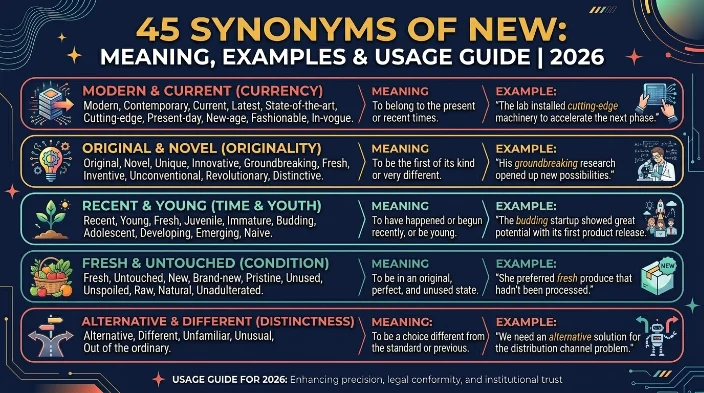
New means something that has just been made, discovered, or started. The best synonyms include fresh, recent, modern, novel, original, brand-new, up-to-date, and innovative. The most common everyday synonym is fresh, while recent works best for time-related contexts. Each synonym has a slightly different meaning, tone, or context, so choose carefully based on your situation.
Top 10 Synonyms
- Fresh
- Recent
- Modern
- Novel
- Original
- Brand-new
- Up-to-date
- Innovative
- Contemporary
- Latest
Every synonym has a slightly different meaning, tone, or context, so choose carefully based on your situation.
Do you realize how often you use the word “new”? It’s everywhere in English, but overusing it makes your writing sound repetitive and unimaginative.
Learning synonyms for “new” helps you express yourself more precisely. Whether you’re describing a new product, a recent experience, or a modern idea, having the right word makes your English sound more natural and impressive.
In this guide, you’ll discover 35 powerful alternatives to “new.” You’ll learn their meanings, when to use them, and which ones native speakers prefer in different situations. Let’s begin!
What Does “New” Mean?
Definition
New means something that has not existed before, has just been made, or has recently been discovered. It describes things that are different from what came before.
In everyday terms, think of “new” like a fresh start. A new shirt hasn’t been worn. A new idea hasn’t been thought before. A new day is just beginning.
New can describe:
- Physical objects (“I bought a new phone”)
- Ideas and concepts (“She has a new way of thinking”)
- Experiences (“This is a new feeling for me”)
- Time and recentness (“The new year started”)
Pronunciation
| Feature | Value |
|---|---|
| US IPA | /nuː/ |
| UK IPA | /njuː/ |
| Syllables | 1 |
| Tip | Say it with a clear ‘n’ sound |
Grammar
| Grammar Feature | Information |
|---|---|
| Part of Speech | Adjective |
| Common Position | Before a noun or after a linking verb |
| Typical Pattern | new + noun |
Example Sentences:
- “She bought a new car yesterday.”
- “This idea feels new and exciting.”
- “We need new approaches to old problems.”
Grammar Notes: “New” is a one-syllable adjective. The comparative form is “newer” and the superlative is “newest.” It can also function as a noun (“the new” meaning new things or people).
Word Family
| Word | Part of Speech | Meaning |
|---|---|---|
| New | Adjective | Recently made or discovered |
| Newly | Adverb | Recently, freshly |
| Newness | Noun | The quality of being new |
| Renew | Verb | To make new again |
| Newish | Adjective | Somewhat new |
45 Synonyms of “New”
1. Fresh
Meaning: New and different; recently made or obtained.
Best Used For: Daily conversation, food, ideas, experiences.
Formality: Neutral
Tone: Positive, Refreshing
Frequency: ⭐⭐⭐⭐⭐ Very Common
CEFR Level: A2
Example Sentence 1: “We need fresh ideas for the project.”
Example Sentence 2: “The bakery sells fresh bread every morning.”
Usage Tip: “Fresh” is the most common everyday synonym. It suggests newness that feels good—like fresh air or fresh food. Use it for anything that feels revitalizing.
2. Recent
Meaning: Happening or done not long ago.
Best Used For: Time-related contexts, news, events.
Formality: Neutral
Tone: Time-focused, Practical
Frequency: ⭐⭐⭐⭐⭐ Very Common
CEFR Level: A2
Example Sentence 1: “The recent changes improved our workflow.”
Example Sentence 2: “We discussed recent developments in technology.”
Usage Tip: “Recent” is about time. Use it when you want to emphasize that something happened just a short time ago. It’s different from “new” because it only focuses on time.
3. Modern
Meaning: Relating to the present or recent times; using new ideas.
Best Used For: Design, technology, current trends.
Formality: Neutral
Tone: Contemporary, Progressive
Frequency: ⭐⭐⭐⭐⭐ Very Common
CEFR Level: A2
Example Sentence 1: “The office has a modern design.”
Example Sentence 2: “They use modern teaching methods.”
Usage Tip: “Modern” suggests something fits the current time. Use it for styles, technology, and approaches that feel up-to-date.
4. Novel
Meaning: New and unusual; different from anything before.
Best Used For: Academic writing, creative work, ideas.
Formality: Formal
Tone: Creative, Unusual
Frequency: ⭐⭐⭐⭐ Common
CEFR Level: B2
Example Sentence 1: “The researcher proposed a novel theory.”
Example Sentence 2: “The artist’s novel style attracted attention.”
Usage Tip: “Novel” is formal and suggests something unique. Use it for new ideas, approaches, or creative work. It’s stronger than just “new.”
5. Original
Meaning: New and different from anything that came before.
Best Used For: Creative work, ideas, inventions.
Formality: Neutral to Formal
Tone: Creative, Authentic
Frequency: ⭐⭐⭐⭐⭐ Very Common
CEFR Level: B1
Example Sentence 1: “She came up with an original idea.”
Example Sentence 2: “This is an original design, not a copy.”
Usage Tip: “Original” suggests something is the first of its kind. Use it for creative work and unique ideas. It’s a compliment!
6. Brand-new
Meaning: Completely new and never used before.
Best Used For: Products, items, physical things.
Formality: Informal
Tone: Exciting, Fresh
Frequency: ⭐⭐⭐⭐⭐ Very Common
CEFR Level: B1
Example Sentence 1: “She bought a brand-new car.”
Example Sentence 2: “The house has brand-new appliances.”
Usage Tip: “Brand-new” is casual and emphasizes that something is completely unused. Use it for physical objects. It’s more emphatic than just “new.”
7. Up-to-date
Meaning: Having the most current information, ideas, or technology.
Best Used For: Technology, information, knowledge.
Formality: Neutral
Tone: Current, Informed
Frequency: ⭐⭐⭐⭐ Common
CEFR Level: B1
Example Sentence 1: “Our software is fully up-to-date.”
Example Sentence 2: “She keeps her knowledge up-to-date.”
Usage Tip: “Up-to-date” is about being current. Use it for technology, information, and skills. It suggests you haven’t fallen behind.
8. Innovative
Meaning: Using new ideas or methods; creative and forward-thinking.
Best Used For: Technology, business, creative work.
Formality: Formal
Tone: Creative, Progressive
Frequency: ⭐⭐⭐⭐⭐ Very Common
CEFR Level: B2
Example Sentence 1: “The company is known for its innovative products.”
Example Sentence 2: “Her innovative approach solved the problem.”
Usage Tip: “Innovative” is a powerful positive word. Use it for creative solutions and forward-thinking ideas. It’s common in business and technology.
9. Contemporary
Meaning: Belonging to the present time; modern.
Best Used For: Art, design, writing, current culture.
Formality: Formal
Tone: Modern, Current
Frequency: ⭐⭐⭐⭐ Common
CEFR Level: B2
Example Sentence 1: “The museum features contemporary art.”
Example Sentence 2: “She writes contemporary fiction.”
Usage Tip: “Contemporary” is formal and suggests current style. Use it for art, design, and culture. It’s similar to “modern” but often more specific.
10. Latest
Meaning: The most recent or newest.
Best Used For: News, technology, products, trends.
Formality: Neutral
Tone: Current, Exciting
Frequency: ⭐⭐⭐⭐⭐ Very Common
CEFR Level: A2
Example Sentence 1: “Have you seen the latest news?”
Example Sentence 2: “The latest model has better features.”
Usage Tip: “Latest” is about being the most recent. Use it for news, technology, and products. It’s always the newest among a group.
11. Fresh
Meaning: New and different; recently made or obtained.
Best Used For: Daily conversation, food, ideas, experiences.
Formality: Neutral
Tone: Positive, Refreshing
Frequency: ⭐⭐⭐⭐⭐ Very Common
CEFR Level: A2
Example Sentence 1: “We need fresh ideas for the project.”
Example Sentence 2: “The bakery sells fresh bread every morning.”
Usage Tip: “Fresh” is the most common everyday synonym. It suggests newness that feels good like fresh air or fresh food. Use it for anything that feels revitalizing.
12. Recent
Meaning: Happening or done not long ago.
Best Used For: Time-related contexts, news, events.
Formality: Neutral
Tone: Time-focused, Practical
Frequency: ⭐⭐⭐⭐⭐ Very Common
CEFR Level: A2
Example Sentence 1: “The recent changes improved our workflow.”
Example Sentence 2: “We discussed recent developments in technology.”
Usage Tip: “Recent” is about time. Use it when you want to emphasize that something happened just a short time ago. It’s different from “new” because it only focuses on time.
13. Modern
Meaning: Relating to the present or recent times; using new ideas.
Best Used For: Design, technology, current trends.
Formality: Neutral
Tone: Contemporary, Progressive
Frequency: ⭐⭐⭐⭐⭐ Very Common
CEFR Level: A2
Example Sentence 1: “The office has a modern design.”
Example Sentence 2: “They use modern teaching methods.”
Usage Tip: “Modern” suggests something fits the current time. Use it for styles, technology, and approaches that feel up-to-date.
14. Novel
Meaning: New and unusual; different from anything before.
Best Used For: Academic writing, creative work, ideas.
Formality: Formal
Tone: Creative, Unusual
Frequency: ⭐⭐⭐⭐ Common
CEFR Level: B2
Example Sentence 1: “The researcher proposed a novel theory.”
Example Sentence 2: “The artist’s novel style attracted attention.”
Usage Tip: “Novel” is formal and suggests something unique. Use it for new ideas, approaches, or creative work. It’s stronger than just “new.”
15. Original
Meaning: New and different from anything that came before.
Best Used For: Creative work, ideas, inventions.
Formality: Neutral to Formal
Tone: Creative, Authentic
Frequency: ⭐⭐⭐⭐⭐ Very Common
CEFR Level: B1
Example Sentence 1: “She came up with an original idea.”
Example Sentence 2: “This is an original design, not a copy.”
Usage Tip: “Original” suggests something is the first of its kind. Use it for creative work and unique ideas. It’s a compliment!
16. Brand-new
Meaning: Completely new and never used before.
Best Used For: Products, items, physical things.
Formality: Informal
Tone: Exciting, Fresh
Frequency: ⭐⭐⭐⭐⭐ Very Common
CEFR Level: B1
Example Sentence 1: “She bought a brand-new car.”
Example Sentence 2: “The house has brand-new appliances.”
Usage Tip: “Brand-new” is casual and emphasizes that something is completely unused. Use it for physical objects. It’s more emphatic than just “new.”
17. Up-to-date
Meaning: Having the most current information, ideas, or technology.
Best Used For: Technology, information, knowledge.
Formality: Neutral
Tone: Current, Informed
Frequency: ⭐⭐⭐⭐ Common
CEFR Level: B1
Example Sentence 1: “Our software is fully up-to-date.”
Example Sentence 2: “She keeps her knowledge up-to-date.”
Usage Tip: “Up-to-date” is about being current. Use it for technology, information, and skills. It suggests you haven’t fallen behind.
18. Innovative
Meaning: Using new ideas or methods; creative and forward-thinking.
Best Used For: Technology, business, creative work.
Formality: Formal
Tone: Creative, Progressive
Frequency: ⭐⭐⭐⭐⭐ Very Common
CEFR Level: B2
Example Sentence 1: “The company is known for its innovative products.”
Example Sentence 2: “Her innovative approach solved the problem.”
Usage Tip: “Innovative” is a powerful positive word. Use it for creative solutions and forward-thinking ideas. It’s common in business and technology.
19. Contemporary
Meaning: Belonging to the present time; modern.
Best Used For: Art, design, writing, current culture.
Formality: Formal
Tone: Modern, Current
Frequency: ⭐⭐⭐⭐ Common
CEFR Level: B2
Example Sentence 1: “The museum features contemporary art.”
Example Sentence 2: “She writes contemporary fiction.”
Usage Tip: “Contemporary” is formal and suggests current style. Use it for art, design, and culture. It’s similar to “modern” but often more specific.
20. Latest
Meaning: The most recent or newest.
Best Used For: News, technology, products, trends.
Formality: Neutral
Tone: Current, Exciting
Frequency: ⭐⭐⭐⭐⭐ Very Common
CEFR Level: A2
Example Sentence 1: “Have you seen the latest news?”
Example Sentence 2: “The latest model has better features.”
Usage Tip: “Latest” is about being the most recent. Use it for news, technology, and products. It’s always the newest among a group.
21. Freshly-minted
Meaning: Completely new and just created.
Best Used For: Graduates, new products, new ideas.
Formality: Informal to Neutral
Tone: Exciting, Fresh
Frequency: ⭐⭐⭐ Moderate
CEFR Level: B2
Example Sentence 1: “The company hired freshly-minted graduates.”
Example Sentence 2: “Her freshly-minted ideas impressed the team.
Usage Tip: “Freshly-minted” is a playful way to say something is brand new. Use it for people just starting out or new creations.
22. Current
Meaning: Happening or existing now.
Best Used For: Events, information, technology.
Formality: Neutral
Tone: Present, Ongoing
Frequency: ⭐⭐⭐⭐⭐ Very Common
CEFR Level: A2
Example Sentence 1: “She read a book about current events.”
Example Sentence 2: “We need to stay current with technology.”
Usage Tip: “Current” is about the present time. Use it for things that are happening now. It’s different from “new” because it emphasizes the present moment.
23. Cutting-edge
Meaning: Very new and advanced.
Best Used For: Technology, science, research.
Formality: Informal
Tone: Advanced, Exciting
Frequency: ⭐⭐⭐⭐ Common
CEFR Level: B2
Example Sentence 1: “The lab uses cutting-edge equipment.”
Example Sentence 2: “The company develops cutting-edge technology.”
Usage Tip: “Cutting-edge” is a strong, positive word. Use it for the newest and most advanced technology or ideas. It suggests being ahead of the competition.
24. State-of-the-art
Meaning: Using the newest and most advanced technology.
Best Used For: Equipment, technology, facilities.
Formality: Formal
Tone: Advanced, Impressive
Frequency: ⭐⭐⭐⭐ Common
CEFR Level: B2
Example Sentence 1: “The hospital has state-of-the-art equipment.
Example Sentence 2: “Their facility is state-of-the-art.”
Usage Tip: “State-of-the-art” is formal and impressive. Use it for the best and newest technology. It’s stronger than just “new.”
25. Fresh
Meaning: New and different; recently made or obtained.
Best Used For: Daily conversation, food, ideas, experiences.
Formality: Neutral
Tone: Positive, Refreshing
Frequency: ⭐⭐⭐⭐⭐ Very Common
CEFR Level: A2
Example Sentence 1: “We need fresh ideas for the project.”
Example Sentence 2: “The bakery sells fresh bread every morning.”
Usage Tip: “Fresh” is the most common everyday synonym. It suggests newness that feels good—like fresh air or fresh food. Use it for anything that feels revitalizing.
26. Recent
Meaning: Happening or done not long ago.
Best Used For: Time-related contexts, news, events.
Formality: Neutral
Tone: Time-focused, Practical
Frequency: ⭐⭐⭐⭐⭐ Very Common
CEFR Level: A2
Example Sentence 1: “The recent changes improved our workflow.”
Example Sentence 2: “We discussed recent developments in technology.”
Usage Tip: “Recent” is about time. Use it when you want to emphasize that something happened just a short time ago. It’s different from “new” because it only focuses on time.
27. Modern
Meaning: Relating to the present or recent times; using new ideas.
Best Used For: Design, technology, current trends.
Formality: Neutral
Tone: Contemporary, Progressive
Frequency: ⭐⭐⭐⭐⭐ Very Common
CEFR Level: A2
Example Sentence 1: “The office has a modern design.”
Example Sentence 2: “They use modern teaching methods.”
Usage Tip: “Modern” suggests something fits the current time. Use it for styles, technology, and approaches that feel up-to-date.
28. Novel
Meaning: New and unusual; different from anything before.
Best Used For: Academic writing, creative work, ideas.
Formality: Formal
Tone: Creative, Unusual
Frequency: ⭐⭐⭐⭐ Common
CEFR Level: B2
Example Sentence 1: “The researcher proposed a novel theory.”
Example Sentence 2: “The artist’s novel style attracted attention.”
Usage Tip: “Novel” is formal and suggests something unique. Use it for new ideas, approaches, or creative work. It’s stronger than just “new.”
29. Original
Meaning: New and different from anything that came before.
Best Used For: Creative work, ideas, inventions.
Formality: Neutral to Formal
Tone: Creative, Authentic
Frequency: ⭐⭐⭐⭐⭐ Very Common
CEFR Level: B1
Example Sentence 1: “She came up with an original idea.”
Example Sentence 2: “This is an original design, not a copy.”
Usage Tip: “Original” suggests something is the first of its kind. Use it for creative work and unique ideas. It’s a compliment!
30. Brand-new
Meaning: Completely new and never used before.
Best Used For: Products, items, physical things.
Formality: Informal
Tone: Exciting, Fresh
Frequency: ⭐⭐⭐⭐⭐ Very Common
CEFR Level: B1
Example Sentence 1: “She bought a brand-new car.”
Example Sentence 2: “The house has brand-new appliances.”
Usage Tip: “Brand-new” is casual and emphasizes that something is completely unused. Use it for physical objects. It’s more emphatic than just “new.”
31. Up-to-date
Meaning: Having the most current information, ideas, or technology.
Best Used For: Technology, information, knowledge.
Formality: Neutral
Tone: Current, Informed
Frequency: ⭐⭐⭐⭐ Common
CEFR Level: B1
Example Sentence 1: “Our software is fully up-to-date.”
Example Sentence 2: “She keeps her knowledge up-to-date.”
Usage Tip: “Up-to-date” is about being current. Use it for technology, information, and skills. It suggests you haven’t fallen behind.
32. Innovative
Meaning: Using new ideas or methods; creative and forward-thinking.
Best Used For: Technology, business, creative work.
Formality: Formal
Tone: Creative, Progressive
Frequency: ⭐⭐⭐⭐⭐ Very Common
CEFR Level: B2
Example Sentence 1: “The company is known for its innovative products.”
Example Sentence 2: “Her innovative approach solved the problem.”
Usage Tip: “Innovative” is a powerful positive word. Use it for creative solutions and forward-thinking ideas. It’s common in business and technology.
33. Contemporary
Meaning: Belonging to the present time; modern.
Best Used For: Art, design, writing, current culture.
Formality: Formal
Tone: Modern, Current
Frequency: ⭐⭐⭐⭐ Common
CEFR Level: B2
Example Sentence 1: “The museum features contemporary art.”
Example Sentence 2: “She writes contemporary fiction.”
Usage Tip: “Contemporary” is formal and suggests current style. Use it for art, design, and culture. It’s similar to “modern” but often more specific.
34. Latest
Meaning: The most recent or newest.
Best Used For: News, technology, products, trends.
Formality: Neutral
Tone: Current, Exciting
Frequency: ⭐⭐⭐⭐⭐ Very Common
CEFR Level: A2
Example Sentence 1: “Have you seen the latest news?”
Example Sentence 2: “The latest model has better features.”
Usage Tip: “Latest” is about being the most recent. Use it for news, technology, and products. It’s always the newest among a group.
35. Freshly-minted
Meaning: Completely new and just created.
Best Used For: Graduates, new products, new ideas.
Formality: Informal to Neutral
Tone: Exciting, Fresh
Frequency: ⭐⭐⭐ Moderate
CEFR Level: B2
Example Sentence 1: “The company hired freshly-minted graduates.”
Example Sentence 2: “Her freshly-minted ideas impressed the team.”
Usage Tip: “Freshly-minted” is a playful way to say something is brand new. Use it for people just starting out or new creations.
Synonyms Comparison Table
| Synonym | Best Context | Formality | Tone | Frequency |
|---|---|---|---|---|
| Fresh | Daily use | Neutral | Positive | ⭐⭐⭐⭐⭐ |
| Recent | Time | Neutral | Practical | ⭐⭐⭐⭐⭐ |
| Modern | Design/tech | Neutral | Progressive | ⭐⭐⭐⭐⭐ |
| Novel | Academic | Formal | Creative | ⭐⭐⭐⭐ |
| Original | Creative work | Neutral | Authentic | ⭐⭐⭐⭐⭐ |
| Brand-new | Products | Informal | Exciting | ⭐⭐⭐⭐⭐ |
| Up-to-date | Tech/info | Neutral | Current | ⭐⭐⭐⭐ |
| Innovative | Business/tech | Formal | Creative | ⭐⭐⭐⭐⭐ |
| Contemporary | Art/design | Formal | Modern | ⭐⭐⭐⭐ |
| Latest | News/products | Neutral | Exciting | ⭐⭐⭐⭐⭐ |
Best Synonyms by Situation
| Situation | Best Synonym | Why It Works |
|---|---|---|
| Daily Conversation | Fresh, Brand-new | Natural and clear |
| Resume | Innovative, Original | Shows creativity |
| Business Report | Up-to-date, Contemporary | Professional and current |
| Academic Writing | Novel, Original | Formal and precise |
| Technology | Cutting-edge, State-of-the-art | Emphasizes advancement |
| Creative Work | Original, Fresh | Shows uniqueness |
| News | Recent, Latest | Time-focused |
| Product Launch | Brand-new, Innovative | Exciting and impressive |
| Art/Design | Contemporary, Modern | Style-appropriate |
| Marketing | Innovative, Cutting-edge | Persuasive |
Formal vs Informal Synonyms
Formal Alternatives
| Synonym | Best Used For |
|---|---|
| Novel | Academic, research |
| Contemporary | Art, culture |
| Innovative | Business, technology |
| Original | Academic, creative |
| State-of-the-art | Technology, facilities |
Neutral Alternatives
| Synonym | Best Used For |
|---|---|
| Fresh | Daily use |
| Recent | Time contexts |
| Modern | General use |
| Current | Present time |
| Up-to-date | Information, tech |
Informal Alternatives
| Synonym | Best Used For |
|---|---|
| Brand-new | Products, objects |
| Cutting-edge | Technology |
| Freshly-minted | New graduates, ideas |
| Latest | News, products |
When to choose each level: Use formal synonyms for academic papers, business reports, and official documents. Use neutral synonyms for everyday writing and most professional contexts. Use informal synonyms in casual conversations and creative writing.
Strong vs Mild Synonyms
Mild (Everyday Situations)
- Fresh
- Recent
- Current
- New
- Modern
Moderate (More Expressive)
- Original
- Contemporary
- Up-to-date
- Latest
- Brand-new
Strong (High-Intensity)
- Innovative
- Cutting-edge
- State-of-the-art
- Novel
- Groundbreaking
Remember: Stronger doesn’t always mean better. “Cutting-edge” sounds impressive but might be too dramatic for a simple new idea. Choose the intensity that matches your situation.
Real-Life Examples
In the Office
“Our team introduced fresh ideas for the marketing campaign.”
In a Business Report
“The company invested in cutting-edge technology to stay competitive.”
In Technology
“The state-of-the-art system handles data much faster.”
In Education
“Her novel approach to teaching engaged all the students.”
In Daily Conversation
“I bought a brand-new laptop last week.”
In Art
“The museum displays contemporary works by local artists.”
In News
“Have you heard the latest developments?”
Common Collocations
| Common Phrase | Better Alternative |
|---|---|
| New idea | Fresh idea, Original idea |
| New technology | Cutting-edge technology, Innovative technology |
| New product | Brand-new product, Latest product |
| New approach | Novel approach, Fresh approach |
| New design | Modern design, Contemporary design |
| New information | Up-to-date information, Current information |
| New equipment | State-of-the-art equipment |
Common Phrases
- “Brand new” – Meaning: Completely new. Instead of “new,” say “brand-new” for emphasis.
- “Fresh start” – Meaning: A new beginning. Instead of “new start,” say “fresh start.”
- “Cutting edge” – Meaning: Very advanced. Instead of “new,” say “cutting-edge” for technology.
- “Up to date” – Meaning: Current. Instead of “new,” say “up-to-date” for information.
Context Guide
| Situation | Best Synonym | Reason |
|---|---|---|
| Essay | Novel, Original | Formal and academic |
| Speech | Fresh, Innovative | Engaging and positive |
| Business Email | Up-to-date, Current | Professional and clear |
| Novel | Original, Fresh | Creative and descriptive |
| Presentation | Cutting-edge, Innovative | Impressive and confident |
| Conversation | Fresh, Brand-new | Natural and easy |
| Academic Writing | Novel, Original | Scholarly and precise |
| Marketing Copy | Innovative, State-of-the-art | Persuasive and impressive |
Related Words
Near Synonyms
- Fresh: New and different
- Recent: Not long ago
- Modern: Current times
- Novel: New and unusual
Antonyms
- Old: Not new
- Ancient: Very old
- Outdated: No longer current
- Traditional: Following old ways
Related Adjectives
- Modern: Current times
- Contemporary: Present time
- Recent: Not long ago
- Current: Happening now
Related Nouns
- Newness: The quality of being new
- Novelty: The quality of being new and interesting
- Innovation: A new method or idea
- Modernity: The quality of being modern
Related Verbs
- Renew: To make new again
- Refresh: To make something feel new
- Update: To bring up to date
- Innovate: To introduce new ideas
Frequently Asked Questions
What is another word for new?
The best alternatives are fresh, recent, modern, novel, original, brand-new, up-to-date, and innovative. The most common everyday synonym is fresh, which works in almost any context. For time-related contexts, recent is excellent.
Which synonym sounds the most professional?
Innovative, original, and cutting-edge sound the most professional. Innovative is common in business, while original works well in academic contexts. For technology, state-of-the-art is highly professional.
What is the strongest synonym for new?
Innovative and cutting-edge are among the strongest alternatives. Groundbreaking and revolutionary are even stronger but can sound dramatic. Use them carefully for truly exceptional things.
Which synonym is best for essays?
Novel, original, and contemporary work best in academic essays. They’re formal enough for academic writing while remaining clear and accessible. Avoid informal alternatives like brand-new in formal writing.
What’s the difference between new and novel?
Novel is more specific and formal. It suggests something is not just new but unusual and interesting. New is general and can describe anything that hasn’t existed before. Novel often implies creativity or originality.
Which synonym is most common in everyday English?
Fresh and brand-new are the most common everyday alternatives. Native speakers use these frequently in conversation. Fresh is especially common for ideas, food, and experiences.
What is the opposite of new?
The most common opposites are old, ancient, outdated, and traditional. These words describe things that are not new or no longer current.
Is “new” an adjective or noun?
“New” is primarily an adjective. However, it can function as a noun in specific contexts, like “the new” (new things or people) or “the new and the old.”
Conclusion
Learning alternatives to “new” helps you express yourself more precisely and naturally. The right word depends on your context, audience, and what you want to emphasize.
For everyday situations, fresh and brand-new are your safest choices. They’re natural, clear, and work in almost any context. For professional writing, innovative, original, and cutting-edge will help you sound more impressive. For academic contexts, novel and contemporary are excellent choices.
Remember these key principles:
- Formal situations need formal words like novel, contemporary, or state-of-the-art
- Neutral situations work well with fresh, recent, or modern
- Informal situations let you use brand-new or latest
