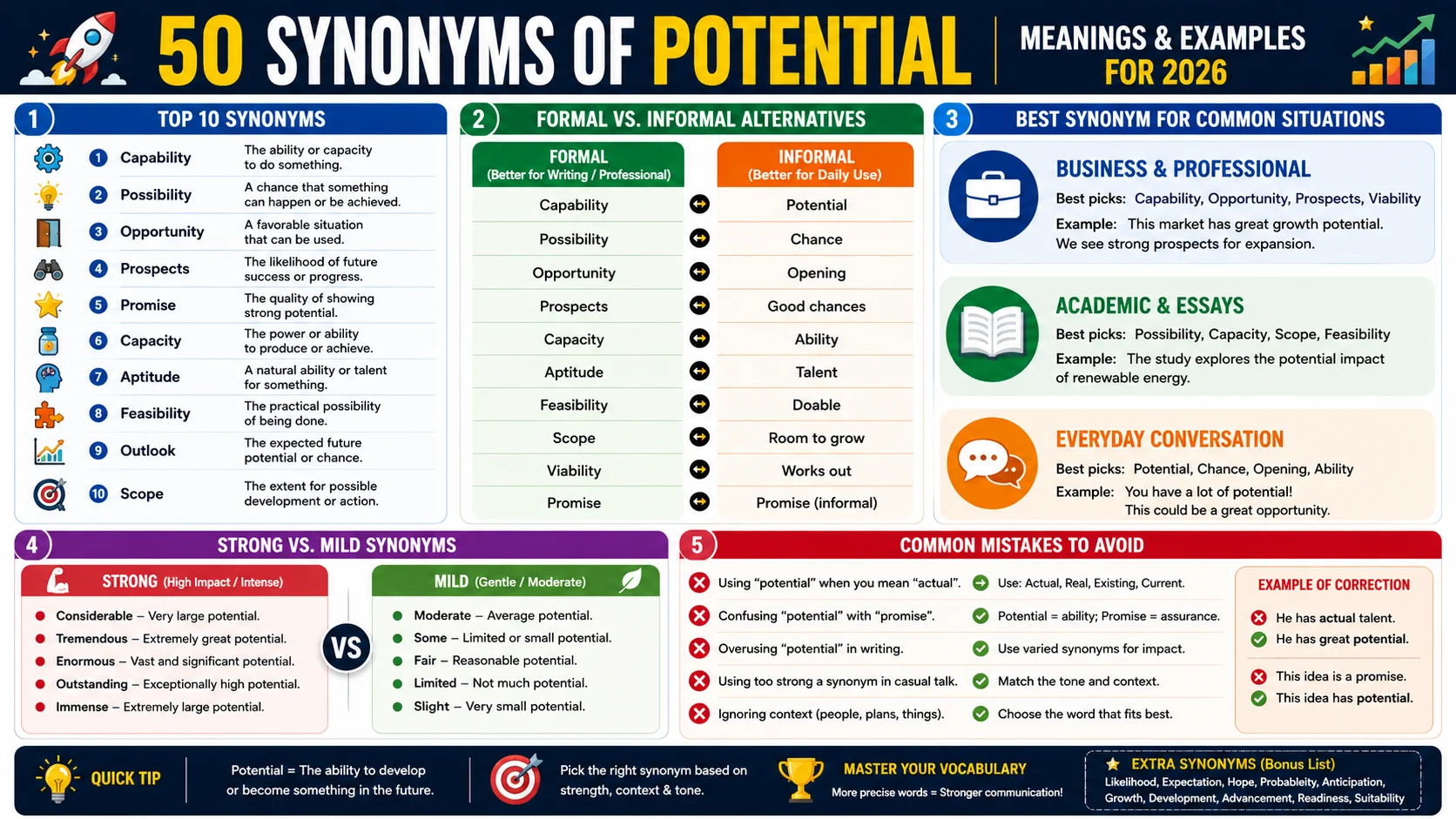
“Potential” means the ability to become something in the future or the possibility for success. The best synonyms are possibility, promise, capability, capacity, and aptitude. “Possibility” is the most common natural alternative. Each synonym has a slightly different meaning and context where it fits best.
Top 10 Synonyms
- Possibility
- Promise
- Capability
- Capacity
- Aptitude
- Talent
- Ability
- Prospect
- Likelihood
- Potentiality
“Potential” is a word filled with hope and possibility. We talk about the potential of a student, the potential of a business, or the potential of an idea. But using it too often can make your English feel repetitive.
Think about it. You can describe someone’s potential, a product’s potential, or the potential for success. Each situation might need a different word that captures the specific type of possibility.
In this guide, you’ll learn 35 powerful synonyms for “potential.” You’ll discover exactly when to use each one, how formal they are, and what common mistakes to avoid. Let’s begin!
What Does “Potential” Mean?
Definition
Potential” means the ability or possibility to become something in the future. It’s about what could happen, not what is happening now. When someone has potential, they have the ability to succeed or develop in the future.
Pronunciation
| Feature | Value |
|---|---|
| US IPA | /pəˈtɛnʃəl/ |
| UK IPA | /pəˈtɛnʃəl/ |
| Syllables | 3 (po-ten-tial) |
| Tip | Stress the second syllable: “puh-TEN-shul” |
Grammar
| Grammar Feature | Information |
|---|---|
| Part of Speech | Noun and Adjective |
| Common Position | Subject or object (noun); before a noun (adjective) |
| Typical Pattern | Potential + for + something / Potential + of + something |
Examples:
- “She has great potential as a musician.” (noun)
- “This is a potential problem.” (adjective)
- “The potential for growth is huge.” (noun)
Grammar Note: “Potential” can be a noun (the possibility) or an adjective (possible but not yet real).
Word Family
| Word | Part of Speech | Meaning |
|---|---|---|
| Potential | Noun/Adjective | Ability or possibility |
| Potentially | Adverb | In a possible way |
| Potentiality | Noun | The quality of being potential |
| Potent | Adjective | Powerful and strong |
15 Synonyms of “Potential”
Possibility
Meaning: Something that may happen or exist.
Best Used For: General situations, future events.
Formality: Neutral
Tone: Hopeful, Open
Frequency: ⭐⭐⭐⭐⭐ (Very Common)
CEFR Level: A2
Example Sentence 1: “There is a possibility of rain tomorrow.”
Example Sentence 2: “The possibility of success is high.”
Usage Tip: “Possibility” is the most direct synonym. Use it for any situation where something could happen.
Common Confusion: Possibility vs Potential. “Possibility” is broader and can be about any chance. “Potential” often suggests the ability to develop or grow.
Promise
Meaning: A sign that someone or something will be successful.
Best Used For: People, projects, careers.
Formality: Neutral
Tone: Hopeful, Positive
Frequency: ⭐⭐⭐⭐ (Common)
CEFR Level: B2
Example Sentence 1: “She shows great promise as a young artist.”
Example Sentence 2: “The new product shows promise.”
Usage Tip: “Promise” suggests a strong chance of future success. Use it for talented people or promising opportunities.
Capability
Meaning: The power or ability to do something.
Best Used For: Skills, abilities, machines.
Formality: Formal
Tone: Professional, Practical
Frequency: ⭐⭐⭐⭐ (Common)
CEFR Level: B2
Example Sentence 1: “She has the capability to lead the team.”
Example Sentence 2: “The system has the capability to process large amounts of data.”
Usage Tip: “Capability” emphasizes practical ability. Use it for skills and performance.
Capacity
Meaning: The ability to contain, hold, or do something.
Best Used For: Minds, people, containers.
Formality: Formal
Tone: Measurable, Practical
Frequency: ⭐⭐⭐⭐ (Common)
CEFR Level: B2
Example Sentence 1: “She has a great capacity for learning.”
Example Sentence 2: “The capacity of the room is 200 people.”
Usage Tip: “Capacity” suggests the maximum ability. Use it for mental or physical limits.
Aptitude
Meaning: A natural ability to learn or do something.
Best Used For: Skills, education, talents.
Formality: Formal
Tone: Natural, Gifted
Frequency: ⭐⭐⭐ (Moderate)
CEFR Level: C1
Example Sentence 1: “She has an aptitude for mathematics.”
Example Sentence 2: “His aptitude for languages is impressive.”
Usage Tip: “Aptitude” suggests natural talent. Use it for innate abilities.
Talent
Meaning: A natural ability or skill.
Best Used For: People, performances, creative work.
Formality: Neutral
Tone: Gifted, Creative
Frequency: ⭐⭐⭐⭐⭐ (Very Common)
CEFR Level: A2
Example Sentence 1: “She has a talent for singing.”
Example Sentence 2: “His talent is obvious to everyone.”
Usage Tip: “Talent” suggests a natural ability. Use it for gifts and skills.
Ability
Meaning: The power or skill to do something.
Best Used For: General skills, everyday abilities.
Formality: Neutral
Tone: Capable, Practical
Frequency: ⭐⭐⭐⭐⭐ (Very Common)
CEFR Level: A2
Example Sentence 1: “She has the ability to solve problems.”
Example Sentence 2: “His ability to learn is amazing.”
Usage Tip: “Ability” is the most general word for skills. Use it for any capability.
Prospect
Meaning: The possibility of future success.
Best Used For: Business, careers, future plans.
Formality: Neutral
Tone: Future-focused, Hopeful
Frequency: ⭐⭐⭐⭐ (Common)
CEFR Level: B2
Example Sentence 1: “The job has excellent prospects.
Example Sentence 2: “His prospects for promotion are good.”
Usage Tip: “Prospect” suggests future opportunities. Use it for careers and business.
Likelihood
Meaning: The chance that something will happen.
Best Used For: Probability, predictions.
Formality: Formal
Tone: Analytical, Probable
Frequency: ⭐⭐⭐ (Moderate)
CEFR Level: B2
Example Sentence 1: “There is a high likelihood of success.”
Example Sentence 2: “The likelihood of rain is low.”
Usage Tip: “Likelihood” emphasizes probability. Use it for statistical or chance-based situations.
Potentiality
Meaning: The quality of being potential; latent ability.
Best Used For: Philosophical, formal contexts.
Formality: Very Formal
Tone: Abstract, Philosophical
Frequency: ⭐ (Very Rare)
CEFR Level: C1
Example Sentence 1: “The potentiality for growth is enormous.”
Example Sentence 2: “He explored the potentiality of the idea.”
Usage Tip: “Potentiality” is very formal and rare. Use it only in formal or philosophical contexts.
Promise (as a noun)
Meaning: Evidence of future success.
Best Used For: People, talents, abilities.
Formality: Neutral
Tone: Hopeful, Positive
Frequency: ⭐⭐⭐⭐ (Common)
CEFR Level: B2
Example Sentence 1: “The young athlete shows promise.”
Example Sentence 2: “Her early work shows great promise.”
Usage Tip: “Promise” suggests potential that is visible. Use it for people and their abilities.
Faculty
Meaning: An inherent mental or physical power.
Best Used For: Minds, intelligence, senses.
Formality: Formal
Tone: Intellectual, Capable
Frequency: ⭐⭐ (Rare)
CEFR Level: C1
Example Sentence 1: “She has the faculty for learning languages.”
Example Sentence 2: “His mental faculties are sharp.”
Usage Tip: “Faculty” is a formal word for mental or physical abilities.
Wherewithal
Meaning: The money, resources, or ability to do something.
Best Used For: Finance, resources, capability.
Formality: Formal
Tone: Resourceful, Capable
Frequency: ⭐⭐ (Rare)
CEFR Level: C1
Example Sentence 1: “She has the wherewithal to start her own business.”
Example Sentence 2: “He lacked the wherewithal to complete the project.
Usage Tip: “Wherewithal” suggests having the necessary resources. Use it for financial or practical contexts.
Gift
Meaning: A natural ability or talent.
Best Used For: People, skills, creativity.
Formality: Neutral
Tone: Special, Talented
Frequency: ⭐⭐⭐⭐ (Common)
CEFR Level: B2
Example Sentence 1: “She has a gift for making people feel comfortable.”
Example Sentence 2: “His gift for music is extraordinary.”
Usage Tip: “Gift” is a warm word for natural talent. Use it for special abilities.
Knack
Meaning: A natural skill or talent.
Best Used For: Informal contexts, specific skills.
Formality: Informal
Tone: Natural, Easy
Frequency: ⭐⭐⭐ (Moderate)
CEFR Level: B2
Example Sentence 1: “She has a knack for solving problems.”
Example Sentence 2: “He has a knack for making friends.”
Usage Tip: “Knack” is informal. Use it for natural talents in casual conversation.
Synonyms Comparison Table
| Synonym | Best Context | Formality | Tone | Frequency |
|---|---|---|---|---|
| Possibility | General chances | Neutral | Hopeful | ⭐⭐⭐⭐⭐ |
| Ability | General skills | Neutral | Capable | ⭐⭐⭐⭐⭐ |
| Talent | Natural gifts | Neutral | Gifted | ⭐⭐⭐⭐⭐ |
| Capability | Professional skills | Formal | Practical | ⭐⭐⭐⭐ |
| Promise | Future success | Neutral | Hopeful | ⭐⭐⭐⭐ |
| Prospect | Career, business | Neutral | Future-focused | ⭐⭐⭐⭐ |
| Aptitude | Natural learning | Formal | Gifted | ⭐⭐⭐ |
| Capacity | Maximum ability | Formal | Measurable | ⭐⭐⭐⭐ |
| Likelihood | Probability | Formal | Analytical | ⭐⭐⭐ |
| Gift | Special talent | Neutral | Warm | ⭐⭐⭐⭐ |
Best Synonyms by Situation
| Situation | Best Synonym | Why It Works |
|---|---|---|
| Daily Conversation | Possibility | Natural and common |
| Business Email | Capability | Professional and clear |
| Academic Writing | Capacity | Formal and precise |
| School Assignment | Ability | Clear and simple |
| Professional Meeting | Prospect | Sounds professional |
| Presentation | Potential | Clear and motivating |
| Creative Writing | Promise | Adds literary depth |
| Social Media | Potential | Casual and relatable |
| Job Interview | Capability | Professional and confident |
Formal vs Informal Synonyms
Formal Alternatives
| Synonym | Best Used For |
|---|---|
| Capacity | Maximum ability |
| Capability | Professional ability |
| Aptitude | Natural learning ability |
| Potentiality | Philosophical contexts |
| Faculty | Intellectual powers |
Neutral Alternatives
| Synonym | Best Used For |
|---|---|
| Possibility | Most general situations |
| Ability | General skills |
| Talent | Natural gifts |
| Promise | Future success |
| Prospect | Future opportunities |
Informal Alternatives
| Synonym | Best Used For |
|---|---|
| Knack | Natural talent (casual) |
| Gift | Special ability |
| Potential | General use |
Choosing the Right Level: Use “capacity” and “aptitude” for formal writing. Use “possibility” and “ability” for most situations. Use “knack” and “gift” with friends.
Strong vs Mild Synonyms
Mild
Suitable for everyday situations with less intensity.
- Possibility
- Ability
- Likelihood
Moderate
More specific or professional alternatives.
- Talent
- Capability
- Promise
- Gift
Strong
High-intensity alternatives suggesting exceptional ability.
- Aptitude (natural talent)
- Capacity (maximum potential)
- Potentiality (philosophical depth)
How Intensity Changes Meaning: “She has ability” is general. “She has great capacity” suggests exceptional potential. Choose stronger words when you want to emphasize outstanding ability.
Real-Life Examples
School: “The teacher sees great potential in the student.”
Office: “She has the capability to lead the project.”
Business Email: “We need to consider the potential of this partnership.”
Meetings: “The prospect for growth is excellent.”
Presentations: “This product shows great promise.”
Daily Conversations: “He has a talent for music.”
Social Media: “Unlock your full potential!”
Academic Writing: “The study explores the potential of this treatment.”
Common Collocations
| Common Phrase | Better Alternative |
|---|---|
| Potential for | Possibility of |
| Great potential | Great promise |
| Human potential | Human capability |
| Potential candidate | Possible candidate |
| Growth potential | Growth prospects |
Common Phrases
Potential is endless: The possibilities are unlimited. (e.g., “Her potential is endless.”)
Realize potential: To achieve what you’re capable of. (e.g., “She realized her full potential.”)
Untapped potential: Ability not yet used. (e.g., “There’s untapped potential in the market.”)
Potential is limitless: No limits to ability. (e.g., “His potential is limitless.”)
Promise of something: The potential for success. (e.g., “The promise of a better future.”)
Context Guide
| Situation | Best Synonym | Reason |
|---|---|---|
| Essay | Capacity | Academic and formal |
| Speech | Potential | Inspiring and clear |
| Business Email | Capability | Professional and clear |
| Novel | Promise | Adds literary depth |
| Presentation | Potential | Clear and motivating |
| Conversation | Ability | Natural and relatable |
| Academic Writing | Capacity | Precise and formal |
| Marketing Copy | Potential | Engaging and hopeful |
Related Words
Near Synonyms
- Possibility: Something that could happen.
- Promise: A sign of future success.
- Capability: The ability to do something.
- Aptitude: Natural talent.
- Capacity: Maximum ability.
Antonyms
- Inability: Lack of ability.
- Impossibility: Cannot happen.
- Incapacity: Lack of capacity.
- Incompetence: Lack of skill.
- Ineptitude: Lack of ability.
Related Adjectives
- Potential: Possible but not yet real.
- Promising: Showing signs of success.
- Able: Having the ability.
- Capable: Having the skill.
- Talented: Having natural ability.
Related Nouns
- Ability: The power to do something.
- Talent: Natural skill.
- Capacity: Maximum ability.
- Capability: The power to do.
- Aptitude: Natural ability.
Related Verbs
- Develop: To grow potential.
- Realize: To achieve potential.
- Unlock: To release potential.
- Discover: To find potential.
- Explore: To examine potential.
Frequently Asked Questions
What is another word for potential?
Common synonyms include possibility, promise, capability, capacity, and aptitude. “Possibility” is the most common and direct alternative.
Which synonym sounds the most professional?
Capability and capacity sound very professional. “Aptitude” is excellent for educational contexts.
What is the strongest synonym for potential?
Aptitude and capacity are among the strongest synonyms. “Aptitude” suggests natural talent. “Capacity” suggests the maximum ability to hold or do something.
Which synonym is best for essays?
Capacity and potentiality are excellent for academic essays. They are formal and precise.
What’s the difference between potential and possibility?
“Potential” often suggests an ability to develop. “Possibility” is broader and includes any chance something could happen.
Which synonym is most common in everyday English?
“Possibility” and “ability” are very common in everyday speech. “Talent” is also frequently used.
What is the opposite of potential?
Common opposites are inability, impossibility, and incapacity. These words describe a lack of ability or possibility.
Conclusion
“Potential” is a word filled with hope and possibility, but now you have 35 fantastic alternatives. Each synonym adds a different shade of meaning to your language.
Remember, the key is understanding the context. Use “possibility” for general chances. Use “capability” for professional abilities. Use “talent” for natural gifts. Use “capacity” for maximum ability.
The best way to improve is practice. Try using one or two new synonyms each day. Listen for these words in conversations and books. Your vocabulary will become richer and more impressive with time.
