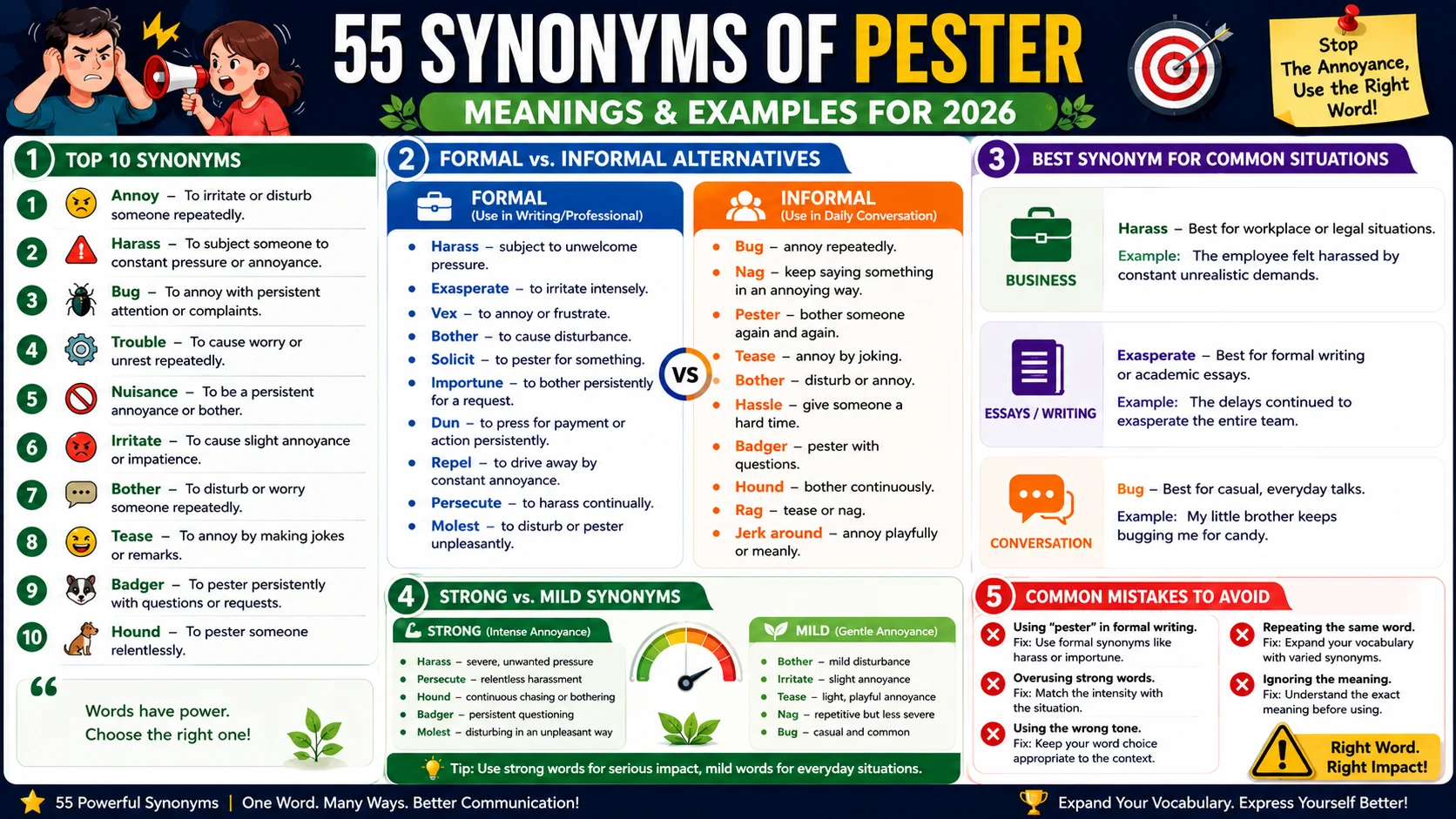
“Pester” means to annoy someone by asking them something repeatedly. The best synonyms are annoy, bother, harass, nag, and badger. “Annoy” is the most common natural alternative. Each synonym has a slightly different meaning and context where it fits best.
Top 10 Synonyms
- Annoy
- Bother
- Harass
- Nag
- Badger
- Tease
- Torment
- Provoke
- Irritate
- Bug
“Pester” is a word we all use. We’ve all been pestered by someone a child asking for candy, a friend asking for a favor, or a salesperson calling too often. It’s a useful word, but using it too much can make your English feel repetitive.
Think about it. You can pester someone with questions, pester them for money, or pester them to do something. Each situation might need a different word that captures the specific type of annoyance.
In this guide, you’ll learn 35 powerful synonyms for “pester.” You’ll discover exactly when to use each one, how formal they are, and what common mistakes to avoid. Let’s begin!
What Does “Pester” Mean?
Definition
Pester” means to annoy or bother someone repeatedly with requests, questions, or demands. It’s the kind of nagging that makes people feel frustrated or irritated. When you pester someone, you keep asking or bothering them even when they’ve already said no or shown they’re busy.
Pronunciation
| Feature | Value |
|---|---|
| US IPA | /ˈpɛstər/ |
| UK IPA | /ˈpɛstə/ |
| Syllables | 2 (pes-ter) |
| Tip | Stress the first syllable: “PES-ter” |
Grammar
| Grammar Feature | Information |
|---|---|
| Part of Speech | Verb (transitive) |
| Common Position | After the subject |
| Typical Pattern | Subject + pester + person + for/to + something |
Examples:
- “The children pestered their parents for candy.”
- “Stop pestering me with questions.”
- “He pesters his sister to borrow her car.”
Grammar Note: “Pester” is a transitive verb that needs an object. You pester someone, not just “pester.”
Word Family
| Word | Part of Speech | Meaning |
|---|---|---|
| Pester | Verb | To annoy with repeated requests |
| Pestering | Gerund/Adjective | The act of annoying repeatedly |
| Pesterer | Noun | A person who pesters others |
| Pesteringly | Adverb | In a pestering manner |
15 Synonyms of “Pester”
Annoy
Meaning: To make someone slightly angry or uncomfortable.
Best Used For: General situations, everyday annoyances.
Formality: Neutral
Tone: Mild, Irritating
Frequency: ⭐⭐⭐⭐⭐ (Very Common)
CEFR Level: A2
Example Sentence 1: “The loud music from next door started to annoy me.”
Example Sentence 2: “She finds it annoying when people interrupt her.”
Usage Tip: “Annoy” is the most common and versatile synonym. Use it for anything that bothers you mildly.
Common Confusion: Annoy vs Pester. “Annoy” is broader and can be any irritation. Pester” specifically means repeated bothering.
Bother
Meaning: To make someone feel worried, upset, or annoyed.
Best Used For: General everyday situations, casual contexts.
Formality: Neutral
Tone: Mild, Concerned
Frequency: ⭐⭐⭐⭐⭐ (Very Common)
CEFR Level: A2
Example Sentence 1: “Don’t bother me while I’m working.”
Example Sentence 2: “Would it bother you if I opened the window?”
Usage Tip: “Bother” is extremely common in everyday speech. It can mean “annoy” or “worry” depending on context.
Harass
Meaning: To repeatedly annoy or threaten someone, often in a hostile way.
Best Used For: Legal contexts, serious situations, workplace issues.
Formality: Formal
Tone: Serious, Hostile
Frequency: ⭐⭐⭐ (Moderate)
CEFR Level: B2
Example Sentence 1: “He was accused of harassing his coworkers.
Example Sentence 2: “She filed a complaint about online harassment.”
Usage Tip: “Harass” is much stronger than “pester.” Use it for serious, often illegal, repeated annoyance.
Nag
Meaning: To annoy someone by constantly criticizing or asking them to do something.
Best Used For: Personal relationships, family situations.
Formality: Informal
Tone: Complaining, Persistent
Frequency: ⭐⭐⭐⭐ (Common)
CEFR Level: B1
Example Sentence 1: “She nags him about cleaning his room every day.
Example Sentence 2: “Stop nagging me I’ll do it later.
Usage Tip: “Nag” is often used for personal situations, especially in families. It implies constant, annoying reminders.
Badger
Meaning: To pester someone into doing something through persistent questioning.
Best Used For: Journalists, police, persistent questioning.
Formality: Neutral
Tone: Persistent, Aggressive
Frequency: ⭐⭐⭐ (Moderate)
CEFR Level: B2
Example Sentence 1: “The reporters badgered the politician for answers.
Example Sentence 2: “She badgered me until I agreed to go.”
Usage Tip: “Badger” suggests persistent, often aggressive questioning. It’s more intense than “pester.”
Tease
Meaning: To make fun of someone in a playful or unkind way.
Best Used For: Friends, siblings, playful situations.
Formality: Informal
Tone: Playful, Annoying
Frequency: ⭐⭐⭐⭐⭐ (Very Common)
CEFR Level: A2
Example Sentence 1: “The older kids teased him about his haircut.”
Example Sentence 2: “She teases her brother about his cooking skills.”
Usage Tip: “Tease” can be playful or mean, depending on context. It’s usually not as serious as “pester.”
Torment
Meaning: To cause someone great mental or physical suffering.
Best Used For: Severe situations, bullying, intense annoyance.
Formality: Formal
Tone: Severe, Cruel
Frequency: ⭐⭐⭐ (Moderate)
CEFR Level: B2
Example Sentence 1: “The bullies tormented the new student.”
Example Sentence 2: “His guilt tormented him for years.
Usage Tip: “Torment” is much stronger than “pester.” Use it for causing real suffering.
Provoke
Meaning: To deliberately annoy or anger someone.
Best Used For: Arguments, conflicts, deliberate annoyance.
Formality: Formal
Tone: Deliberate, Confrontational
Frequency: ⭐⭐⭐ (Moderate)
CEFR Level: B2
Example Sentence 1: “He tried to provoke an argument with his comment.
Example Sentence 2: “Don’t provoke the dog it might bite.”
Usage Tip: “Provoke” is about deliberately causing a reaction. It’s often used for anger or conflict.
Irritate
Meaning: To make someone annoyed or angry.
Best Used For: Physical or emotional irritation.
Formality: Neutral
Tone: Mild, Bothersome
Frequency: ⭐⭐⭐⭐ (Common)
CEFR Level: B1
Example Sentence 1: “His constant tapping irritated me.”
Example Sentence 2: “The rough fabric irritated her skin.”
Usage Tip: “Irritate” is a very common synonym. It can be physical (skin) or emotional (annoyance).
Bug
Meaning: To annoy or bother someone.
Best Used For: Casual conversation, friends, everyday situations.
Formality: Informal
Tone: Casual, Annoying
Frequency: ⭐⭐⭐⭐ (Common)
CEFR Level: B1
Example Sentence 1: “Stop bugging me I’m trying to concentrate.”
Example Sentence 2: “His constant questions are bugging me.”
Usage Tip: “Bug” is a very casual, informal word for “annoy.” Use it with friends, not in formal writing.
Nuisance
Meaning: A person or thing that causes annoyance.
Best Used For: Legal contexts, formal complaints, describing annoyances.
Formality: Formal
Tone: Annoying, Troublesome
Frequency: ⭐⭐⭐ (Moderate)
CEFR Level: B2
Example Sentence 1: “The neighbor’s dog is becoming a nuisance.”
Example Sentence 2: “He filed a complaint about the noise nuisance.”
Usage Tip: “Nuisance” is a noun, not a verb. Use it to describe the person or thing that’s annoying.
Hound
Meaning: To chase or harass someone persistently.
Best Used For: Journalists, police, persistent pursuit.
Formality: Neutral
Tone: Persistent, Pressuring
Frequency: ⭐⭐⭐ (Moderate)
CEFR Level: B2
Example Sentence 1: “The paparazzi hounded the celebrity everywhere.”
Example Sentence 2: “He was hounded by the press for weeks.”
Usage Tip: “Hound” is stronger than “pester” and suggests being followed or pursued relentlessly.
Plague
Meaning: To cause continuous trouble or distress.
Best Used For: Problems, disasters, persistent difficulties.
Formality: Formal
Tone: Severe, Troublesome
Frequency: ⭐⭐ (Rare)
CEFR Level: C1
Example Sentence 1: “The country was plagued by drought.”
Example Sentence 2: “Financial problems plagued the company.”
Usage Tip: “Plague” is a strong word for ongoing problems. Use it for serious difficulties.
Go on at
Meaning: To keep complaining or asking about something.
Best Used For: Family, personal relationships, informal contexts.
Formality: Informal
Tone: Complaining, Persistent
Frequency: ⭐⭐ (Rare)
CEFR Level: B2
Example Sentence 1: “She goes on at me about getting a job.”
Example Sentence 2: “He’s always going on at me about my grades.
Usage Tip: “Go on at” is a British expression. It’s very informal and means to keep pestering.
Ride
Meaning: To annoy or tease someone persistently.
Best Used For: Friends, informal teasing, bullying.
Formality: Informal
Tone: Persistent, Annoying
Frequency: ⭐⭐ (Rare)
CEFR Level: B2
Example Sentence 1: “The older kids rode him about his accent.”
Example Sentence 2: “She always rides her brother about his clothes.”
Usage Tip: “Ride” is informal and means to tease or annoy persistently, often in a mean way.
Synonyms Comparison Table
| Synonym | Best Context | Formality | Tone | Frequency |
|---|---|---|---|---|
| Annoy | General irritation | Neutral | Mild | ⭐⭐⭐⭐⭐ |
| Bother | Everyday situations | Neutral | Mild | ⭐⭐⭐⭐⭐ |
| Nag | Family, personal | Informal | Complaining | ⭐⭐⭐⭐ |
| Bug | Casual conversation | Informal | Casual | ⭐⭐⭐⭐ |
| Irritate | Physical or emotional | Neutral | Mild | ⭐⭐⭐⭐ |
| Tease | Playful situations | Informal | Playful | ⭐⭐⭐⭐⭐ |
| Badger | Persistent questioning | Neutral | Persistent | ⭐⭐⭐ |
| Harass | Serious, legal issues | Formal | Hostile | ⭐⭐⭐ |
| Torment | Severe suffering | Formal | Cruel | ⭐⭐⭐ |
| Hound | Persistent pursuit | Neutral | Pressuring | ⭐⭐⭐ |
Best Synonyms by Situation
| Situation | Best Synonym | Why It Works |
|---|---|---|
| Daily Conversation | Bother / Bug | Natural and casual |
| Business Email | Annoy / Irritate | Professional and clear |
| Academic Writing | Harass / Provoke | Formal and precise |
| School Assignment | Annoy / Bother | Clear and appropriate |
| Professional Meeting | Annoy / Disrupt | Professional tone |
| Presentation | Avoid using (too negative) | Not appropriate |
| Creative Writing | Torment / Plague | Adds literary depth |
| Social Media | Bug / Nag | Casual and relatable |
| Legal Context | Harass | Serious and precise |
Formal vs Informal Synonyms
Formal Alternatives
| Synonym | Best Used For |
|---|---|
| Harass | Legal, workplace, serious situations |
| Torment | Severe, cruel situations |
| Provoke | Conflict, deliberate annoyance |
| Plague | Serious problems, disasters |
| Persecute | Systematic harassment |
Neutral Alternatives
| Synonym | Best Used For |
|---|---|
| Annoy | Most general situations |
| Bother | Everyday mild annoyance |
| Irritate | Physical or emotional irritation |
| Badger | Persistent questioning |
Informal Alternatives
| Synonym | Best Used For |
|---|---|
| Bug | Casual conversation |
| Nag | Family, personal contexts |
| Tease | Playful situations |
| Go on at | British, informal contexts |
Choosing the Right Level: Use “harass” or “torment” for serious, formal situations. Use “annoy” and “bother” for most everyday contexts. Use “bug” and “nag” only with friends and family.
Strong vs Mild Synonyms
Mild
Suitable for everyday situations with less intensity.
- Annoy
- Bother
- Irritate
- Bug
Moderate
More persistent or bothersome alternatives.
- Nag
- Tease
- Badger
- Pester
Strong
High-intensity alternatives suggesting serious annoyance.
- Harass (serious, often illegal)
- Torment (causing suffering)
- Plague (ongoing trouble)
- Hound (relentless pursuit)
How Intensity Changes Meaning: “He annoyed me” is mild. “He harassed me” is serious. Choose stronger words when you want to emphasize how serious the annoyance is.
Real-Life Examples
School: “The younger students pestered the teacher for extra homework help.”
Office: “Please don’t bother me during the meeting.”
Business Email: “Frequent interruptions can annoy employees.”
Meetings: “The team lead nagged the group about deadlines.”
Presentations: “Avoid provoking conflict in team discussions.”
Daily Conversations: “My little brother always bugs me to play with him.”
Social Media: “Stop nagging me I’ll do it later!”
Academic Writing: “The participants were not harassed during the study.”
Common Collocations
| Common Phrase | Better Alternative |
|---|---|
| Pester someone | Bother someone |
| Pester for money | Nag for money |
| Pester with questions | Badger with questions |
| Pester about something | Go on about something |
| Constantly pester | Continuously bother |
Common Phrases
Get on someone’s nerves: To annoy someone. (e.g., “His behavior really gets on my nerves.”)
to make one livid: To annoy someone a lot. (e.g., “The constant questions to get on one’s last nerve.”)
Pick on someone: To tease or bully. (e.g., “He always picks on his little brother.”)
Get under someone’s skin: To bother someone deeply. (e.g., “Her comments got under my skin.”)
Have a go at: To criticize or argue with. (e.g., “She had a go at him for being late.”)
Context Guide
| Situation | Best Synonym | Reason |
|---|---|---|
| Essay | Harass / Provoke | Academic and formal |
| Speech | Avoid (negative) | Not appropriate |
| Business Email | Annoy / Irritate | Professional and clear |
| Novel | Torment / Plague | Adds literary depth |
| Presentation | Avoid (too negative) | Not appropriate |
| Conversation | Bother / Bug | Natural and casual |
| Academic Writing | Harass / Provoke | Precise and formal |
| Legal Documents | Harass | Serious and precise |
Related Words
Near Synonyms
- Persecute: To treat someone unfairly or cruelly.
- Torment: To cause severe suffering.
- Inconvenience: To cause slight trouble.
- Disrupt: To interrupt and cause disorder.
- Vex: To make someone annoyed (old-fashioned).
Antonyms
- Ignore: To pay no attention to.
- Leave alone: To stop bothering.
- Respect: To show consideration.
- Appreciate: To value and enjoy.
- Honor: To show respect.
Related Adjectives
- Annoying: Causing annoyance.
- Persistent: Continuing firmly.
- Irritating: Causing irritation.
- Tiresome: Making one feel tired or bored.
- Exasperating: Intensely irritating.
Related Nouns
- Annoyance: The feeling of being annoyed.
- Irritation: A feeling of annoyance.
- Harassment: Persistent annoyance or threat.
- Persecution: Unfair treatment.
- Aggravation: A worsening or annoyance.
Related Verbs
- Annoy: To make slightly angry.
- Bother: To make worried or annoyed.
- Irritate: To make annoyed or angry.
- Provoke: To deliberately anger.
- Harass: To persistently annoy or threaten.
Frequently Asked Questions
What is another word for pester?
Common synonyms include annoy, bother, harass, nag, badger, and bug. “Annoy” and “bother” are the most common and versatile alternatives.
Which synonym sounds the most professional?
Harass is the most professional synonym, but be careful it’s much more serious than “pester.” “Annoy” is also professional and safe for business contexts.
What is the strongest synonym for pester?
Harass and torment are the strongest synonyms. “Harass” suggests serious, persistent annoyance that may be illegal. “Torment” suggests causing real suffering.
Which synonym is best for essays?
Annoy and provoke are acceptable for essays. “Harass” is appropriate if discussing serious workplace or social issues.
What’s the difference between pester and nag?
“Pester” is more general and can be anyone bothering anyone. “Nag” is more specific to personal relationships, especially family members complaining or reminding.
Which synonym is most common in everyday English?
“Annoy” and “bother” are the most common in everyday speech. “Bug” is also very common in casual conversation.
What is the opposite of pester?
Common opposites are ignore, leave alone, and respect. These words mean to stay away or show consideration.
Conclusion
“Pester” is a useful word, but now you have 35 fantastic alternatives. Each synonym adds a different shade of meaning to your language.
Remember, the key is understanding the context. Use “annoy” and “bother” for mild situations. Use “nag” for family and personal relationships. Use “badger” for persistent questioning. Use “harass” for serious, formal contexts.
The best way to improve is practice. Try using one or two new synonyms each day. Listen for these words in conversations and movies. Your vocabulary will become richer and more expressive with time.
