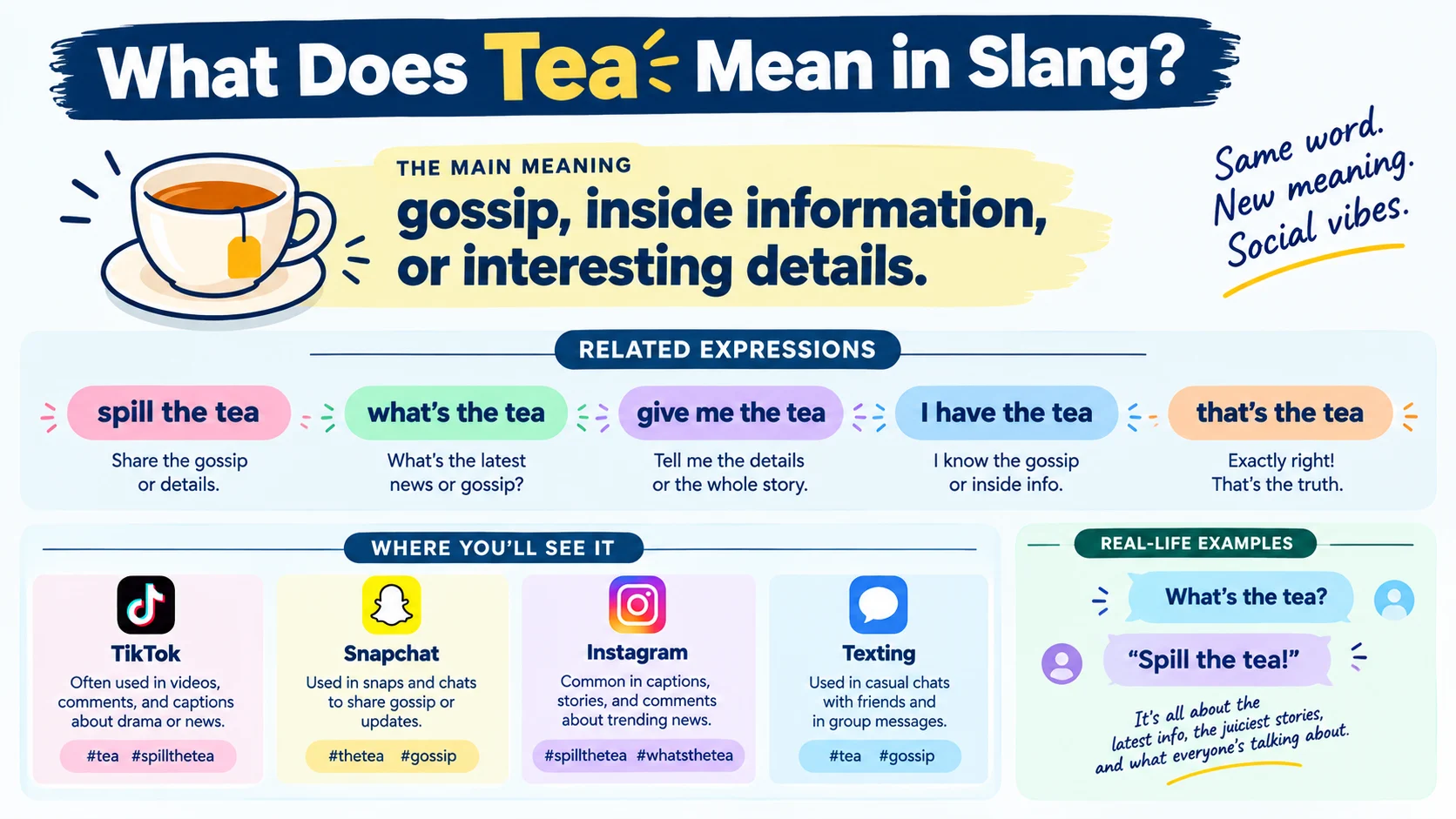
What does tea mean in slang? Tea means gossip, personal information, rumors, or interesting details about a situation. Saying “spill the tea” usually means “tell me what happened” or “give me the inside story.” The phrase can sound playful, curious, dramatic, or informal.
what does tea mean in slang is a question that often comes up when someone sees phrases like “spill the tea,” “what’s the tea,” or simply “tea” in a text or social media comment. In modern American internet language, tea usually refers to gossip, private details, or information that people find interesting.
However, the word does not always carry a negative meaning. Someone can use it for harmless updates between friends. They might also use it when discussing celebrity news, relationship drama, workplace stories, or social situations.
The expression became especially common across social media. Today, people use it on TikTok, Snapchat, Instagram, group chats, text messages, and other online spaces.
Importantly, context determines the meaning. “I need tea” does not necessarily mean someone wants a drink. In a casual conversation, it may mean that the person wants interesting information.
The slang also connects with expressions such as “spill the tea,” “give me the tea,” “what’s the tea,” and “that’s the tea.” Each phrase carries a slightly different conversational purpose.
QUICK ANSWER BOX
| Meaning | Context | Primary Platforms | Example | Tone |
| Gossip, inside information, or interesting details | Casual conversation | TikTok, Snapchat, Instagram, texting | “Okay, what’s the tea?” | Playful, curious, informal |
| News about a social situation | Friends and group chats | Messaging apps | “Give me the tea!” | Excited or dramatic |
| A revealing story | Social media comments | TikTok and Instagram | “The comments have all the tea.” | Humorous or intrigued |
| Confirmation of an interesting detail | Online conversations | Most social platforms | “That is some serious tea.” | Entertained or surprised |
What does tea mean in slang?
At its simplest, what does tea mean in slang can be answered with one idea: tea means interesting information, especially gossip or personal details about a situation.
The term often appears when someone wants information that may not be widely known. For example, a friend might say, “You were there last night. What’s the tea?”
They are not asking about a beverage. Instead, they want the story.
Another common expression is “spill the tea.” Here, “spill” means reveal or share information. The phrase can suggest that the information is juicy, surprising, dramatic, or entertaining.
Where Did “Tea” Come From?
The modern slang sense has a longer history than many people realize.
The expression is strongly associated with Black American LGBTQ+ culture and drag culture. Linguistic histories often connect the slang to the letter T, which can represent “truth.” The expression “spill the T” developed alongside forms such as “spill the tea.”
The slang later spread through broader American popular culture, including television, celebrity media, drag culture, memes, and social platforms.
The exact history is more complex than a single origin story. Different explanations have circulated online. Therefore, it is more accurate to describe the expression as part of a broader history of American slang rather than claim one universally proven invention.
What Does “Spill the Tea” Mean?
“Spill the tea” means tell me the interesting details.
It can refer to gossip, but it does not always involve malicious rumors.
For example:
“You said your roommate moved out. Spill the tea.”
This means:
“Tell me what happened.”
The phrase can also appear in harmless conversations.
“How did the surprise party go? Spill the tea!”
Here, the speaker simply wants the story.
What Does “The Tea” Mean?
“The tea” usually means the information itself.
For example:
“I have the tea.”
This can mean:
“I know something interesting.”
Likewise:
“What’s the tea?”
usually means:
“What happened?”
The phrase can sound more dramatic than simply asking, “What happened?” That dramatic quality helps explain why it works so well on social media.
Is “Tea” Always Gossip?
No.
That distinction matters.
Tea often involves gossip, but the word can describe any interesting inside information. The information might concern friends, celebrities, dating, work, school, entertainment, or an unusual event.
For example, someone might say:
“I have some tea about the concert.”
That could mean they heard a rumor. It could also mean they know an amusing backstage story.
Therefore, the safest interpretation depends on the surrounding conversation.
Contextual Dynamics and Nuances of the Term
Slang rarely has one fixed meaning. Instead, speakers adjust the meaning according to tone, relationship, platform, and situation.
Gossip Versus Harmless Updates
Sometimes tea clearly means gossip.
“Did you hear what happened between them? I need the tea.”
In another situation, it may simply mean information.
“What’s the tea in the new restaurant?”
The second example sounds closer to “What have you heard about it?”
Consequently, readers should not automatically interpret every use of tea as malicious gossip.
Positive, Neutral, and Negative Uses
| Use | Example | Likely Meaning |
| Positive | “That story is amazing tea.” | Interesting information |
| Neutral | “What’s the tea about the event?” | Details or updates |
| Negative | “She keeps spreading tea about everyone.” | Gossip |
| Humorous | “The group chat has tea tonight.” | Entertaining drama |
| Dramatic | “Girl, spill the tea!” | Tell me everything |
The Role of Tone
Tone changes the emotional effect.
“Tea?” can sound curious.
“Spill the tea!” sounds exciting.
“Here’s the tea” sounds like someone is about to reveal information.
“That’s the tea” can sound final. The speaker may be signaling that they have stated their version of events.
Meanwhile, “No tea” can mean there is no gossip or nothing interesting to report.
The Difference Between Tea and Rumor
Tea and rumor overlap, but they are not identical.
A rumor is usually unverified information. Tea can refer to verified information, personal details, gossip, or simply an interesting story.
That difference becomes important in responsible communication.
If someone says, “I have tea about the company,” they might possess firsthand information. They might also have heard something from another person.
Therefore, listeners should avoid treating “tea” as proof that a claim is true.
Why People Use the Expression
The slang makes ordinary questions feel more entertaining.
Compare these:
“What happened?”
and:
“What’s the tea?”
The second version creates a playful social atmosphere. It suggests curiosity and shared interest.
Furthermore, the phrase is short. That makes it ideal for captions, comments, texts, and quick conversations.
Real Life Conversation Examples Using what does tea mean in slang
The following examples show how people naturally use the expression in different situations.
Example 1: Friends Discussing a Party
Maya: You left the party early.
Jordan: Yeah, I had to work this morning.
Maya: Okay, but what’s the tea?
Jordan: Honestly, nothing huge. Two people argued over the music.
Here, “what’s the tea?” means “What happened after I left?”
Example 2: Relationship Drama
Alex: Did you hear that Sam and Taylor stopped talking?
Chris: Wait, seriously? Spill the tea.
Alex: Apparently, they had an argument last weekend.
In this conversation, “spill the tea” requests the story behind the situation.
Example 3: Celebrity News
Nina: Did you see that celebrity interview?
Taylor: No. What’s the tea?
Nina: They finally explained why they left the show.
Here, the term refers to interesting entertainment news.
Example 4: Group Chat
Chris: Everyone is being weird today.
Jamie: What happened?
Chris: I have no idea.
Morgan: Same. Someone give me the tea.
The phrase creates a playful request for information.
Example 5: Harmless Workplace Story
Drew: Why did everyone leave the meeting so quickly?
Casey: The presentation software stopped working.
Drew: That’s the whole tea?
Casey: Yep. No drama today.
This example demonstrates that the phrase can be humorous. It does not always involve serious gossip.
Platform Specific Breakdown
Different platforms give slang slightly different social functions. However, the underlying meaning usually remains recognizable.
How It Is Used on Snapchat
Snapchat favors quick, informal communication. Users often share short messages, photos, videos, and private stories.
Consequently, tea fits naturally into the platform.
A Snapchat message might say:
“Girl, I have tea.”
The recipient may understand that a story or revelation is coming.
Another message could say:
“What’s the tea?”
That usually asks for an update.
Snapchat also supports playful exaggeration. Someone may describe a small social event as “major tea” simply to make the conversation more entertaining.
Context still matters. A message about actual tea could obviously refer to the drink.
The Role of what does tea mean in slang on TikTok
TikTok has helped popularize many slang expressions through short videos, comments, livestreams, and creator communities.
The phrase often appears in captions and comments.
For example:
“Wait until you hear the tea.”
A creator may use that line before explaining a story.
TikTok comments can also use expressions such as:
“Spill!”
“What’s the tea?”
“We need the tea.”
“Okay, but where’s the tea?”
The exact phrase can therefore function as a request for context or a reaction to an unfolding story.
TikTok also demonstrates how quickly slang can move between communities. A phrase may begin within a specific cultural group and later become widespread among mainstream internet users.
Instagram and Texting Dynamics
Instagram uses tea across comments, direct messages, captions, Stories, and Reels.
A comment might say:
“Okay, but what’s the tea?”
A direct message could be more personal:
“I saw your story. Spill the tea.”
Texting works similarly.
However, texting often provides less visual context. Therefore, punctuation and wording can affect the tone.
Compare:
“What’s the tea?”
with:
“WHAT’S THE TEA 😂”
The second version usually communicates stronger excitement or playful drama.
Alternative Meanings and NLP Variations of the Phrase
Understanding the semantic variations helps search engines and readers connect related expressions.
| Expression | Meaning |
| Tea | Gossip, details, or interesting information |
| The tea | The specific information or story |
| Spill the tea | Reveal the details |
| Spill it | Tell the story |
| What’s the tea? | What happened? |
| Give me the tea | Tell me what you know |
| I have tea | I know something interesting |
| That’s the tea | That is the story or conclusion |
| No tea | Nothing interesting to report |
| Hot tea | Especially interesting or dramatic information |
“Spill the Tea”
This is probably the most recognizable expression associated with the slang.
The verb “spill” creates an image of accidentally releasing something contained. In slang, that metaphor becomes “reveal information.”
“Give Me the Tea”
This expression sounds direct but usually remains casual.
Someone might say:
“You were there. Give me the tea.”
The person wants the other speaker’s version of events.
“What’s the Tea?”
This form works as a conversational opener.
It can replace:
“What happened?”
“What did I miss?”
“What have you heard?”
“What is going on?”
The intended meaning depends on context.
“That’s the Tea”
This phrase works differently.
Instead of requesting information, the speaker may use it to conclude a discussion.
For example:
“He forgot the meeting again. That’s the tea.”
The speaker may mean that this is simply the situation or the relevant fact.
Misinterpretations: When NOT to Use what does tea mean in slang
Slang works best when the audience understands it.
Therefore, avoid relying on tea when the setting requires precise communication.
Formal Business Writing
A workplace report should not normally say:
“Here’s the tea about the project.”
Instead, write:
“Here is an update on the project.”
Formal language improves clarity and reduces ambiguity.
Academic Writing
Academic work requires precise terminology.
Instead of:
“The article gives us the tea.”
Use:
“The article provides additional context.”
Sensitive Personal Situations
Use caution when discussing someone’s private information.
Calling personal information “tea” can make serious circumstances sound entertaining.
For example, a person’s medical, financial, family, or relationship problems deserve appropriate sensitivity.
Unverified Claims
The phrase can also encourage people to treat rumors casually.
If someone says:
“I had tea when he got fired.”
That does not prove the claim.
A better response may be:
“Is that confirmed?”
This distinction matters because social media can spread unverified information quickly.
Professional Customer Communication
Customer service messages should prioritize clarity.
Instead of:
“Let me give you the tea.”
Use:
“Here is what happened with your order.”
The second version communicates the information without relying on slang.
How to Respond to what does tea mean in slang
Responding is usually easy once you understand the social purpose.
If someone asks, “What’s the tea?” you can provide the relevant story.
For example:
“Apparently, they canceled the event because the venue had a scheduling problem.”
If you do not know anything, say:
“Honestly, I have no tea.”
If you know something but do not want to share it, you can say:
“I know what happened, but I probably shouldn’t share it.”
That response maintains a boundary without creating unnecessary conflict.
Common Responses
| Someone Says | Natural Response |
| “What’s the tea?” | “Apparently, they had an argument.” |
| “Spill the tea!” | “Okay, here’s what happened.” |
| “Do you have any tea?” | “Nope, I haven’t heard anything.” |
| “Give me the tea.” | “I can tell you what I know.” |
| “That’s the tea.” | “Got it.” |
| “Any tea today?” | “Nothing interesting so far.” |
When You Want More Context
Ask for a short follow up.
“What part do you want to know?”
Or:
“Do you mean the story about the party?”
This approach prevents misunderstandings.
When You Want to Stay Neutral
You can also avoid repeating rumors.
“I heard something, but I don’t know whether it’s true.”
That distinction is especially useful in group chats and social media conversations.
FAQs
1. What does tea mean in slang?
In slang, tea usually means gossip, interesting information, personal details, or the story behind a situation. The expression can be playful and does not automatically mean malicious gossip.
2. Is “tea” the same as gossip?
Not exactly. Gossip usually involves talking about other people, often when they are absent. Tea can mean gossip, but it can also mean interesting information or an inside story.
3. What does “spill the tea” mean?
“Spill the tea” means “tell me the details” or “reveal what happened.” It usually appears in casual conversations between people who want more information.
4. Why do people say “what’s tea”?
People say it when they want to know what happened or what information is circulating about a situation. It often sounds more playful than simply asking, “What happened?”
5. Is tea positive or negative slang?
Tea can be either positive, neutral, or negative. The emotional meaning depends on the subject and tone. A harmless funny story can be called tea just as easily as social drama.
6. Is “tea” appropriate in professional conversations?
Usually, it is better to use clearer language in formal settings. Terms such as “update,” “details,” “information,” or “context” work better in professional communication.
7. Does tea always mean a rumor?
No. Tea can describe verified information, firsthand details, an entertaining story, or a rumor. You should not assume that every piece of “tea” is factually confirmed.
8. Why is tea common on TikTok and Instagram?
Short social posts encourage compact, expressive language. Tea communicates curiosity and drama with only a few words. Consequently, it works well in comments, captions, direct messages, and videos.
9. Can I use “tea” with older Americans?
You can, but familiarity varies. Internet slang spreads unevenly across age groups, regions, communities, and platforms. Therefore, the safest choice depends on your audience.
10. What is another way to say “spill the tea”?
You can say “tell me what happened,” “give me the details,” “what did I miss,” or “tell me the story.” These alternatives communicate the same basic request without slang.
Conclusion:
Understanding what tea means in slang starts with a simple definition: tea usually means gossip, inside information, or interesting details.
However, the expression has more flexibility than that definition suggests.
People use “tea” to ask questions, introduce stories, react to drama, and create playful conversations. They may use it with friends, in group chats, or across social media.
The phrase “spill the tea” usually asks someone to reveal the details. Meanwhile, “what’s the tea?” commonly asks what happened. “That’s the tea” can signal that the speaker has finished explaining the situation.
The expression also demonstrates how internet language evolves. Slang can move between communities, platforms, entertainment media, and everyday conversations. As it spreads, its meaning can become broader.
Still, context remains essential.
A casual friend might understand “give me the tea” immediately. A professional audience may find the same wording unclear or overly informal.
Therefore, the best way to understand the expression is to consider the speaker, audience, platform, and situation.
In everyday American internet English, tea is less about the beverage and more about the story behind the story.
