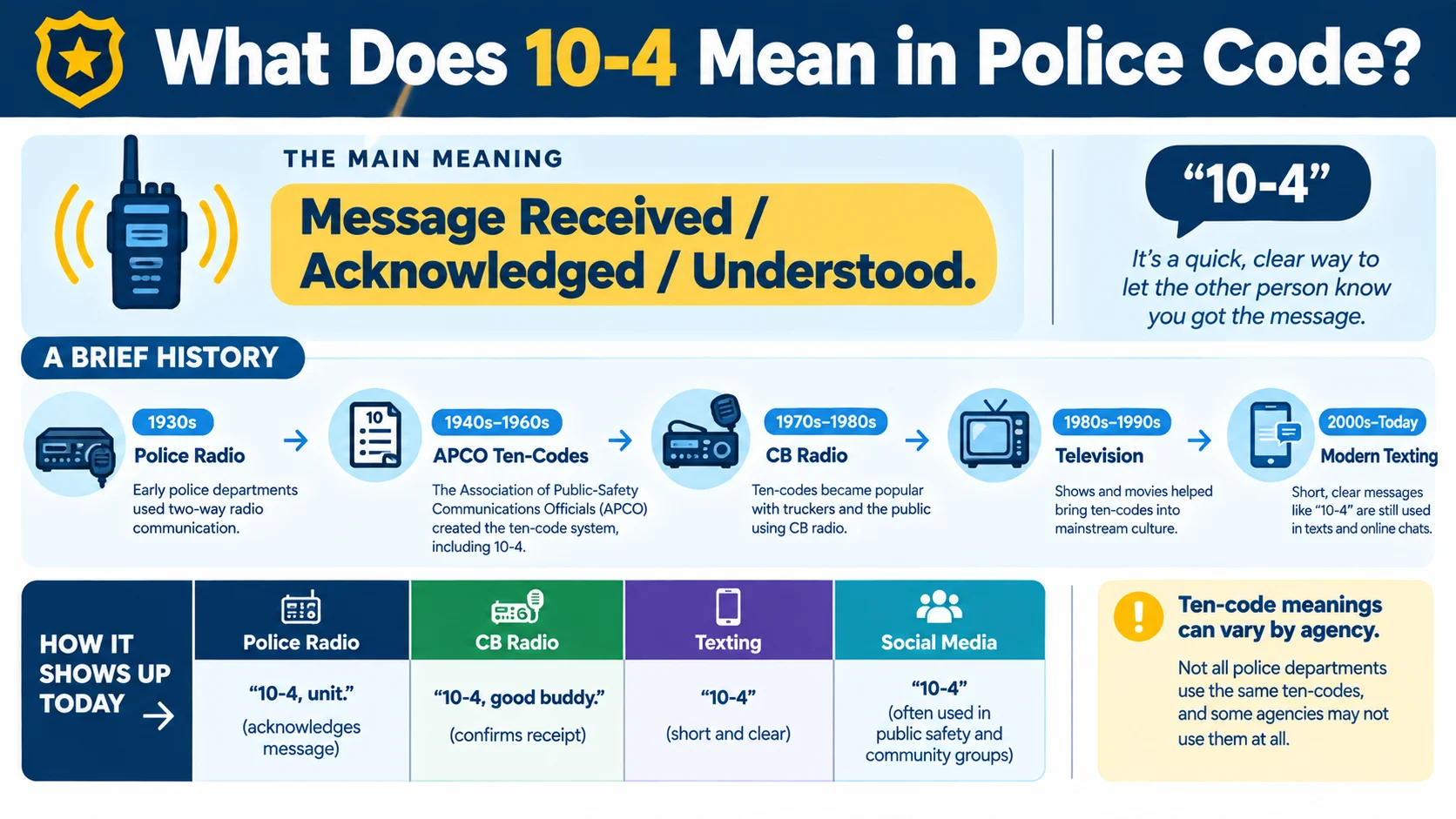
10 4 means “message received,” “acknowledged,” or “understood.” Police and other radio users historically used it as a brief confirmation. Today, Americans also use “10 4” casually to mean “got it,” “okay,” or “sounds good.”
What does 10 4 mean in the police code? It means “message received and understood” or simply “acknowledged.” The expression comes from the historic American police radio ten-code system. However, its meaning has expanded beyond police communication.
Today, people may say “10 4” when they want to confirm information. For example, someone might respond, “10 4, I’ll meet you at seven.” In that context, the speaker is saying, “Understood.”
The phrase has an interesting history. It began as radio shorthand during the early development of public-safety communications. Later, television, CB radio, trucking culture, movies, and popular music carried it into everyday American speech.
Importantly, “10 4” does not usually describe an emergency. It does not automatically mean that someone has arrived, arrested someone, or received special instructions. Instead, it primarily confirms that a communication was heard and understood.
There is also an important technical distinction. Police ten-codes were never perfectly universal across every American agency. Departments could adopt different meanings for different numbers. Therefore, “10 4” has broad recognition, but other ten-codes may require local context.
Quick Answer
| Meaning | Context | Primary Platforms | Example | Tone |
| Message received | Police radio | Police communications | “10 4, heading there.” | Professional |
| Understood | Radio communication | CB radio | “10 4, I copy you.” | Practical |
| Okay | Casual conversation | Texting | “10 4, see you tonight.” | Casual |
| Got it | Internet slang | TikTok, Instagram, Snapchat | “10 4 😂” | Playful |
| Sounds good | Informal speech | Text and chat | “10 4, works for me.” | Friendly |
What Does 10 4 Mean in Police Code?
The core meaning is acknowledgment.
When an officer receives an instruction from dispatch, the officer can use the code to confirm receipt. In plain English, the response could mean:
- “I received your message.”
- “I understand.”
- “Understood.”
- “Acknowledged.”
- “Okay.”
- “Roger that.”
The precise wording can change with the situation. Nevertheless, the central idea remains the same: the listener confirms that the transmission was received and understood.
Why Police Used Ten-Codes
Early police radio communication had practical limitations. Radio channels were limited, and officers needed to communicate efficiently. Short codes reduced the number of spoken words required during routine transmissions.
The Association of Public-Safety Communications Officials, commonly known as APCO, began developing standardized communication practices in the 1930s. The ten-code system developed between roughly 1937 and 1940. Charles “Charlie” Hopper of the Illinois State Police is widely credited with developing the system that influenced these codes.
The “10” prefix also had a technical purpose in early radio operations. According to historical accounts, older equipment could take a brief moment to reach full transmission power. The prefix helped make the beginning of a coded transmission more reliable.
Consequently, “10 4” was not originally created as internet slang. It came from an era when radio efficiency mattered greatly.
What Does the Number 4 Represent?
The “4” identifies a particular message within the ten-code system.
In the commonly recognized APCO system, 10-4 means an acknowledgment or affirmative response. The number itself does not mean “yes” in ordinary mathematics or general communication. Instead, 10-4 functions as a complete radio signal.
That distinction matters because ten-codes work as predefined communication units. You should not normally interpret “10” and “4” separately.
Is 10 4 the Same as “Roger”?
They are similar, but they are not exactly identical terms in every historical communication system.
“Roger” traditionally indicated that a transmission had been received. “10-4” similarly communicates acknowledgement. In everyday American English, however, both can function as quick ways to say “got it.”
For example:
“Meet me at the north entrance.”
“10-4.”
The response confirms understanding.
Likewise:
“Roger that.”
Both responses communicate acknowledgment without repeating the original instruction.
Contextual Dynamics and Nuances of the Term
Context determines how “10 4” sounds.
In a police radio setting, it can sound procedural. In a text conversation, it can sound humorous or deliberately old-school. Meanwhile, a truck driver using the phrase over CB radio may use it as natural radio vocabulary.
Therefore, the literal meaning stays relatively stable while the social meaning changes.
Police and Emergency Communications
In historical police communication, “10-4” served a straightforward operational purpose. An officer could acknowledge dispatch without repeating a longer sentence.
For example:
Dispatch: “Unit 12, proceed to the intersection of Main and Oak.”
Officer: “10-4.”
The officer has confirmed receipt.
However, the exact ten-code system used by a department may differ from another department. That variation is one reason public-safety organizations have increasingly emphasized plain language for communication between different agencies.
CB Radio and Trucking
The phrase also became strongly associated with citizens band radio.
CB radio culture expanded dramatically in the United States during the 1970s. Truckers and other radio users adopted many expressions associated with radio communication. “10-4” became one of the most recognizable examples.
Popular culture strengthened that connection. Television, movies, and music repeatedly portrayed radio users saying “10-4,” helping the phrase move beyond professional communication.
Everyday American English
Today, someone might say:
“Can you send me the address?”
“10-4.”
Here, the phrase has nothing to do with an actual police radio.
It simply means:
“Sure. I understand.”
This casual use can also carry a playful tone. Someone may choose “10-4” instead of “okay” because it sounds humorous, nostalgic, or slightly theatrical.
Is 10 4 Formal or Informal?
The answer depends on the setting.
| Situation | Natural? | Typical interpretation |
| Police radio | Yes | Acknowledged |
| CB radio | Yes | Received and understood |
| Workplace email | Usually no | Too informal or stylized |
| Texting friends | Yes | Got it |
| Social media comments | Sometimes | Okay or understood |
| Academic writing | No | Use “acknowledged” or “understood” |
| Legal documents | No | Use precise formal wording |
Furthermore, the phrase can sound intentionally humorous in a modern conversation.
Real-Life Conversation Examples Using 10 4
The following examples show how the expression can change depending on context.
Example 1: Police Radio
Dispatcher: “Unit 21, respond to the reported disturbance at 5th Street.”
Officer: “10-4. En route.”
Here, the response acknowledges the instruction. The second sentence adds information about the officer’s status.
Example 2: CB Radio
Driver A: “Breaker, you still heading north?”
Driver B: “10-4. I’m about five miles out.”
In this situation, the phrase works as a radio shorthand.
Example 3: Texting a Friend
Friend A: “Bring your charger when you come over.”
Friend B: “10-4 😂”
The phrase is playful. The sender means, “Got it.”
Example 4: Workplace Chat
Manager: “Please update the spreadsheet before the meeting.”
Employee: “10-4, I’ll handle it.”
This is understandable, but it may sound informal. A workplace with a relaxed culture might accept it. A formal corporate environment may prefer “Understood” or “Will do.”
Example 5: Family Conversation
Parent: “Call me when you get home.”
Adult child: “10-4.”
Here, the phrase simply means “Okay, I understand.”
These examples show why context matters. The expression does not automatically indicate police activity. Instead, the surrounding conversation determines its tone.
Platform-Specific Breakdown
Online platforms have changed how people encounter traditional slang. However, “10 4” does not have a unique official meaning on Snapchat, TikTok, or Instagram.
Instead, users generally borrow its established meaning and adapt it to the tone of the platform.
How It Is Used on Snapchat
On Snapchat, “10 4” can mean “okay,” “got it,” or “understood.”
For example:
Friend: “I’ll pick you up at 8.”
Reply: “10 4 👍”
The expression can make the response feel more playful than simply saying “okay.”
However, Snapchat does not assign a special platform-specific definition to the phrase. If you see it in a message, read the surrounding conversation first.
The Role of 10 4 on TikTok
TikTok often revives older slang and phrases through memes, jokes, nostalgia, and pop-culture references.
Consequently, someone may use “10 4” as a humorous way to imitate police, trucker, or radio language.
For example:
“Bro said the game starts at 9.”
“10 4 🫡”
The intended meaning is usually “Understood.”
The phrase may also appear in captions or comments when a creator wants an old-school communication style.
Instagram and Texting Dynamics
Instagram comments and direct messages often favor short expressions. Therefore, “10 4” can work as a compact acknowledgment.
Consider:
“I sent you the photos.”
“10 4.”
The response means, “Got them” or “Understood.”
Still, tone matters. In a serious conversation, “10 4” can sound dismissive or overly casual. In a friendly conversation, it may sound funny.
Why People Use Numbers Instead of Words
Internet communication frequently compresses language.
People use abbreviations, acronyms, emojis, and numbers because these forms are quick to type. “10 4” fits that pattern, although its history predates smartphones by decades.
Furthermore, numeric expressions can create a recognizable personality. Someone might write “10 4” specifically because “okay” feels too ordinary.
Alternative Meanings and NLP Variations of the Phrase
Natural-language systems may encounter several variations of the same expression.
| Variation | Likely meaning |
| 10-4 | Acknowledged |
| 10 4 | Acknowledged |
| Ten-four | Understood |
| Ten four | Understood |
| 10/4 | Sometimes a stylized form |
| Ten-four, got it | Strong acknowledgment |
| 10-4 👍 | Casual agreement |
| 10-4 lol | Playful acknowledgment |
| Roger | Received or understood |
| Copy that | Message received |
| Gotcha | Informal acknowledgment |
| Understood | Direct formal equivalent |
The spelling can change without changing the underlying idea.
“Ten-Four” Versus “10-4”
Both forms represent the same expression.
“10-4” looks more like the original numeric radio code. “Ten-four” represents the pronunciation in written English.
You may also see “10 4” without a hyphen. Online writers often remove punctuation for convenience.
“10-4” Versus “Affirmative”
“Affirmative” generally communicates a positive confirmation.
“10-4” specifically carries the historical meaning of acknowledgement or message receipt.
Therefore, the terms overlap, but they are not necessarily interchangeable in every professional communication system.
“10-4” Versus “Copy That”
“Copy that” is another radio-style phrase.
For example:
“Meet at the south entrance.”
“Copy that.”
The response confirms receipt.
Likewise:
“Meet at the south entrance.”
“10-4.”
Both sound natural in radio-style dialogue.
“10-4” Versus “Okay”
“Okay” is the simplest modern equivalent.
The difference mainly involves tone.
“Okay” sounds ordinary.
“10-4” sounds radio-inspired, nostalgic, humorous, or informal.
Consequently, the choice depends less on literal meaning and more on the personality of the speaker.
Misinterpretations: When Not to Use 10 4
Understanding the phrase also means knowing its limits.
It Does Not Mean “Arrested”
“10-4” does not inherently mean that someone has been arrested.
If you see the phrase in a police-themed conversation, do not automatically interpret it as an arrest code.
Instead, it usually confirms receipt or understanding.
It Does Not Mean “Emergency”
The phrase itself does not indicate an emergency.
Police ten-codes contain many different signals. Some relate to emergencies, locations, status, or specific incidents. However, “10-4” functions primarily as an acknowledgment.
It Does Not Have One Universal Meaning for Every Ten-Code
This is one of the most important points about police codes.
There is no single universally binding American ten-code dictionary that every agency follows identically. Departments have historically modified codes for local needs.
Therefore, you should not assume that every number in the 10-code system means exactly the same thing everywhere.
“10-4” is unusually recognizable because its meaning became widespread in popular culture. Other codes may vary considerably.
It May Sound Odd in Formal Writing
Consider this sentence:
“10-4, I acknowledge receipt of your proposal.”
It communicates the idea, but the combination feels stylistically inconsistent.
A professional version would be:
“I acknowledge receipt of your proposal.”
Likewise, academic writing should normally use standard vocabulary rather than radio slang.
It Can Sound Sarcastic
Tone can completely change an informal phrase.
For example:
“Clean your room.”
“10-4, commander.”
The speaker may technically agree, but “commander” signals humor or sarcasm.
Therefore, when someone sends “10-4,” consider the relationship and conversation before deciding whether they are being serious.
How to Respond in Chat Comfortably
If someone sends “10-4,” you usually do not need a special response.
You can simply continue the conversation.
For example:
Them: “10-4.”
You: “Perfect.”
Or:
Them: “10-4 👍”
You: “See you then.”
You can also mirror the style:
“10-4 😎”
However, you do not need to use the phrase yourself.
Natural Responses
| Message | Comfortable response |
| “10-4” | “Sounds good.” |
| “10-4 👍” | “Perfect.” |
| “Ten-four, I got it.” | “Great.” |
| “10-4, see you at 8.” | “See you then.” |
| “10-4 😂” | “Haha, got it.” |
If You Are Unsure What Someone Means
Ask directly.
For example:
“Do you mean you understand?”
That question works especially well when the phrase appears in an unfamiliar context.
Usually, though, “10-4” means some form of acknowledgment.
Can You Say It in Professional Messages?
You can, but context matters.
A casual team chat may tolerate it.
A formal email usually calls for clearer language.
For example:
| Informal | More professional |
| “10-4, I’ll do it.” | “Understood. I’ll take care of it.” |
| “10-4, thanks.” | “Understood. Thank you.” |
| “10-4, received.” | “Received, thank you.” |
Clarity should take priority over slang in professional communication.
10 High-Intent FAQs About the Slang
What does 10 4 mean in the police code?
It means “message received,” “acknowledged,” or “understood.” It historically served as a short confirmation during radio communication.
Why do police say 10-4?
Police radio users historically used ten-codes to make common messages shorter and more efficient. “10-4” provided a quick way to acknowledge a transmission.
Is 10-4 still used by police?
Some agencies still use ten-codes, while others favor plain language, especially when multiple agencies need to communicate. Usage varies by jurisdiction and agency.
What does “10-4” mean in texting?
In texting, it usually means “okay,” “got it,” “understood,” or “sounds good.” The sender is generally using the phrase as casual radio-inspired slang.
Is 10-4 the same as “Roger that”?
They have similar practical meanings because both can acknowledge receipt of a message. However, they come from different communication traditions.
What does “ten-four” mean?
“Ten-four” is simply the spoken form of “10-4.” It carries the same basic meaning: acknowledgment or understanding.
Is 10-4 a police-only term?
No. The expression spread beyond police communication through CB radio and popular culture. It now appears in ordinary American English as informal slang.
Does 10-4 mean yes?
It can function like “yes” in some casual situations, but its more precise traditional meaning is “message received” or “acknowledged.” Therefore, it is closer to “I understand” than a simple yes.
Why is 10-4 so famous?
Television and CB radio helped turn the expression into a familiar part of American popular culture. Shows, movies, music, and trucking culture all contributed to its widespread recognition.
Is 10-4 appropriate in formal English?
Usually, it is better to use “understood,” “acknowledged,” “received,” or “confirmed” in formal writing. “10-4” works best when the context is casual, humorous, or intentionally radio-themed.
Conclusion:
The meaning of “10 4” is straightforward: acknowledged, understood, or message received.
Its story, however, is much more interesting.
The expression developed from American public-safety radio communication during the early era of police radio. APCO helped develop and standardize ten-code practices during the 1930s and later decades.
Then, the phrase moved beyond police work. CB radio users adopted it. Television introduced it to wider audiences. Movies and popular culture reinforced its connection with radio communication. Eventually, ordinary speakers began using it without any connection to law enforcement.
Today, someone can type “10-4” in a text message and simply mean “got it.”
That evolution demonstrates how language travels. A phrase created for technical communication can become cultural shorthand. Over time, its original setting can fade while its basic meaning survives.
One final distinction remains important: American ten-codes are not perfectly uniform. Different agencies have used different code systems and definitions. Therefore, “10-4” is widely understood, but you should not assume that every police ten-code has one universal meaning.
In modern conversation, the safest interpretation of “10-4” is usually simple: “I understand.”
