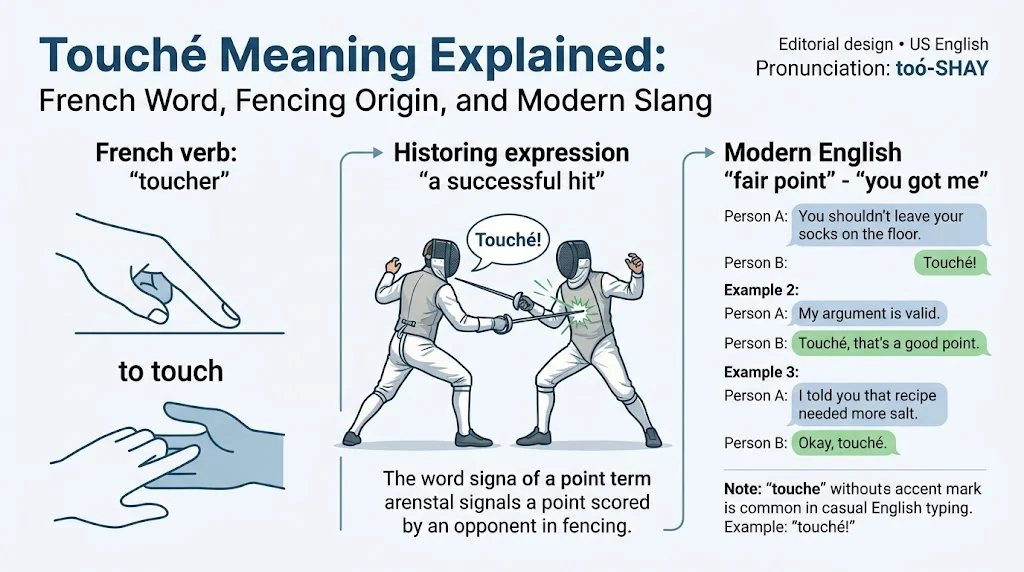
Touché is a French expression meaning “touched,” traditionally used in fencing when someone lands a hit. In English conversation, it means “fair point” or “you got me,” often acknowledging a clever argument, comeback, or observation.
What does touche mean in French is a common question because the expression appears in conversations, movies, social media, memes, and text messages. The answer depends on whether you mean the original French word or the English expression touché.
In French, touché literally means “touched” or “hit.” It comes from the verb toucher, which means “to touch.” The word can describe physical contact, emotional impact, or a fencing hit.
However, English speakers often use touché as a standalone response. In that setting, it usually means “fair point,” “good comeback,” or “you got me there.”
The accent matters in formal French spelling. The standard expression is touché, with an acute accent over the final e. Online, people often type touche without the accent because English keyboards and casual texting make accent marks easy to omit.
Consequently, you may see several versions online. These include “touché,” “touche,” and occasionally playful spellings such as “toucheé.” The intended meaning usually becomes clear from the surrounding conversation.
QUICK ANSWER BOX
| Meaning | Context | Primary Platforms | Example | Tone |
| “Fair point” | Debate or argument | Texting, X, Reddit | “You said you hate spoilers, but you read the ending first.” “Touché.” | Witty |
| “You got me” | Clever comeback | TikTok, Instagram | “You complain about traffic but never leave early.” “Touché.” | Playful |
| “Touched” | Literal French meaning | French language | Je suis touché. | Neutral or emotional |
| “Hit” | Fencing | Sports or historical context | Touché! | Formal or traditional |
| Acknowledgment | Conversation | Movies, chats, social media | “That is actually a good point.” “Touché.” | Respectful |
What does ” touche” mean in French?
The most useful answer is simple: touché means “touched” in French, but English speakers commonly use it to acknowledge a clever point or comeback.
The expression has a strong connection to fencing. In a fencing match, a competitor can call “Touché!” after successfully landing a touch on an opponent. The word therefore signals that the opponent has made contact.
Over time, English adopted the expression outside fencing. Today, someone might say “touché” during an argument without any physical competition involved.
For example:
Person A: “You tell everyone to save money, but you bought another pair of sneakers yesterday.”
Person B: “Touché.”
Here, Person B is not talking about physical contact. Instead, they admit that Person A made a valid observation.
The literal French meaning
The French verb toucher means “to touch.” Its past participle is touché, which can translate as “touched.”
The exact translation changes with context.
For example:
- Je suis touché. = “I am touched.”
- Il a été touché. = “He was hit” or “He was touched.”
- Touché! = “Touched!” in fencing.
- Je suis touché par ton message. = “I am touched by your message.”
Therefore, the French word does not always mean “fair point.” That conversational meaning developed through the fencing expression and its later use in English.
Why English speakers say “touché”
English borrowed many words and expressions from French. Touché became especially useful because it provided a concise way to acknowledge a successful verbal hit.
The metaphor is easy to understand.
Someone makes a sharp argument. You have no strong response. Their statement lands like a fencing touch. You therefore say “Touché.”
In modern English, the word often carries a sense of playful surrender.
It does not necessarily mean that you completely agree with the other person. Instead, you acknowledge that their specific point was effective.
Contextual Dynamics and Nuances of the Term
The meaning changes slightly according to tone, relationship, and situation. Therefore, context matters more than the dictionary definition.
“Touché” as “fair point”
This is the most common modern conversational use.
Imagine someone challenges your argument with a strong counterpoint. You could say:
“Touché. I hadn’t considered that.”
Here, you acknowledge the strength of their reasoning.
The phrase can sound respectful. It can also sound humorous, depending on delivery.
“Touché” as “you got me”
Sometimes the expression acknowledges that someone exposed a contradiction.
For example:
“You said you were avoiding sugar, then ordered the largest dessert.”
“Touché.”
The speaker accepts the criticism without becoming defensive.
In this case, “you got me” provides a natural American English equivalent.
“Touché” as a playful comeback
The expression can also make a conversation feel competitive.
For example:
“You are always late.”
“You arrived twenty minutes late yesterday.”
“Touché.”
Nobody necessarily feels offended. Instead, both people recognize the humor in the exchange.
Tone can change the meaning
The same word can sound friendly, sarcastic, formal, or dismissive.
For example:
| Situation | Likely tone |
| Friendly joke | Playful |
| Serious debate | Respectful |
| Online argument | Potentially sarcastic |
| Romantic teasing | Flirtatious or playful |
| Formal academic discussion | Uncommon but understandable |
| Fencing | Literal and traditional |
Furthermore, punctuation can influence how the message feels.
“Touché.” sounds restrained.
“Touché 😂” sounds playful.
“TOUCHÉ!” sounds dramatic.
“Touché, you got me.” sounds openly acknowledging.
Real Life Conversation Examples Using what does touche mean in french
Scenario 1: Friendly teasing
Alex: You said you were going to stop buying coffee every morning.
Jordan: I did.
Alex: You literally bought one ten minutes ago.
Jordan: Touché.
Here, the speaker admits the contradiction. The word adds humor rather than hostility.
Scenario 2: A debate about exercise
Maya: You keep saying you don’t have time to exercise.
Chris: Because I work late.
Maya: You watched three episodes last night.
Chris: Touché. I walked right into that one.
This use closely matches “fair point.” The response recognizes that the other person presented convincing evidence.
Scenario 3: Texting between friends
Sam: You always tell me to answer texts quickly.
Taylor: Yes.
Sam: You took six hours to answer me yesterday.
Taylor: Touché 😂
The emoji makes the tone especially clear. Without it, the message could still be playful, but the emotional signal would be less obvious.
Scenario 4: A workplace discussion
Manager: We need to reduce unnecessary meetings.
Employee: Then perhaps we should cancel this meeting about reducing meetings.
Manager: Touché.
This example uses the expression as a humorous acknowledgment. The manager recognizes the irony.
Scenario 5: A romantic conversation
Emma: You said you don’t like romantic movies.
Noah: I don’t.
Emma: Yet you watched one with me last night and cried at the end.
Noah: Touché.
Here, the word can create playful intimacy. The speaker acknowledges being caught while keeping the exchange light.
Platform Specific Breakdown
Online communication gives the expression several additional layers. However, the basic idea remains the same: someone makes a strong verbal point, and the other person acknowledges it.
How It Is Used on Snapchat
Snapchat conversations often move quickly. Users commonly rely on short responses, emojis, and conversational shorthand.
Therefore, touché can work well after a clever observation.
For example:
“You said you were studying, but your Snap Story says otherwise 😂”
“Touché.”
The expression does not require a long explanation. It communicates acknowledgement in one word.
Snapchat also encourages visual context. A photo can establish the joke before the recipient replies.
For example, someone might send a picture of a fast food meal after claiming they were eating healthy. The recipient could respond with “Touché.”
The Role of what does touche mean in french on TikTok
TikTok often uses language differently from traditional dictionaries. Users turn ordinary expressions into captions, comments, jokes, and reaction phrases.
On TikTok, touché can appear after someone makes a surprisingly accurate observation.
For example:
“Me saying I don’t need another hoodie while wearing a new hoodie.”
A comment might simply say:
“Touché.”
The word works because TikTok communication frequently rewards concise reactions.
However, context remains essential. Some creators use French expressions for style or humor without focusing on the original French meaning.
Instagram and Texting Dynamics
Instagram comments and direct messages often use the expression in similar ways.
For example:
“You posted this at 2 a.m. and still expect people to believe you have a normal sleep schedule.”
“Touché 😂”
In texting, spelling without the accent is common.
A person may write “touche” because their keyboard does not make accent marks convenient. That does not necessarily indicate incorrect pronunciation or a different intended meaning.
Still, formal French writing should use the correct accent when appropriate.
Alternative Meanings and NLP Variations of the Phrase
Understanding semantic variations helps explain why the expression appears in different forms.
Touché
This is the standard French spelling for the standalone expression.
In English conversation, it commonly means:
- Fair point.
- You got me.
- Good comeback.
- That’s a valid point.
- I concede that point.
- Well played.
- You caught me.
These expressions are not perfectly interchangeable. Their tone differs slightly.
Touche without the accent
English-language typing often removes accents.
Consequently, “touche” can represent “touché” in casual messages.
Search queries also commonly omit accents. Someone searching what does touche mean in french may therefore be looking for the accented French expression.
Touched
The English word “touched” can translate touché in certain French sentences.
For example:
Je suis touché par votre gentillesse.
A natural translation is:
“I am touched by your kindness.”
However, that meaning differs from the English conversational use of “touché.”
Touched in fencing
In fencing, touché refers to a successful touch.
That historical meaning explains the modern metaphor.
The opponent has effectively “landed a hit” in the conversation.
Fair point
“Fair point” is often the closest natural American English translation in a debate.
However, it does not always capture the playful element.
“Touché” can sound more witty or theatrical.
You got me
“You got me” works especially well when someone identifies a contradiction.
For example:
“You criticize my spending habits, but you bought three gadgets this week.”
“You got me.”
That exchange carries roughly the same conversational function.
Well played
“Well played” emphasizes admiration for the cleverness of the response.
Therefore, it can sound more complimentary than “fair point.”
Misinterpretations: When NOT to Use what does touche mean in french
Although the expression is useful, it does not fit every situation.
Do not treat it as universal agreement
Saying “touché” does not necessarily mean you agree with someone’s entire argument.
It usually acknowledges one successful point.
For example:
“You said you dislike social media, but you use it every day.”
“Touché.”
The speaker acknowledges the contradiction. They do not necessarily agree with every opinion the other person has.
Avoid using it as a substitute for “thank you”
If someone compliments you, “touché” usually sounds strange.
For example:
“Your presentation was excellent.”
Responding with “touché” would not naturally mean “thank you.”
A better response would be:
“Thank you!”
Do not confuse it with “touched”
A learner might assume that every appearance of touché means someone feels emotionally moved.
That is not correct.
French uses the word in several grammatical and contextual ways.
The surrounding sentence determines the meaning.
Be careful in sensitive conversations
If someone is sharing grief, trauma, or a serious personal problem, a playful touché can sound dismissive.
For example:
“I’ve been having a really difficult week.”
Responding:
“Touché.”
would normally be inappropriate.
Instead, use an empathetic response.
Do not overuse it
Using the same expression after every clever comment can make your language feel artificial.
Natural speakers vary their responses.
They might say:
- “Fair point.”
- “You got me.”
- “That’s true.”
- “Good point.”
- “Okay, I’ll give you that.”
- “Well played.”
- “I can’t argue with that.”
Consequently, variety makes online communication sound more natural.
How to Respond in Chat Comfortably
If someone sends “touché,” you usually do not need a complicated response.
Your reply should match the tone of the conversation.
If you want to keep joking
Try:
“I knew you’d admit it eventually 😂”
Or:
“Glad we agree.”
If you made a strong point
You can simply continue the conversation.
“Exactly.”
Or:
“See? I had a point.”
If you want to soften the exchange
Try:
“Haha, I’m just teasing.”
This works when you worry that the other person interpreted your comment too seriously.
If someone uses the expression after you catch them
You can respond:
“Gotcha.”
Or:
“I knew you’d say that.”
If you are unsure about their tone
Ask directly:
“Haha, fair enough. Are you agreeing with me?”
Usually, however, the surrounding conversation gives enough information.
Common response choices
| Their message | Comfortable response |
| “Touché.” | “Haha, fair point.” |
| “Touché 😂” | “I knew you’d admit it.” |
| “Okay, touché.” | “I’ll take that.” |
| “Touché, you got me.” | “Exactly!” |
| “Touché, but…” | Continue the discussion |
| “Touché.” after serious criticism | Clarify rather than joke |
10 High Intent FAQs About the Slang
1. What does touche mean in French?
The French word touché literally means “touched” or “hit,” depending on context. As a fencing expression, it means that a competitor successfully landed a touch. In modern English conversation, it commonly means “fair point” or “you got me.”
2. What does touche mean in French texting?
In French texting, the exact meaning depends on the sentence. As a standalone response, it can carry the familiar “fair point” sense. However, French speakers may also use related forms of toucher with their ordinary grammatical meanings.
3. Is “touché” actually French?
Yes. Touché is a French word and a French fencing expression. English adopted it as an interjection, especially for acknowledging an effective argument or comeback.
4. What does touch mean in French on social media?
On social media, it usually signals acknowledgment of a clever point. For example, someone may reply “touché” after another user points out a contradiction. The tone can be humorous, sarcastic, or respectful.
5. Does touché mean “I agree”?
Not necessarily. It usually means that you acknowledge the strength of a particular point. You can say it without accepting the other person’s entire argument.
6. Why do people write “touche” without an accent?
Casual English typing often removes accent marks. Some keyboards make accented characters less convenient. Search queries also frequently omit accents. Therefore, “touche” often represents “touché” online.
7. How do you pronounce touché?
In English, it is commonly pronounced roughly like too-SHAY. The second syllable receives the strongest emphasis. The pronunciation reflects the French origin of the expression.
8. Is touché rude?
Usually, no. It often sounds playful or witty. However, context matters. In a sensitive conversation, it can sound dismissive or sarcastic.
9. Can I use touché in a professional conversation?
Yes, but use judgment. It can work in a relaxed workplace where conversational humor is normal. In a formal business setting, “fair point” or “that’s a valid observation” may sound more appropriate.
10. What is a simple English alternative?
“Fair point” is one of the closest everyday alternatives. Other options include “you got me,” “good point,” “well played,” and “I’ll give you that.”
Suggested Image SEO Metadata
| Element | Recommendation |
| File name | touche-meaning-french-fair-point-infographic.webp |
| Alt text | Touché meaning in French and modern English conversation |
| Title | Touché Meaning Explained |
| Caption | The French meaning, fencing origin, pronunciation, and modern conversational use of touché |
| Placement | Near the definition section |
| Format | WebP |
| Recommended ratio | 16:9 |
| Primary visual topic | French expression and modern English usage |
Conclusion:
The simplest answer to what does touche mean in french is “touched” or “hit,” depending on context. Yet the standalone expression has a more specialized history.
The word comes from the French verb toucher. In fencing, touché signals a successful hit. English speakers later adopted the expression as a witty conversational response.
Today, the expression often means “fair point,” “you got me,” or “well played.”
Its popularity also shows how language changes across cultures. A word can begin in a specific technical setting and later become part of everyday speech.
Online platforms have accelerated that process. Texting, TikTok comments, Instagram conversations, Snapchat messages, and memes all favor short expressions that communicate an idea quickly.
Nevertheless, context remains important.
If someone exposes a contradiction in your argument, touché can acknowledge the point without ending the discussion. If someone shares something deeply personal, however, a more empathetic response usually fits better.
The accent also deserves attention. Touché is the standard spelling. Touche is common in casual English typing and search queries, but the two forms often refer to the same conversational expression.
Ultimately, understanding the expression requires more than translating one French word. Its meaning depends on grammar, history, tone, and the social setting in which someone uses it.
That combination explains why a single word can move from a fencing piste to everyday conversations, television dialogue, memes, and modern internet culture.
