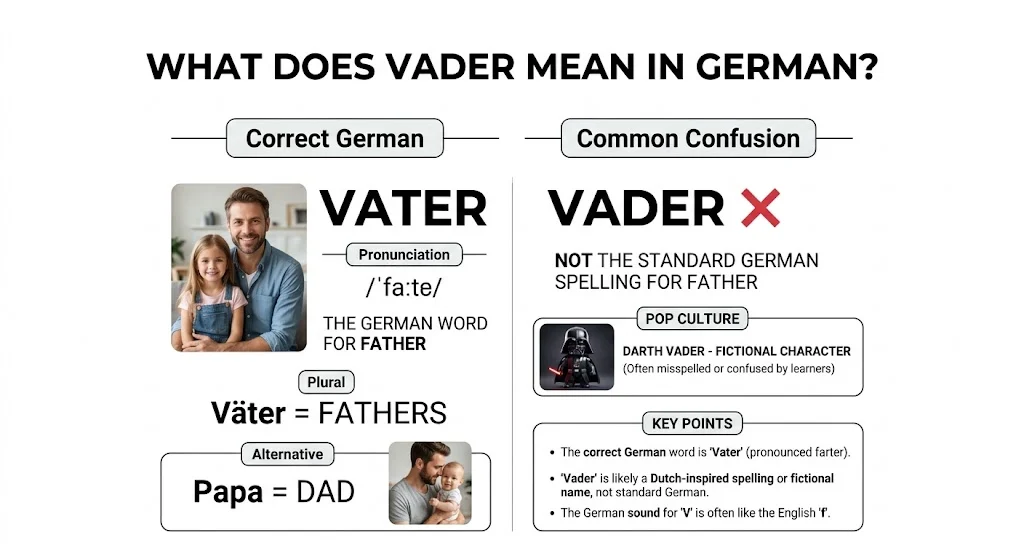
What does vader mean in German? “Vader” is not the standard German spelling for “father.” The German word is Vater, pronounced roughly “FAH-tuh.” It means “father” and can also appear in religious, figurative, and compound expressions.
The question of what does vader mean in German usually comes from confusion between the English spelling “Vader” and the German word Vater. In standard German, Vater means “father.” The letter t is essential to the normal German spelling.
This distinction matters because “Vader” has a famous connection with popular culture. Many English speakers encounter the name through Darth Vader from Star Wars. That connection often leads people to wonder whether the character’s name literally means “father” in German.
The linguistic answer needs a little nuance. Vater is genuinely German. Vader, without the t, is not the standard German noun for father. However, the similarity is striking, especially because the Star Wars character has a major relationship to the concept of fatherhood.
German dictionaries list Vater as a masculine noun. Its standard pronunciation is approximately FAH-tuh, with the first syllable receiving the main stress. Cambridge gives the IPA pronunciation /ˈfaːtɐ/.
Therefore, if you see “Vader” in an English-language conversation and someone asks for its German meaning, the safest explanation is simple: the German word for father is Vater, not Vader.
QUICK ANSWER BOX
| Meaning | Context | Primary Platforms | Example | Tone |
| Father | Standard German | Language learning, translation, conversation | Mein Vater = “My father” | Neutral |
| Vater | German noun | German writing and speech | Er ist mein Vater. | Neutral |
| “Vader” | Usually not standard German for father | Pop culture, names, online discussions | Darth Vader | Context dependent |
| Papa | Familiar German word for father | Family conversation | Mein Papa | Informal |
| Figurative “father” | Creator or originator | Literature, history, discussion | der Vater einer Idee | Formal or figurative |
What does vader mean in German?
The exact phrase what does vader mean in german can produce a misleading answer if the spelling receives no attention. The standard German word is Vater, not Vader. Duden defines Vater as a masculine noun and gives several meanings connected with fatherhood, caregiving, protection, religion, and ancestry.
In its most basic sense, Vater means a male parent. Duden describes the word in relation to a man who has one or more children. Cambridge likewise translates Vater as “father.”
The correct German spelling
The spelling is:
Vater
Not:
Vader
The difference is only one letter, but that letter changes the German word.
| Form | Standard German? | Meaning |
| Vater | Yes | Father |
| Väter | Yes | Fathers |
| Vaters | Yes | Of the father / father’s |
| Papa | Yes | Dad / father, familiar |
| Papi | Familiar | Daddy |
| Vader | No, not the standard noun | Not the normal German word for father |
The plural also changes the vowel: Väter means “fathers.” Cambridge lists the nominative plural as Väter and the genitive singular as Vaters.
How to pronounce Vater
English speakers can approximate Vater as:
FAH-tuh
The first syllable carries the main stress. The German V at the beginning is pronounced like an English f in this word.
Cambridge represents the pronunciation as /ˈfaːtɐ/.
The final German -er does not sound like the strongly pronounced English “er” in “teacher.” It has a reduced vowel sound.
What does Vater literally mean?
At its core, Vater means “father.” However, German uses the word in several broader contexts.
For example, a person can be called a figurative father when they create, develop, or originate something. Cambridge gives the example of someone being regarded as one of the “fathers” of the internet.
Duden also records figurative uses such as der geistige Vater, meaning the intellectual or creative originator of an idea.
So the word can refer to biological parenthood, social fatherhood, symbolic fatherhood, and religious concepts.
Contextual Dynamics & Nuances of the Term
Understanding what does vader mean in german requires separating three ideas: Vater as a German word, Vader as a name, and the cultural association created by Star Wars.
Vater as an ordinary German noun
In everyday German, Vater is completely ordinary. It is not internet slang.
Examples include:
- Mein Vater ist Arzt. — “My father is a doctor.”
- Wo ist dein Vater? — “Where is your father?”
- Ich besuche meinen Vater. — “I am visiting my father.”
- Ihr Vater lebt in Berlin. — “Her father lives in Berlin.”
The noun normally appears with an article when grammar requires one.
For example:
- der Vater — the father
- ein Vater — a father
- mein Vater — my father
- dein Vater — your father
Vater versus Papa
German has a familiar alternative: Papa.
Duden identifies Papa as a familiar term meaning Vater.
That creates a useful comparison:
| German | English | Typical feel |
| Vater | Father | Standard and neutral |
| Papa | Dad | Familiar |
| Papi | Daddy | More affectionate or childlike |
| Vati | Daddy/Dad | Familiar, regional or family dependent |
The precise choice depends on the speaker, family, age, and situation.
Religious meaning
Vater also appears in religious language.
For example, German Christians may refer to God as Vater in expressions such as Vater im Himmel, meaning “Father in Heaven.” Duden lists this religious use explicitly.
The phrase Vater unser corresponds to “Our Father,” referring to the Christian prayer.
Therefore, the word does not always refer to a biological parent.
Figurative meaning
German also uses Vater metaphorically.
Someone can be described as the “father” of an idea, movement, invention, or institution. Duden records this figurative meaning, while Cambridge gives examples involving the originator of something.
This resembles English usage.
For instance:
| German expression | Approximate English meaning |
| der Vater einer Idee | the father of an idea |
| der geistige Vater | intellectual or creative father |
| die Väter des Grundgesetzes | the fathers of the Basic Law |
| Vater Staat | Father State / the state personified |
Duden specifically records Vater Staat as a humorous expression for the state, particularly in contexts involving finances and taxes.
Historical and ancestral meaning
The word can also appear in elevated or historical contexts.
Duden lists Väter in the sense of ancestors, describing this usage as elevated and old-fashioned.
Thus, context determines whether Vater refers to a parent, creator, religious figure, symbolic authority, or ancestor.
Real Life Conversation Examples Using what does vader mean in german
Because what does vader mean in German is primarily a language question rather than a German slang expression, real conversations usually involve clarification.
Example 1: Asking about the spelling
Alex: I saw the word “Vader.” Is that German?
Mia: Not as the normal German word for father.
Alex: What is the German word?
Mia: Vater.
Alex: How do you pronounce it?
Mia: Roughly “FAH-tuh.”
Example 2: Talking about Star Wars
Sam: Does “Vader” mean father in German?
Chris: The German word for father is Vater, with a “t.”
Sam: So Vader isn’t the normal German spelling?
Chris: Correct. Vader is associated with the Star Wars character. Vater is the actual German noun.
Example 3: Learning German
Student: How do I say “my father” in German?
Teacher: Mein Vater.
Student: And “my dad”?
Teacher: Mein Papa is a natural familiar option.
Student: So Vater is more like “father”?
Teacher: Exactly. It is the standard noun.
Example 4: Understanding a sentence
Jordan: Was bedeutet mein Vater hier ?
Taylor: It means “My father is here.”
Jordan: So Vater means father?
Taylor: Yes.
Jordan: I thought it was spelled “Vader.”
Taylor: The German spelling is Vater.
Example 5: Discussing a translation
Nina: Google says Vader means father. Is that correct?
Leo: It depends on what you’re translating.
Nina: What do you mean?
Leo: If you’re asking about German, the standard word is Vater. “Vader” is not the normal German spelling.
Nina: Got it. So the missing “t” matters.
Leo: Exactly.
Platform Specific Breakdown
How It Is Used on Snapchat
Searches for what vader means in German may sometimes appear in social media conversations because users frequently ask about unfamiliar words, usernames, character names, or captions.
However, there is no linguistic reason to treat Vader as a special Snapchat slang term.
If someone writes “Vader” on Snapchat, context becomes essential. It could refer to the Star Wars character. It could be a username. It could be a surname or fictional reference. It could also simply be a misspelling of Vater.
For example:
User: “Does Vader mean dad?”
Reply: “The German word is Vater, which means father.”
That response gives the useful distinction without assuming the sender intended German.
The Role of what does vader mean in german on TikTok
TikTok can amplify questions about language because short videos often explain words, names, translations, and cultural references.
Still, a viral caption does not automatically make a word German slang.
If a TikTok says that “Vader means father in German,” the claim should be checked against a German dictionary. Duden and Cambridge both identify Vater as the German word corresponding to “father.”
Therefore, TikTok users should distinguish between:
| Claim | Linguistic assessment |
| Vater means father in German | Correct |
| Vader is the normal German word for father | Incorrect |
| Vader is associated with Star Wars | Correct |
| Vader can appear as a name | Context dependent |
| Vader is universal German slang | Not supported |
This distinction prevents social media explanations from turning a spelling variation into a supposed slang definition.
Instagram and Texting Dynamics
Instagram captions and text messages often remove context. A single word may function as a username, nickname, joke, quotation, or cultural reference.
Consequently, “Vader” should not automatically be translated as Vater.
If someone posts:
“My Vader ❤️”
you cannot determine the intended meaning from the word alone.
It might refer to a person, fictional character, family joke, or username.
If the post explicitly discusses German vocabulary, however, the intended concept may be Vater.
The safest translation method is always contextual.
Alternative Meanings & NLP Variations of the Phrase
The search phrase what does vader mean in german contains several closely related concepts.
Vader
“Vader” is not the standard German noun for father.
It can function as a name, especially in references to Darth Vader.
It can also occur as a surname or fictional identifier.
Vater
Vater is the standard German noun meaning “father.” Duden provides several senses and records its origin in Middle High German vater and Old High German fater.
Väter
Väter is the plural of Vater.
It means “fathers.”
The vowel changes from a to ä.
Vaters
Vaters is the genitive singular form.
It can correspond to “of the father” or appear in possessive constructions.
Papa
Papa means “dad” or “father” in a familiar context. Duden classifies it as a familiar usage.
Vaterland
The compound Vaterland literally contains Vater plus Land. It means “fatherland” or homeland in an elevated or often emotional sense. Duden defines it as the country associated with one’s origin, people, or national belonging.
Vatertag
Vatertag means “Father’s Day,” although the cultural details associated with the term vary by German speaking country. Duden records more than one usage, including German and Austrian contexts.
These examples show why a single word can participate in a large semantic network.
Misinterpretations: When NOT to Use what does vader mean in german
The biggest mistake is treating what does vader mean in german as proof that Vader itself is the German word for father.
It is not.
Do not write Vader when you mean Vater
If you are writing German and want to say “father,” use:
Vater
For example:
Correct: Mein Vater arbeitet heute.
Incorrect: Mein Vater arbeitet heute.
The second version does not represent the standard German noun.
Do not assume every similar word is slang
Online discussions frequently blur the boundaries between language, memes, names, and slang.
A word can become popular online without becoming part of standard German vocabulary.
Duden describes Vater as a normal German noun and documents its meanings, grammar, pronunciation, synonyms, and origin.
Do not translate names literally without context
Darth Vader is a proper name.
Names can contain linguistic associations without functioning as ordinary vocabulary.
Therefore, translating a fictional name requires more context than translating a dictionary noun.
Do not confuse German with Dutch
This distinction can also matter for multilingual searches. Words that look similar across Germanic languages do not necessarily have identical meanings or spellings.
For German specifically, the standard noun is Vater.
Do not treat pronunciation as identical
English speakers may pronounce “Vader” like a name. German Vater has a different pronunciation.
Cambridge represents Vater as /ˈfaːtɐ/.
That pronunciation difference reinforces the spelling distinction.
How to Respond in Chat Comfortably
If someone asks what does vader mean in German, you can answer without making the conversation complicated.
A short response works well:
“The German word is Vater, not Vader. Vater means ‘father.’”
If the person mentions Darth Vader, add the cultural context:
“Vater means ‘father’ in German. ‘Vader’ is the Star Wars character’s name, so they’re similar but not the same German word.”
If the person asks whether “Vader” is German slang, explain:
“No. Vater is the standard German word for father. ‘Vader’ isn’t the standard German spelling.”
If they are learning German, provide a useful example:
“Mein Vater means ‘my father,’ while mein Papa is closer to ‘my dad.’”
This approach works because it answers the question first. Then it supplies the nuance.
FAQs
What does vader mean in German?
The standard German word is Vater, meaning “father.” “Vader” is not the normal German spelling of that noun.
Does Vater mean father in German?
Yes. Vater is the standard German noun for “father.” Duden lists it as a masculine noun, while Cambridge translates it as “father.”
Is Vader actually a German word?
Not as the standard German word for father. The standard spelling is Vater. “Vader” can instead function as a name or cultural reference depending on context.
Why do people connect Vader with the word father?
The strongest cultural connection comes from Darth Vader in Star Wars. The character’s identity and storyline involve fatherhood, which makes the similarity between “Vader” and German Vater especially noticeable.
How do you pronounce Vater?
Vater is pronounced approximately FAH-tuh. Cambridge gives the IPA pronunciation /ˈfaːtɐ/.
What is the German word for dad?
Papa is a common familiar term for “dad.” Duden identifies Papa as a familiar expression meaning Vater.
What is the plural of Vater?
The plural is Väter, meaning “fathers.” The vowel changes from a to ä.
What does Mein Vater mean?
Mein Vater means “my father.” Mein means “my,” while Vater means “father.”
Does Vater have meanings beyond biological father?
Yes. German uses Vater for social fatherhood, religious references, figurative creators or originators, and certain elevated or historical references. Duden documents these broader senses.
Is Vader German slang for father?
No. The standard German word is Vater. Treating “Vader” as universal German slang would confuse a proper name or spelling variation with standard German vocabulary.
Conclusion:
The answer to what does vader mean in German is straightforward once spelling and context are separated. The standard German word for “father” is Vater, not Vader. Duden and Cambridge both document Vater with the meaning “father,” while Duden also records broader religious, figurative, and historical uses.
The confusion largely comes from the visual similarity between Vater and “Vader.” Popular culture adds another layer through Darth Vader, whose name has encouraged generations of viewers to notice the resemblance.
However, similarity does not make two words identical.
In German, Vater is the correct everyday noun. Papa provides a familiar alternative. Väter is the plural. Vaters appears as a genitive form. Meanwhile, “Vader” should be interpreted according to context rather than automatically translated as “father.”
This distinction also illustrates a broader lesson about internet language. Search engines, social platforms, memes, usernames, and fictional names can bring unrelated linguistic concepts together. Consequently, a viral explanation may simplify a word’s history or grammar.
For reliable German vocabulary, dictionary evidence remains more useful than a social media assumption.
So, when someone asks what does vader mean in German, the clearest answer is: The German word is Vater, meaning “father.” “Vader” is not the standard German spelling.
