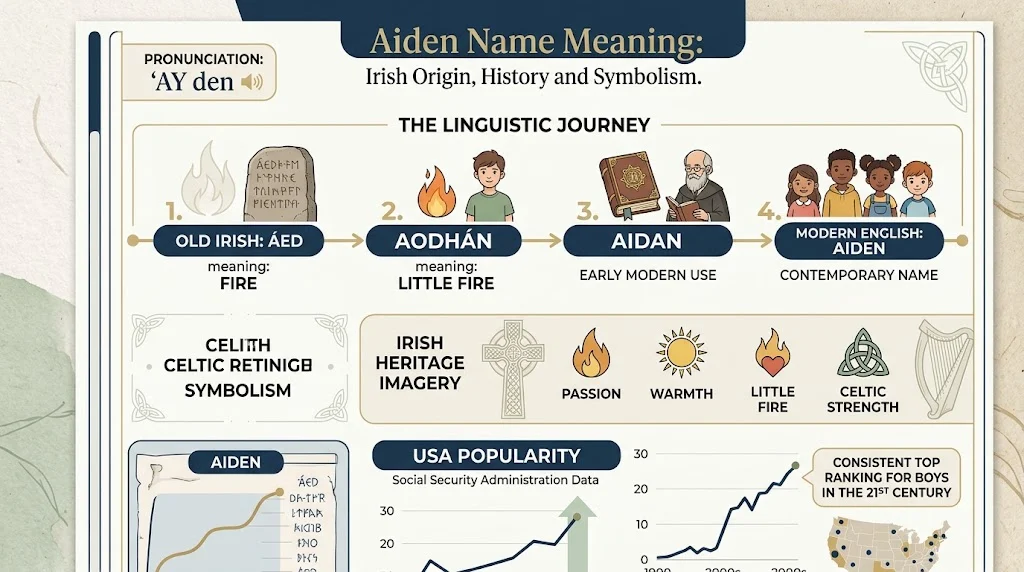
Aiden is an English form of the Irish name Aidan, derived from Old Irish Aodhán, meaning “little fire.” It connects to Aodh, an ancient Irish name meaning “fire,” and carries associations with warmth, energy, and vitality.
The Aiden name’s meaning traces back to the Irish name Aodhán, traditionally interpreted as “little fire.” The name has deep Celtic roots and a long history in Irish naming traditions. Over time, Aodhán developed into forms such as Aidan and Aiden in English usage.
Today, Aiden feels modern, familiar, and easy to pronounce. However, its history reaches much further back than its current popularity suggests. The original Irish form was connected to the Old Irish element Áed, meaning “fire.” The diminutive ending created the sense of a smaller or younger form, giving Aodhán its traditional interpretation of “little fire.”
The name also has an important historical connection to early medieval Ireland. Aodhán was used by historical rulers and saints. One notable bearer was a sixth century king of Dál Riata. Several early Irish saints also carried related forms of the name.
Furthermore, the spelling Aiden became established as an English variant of Aidan. In the United States, Aiden became especially familiar during the late twentieth and early twenty-first centuries. The spelling appeared prominently in American naming data during the 2000s and 2010s.
So, is Aiden simply a modern baby name? Not quite. Its appeal combines an ancient Irish foundation with a contemporary American spelling.
Quick Answer Box
| Meaning | Context | Primary Platforms | Example | Tone |
| Little fire | Irish and Old Irish roots | Baby names, family records, social profiles, everyday conversation | “We named our son Aiden.” | Warm and modern |
| Fire | Root connected with Aodh | Historical and linguistic context | “Aiden has an Irish origin.” | Traditional |
| Irish name | Modern English form of an Irish name | Naming websites and conversations | “Aiden is an Irish name.” | Informative |
| Variant of Aidan | English spelling variation | American naming culture | “Aiden and Aidan are related forms.” | Casual |
What Does Aiden Name Meaning Mean?
The simplest explanation is “little fire.” The meaning comes from the Old Irish name Áedán, which is a diminutive form of Áed. The name Aodh is a related Irish form, and Áed is associated with the meaning “fire.”
The word “little” deserves some context. In historical names, a diminutive does not always mean that someone is physically small. It can indicate an affectionate, familiar, or derived form. Therefore, “little fire” should not necessarily be interpreted literally.
Instead, the name can be understood as a compact form built from an older fire related personal name.
The Old Irish Root
The linguistic foundation reaches back to Áed. This Old Irish name meant “fire” and was used by numerous figures in early Irish history and mythology. It was also associated with several Irish high kings.
Aodh is the later Irish form related to Áed. Aodhán then developed as a diminutive form. Consequently, Aodhán can be understood as a smaller or affectionate form connected with Aodh.
The English forms eventually became easier for English speakers to pronounce and spell.
Aiden as an English Variant
Aiden is generally treated as an English variant of Aidan. Behind the Name identifies Aiden as an English modern variant of Aidan. Aidan itself is an anglicized form of Aodhán.
That distinction matters.
Aiden did not originate independently as an unrelated modern American word. Instead, it belongs to a larger family of related forms.
| Historical or Related Form | Language or Usage | Relationship |
| Áed | Old Irish | Root associated with fire |
| Aodh | Irish | Related Irish form |
| Aodhán | Old Irish | Diminutive form |
| Aidan | Irish and modern English | Anglicized form |
| Aiden | Modern English | Variant of Aidan |
| Aydan | Modern English | Variant spelling |
| Ayden | Modern English | Variant spelling |
What Does “Little Fire” Symbolize?
Fire has many cultural associations. It can represent warmth, energy, light, persistence, and transformation.
However, these symbolic interpretations should be separated from the historical meaning. The documented etymological meaning is “little fire.” Ideas such as “strong leader,” “passionate person,” or “bright personality” are modern symbolic interpretations rather than literal translations.
That distinction makes the name easier to understand accurately.
The Historical Journey Behind the Name
The story of the name begins in Ireland rather than modern America.
Aodh was an established Old Irish personal name. Its meaning was associated with fire. The diminutive Aodhán developed from this older form.
Historical records connect Aodhán with early Irish figures. The name was borne by a sixth century king of Dál Riata. It was also used by early Christian saints, including a sixth century bishop of Ferns and a seventh century bishop of Lindisfarne.
This religious and historical usage helped preserve related forms of the name across generations.
From Aodhán to Aidan
English speakers often adapted Irish names into forms that were easier to pronounce in English. Aidan became one such anglicized form.
Later, Aiden developed as a spelling variant. The two forms sound almost identical in ordinary American English. The main difference is visual rather than phonetic.
For many parents, that spelling difference also creates a slightly different visual identity.
From Ireland to the United States
The name gained considerable visibility in the United States during the late twentieth century. According to Behind the Name, Aidan became popular in America partly because its sound fit patterns found in names such as Braden and Hayden. Aidan reached a peak ranking of 39 for boys in 2003.
Aiden became particularly prominent in more recent American naming culture.
The Social Security Administration’s data places Aiden at number 13 among boys’ names during the 2010s, with 129,675 recorded occurrences during that decade.
For the 2020 through 2025 period, Aiden ranked number 37 among boys’ names in the Social Security Administration’s preliminary decade data, with 42,793 occurrences. The agency notes that this decade ranking covers only the first six years of the 2020s.
Therefore, the name remains well established in American naming culture even though its ranking has changed over time.
Contextual Dynamics & Nuances of the Term
A personal name behaves differently from slang or an internet abbreviation. Therefore, the context around Aiden is usually about identity, naming, family history, or cultural background.
As a Baby Name
Parents may choose Aiden because they like its sound, its Irish connection, its historical background, or its modern familiarity.
For example:
“We chose Aiden because we wanted an Irish name that works easily in the United States.”
That statement combines cultural heritage with practical naming considerations.
As a Cultural Reference
Someone may ask about Aiden while researching Irish names. In that context, the most useful explanation focuses on etymology rather than personality claims.
A concise answer would be:
“Aiden is an English variant of Aidan, which comes from the Irish Aodhán and traditionally means ‘little fire.’”
This explanation is both short and historically grounded.
As a Modern American Name
In the United States, many people encounter Aiden without immediately thinking about its Irish origins. The spelling has become familiar enough to function naturally within contemporary American naming culture.
Consequently, the name can carry two identities at once.
It has an ancient linguistic foundation. At the same time, it feels contemporary.
Pronunciation
Aiden is commonly pronounced AY den.
The pronunciation is straightforward for most English speakers. That accessibility has likely helped the spelling work well in American contexts.
The pronunciation can be represented as:
AY den
The first syllable rhymes approximately with “day,” while the second resembles the unstressed sound in “button.”
Real Life Conversation Examples Using Aiden Name Meaning
The following examples show how people might naturally discuss the name in everyday conversation.
Example 1: Choosing a Baby Name
Maya: We are thinking about naming the baby Aiden.
Chris: I like it. Do you know what it means?
Maya: Yes. It comes from an Irish name and is usually explained as “little fire.”
Chris: That is actually a pretty meaningful origin.
Maya: Exactly. We also like how easy it is to pronounce.
Example 2: Asking About Heritage
Jordan: Is Aiden an Irish name?
Sam: Yes. Aiden is a modern English spelling related to Aidan.
Jordan: And what does it mean?
Sam: It comes from Aodhán, which means “little fire.”
Jordan: That explains why I have seen it listed as an Irish name.
Example 3: Comparing Spellings
Alex: Would you spell it Aiden or Aidan?
Taylor: I prefer Aiden because I like the way it looks.
Alex: Are they different names?
Taylor: They are related forms. Aiden is considered a variant of Aidan.
Alex: So the pronunciation can stay basically the same?
Taylor: Exactly.
Example 4: Explaining the Meaning
Nora: What does your son’s name mean?
Daniel: Aiden means “little fire.”
Nora: That sounds symbolic.
Daniel: It does. The original meaning comes from an old Irish name connected with fire.
Nora: I love names with historical roots.
Example 5: Casual Texting
Emma: Why did you choose Aiden?
Liam: We wanted something simple with Irish roots.
Emma: Does it have a meaning?
Liam: Yeah. “Little fire.”
Emma: That is a great meaning.
Liam: Thanks. We also liked that it works well in the US.
Platform Specific Breakdown
Aiden does not function as internet slang. Instead, digital platforms mainly affect how people research, share, and discuss the name.
How It Is Used on Snapchat
On Snapchat, Aiden may appear as a person’s display name, username, contact name, or story reference.
There is no standard Snapchat meaning that changes the historical meaning of the name.
For example, if someone sees “Aiden” in a Snapchat conversation, the most likely interpretation is simply that it is someone’s name.
Context still matters. A username could contain additional letters, numbers, or creative spelling. Those additions do not automatically create a new definition.
A Snapchat conversation might look like this:
“Did Aiden send you the picture?”
Here, Aiden clearly functions as a person’s name.
Another example could be:
“My baby name list has Aiden at the top.”
Again, the term refers to the given name rather than internet slang.
The Role of Aiden Name Meaning on TikTok
TikTok can increase interest in baby names, name meanings, pronunciation, and cultural origins.
Creators may publish videos about Irish names or explain the symbolism behind different names. Such videos can make a traditional meaning more visible to a younger audience.
However, social media explanations sometimes simplify etymology.
For example, a creator might describe Aiden as meaning “fiery,” “strong,” or “passionate.” Those descriptions may communicate symbolism, but they should not replace the documented etymology.
The historically grounded meaning is connected with “little fire.”
Therefore, readers should distinguish between:
| Type of Statement | Example | Accuracy |
| Etymological meaning | “Little fire” | Historically grounded |
| Root meaning | “Fire” | Connected to Áed |
| Symbolic interpretation | “Energetic” | Interpretive |
| Personality claim | “People named Aiden are passionate” | Not established by the name |
| Social media description | “Aiden is a powerful name” | Subjective |
This distinction is particularly important when researching names online.
Instagram and Texting Dynamics
Instagram uses names in several ways. Aiden may appear in profile names, captions, comments, usernames, baby announcement posts, or family photographs.
For example:
“Welcome to the world, Aiden.”
That sentence simply announces a child’s name.
A caption might also explain its background:
“We chose Aiden for its Irish roots and its traditional meaning of ‘little fire.’”
This kind of usage combines personal storytelling with etymological information.
In texting, the name usually requires no special interpretation.
“Can you ask Aiden?”
“Aiden is coming at six.”
“I love the name Aiden.”
In each case, context makes the meaning obvious.
Alternative Meanings
Search engines and language models may encounter many related queries. Understanding them helps clarify what users usually mean when they search for the topic.
Common Semantic Variations
People may search for:
- Aiden meaning
- Aiden name origin
- Aiden Irish name meaning
- What does Aiden mean?
- Meaning of the name Aiden
- Aiden baby name meaning
- Aiden boy name meaning
- Aiden Irish origin
- Aidan vs Aiden
- Aiden pronunciation
- Aiden biblical meaning
- Aiden Celtic meaning
These queries are related, but they do not all ask exactly the same question.
For example, “Aiden pronunciation” focuses on sound. “Aiden origin” focuses on history. “Aidan vs Aiden” focuses on spelling and relationship.
Aiden and Aidan
Aiden and Aidan are closely related forms.
Behind the Name identifies Aidan as an anglicized form of Aodhán and Aiden as an English variant of Aidan.
| Name | General Usage | Relationship |
| Aodhán | Old Irish | Historical source form |
| Aidan | Irish and English | Anglicized form |
| Aiden | Modern English | Variant spelling |
| Aydan | Modern English | Variant spelling |
| Ayden | Modern English | Variant spelling |
Is It a Biblical Name?
Aiden is not traditionally a biblical name.
Its documented linguistic history points toward Old Irish and Irish naming traditions. Therefore, it should not be presented as a name originating in the Bible.
Some modern websites may associate names with biblical themes or religious virtues. However, that does not establish biblical etymology.
Is It a Celtic Name?
The name has Irish roots and therefore belongs to the broader Celtic linguistic and cultural context.
Still, “Celtic” can be too broad when a more precise description is available. Irish and Old Irish are more specific terms for its historical development.
Misinterpretations:
The most common misunderstanding is treating the name as if it were modern slang.
It is not.
Aiden is a personal name. Its meaning comes from historical linguistic roots rather than current internet culture.
Do Not Treat It as a Slang Definition
If someone writes:
“Aiden just texted me.”
There is no hidden slang meaning.
The person is almost certainly referring to someone named Aiden.
Do Not Turn Symbolism Into Fact
Another mistake involves statements such as:
“Everyone named Aiden is naturally energetic.”
That is not a linguistic fact.
A name’s etymology does not determine an individual’s personality.
The word “fire” may inspire symbolic associations with energy or warmth. However, those associations are interpretations rather than personality predictions.
Do Not Confuse Similar Spellings
Aiden, Aidan, Ayden, Aydan, and Aden can appear similar.
However, spelling variants can have different linguistic histories or naming conventions. They should not automatically be treated as completely separate names or exact equivalents.
Do Not Invent Cultural Claims
Because the name has Irish roots, it can be tempting to attach broad claims about Irish culture to every person named Aiden.
That would go beyond the evidence.
A name’s origin can tell us about language and naming history. It cannot tell us someone’s ancestry, nationality, religion, or personality.
How to Respond in Chat Comfortably
When someone asks about the name, a short response usually works best.
If Someone Asks “What Does Aiden Mean?”
You can say:
“Aiden comes from the Irish name Aodhán and traditionally means ‘little fire.’”
That gives the essential answer immediately.
If Someone Asks “Is Aiden Irish?”
A natural answer is:
“Yes. It is a modern English form related to the Irish name Aidan, which comes from Aodhán.”
If Someone Asks About Aiden and Aidan
Try:
“They are related forms. Aiden is a modern English spelling variant of Aidan.”
If Someone Wants a More Personal Explanation
You could say:
“It has an Irish background and a traditional meaning connected with ‘little fire.’ The fire association can also give it a warm and energetic symbolic feel.”
The first part is etymological. The second part is clearly symbolic.
That distinction keeps the answer accurate while still making it useful.
Popularity and Modern American Usage
Aiden has had a significant presence in American baby naming.
The Social Security Administration’s historical data shows that the spelling was especially prominent during the 2000s and 2010s. During the 2010s, Aiden ranked 13th among boys’ names, with 129,675 recorded occurrences.
During the 2000s, Aiden ranked 54th among boys, with 83,554 recorded occurrences. Aidan also appeared separately at number 55, with 76,513 occurrences.
That separate treatment is important. The Social Security Administration counts different spellings separately in its name rankings.
Therefore, combining Aiden and Aidan into one ranking would not accurately represent the agency’s published figures.
For 2020 through 2025, Aiden ranked 37th among boys in the agency’s decade table, with 42,793 occurrences.
This shows how the name moved from a major 2000s and 2010s trend into an established modern American name.
Why the Spelling Works Well in the USA
Several features make Aiden easy to use in English.
First, pronunciation is intuitive.
Second, the spelling resembles familiar names such as Hayden and Brayden.
Third, the name has an established history in English speaking countries.
Finally, it combines a recognizable sound with a distinctive Irish origin.
That combination can make the name feel both familiar and culturally rooted.
Related Names and Spelling Variants
People researching the name often compare it with several related forms.
| Name | General Association | Key Difference |
| Aiden | Modern English | Common contemporary spelling |
| Aidan | Irish and English | Traditional anglicized spelling |
| Aodhán | Old Irish | Historical source form |
| Aodh | Irish | Older related root name |
| Aydan | Modern English | Alternative spelling |
| Ayden | Modern English | Alternative spelling |
| Aden | Modern usage | Similar visual form |
The relationship between Aodhán, Aidan, and Aiden is the clearest historical chain.
Aiden vs Aidan
The difference is primarily spelling in contemporary English usage.
Many English speakers pronounce both forms similarly.
Aidan has a stronger connection to the established anglicized form. Aiden is the modern spelling that became especially familiar in the United States.
Aiden vs Ayden
Ayden is another modern spelling variant.
The pronunciation may remain essentially the same in English. However, the visual style differs.
Parents often choose between these spellings based on personal preference rather than a major difference in meaning.
Is Aiden a Good Name for a Baby?
Whether a name is suitable depends on personal preference. However, several factual characteristics can help parents evaluate it.
Aiden has:
- An established Irish origin.
- A documented historical meaning.
- A simple English pronunciation.
- A long history of related forms.
- Strong familiarity in the United States.
- Multiple recognized spelling variants.
- Significant representation in recent American baby name data.
Its biggest practical advantage is familiarity. Most English speakers can recognize and pronounce it without much difficulty.
Its main consideration is popularity. Parents who want a highly unusual name may find Aiden less distinctive than a rare Irish name.
That distinction depends on the family’s priorities.
Aiden Name Meaning for Middle Names
Aiden pairs naturally with many short and traditional middle names.
Examples include:
| First Name | Middle Name | Overall Style |
| Aiden James | James | Classic |
| Aiden Thomas | Thomas | Traditional |
| Aiden Michael | Michael | Familiar |
| Aiden Alexander | Alexander | Formal |
| Aiden Cole | Cole | Short and modern |
| Aiden Brooks | Brooks | Contemporary |
| Aiden Ryan | Ryan | Familiar Irish leaning |
| Aiden Joseph | Joseph | Traditional |
| Aiden Daniel | Daniel | Timeless |
| Aiden Patrick | Patrick | Irish association |
These combinations are style suggestions, not linguistic rules.
A name can work well because of rhythm, family significance, initials, or personal preference.
FAQs
1. What does Aiden mean?
The name traditionally means “little fire.” It comes from the Old Irish name Aodhán, a diminutive related to Áed, an Old Irish name meaning “fire.”
2. Is Aiden an Irish name?
Yes. Aiden is a modern English variant of Aidan, which is an anglicized form of the Irish name Aodhán.
3. How do you pronounce Aiden?
It is commonly pronounced AY den in English.
4. What is the difference between Aiden and Aidan?
They are closely related spellings. Aidan is the established anglicized form of Aodhán, while Aiden is a modern English variant of Aidan.
5. Is Aiden a biblical name?
No. Its documented origin is Irish and Old Irish rather than biblical.
6. Is Aiden a boy’s name?
In modern American usage, Aiden has historically been used predominantly as a masculine given name. U.S. Social Security Administration data lists it among boys’ names.
7. What does the fire connection represent?
The literal etymological connection is to “fire.” Symbolically, people may associate fire with warmth, light, energy, or vitality. Those symbolic associations are interpretations rather than additional dictionary meanings.
8. Was Aiden popular in the United States?
Yes. The spelling Aiden was especially prominent during the 2000s and 2010s. It ranked 54th among boys during the 2000s and 13th during the 2010s in Social Security Administration decade data.
9. Is Aiden still common in the USA?
Aiden remains well established in recent U.S. naming data. For 2020 through 2025, it ranked 37th among boys in the Social Security Administration’s preliminary decade ranking.
10. What are similar names to Aiden?
Related or stylistically similar choices include Aidan, Ayden, Aydan, Aden, Hayden, Caden, Brayden, and other names with similar modern English sounds.
Image SEO Architecture
Featured Infographic Prompt
Create a clean, premium vertical infographic titled “Aiden Name Meaning: Irish Origin, History and Symbolism.” Show the linguistic journey from Old Irish Áed meaning “fire” to Aodhán meaning “little fire,” then Aidan and modern English Aiden. Include pronunciation “AY den,” Irish heritage imagery, a subtle Celtic inspired visual style, a timeline showing the historical development, and a small USA popularity section referencing Social Security Administration data. Use readable typography, generous white space, simple icons, and a sophisticated editorial design. Avoid stereotypes, clutter, excessive decoration, and unsupported personality claims.
Suggested Image Alt Text
Aiden name meaning, Irish origin, pronunciation, history, and little fire symbolism
Suggested Image File Name
aiden-name-meaning-irish-origin-history.png
Suggested Image Caption
Aiden is a modern English form related to the Irish Aidan and Old Irish Aodhán, traditionally meaning “little fire.”
What Makes the Name Distinctive?
The strongest feature of Aiden is its combination of historical depth and modern accessibility.
Its linguistic roots are old. Its contemporary spelling feels familiar.
That combination gives the name a broad semantic range.
For someone interested in Irish heritage, the connection to Aodhán provides historical substance. For someone choosing a contemporary American baby name, the spelling offers simplicity.
Furthermore, the meaning “little fire” is memorable without requiring an elaborate explanation.
Historical Depth
The name connects to early Irish history and Christian tradition. Aodhán was used by historical figures and saints.
Modern Accessibility
Aiden uses a pronunciation pattern that is easy for many American English speakers.
Symbolic Potential
Fire can suggest warmth and energy. However, these are symbolic interpretations rather than literal translations.
Linguistic Flexibility
The name has several related spellings. Therefore, families can choose a form that fits their preferred visual style.
Common Questions Parents Should Ask Before Choosing the Name
Parents researching a name may benefit from looking beyond its dictionary meaning.
First, consider how the first and last names sound together.
Second, examine the initials.
Third, consider whether the spelling will be easy for teachers and administrators to read.
Fourth, decide whether popularity matters.
Finally, consider whether the cultural origin has personal significance.
These questions can matter more than a single definition.
A name is used every day. Therefore, pronunciation, spelling, family meaning, and cultural connection can all influence how satisfying the choice feels.
Final Takeaway
The core Aiden name means “little fire.” Its history leads back to the Old Irish name Aodhán, which developed from the older fire related name Áed. Aidan is the established anglicized form, while Aiden is a modern English variant.
The name therefore has a much older history than its modern spelling suggests.
In the United States, Aiden became particularly visible during the 2000s and 2010s. Social Security Administration data placed it among the most frequently used boys’ names during both decades. It remained prominent in the agency’s 2020 through 2025 preliminary decade data as well.
Its meaning also deserves careful interpretation. “Little fire” is the historical linguistic explanation. Descriptions such as energetic, warm, bright, or passionate can work as symbolism, but they should not be presented as literal definitions.
Ultimately, Aiden connects an ancient Irish naming tradition with modern English usage. Its simple pronunciation, recognizable spelling, historical depth, and memorable fire association explain why it continues to attract attention among American name researchers and parents.
