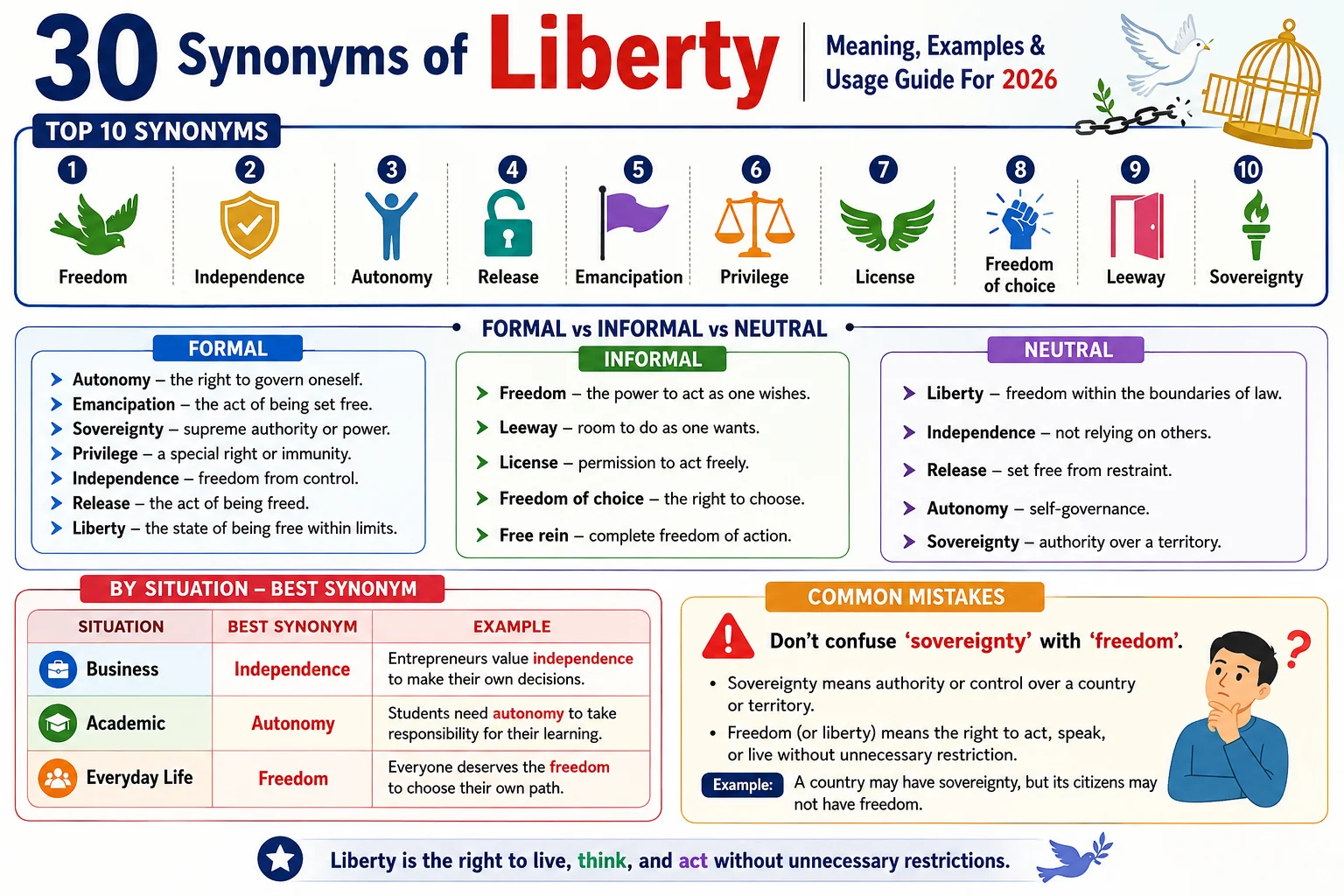
Liberty means the state of being free, having the power to act, speak, or think without restrictions . The best synonyms for liberty include freedom, independence, autonomy, self-determination, and sovereignty. While “freedom” is the most common and general term, “independence” often refers to freedom from control by others . Each synonym carries a slightly different meaning, tone, and context.
Welcome! If you’re looking to improve your English, understanding synonyms is a powerful tool. While “liberty” is a beautiful word, sometimes you need a more exact term. Do you want to sound more professional in an email? Are you writing a story and need the perfect word to capture a character’s struggle? This guide is for you.
By the end of this article, you’ll not only know many words like “liberty” but also exactly when and how to use each one. We’ll cover everything from formal alternatives to words that sound more natural in everyday conversation.
What Does “Liberty” Mean?
Definition
In simple terms, liberty is the state of being free. It means you are not in prison, not controlled by someone else, and have the right to make your own choices . It’s a powerful concept that refers to freedom from outside control, whether that’s a government, a boss, or any other kind of restraint . While it often refers to big political ideas, it can also describe simple personal freedoms, like the liberty to choose your own path in life.
Pronunciation
- US IPA: /ˈlɪb.ɚ.ti/
- UK IPA: /ˈlɪb.ə.ti/
- Syllables: 3 (Lib-er-ty)
- Pronunciation Tip: The stress is on the first syllable “LIB.” Think of the word “library” but with a “ty” at the end instead of “rary.”
Grammar
- Grammar Feature: Noun
- Common Position: Can be the subject or object of a sentence.
- Typical Pattern: “The liberty to [verb]” or “Liberty from [noun].”
Here are a few natural examples:
- “We have the liberty to choose our own projects at work.”
- “For centuries, people have fought for liberty from tyranny.”
- “He took the liberty of making a few changes to the document.”
Grammar Note: “Liberty” is often uncountable (like freedom), but we use the plural “liberties” to mean specific rights or privileges, or to describe rude behavior (taking liberties) .
Word Family
| Word | Part of Speech | Meaning | Related Form |
|---|---|---|---|
| Liberty | Noun | The state of being free. | – |
| Liberties | Noun (Plural) | Specific rights or privileges; acts of disrespect. | – |
| Liberate | Verb | To set someone free. | Liberation (Noun), Liberator (Noun) |
| Libertarian | Noun/Adjective | Someone who believes in maximum liberty. | Libertarianism (Noun) |
| Free | Adjective/Verb | Not under the control of another. | Freedom (Noun) |
| Autonomous | Adjective | Self-governing; independent. | Autonomy (Noun) |
10 15 Synonyms of “Liberty”
Here are the most useful synonyms, organized from the most common to the most specific.
1. Freedom
- Meaning: The power or right to act, speak, or think as you want without hindrance or restraint. It is the most direct and common synonym for liberty .
- Best Used For: Daily conversation, general writing, and most contexts.
- Formality: Neutral
- Tone: Positive, Neutral
- Frequency: ⭐⭐⭐⭐⭐ Very Common
- CEFR Level: A2
- Example Sentence 1: “Freedom of speech is a fundamental human right.”
- Example Sentence 2: “He enjoyed the freedom of being his own boss.”
- Usage Tip: You can almost always use “freedom” in place of “liberty.” It feels more personal and less formal. Use “liberty” for a more formal or historical feel.
2. Independence
- Meaning: Freedom from being controlled or influenced by others; self-sufficiency.
- Best Used For: Talking about countries, people, or personal finance.
- Formality: Neutral
- Tone: Positive, Professional
- Frequency: ⭐⭐⭐⭐⭐ Very Common
- CEFR Level: B1
- Example Sentence 1: “The country celebrated its independence from colonial rule” .
- Example Sentence 2: “Getting a job gave her financial independence.”
- Usage Tip: This focuses on not needing someone or something else. You can be free in a prison, but you can’t be independent.
3. Autonomy
- Meaning: The right or condition of self-government, especially in an organization or region. It means you make your own rules .
- Best Used For: Professional, academic, and political contexts.
- Formality: Formal
- Tone: Professional, Academic
- Frequency: ⭐⭐⭐⭐ Common
- CEFR Level: B2
- Example Sentence 1: “The regional government was granted greater autonomy.”
- Example Sentence 2: “Team members have the autonomy to decide their own workflow.”
- Usage Tip: Use this when talking about groups, departments, or regions that have the power to govern themselves.
4. Self-determination
- Meaning: The process by which a group of people, usually with a common identity, make their own decisions about their political future .
- Best Used For: Academic, political, and historical discussions.
- Formality: Formal
- Tone: Academic, Professional
- Frequency: ⭐⭐⭐ Moderate
- CEFR Level: B2
- Example Sentence 1: “The principle of national self-determination was a major goal of the movement.”
- Example Sentence 2: “They were fighting for the right to self-determination.”
- Usage Tip: This is a powerful word used for nations or groups of people. It’s not for everyday situations.
5. Sovereignty
- Meaning: The supreme authority within a territory. It means a country has full control over its own affairs without interference from outside .
- Best Used For: Formal political and legal contexts.
- Formality: Formal
- Tone: Professional, Serious
- Frequency: ⭐⭐⭐ Moderate
- CEFR Level: B2
- Example Sentence 1: “The nation’s sovereignty was respected by all other countries.”
- Example Sentence 2: “They refused to sign a treaty that would compromise their sovereignty.”
- Usage Tip: This is about ultimate control and authority. A state can be independent but still share some sovereignty in a union.
6. Emancipation
- Meaning: The act of setting someone free from legal, social, or political restrictions, or from slavery .
- Best Used For: Historical contexts, academic writing, and literature.
- Formality: Formal
- Tone: Serious, Historical
- Frequency: ⭐⭐⭐ Moderate
- CEFR Level: B2
- Example Sentence 1: “The Emancipation Proclamation was a pivotal moment in American history.”
- Example Sentence 2: “She dedicated her life to the emancipation of women.”
- Usage Tip: This is a strong, powerful word for breaking chains literal or metaphorical.
7. Latitude
- Meaning: Freedom from normal restrictions or limits to act or choose; leeway .
- Best Used For: Business, professional contexts, and writing.
- Formality: Formal
- Tone: Professional, Neutral
- Frequency: ⭐⭐⭐ Moderate
- CEFR Level: B2
- Example Sentence 1: “The new policy gives employees a lot of latitude in how they work.”
- Example Sentence 2: “You have some latitude in interpreting the rule.”
- Usage Tip: This doesn’t mean absolute freedom. It means you have some room to maneuver within set boundaries.
8. Discretion
- Meaning: The freedom to decide what should be done in a particular situation .
- Best Used For: Formal writing, business, and professional contexts.
- Formality: Formal
- Tone: Professional, Neutral
- Frequency: ⭐⭐⭐⭐ Common
- CEFR Level: B2
- Example Sentence 1: “The manager used her discretion to approve the employee’s leave.”
- Example Sentence 2: “You have the discretion to handle the situation as you see fit.”
- Usage Tip: This often implies the power to make a wise judgment. It’s not just freedom; it’s freedom to make a choice.
9. Franchise
- Meaning: The right to vote .
- Best Used For: Political and historical discussions.
- Formality: Formal
- Tone: Professional, Serious
- Frequency: ⭐⭐ Rare
- CEFR Level: B2
- Example Sentence 1: “The 19th Amendment extended the franchise to women.”
- Example Sentence 2: “Voting is the most common exercise of the franchise.”
- Usage Tip: This is a very specific word that means the “right to vote,” not freedom in general.
10. License (or Licence)
- Meaning: Freedom to do something, often that is not normally allowed; can also mean excessive freedom .
- Best Used For: Creative writing, formal and informal discussions.
- Formality: Neutral
- Tone: Neutral, sometimes Negative
- Frequency: ⭐⭐⭐ Moderate
- CEFR Level: B2
- Example Sentence 1: “The poet used artistic license to create a powerful effect” .
- Example Sentence 2: “His rude comments were just a license for bad behavior.”
- Usage Tip: This often has a negative connotation of going too far or breaking the rules. “Poetic license” is a positive exception.
11. Shore Leave
- Meaning: Permission for a sailor or naval officer to go ashore .
- Best Used For: Nautical or military contexts.
- Formality: Neutral
- Tone: Informal, Specific
- Frequency: ⭐ Very Rare
- CEFR Level: B1
- Example Sentence 1: “The sailors were eager to get shore leave after months at sea” .
- Example Sentence 2: “He got into trouble during his shore leave.”
- Usage Tip: This is a very specific job-related term. Don’t use it for anything else.
12. Self-government
- Meaning: The governing of a country, region, or group by its own members .
- Best Used For: Political and historical discussions.
- Formality: Formal
- Tone: Professional
- Frequency: ⭐⭐ Rare
- CEFR Level: B2
- Example Sentence 1: “The colony was granted self-government in 1965.”
- Example Sentence 2: “Many believe local issues are best solved through self-government.”
- Usage Tip: Similar to autonomy but emphasizes the act of governing oneself.
13. Volition
- Meaning: The faculty or power of using one’s own will to make a choice .
- Best Used For: Formal, academic, or literary contexts.
- Formality: Formal
- Tone: Academic, Sophisticated
- Frequency: ⭐⭐ Rare
- CEFR Level: C1
- Example Sentence 1: “She left the company entirely of her own volition.”
- Example Sentence 2: “The decision was made without his volition.”
- Usage Tip: This is a very precise word for the inner power of choice. It’s often used to emphasize that an action was a free choice.
Synonyms Comparison Table
| Synonym | Best Context | Formality | Tone | Frequency |
|---|---|---|---|---|
| Freedom | General use, daily conversation | Neutral | Positive | ⭐⭐⭐⭐⭐ |
| Independence | Personal, political, financial | Neutral | Positive, Professional | ⭐⭐⭐⭐⭐ |
| Autonomy | Work groups, regions, organizations | Formal | Professional | ⭐⭐⭐⭐ |
| Sovereignty | Countries, international law | Formal | Serious | ⭐⭐⭐ |
| Emancipation | Historical, social movements | Formal | Serious, Historical | ⭐⭐⭐ |
| Latitude | Business, professional rules | Formal | Neutral | ⭐⭐⭐ |
| Discretion | Professional decisions, judgment | Formal | Professional | ⭐⭐⭐⭐ |
| Self-determination | Politics, national identity | Formal | Academic | ⭐⭐⭐ |
| Franchise | Voting rights, politics | Formal | Serious | ⭐⭐ |
| Volition | Academic, literary, personal choice | Formal | Sophisticated | ⭐⭐ |
Best Synonyms by Situation
| Situation | Best Synonym | Why It Works |
|---|---|---|
| Daily Conversation | Freedom | It’s the simplest and most natural word. “I have the freedom to” |
| Business Email | Autonomy / Discretion | Sounds professional and implies trust. “We value your autonomy.” |
| Academic Writing | Sovereignty / Emancipation | Shows a more formal and precise vocabulary. |
| School Assignment | Independence / Freedom | Easy to understand and appropriate for most levels. |
| Professional Meeting | Latitude / Autonomy | Gives a clear and respectful meaning of leeway. |
| Presentation | Self-determination | Powerful word for discussing current events or history. |
| Creative Writing | License / Volition | Allows for poetic or descriptive language. |
| Social Media | Freedom | Short, powerful, and instantly understandable. |
| Movie Review | Creative License | Perfect for describing an artist’s choices. |
| Book Review | Emancipation / Freedom | Good for discussing themes of a novel’s characters. |
Formal vs Informal Synonyms
Formal Alternatives
| Synonym | Best Used For |
|---|---|
| Autonomy | Academic writing, business strategy discussions |
| Sovereignty | Legal and political discourse |
| Emancipation | Historical and sociological analysis |
| Self-determination | Geopolitical and historical reports |
| Discretion | Professional policies, management |
Neutral Alternatives
| Synonym | Best Used For |
|---|---|
| Freedom | Almost everything |
| Independence | Almost everything |
| Latitude | Professional writing, daily use |
| Choice | Daily conversation |
Informal Alternatives
| Synonym | Best Used For |
|---|---|
| Liberty | Slightly formal but used in conversation |
| License | Casual or creative contexts |
| Leeway | Common in conversation |
| Laissez-faire | Relaxed or managerial context |
Formality Guide: If you’re writing a work email or academic paper, choose Formal words. If you’re chatting with friends, use Neutral or Informal words like “freedom” or “independence.” If you use a formal word like “sovereignty” in casual conversation, it may sound strange or overly serious.
Strong vs Mild Synonyms
Mild
- Freedom: The standard word.
- Independence: A standard, strong feeling of self-reliance.
- Choice: The ability to pick one thing over another.
Moderate
- Autonomy: A strong word for self-rule within a system.
- Latitude: Having some room to act. It’s more moderate than “autonomy.”
Strong
- Emancipation: Breaking free from something oppressive. Very powerful.
- Sovereignty: Complete power and control over a territory.
- Liberation: A dramatic word for being set free from an oppressive force.
- Intensity Note: The intensity of the word changes its impact. If you say you want “emancipation” from a boring job, it sounds very dramatic. If you want “independence,” it sounds more personal and professional. If you want “freedom,” it’s a general desire. Always check the context to choose the correct intensity.
Real-Life Examples
At the Office
- “The new policy gives developers more latitude to experiment with new technologies.”
- “Employees have the discretion to set their own schedules within reason.”
- In a Business Email
- “Thank you for granting me the autonomy to manage this project.”
- “We are committed to respecting the sovereignty of our partner organizations.”
- In a Book or Movie Review
- “The film takes great liberties with the historical facts.”
- “The protagonist’s journey is ultimately one of emancipation from a suffocating society.”
- In Daily Conversation
- “Living alone for the first time gave me a sense of independence.”
- “We have the freedom to spend our weekend however we like.”
Common Collocations
| Common Phrase | Better Alternative |
|---|---|
| Freedom of speech | Autonomy of expression (formal) |
| Personal freedom | Personal liberty (slightly formal), Independence |
| Complete freedom | Full latitude, Complete autonomy |
| Giving freedom | Granting discretion, Granting latitude |
| A free press | An independent press |
Common Phrases
- “To take the liberty”
- Meaning: To do something without asking permission first.
- Example: “I took the liberty of ordering food for everyone.”
- “At your liberty”
- Meaning: (Less common) At your convenience.
- “License to”
- Meaning: Freedom to do something (often bad).
- Example: “His promotion gave him a license to be rude.”
Context Guide
| Situation | Best Synonym | Reason |
|---|---|---|
| Essay about a country | Sovereignty | Demonstrates legal and political control. |
| Speech about equality | Emancipation | A strong, evocative word for historical struggle. |
| Business email about staff | Autonomy / Latitude | Suggests trust and empowerment. |
| Novel about a character’s journey | Freedom / Independence | Simple, relatable words for personal growth. |
| Political presentation | Self-determination | Appropriate and powerful term for group rights. |
| Casual conversation | Freedom | Simple and natural in any context. |
| Academic text on history | Emancipation / Self-government | Demonstrates a formal academic vocabulary. |
| Marketing copy | Freedom / Independence | Positive, simple words that are aspirational. |
Related Words
Near Synonyms
- Self-determination: Closely related to independence and autonomy.
- Sovereignty: The highest form of political freedom.
Antonyms
- Slavery: The state of being a slave .
- Bondage: The state of being a slave or imprisoned .
- Constraint: A limitation or restriction .
- Restraint: A measure or condition that limits freedom .
- Tyranny: Oppressive power, usually by a government .
- Related Adjectives
- Free: Not under the control of another.
- Independent: Not depending on another.
- Autonomous: Self-governing.
- Sovereign: Having supreme power.
- Related Nouns
- Liberation: The act of setting free.
- Independence: The state of being self-sufficient.
- Autonomy: The right to self-government.
- Related Verbs
- Liberate: To set free.
- Free: To release from confinement.
- Emancipate: To free from legal restrictions.
Frequently Asked Questions
What is another word for liberty?
The most common and direct synonym for liberty is “freedom.” Other great alternatives include “independence,” “autonomy,” and “sovereignty,” depending on the context. “Freedom” is the best choice for everyday use because it is simple and can be used in almost any situation .
Which synonym sounds the most professional?
For professional contexts, “autonomy” and “discretion” are excellent choices. “Autonomy” suggests self-governance and is ideal for describing how teams work. “Discretion” implies you have the freedom to make wise choices, which is a sign of trust and responsibility .
What is the strongest synonym for liberty?
The strongest and most dramatic synonyms are “emancipation” and “sovereignty.” “Emancipation” is powerful because it often refers to breaking free from oppression or slavery. “Sovereignty” implies ultimate authority and control, making it the strongest choice for describing a nation’s power .
Which synonym is best for essays?
For academic and persuasive essays, “emancipation,” “self-determination,” and “sovereignty” are the best choices. These are formal, precise, and show a strong command of vocabulary. “Emancipation” is great for historical topics, while “sovereignty” and “self-determination” are ideal for political science or international relations .
What’s the difference between freedom and liberty?
In modern use, “freedom” and “liberty” are almost interchangeable, but “liberty” feels slightly more formal and can imply a political or civil right. “Freedom” is more general and personal. For example, you might say “freedom to choose your lunch,” but “liberty of worship” has a more constitutional tone .
What is the opposite of liberty?
The opposite of liberty includes words like slavery, bondage, restraint, constraint, and tyranny. “Slavery” and “bondage” mean being owned or controlled by someone else, while “constraint” and “restraint” simply mean being held back or limited .
What does “take liberties” mean?
“Take liberties” means to act in a way that is too familiar or to behave in an overly bold manner. For example, if someone makes an unnecessary joke in a serious meeting, they are taking liberties. It can also mean altering or making changes to someone’s work without permission .
Can “license” be a synonym for liberty?
Yes, “license” can be a synonym for liberty, but it often has a negative connotation of excessive or unrestrained freedom. It is commonly used in the phrase “artistic license,” which means the freedom to bend the rules for artistic effect. However, it can also mean “too much freedom” .
Conclusion
In summary, “liberty” is a powerful word for “freedom,” but English offers a rich variety of alternatives to express its many facets. The best synonym depends on your situation: use “freedom” for everyday conversation, “autonomy” for professional settings, “sovereignty” for political contexts, and “emancipation” for dramatic or historical topics.
The key takeaway is to consider context, tone, and formality. Using a precise synonym not only improves your vocabulary but also makes your writing and speaking more effective and impressive. Try using at least one new synonym from this list today to see how natural it feels. The more you practice, the more fluent and confident you’ll become.
