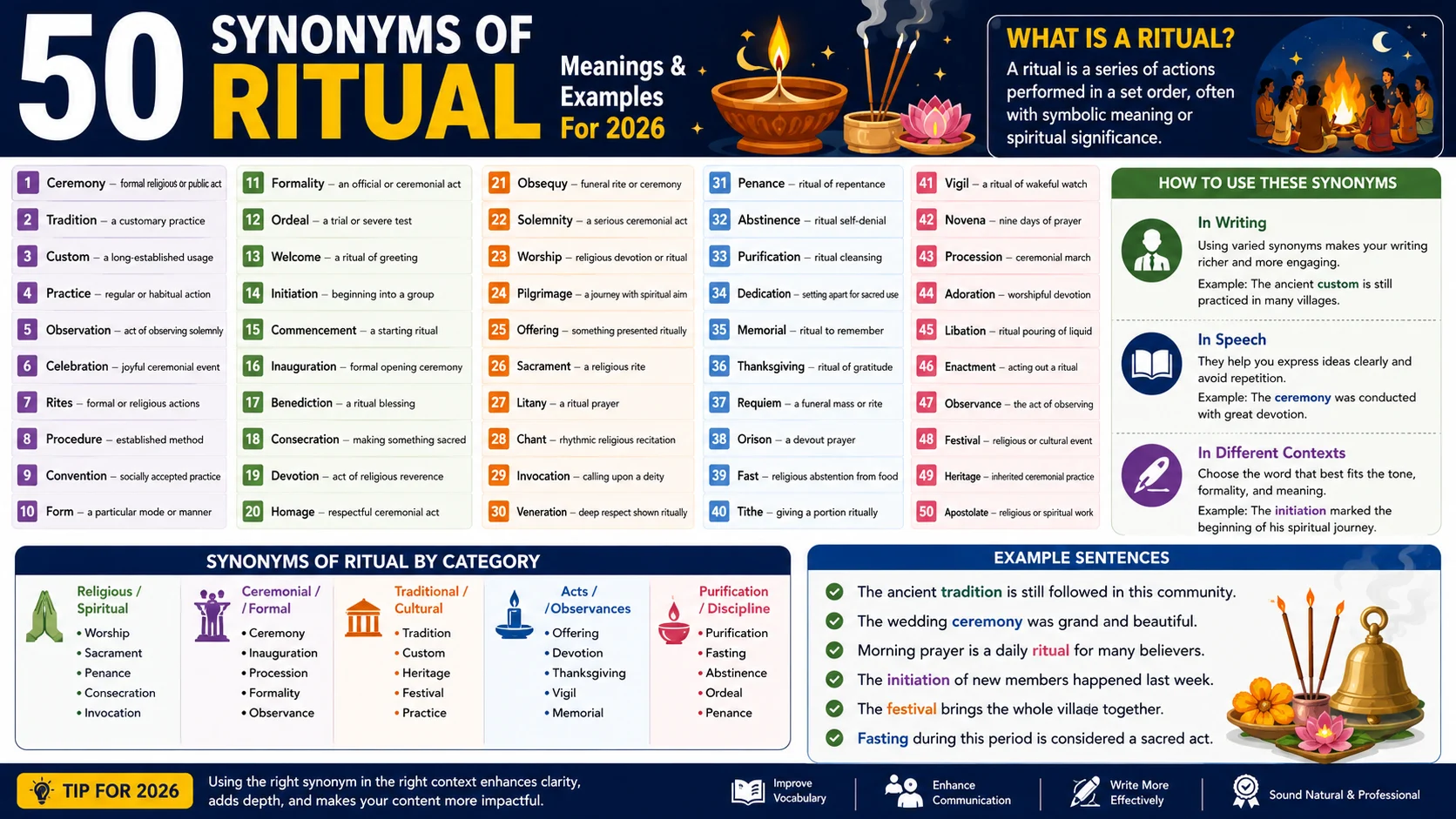
“Ritual” means a set of actions performed regularly, often for religious or cultural reasons. The best synonyms are ceremony, tradition, custom, practice, and observance. “Tradition” is the most common natural alternative. Each synonym has a slightly different meaning and context where it fits best.
Top 10 Synonyms
- Tradition
- Ceremony
- Custom
- Practice
- Observance
- Rite
- Routine
- Habit
- Formality
- Usage
“Ritual” is a fascinating word. It describes the special things we do regularly, often with meaning and purpose. But using it too often can make your English feel repetitive.
Think about it. You have morning rituals, religious rituals, cultural rituals, and family rituals. Each situation might need a different word that captures the specific type of repeated action.
In this guide, you’ll learn 35 powerful synonyms for “ritual.” You’ll discover exactly when to use each one, how formal they are, and what common mistakes to avoid. Let’s begin!
What Does “Ritual” Mean?
Definition
Ritual” means a set of actions performed regularly and in a particular order, often for religious, cultural, or personal reasons. It’s a ceremony, a tradition, or a habit done with meaning. Rituals can be formal like a wedding ceremony or personal like your morning coffee routine.
Pronunciation
| Feature | Value |
|---|---|
| US IPA | /ˈrɪtʃuəl/ |
| UK IPA | /ˈrɪtʃuəl/ |
| Syllables | 3 (rit-u-al) |
| Tip | Stress the first syllable: “RIT-chu-ul” |
Grammar
| Grammar Feature | Information |
|---|---|
| Part of Speech | Noun (and adjective) |
| Common Position | Subject or object |
| Typical Pattern | Ritual + of + something / + for + purpose |
Examples:
- “The ritual of making tea is calming.” (as noun)
- “They perform a ritual every morning.” (as noun)
- “It’s a ritual practice.” (as adjective)
Grammar Note: “Ritual” can be a noun (the ceremony itself) or an adjective (ceremonial actions). It’s often used with words like “perform” or “follow.”
Word Family
| Word | Part of Speech | Meaning |
|---|---|---|
| Ritual | Noun/Adjective | A ceremonial or regular practice |
| Ritualistic | Adjective | Having the nature of a ritual |
| Ritualize | Verb | To make into a ritual |
| Ritualization | Noun | The process of becoming a ritual |
15 Synonyms of “Ritual”
Tradition
Meaning: Beliefs, customs, or practices passed down through generations.
Best Used For: Cultural practices, family customs, holiday celebrations.
Formality: Neutral
Tone: Warm, Cultural
Frequency: ⭐⭐⭐⭐⭐ (Very Common)
CEFR Level: B1
Example Sentence 1: “It’s a family tradition to have dinner together on Sunday.”
Example Sentence 2: “The country has many rich traditions.”
Usage Tip: “Tradition” is the most common and natural synonym. Use it for customs passed down over time.
Common Confusion: Tradition vs Ritual. “Tradition” is broader and involves customs over time. “Ritual” is more specific actions.
Ceremony
Meaning: A formal event with special actions and words.
Best Used For: Weddings, graduations, religious services.
Formality: Formal
Tone: Formal, Solemn
Frequency: ⭐⭐⭐⭐ (Common)
CEFR Level: B1
Example Sentence 1: “The wedding ceremony was beautiful.”
Example Sentence 2: “They attended a graduation ceremony.”
Usage Tip: “Ceremony” is a formal event with specific steps. Use it for official or religious occasions.
Custom
Meaning: A traditional practice or way of doing things.
Best Used For: Cultural practices, social conventions.
Formality: Neutral
Tone: Cultural, Traditional
Frequency: ⭐⭐⭐⭐ (Common)
CEFR Level: B1
Example Sentence 1: “It’s a local custom to greet with a handshake.
Example Sentence 2: “The custom of giving gifts is common here.”
Usage Tip: “Custom” is a general word for traditional practices. It’s similar to tradition but often smaller in scale.
Practice
Meaning: A usual or repeated way of doing something.
Best Used For: Daily actions, professional methods, habits.
Formality: Neutral
Tone: Routine, Practical
Frequency: ⭐⭐⭐⭐⭐ (Very Common)
CEFR Level: A2
Example Sentence 1: “It’s good practice to brush your teeth twice a day.”
Example Sentence 2: “The practice of meditation is common.”
Usage Tip: “Practice” is very common for regular, repeated actions. It’s practical and straightforward.
Observance
Meaning: The following of a custom, rule, or tradition.
Best Used For: Religious holidays, formal rules.
Formality: Formal
Tone: Serious, Respectful
Frequency: ⭐⭐⭐ (Moderate)
CEFR Level: B2
Example Sentence 1: “The observance of the holiday is on Monday.”
Example Sentence 2: “They’re strict about the observance of rules.”
Usage Tip: “Observance” is formal and often used for religious or official occasions.
Rite
Meaning: A formal, often religious, ceremony.
Best Used For: Religious ceremonies, formal rituals.
Formality: Formal
Tone: Religious, Solemn
Frequency: ⭐⭐⭐ (Moderate)
CEFR Level: B2
Example Sentence 1: “The wedding rite was performed by a priest.”
Example Sentence 2: “They follow ancient rites.”
Usage Tip: “Rite” is a formal, often religious word. Use it for serious ceremonies.
Routine
Meaning: A sequence of actions done regularly.
Best Used For: Daily habits, exercise, work.
Formality: Neutral
Tone: Ordinary, Habitual
Frequency: ⭐⭐⭐⭐⭐ (Very Common)
CEFR Level: A2
Example Sentence 1: “My morning routine includes coffee and a shower.”
Example Sentence 2: “She follows a strict exercise routine.”
Usage Tip: “Routine” is very common for daily habits. It’s personal and practical.
Habit
Meaning: A regular practice, often done without thinking.
Best Used For: Personal actions, small customs.
Formality: Neutral
Tone: Personal, Unconscious
Frequency: ⭐⭐⭐⭐⭐ (Very Common)
CEFR Level: A2
Example Sentence 1: “He has a habit of biting his nails.”
Example Sentence 2: “It’s a good habit to read every day.”
Usage Tip: “Habit” is personal and often unconscious. Use it for individual repeated actions.
Formality
Meaning: A formal or ritual action, often with strict rules.
Best Used For: Official events, traditional ceremonies.
Formality: Formal
Tone: Official, Strict
Frequency: ⭐⭐⭐ (Moderate)
CEFR Level: B2
Example Sentence 1: “The ceremony followed all the formalities.”
Example Sentence 2: “He insisted on the proper formalities.”
Usage Tip: “Formality” suggests strict, rule-following actions. Use it for official events.
Usage
Meaning: A customary or accepted way of doing something.
Best Used For: Cultural practices, language, customs.
Formality: Formal
Tone: Traditional, Established
Frequency: ⭐⭐⭐ (Moderate)
CEFR Level: B2
Example Sentence 1: “The usage of bowing is common in Japan.
Example Sentence 2: “It’s an old usage in this culture.
Usage Tip: “Usage” is formal and can mean “custom” or “practice.” It’s less common in everyday speech.
Ceremonial
Meaning: Related to or done as part of a ceremony.
Best Used For: Formal events, traditional actions.
Formality: Formal
Tone: Formal, Traditional
Frequency: ⭐⭐⭐ (Moderate)
CEFR Level: B2
Example Sentence 1: “They wore ceremonial clothing for the event.”
Example Sentence 2: “It was a ceremonial occasion.”
Usage Tip: “Ceremonial” is an adjective that describes formal, traditional actions.
Sacrament
Meaning: A solemn religious ceremony considered to have special spiritual meaning.
Best Used For: Religious contexts, Christianity.
Formality: Formal
Tone: Religious, Sacred
Frequency: ⭐⭐ (Rare)
CEFR Level: C1
Example Sentence 1: “Baptism is a sacrament in many churches.”
Example Sentence 2: “They received the sacrament.”
Usage Tip: “Sacrament” is a specific religious term. Use it only for religious ceremonies.
Liturgy
Meaning: The set of rites, prayers, and ceremonies used in a church.
Best Used For: Christian churches, formal worship.
Formality: Formal
Tone: Religious, Formal
Frequency: ⭐⭐ (Rare)
CEFR Level: C1
Example Sentence 1: “The liturgy was conducted by the priest.”
Example Sentence 2: “They follow the traditional liturgy.”
Usage Tip: “Liturgy” is a specific church term. It’s very formal and religious.
Convention
Meaning: A traditional or accepted way of doing things.
Best Used For: Social norms, professional practices.
Formality: Formal
Tone: Expected, Traditional
Frequency: ⭐⭐⭐ (Moderate)
CEFR Level: B2
Example Sentence 1: “It’s a convention to shake hands when you meet.”
Example Sentence 2: “They followed the conventions of the time.”
Usage Tip: “Convention” suggests accepted social norms. It’s often about expectations.
Prescription
Meaning: An established rule or practice.
Best Used For: Formal practices, guidelines.
Formality: Formal
Tone: Prescribed, Rule-based
Frequency: ⭐⭐ (Rare)
CEFR Level: C1
Example Sentence 1: “The prescription for the ceremony was strict.”
Example Sentence 2: “They followed the prescribed rituals.”
Usage Tip: “Prescription” suggests something that is required or expected.
Synonyms Comparison Table
| Synonym | Best Context | Formality | Tone | Frequency |
|---|---|---|---|---|
| Tradition | Customs, culture | Neutral | Warm | ⭐⭐⭐⭐⭐ |
| Custom | Local practices | Neutral | Cultural | ⭐⭐⭐⭐⭐ |
| Routine | Daily habits | Neutral | Ordinary | ⭐⭐⭐⭐⭐ |
| Habit | Personal actions | Neutral | Personal | ⭐⭐⭐⭐⭐ |
| Practice | General actions | Neutral | Practical | ⭐⭐⭐⭐⭐ |
| Ceremony | Formal events | Formal | Solemn | ⭐⭐⭐⭐ |
| Observance | Religious, rules | Formal | Serious | ⭐⭐⭐ |
| Rite | Religious ceremonies | Formal | Religious | ⭐⭐⭐ |
| Formality | Official rules | Formal | Strict | ⭐⭐⭐ |
| Convention | Social norms | Formal | Expected | ⭐⭐⭐ |
Best Synonyms by Situation
| Situation | Best Synonym | Why It Works |
|---|---|---|
| Daily Conversation | Routine/Habit | Natural and common |
| Business Email | Practice | Professional and clear |
| Academic Writing | Custom/Tradition | Formal and precise |
| School Assignment | Custom | Clear and appropriate |
| Professional Meeting | Practice | Professional and direct |
| Presentation | Tradition | Engaging and clear |
| Creative Writing | Rite | Adds literary depth |
| Social Media | Routine | Casual and relatable |
| Religious Context | Rite/Liturgy | Specific and accurate |
Formal vs Informal Synonyms
Formal Alternatives
| Synonym | Best Used For |
|---|---|
| Ceremony | Formal events, weddings |
| Observance | Religious, official occasions |
| Rite | Religious ceremonies |
| Liturgy | Church services |
| Sacrament | Religious rituals |
Neutral Alternatives
| Synonym | Best Used For |
|---|---|
| Tradition | Cultural practices |
| Custom | Local practices |
| Practice | General actions |
| Routine | Daily habits |
| Habit | Personal actions |
Informal Alternatives
| Synonym | Best Used For |
|---|---|
| Routine | Daily habits |
| Habit | Personal actions |
| Thing | Very casual |
Choosing the Right Level: Use “ceremony” and “observance” for formal occasions. Use “tradition” and “custom” for cultural contexts. Use “routine” and “habit” for everyday personal actions.
Strong vs Mild Synonyms
Mild
Suitable for everyday situations with less intensity.
- Routine
- Habit
- Practice
Moderate
More meaningful or traditional alternatives.
- Tradition
- Custom
- Usage
- Convention
Strong
High-intensity alternatives suggesting deep meaning or formality.
- Ceremony (formal importance)
- Rite (religious seriousness)
- Observance (respectful following)
- Liturgy (sacred worship)
How Intensity Changes Meaning: “My morning routine” is simple. “The ancient rite” is deep. Choose stronger words when you want to emphasize meaning or importance.
Real-Life Examples
School: “The ritual of saying the pledge every morning is a tradition.”
Office: “It’s our practice to have a morning meeting.”
Business Email: “We follow the standard convention for business cards.”
Meetings: “The ceremony was conducted with great respect.”
Presentations: “Cultural traditions are important to preserve.”
Daily Conversations: “My morning routine includes a cup of coffee.”
Social Media: “Here’s my daily habit for staying productive.”
Academic Writing: “The rites of passage in this culture are significant.”
Common Collocations
| Common Phrase | Better Alternative |
|---|---|
| Morning ritual | Morning routine |
| Religious ritual | Religious ceremony |
| Family ritual | Family tradition |
| Cultural ritual | Cultural custom |
| Personal ritual | Personal habit |
Common Phrases
Rite of passage: A ceremony marking an important life event. (e.g., “Graduation is a rite of passage.”)
Set in stone: Fixed and unchangeable. (e.g., “The ritual is set in stone.”)
Old habits die hard: Habits are hard to change. (e.g., “Old habits die hard.”)
Routine maintenance: Regular care. (e.g., “The car needs routine maintenance.”)
Breaking the mold: Doing something different. (e.g., “They broke the mold with their ceremony.”)
Context Guide
| Situation | Best Synonym | Reason |
|---|---|---|
| Essay | Custom/Tradition | Academic and formal |
| Speech | Tradition | Inspiring and warm |
| Business Email | Practice | Professional |
| Novel | Rite | Literary and deep |
| Presentation | Tradition | Clear and engaging |
| Conversation | Routine | Natural and relatable |
| Academic Writing | Custom | Precise and formal |
| Religious Writing | Liturgy | Specific and accurate |
Related Words
Near Synonyms
- Ceremonial: Formal and traditional.
- Traditional: Passed down over time.
- Habitual: Done regularly.
- Customary: According to custom.
- Conventional: According to accepted practice.
Antonyms
- Spontaneity: Acting without planning.
- Impromptu: Without preparation.
- Casual: Informal and relaxed.
- Unconventional: Not following tradition.
- Random: Without order or pattern.
Related Adjectives
- Customary: Usual and traditional.
- Traditional: Passed down.
- Habitual: Done as a habit.
- Routine: Regular and ordinary.
- Ceremonial: Formal and ritualistic.
Related Nouns
- Tradition: Customs passed down.
- Custom: A traditional practice.
- Routine: Regular actions.
- Habit: A regular practice.
- Ceremony: A formal event.
Related Verbs
- Observe: To follow a ritual.
- Perform: To carry out a ritual.
- Follow: To do as tradition requires.
- Celebrate: To mark a ritual event.
- Practice: To do regularly.
Frequently Asked Questions
What is another word for ritual?
Common synonyms include tradition, ceremony, custom, practice, observance, and rite. “Tradition” is the most common and natural alternative.
Which synonym sounds the most professional?
Ceremony and observance sound very professional. “Practice” is also excellent for business contexts.
What is the strongest synonym for ritual?
Rite is one of the strongest synonyms. It suggests a deeply meaningful, often religious ceremony. “Ceremony” is also strong for formal occasions.
Which synonym is best for essays?
Custom and tradition are excellent for academic essays. They are formal and widely understood.
What’s the difference between ritual and routine?
“Ritual” often has special meaning or importance. “Routine” is a regular, ordinary practice without special significance.
Which synonym is most common in everyday English?
“Tradition,” “routine,” and “habit” are the most common in everyday speech. “Practice” is also frequently used.
What is the opposite of ritual?
Common opposites are spontaneity, casualness, and improvisation. These words describe actions without planning or tradition.
Conclusion
“Ritual” is a wonderful word, but now you have 35 fantastic alternatives. Each synonym adds a different shade of meaning to your language.
Remember, the key is understanding the context. Use “tradition” for cultural customs. Use “routine” for daily habits. Use “ceremony” for formal events. Use “rite” for religious occasions.
The best way to improve is practice. Try using one or two new synonyms each day. Listen for these words in conversations and books. Your vocabulary will become richer and more expressive with time.
